
This series begins with a brief history and definition of terms used.

Differences between shade and types of shadow are demonstrated well in Giovanni Battista Moroni’s Portrait of a Gentleman with his Helmet on a Column Shaft (c 1555-56). Here the light source is to the right of and behind the viewer, forming a highlighted band down the length of the marble column.
Either side of that highlight, the rounded surface is no longer perpendicular to the source of light, and the column falls gradually into shade. At its left edge, there’s no light falling directly onto the marble, and it’s dark with attached shadow, that’s the shadow from the object itself, and not cast by anything else. At the base of the column, the light is blocked by the gentleman’s right leg, where that limb’s cast shadow falls onto another surface.
Shade and shadows are strong cues to the shape and depth of the object, and became detailed in all good accounts of both drawing and painting. They’re often the only features enabling the brain to transform an area of colour into a proper 3D object.
Caravaggio
Figurative paintings by Caravaggio (1571–1610).

Caravaggio’s Supper at Emmaus from 1601 isn’t as optically consistent as it might appear. The main source of light is high to the left of the viewer, and highlights on the upper left surfaces of figures and objects. Crisp cast shadows with no visible penumbra are seen on the white tablecloth. No figure casts any shadow on another figure in this tight group. Christ’s right arm does cast a shadow across his right chest, but the main shadows cast by the figures fall on the wall behind Christ, which would require another light source lower on the left, which isn’t consistent with the shadows cast on the tablecloth. Of the ten paintings shown, the primary source of light comes from the left or upper left in seven.
Caravaggism
Figurative paintings by Georges de la Tour (1593–1652), Jusepe de Ribera (1591–1652), Adam Elsheimer (1578–1610), Lavinia Fontana (1552–1614), Artemisia Gentileschi (1611-12), Gerard van van Honthorst (1592–1656).
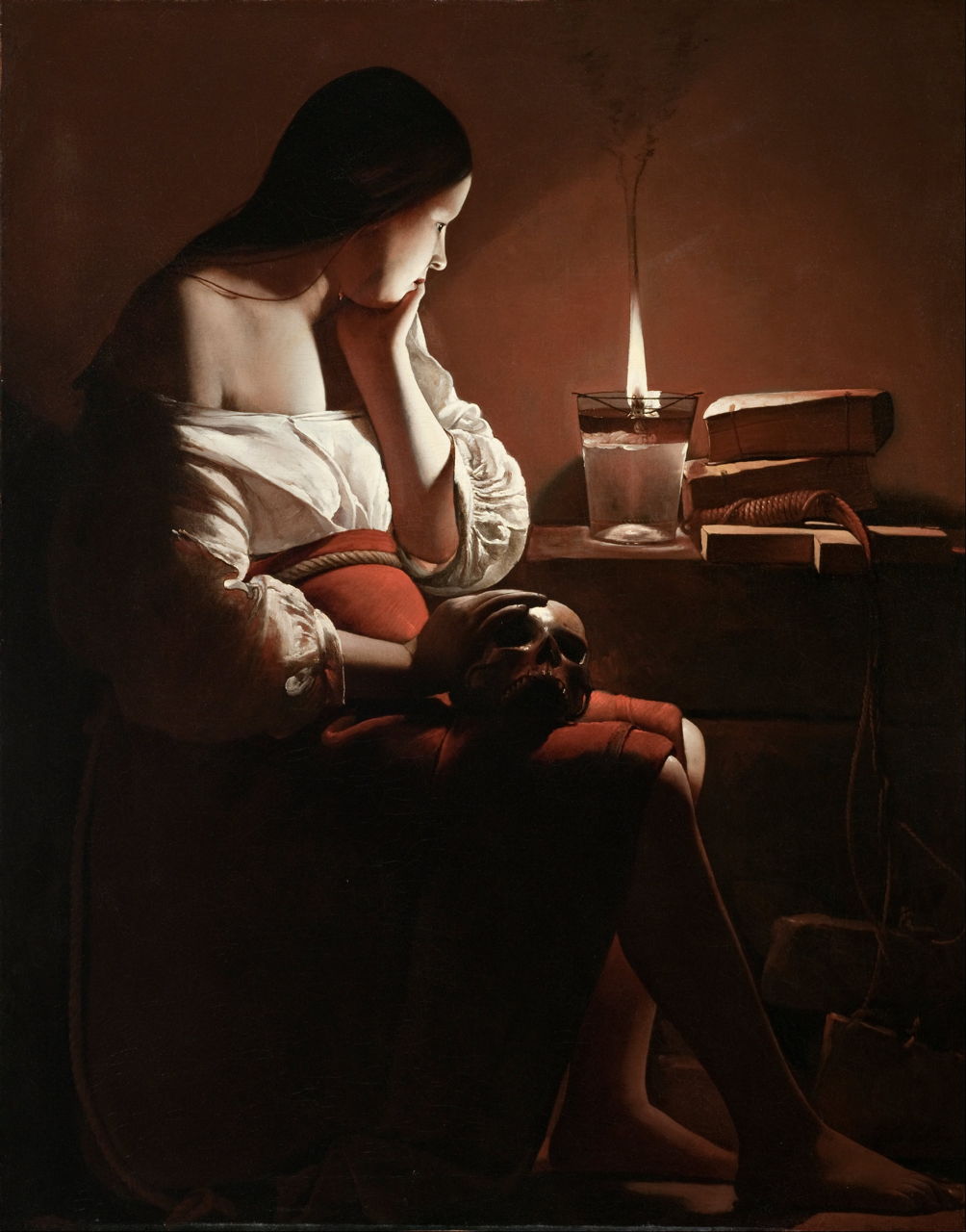
Georges de La Tour’s The Magdalen with the Smoking Flame from around 1630, is lit by a single flame, and draws clear distinction between softer edges of shade, and crisper edges of cast shadows.
The Dutch Golden Age
Figurative paintings by Michiel Jansz. van Mierevelt (1566–1641) and Pieter van Mierevelt (1596–1623), Gerard van Honthorst (1592–1656), Hendrick ter Brugghen (1588-1629), Judith Leyster (1609–1660), Jan Miense Molenaer (c 1610–1668), Rembrandt (1606–1669).
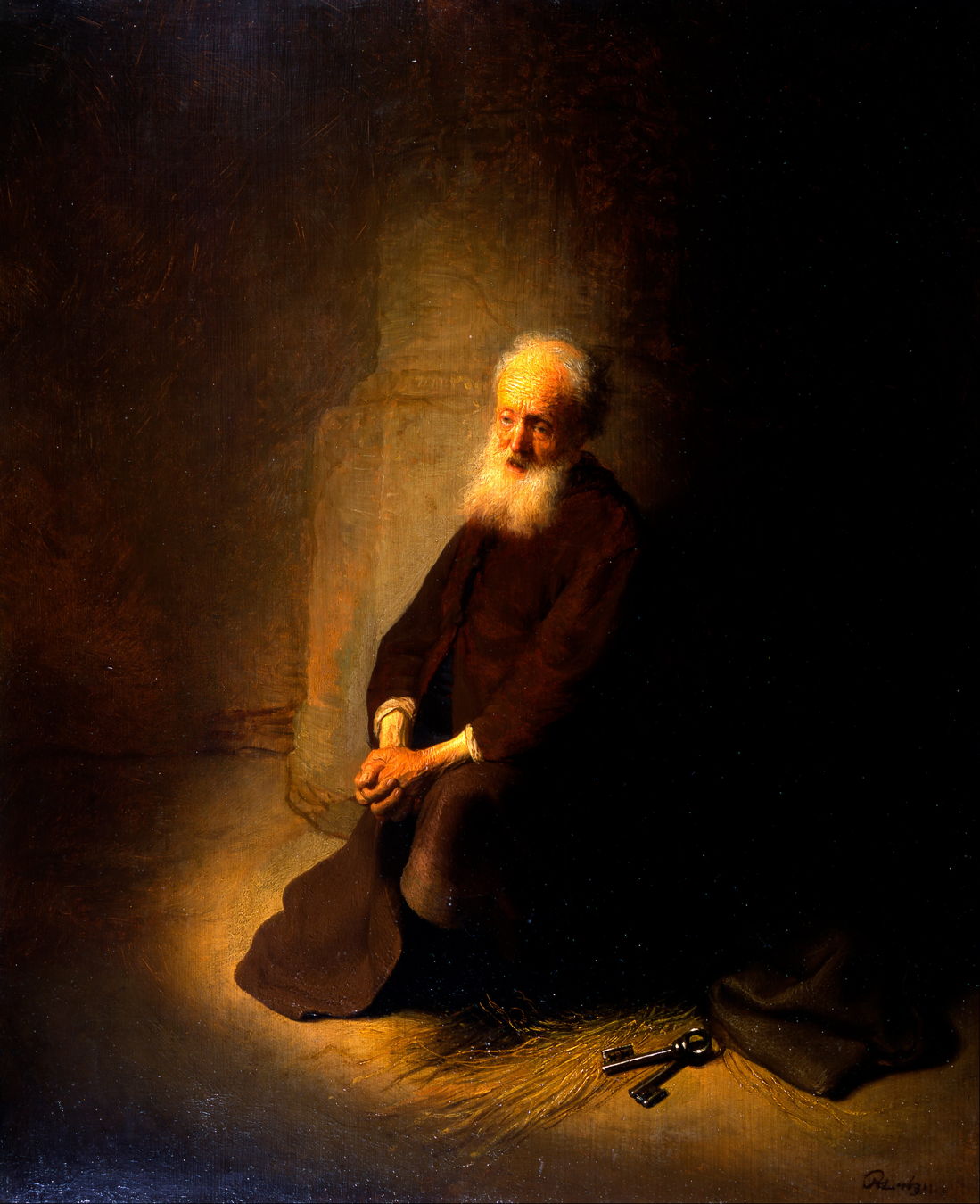
Rembrandt used the technique when appropriate, here in Saint Peter in Prison (The Apostle Peter Kneeling) from 1631.
Diego Velázquez
Figurative paintings by Diego Velázquez (1599–1660).

The most impressive of his early paintings is Old Woman Frying Eggs from 1618, with its wide range of reflective and transparent objects to demonstrate his skills, and his handling of shadows looks impressive. He has manipulated the light carefully to minimise the interference of cast shadows without pushing too far into optical impossibility, and follows the convention of lighting the scene from high on the left.
Early landscape paintings
Landscape paintings by Jacob van Ruisdael (1628/1629–1682, Paulus Potter (1625–1654), Gerrit Adriaensz Berckheyde (1638-1698), Paul Bril (c 1553/4–1626), Claude Lorrain (1604/5–1682), Nicolas Poussin (1594–1665).
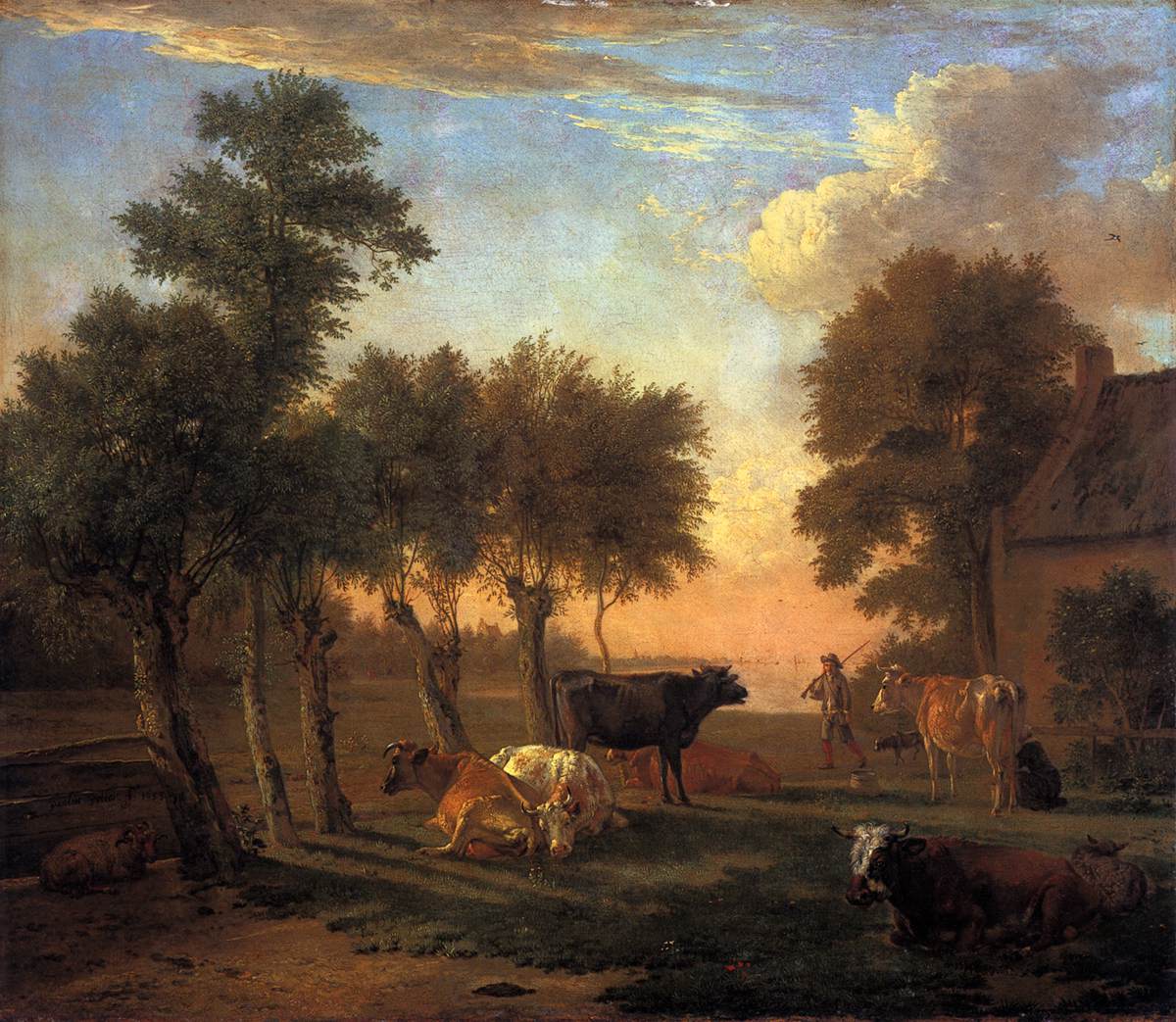
Paulus Potter may have made a detailed lighting study for the prominent cast shadows in Cows Grazing at a Farm from 1653.
Landscape painters who painted in the studio had great challenges in the depiction of shade and shadows, and arrived at various solutions shown here. As we’re so used to seeing the land in flat light, even the most aware viewer may not notice the almost total absence of shadows. But the penalty is that the landscape looks flat and potentially dull.
Landscapes painted in front of the motif
Plein air landscape paintings by Alexandre-François Desportes (1661-1743), Pierre-Henri de Valenciennes (1750–1819), Thomas Jones (1742-1803), Achille Etna Michallon (1796–1822), Jean-Baptiste-Camille Corot (1796-1875), Camille Pissarro (1830-1903).
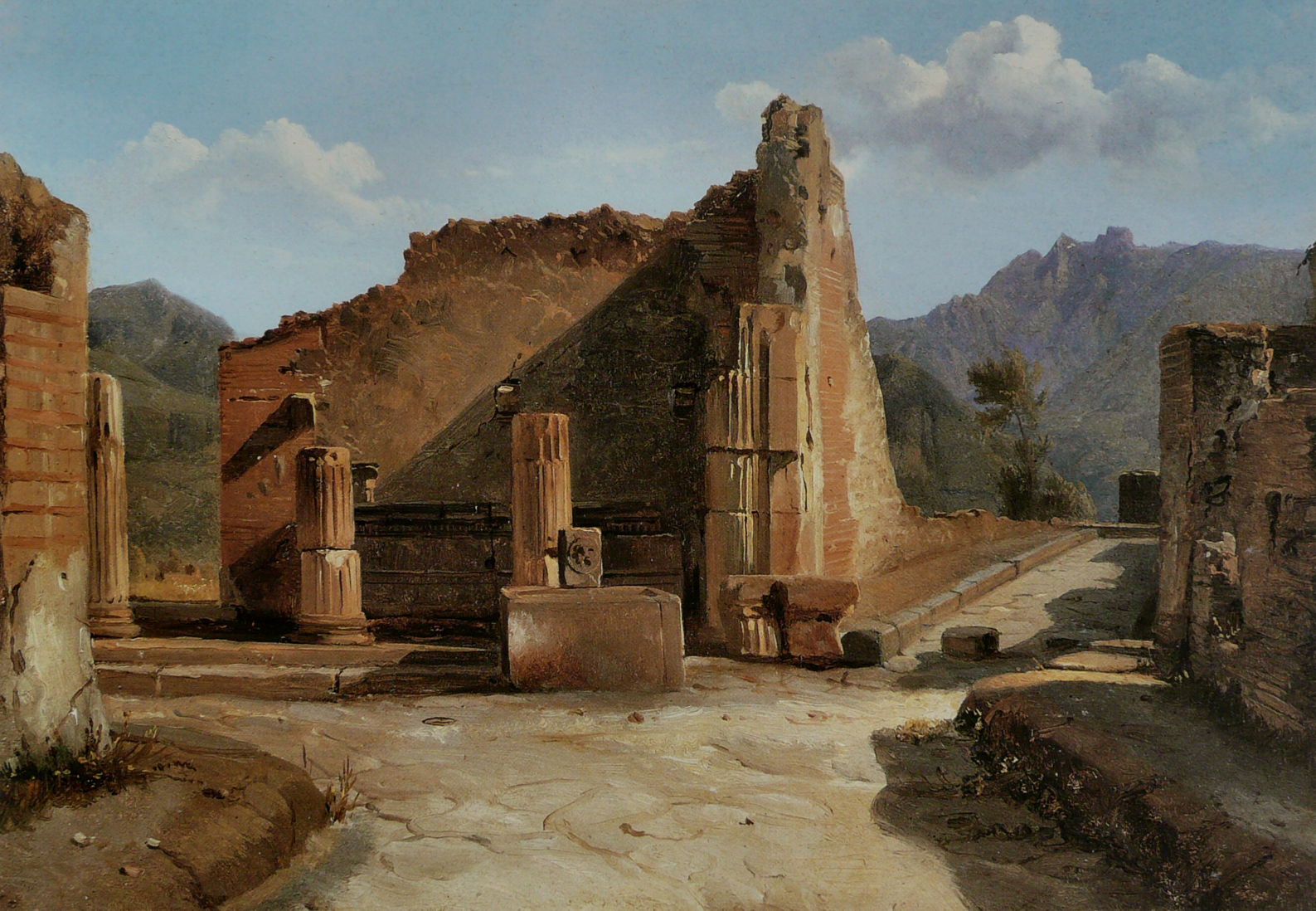
Achille Etna Michallon must have visited the ruins at Pompeii, where he painted The Triangular Forum in Pompeii, probably around 1819-20.
Joseph Wright of Derby
Paintings by Joseph Wright of Derby (1734–1797).

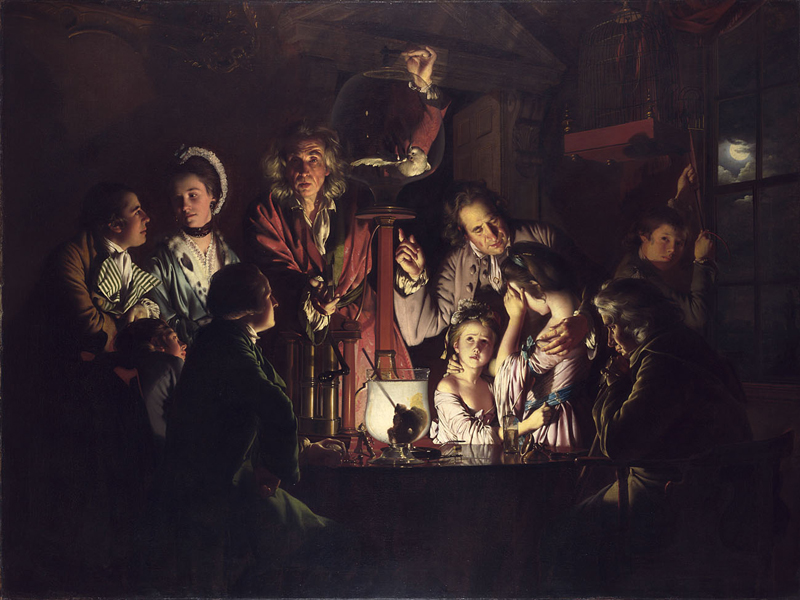
Wright painted A Philosopher Giving that Lecture on the Orrery, in which a Lamp is Put in Place of the Sun in 1766, during the Age of Enlightenment. The orrery is a miniature planetarium showing the movements of the planets and their moons. Its single light source is in the middle of the scene. Cast shadows from the orrery are particularly complex.
The Enlightenment of Joseph Wright
Shadow play
Paintings by Robert Campin, Johann Eleazar Zeissig (1737–1806), Jean-Léon Gérôme (1824–1904), William Holman Hunt (1827–1910), Mykola Pymonenko (1862–1912), Lovis Corinth (1858–1925), Émile Friant (1863–1932), John Collier (1850–1934), Frederick Carl Frieseke (1874–1939), William Girometti (1924–1998).
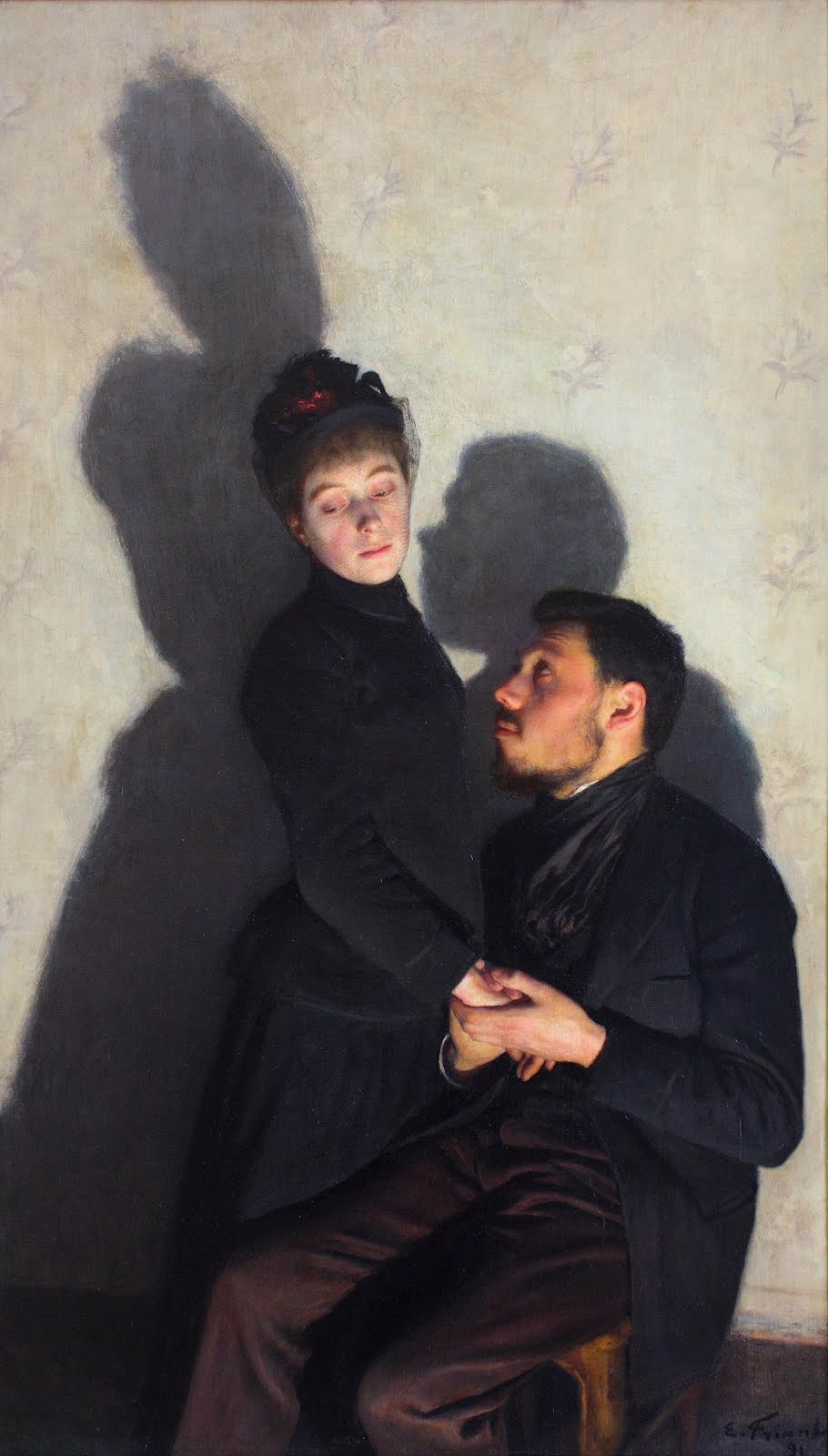
Émile Friant’s Cast Shadows from 1891 shows shadow play of a couple lit by a bright point source with the man looking imploringly up at the woman, who looks aside. Their cast shadows have been carefully manipulated: the shadow of his head is about to kiss her left cheek, but her shadow remains distant from his.
Are shadows grey or coloured?
Paintings by Jean-Baptiste-Siméon Chardin (1699–1779), Camille Pissarro (1830-1903), Paul Cézanne (1839–1906), Paul Signac (1863-1935), John Singer Sargent (1856–1925), Frederick Carl Frieseke (1874–1939), Tom Thomson (1877–1917).
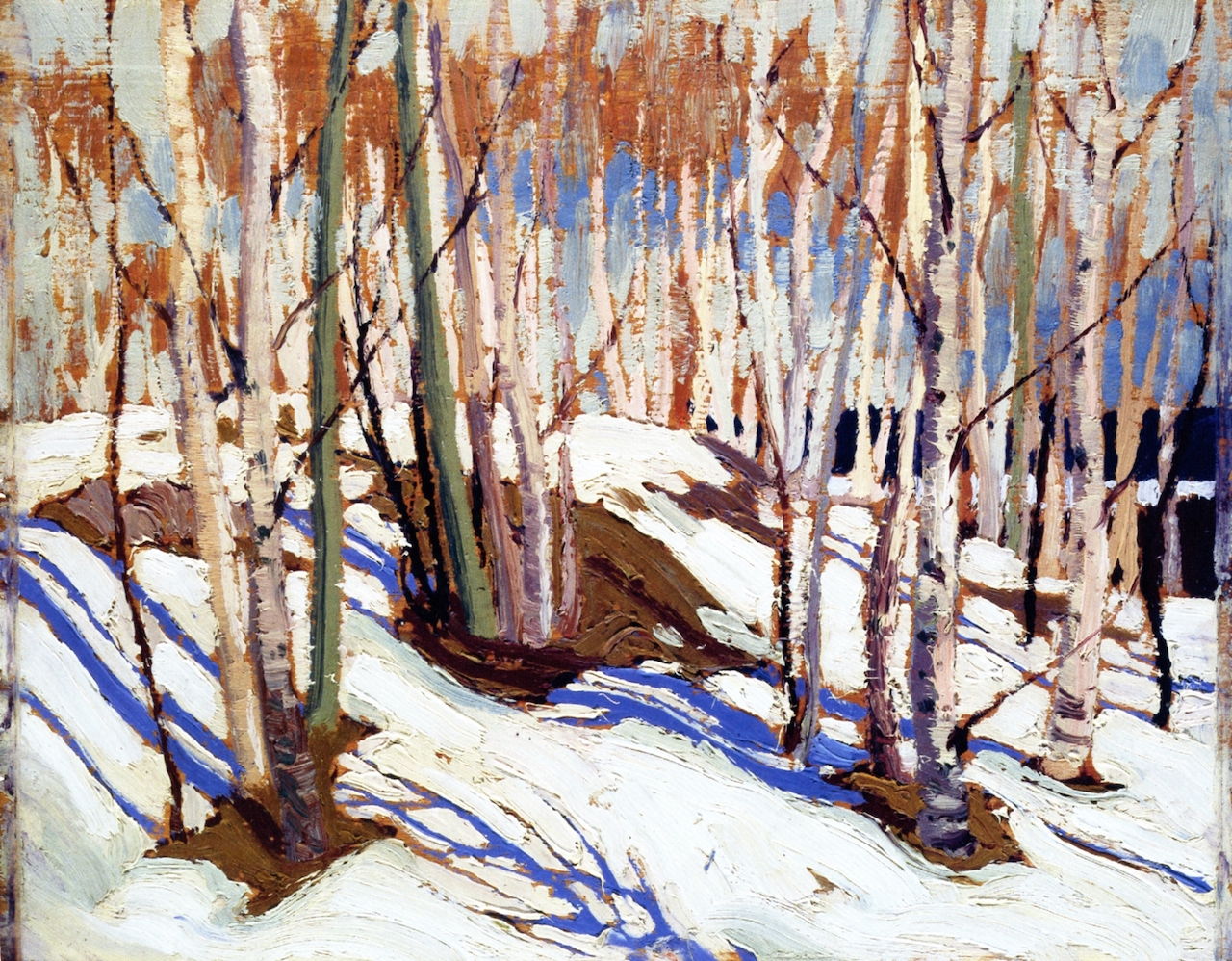
Until the late nineteenth century there had been no question as to the colour of shadows, and they had been almost universally depicted as grey, indicating a reduction in light across the full spectrum. This became controversial for the new Impressionist movement, and since around 1870 there have been many painters who have given cast shadows colours of their own.
Problems
Paintings by Masolino de Panicale (Tommaso di Cristoforo Fini) (c 1383-1447), Canaletto (Giovanni Antonio Canal) (1697-1768), Maurice Prendergast (1858-1924), Eric Ravilious (1903-1942), Paul Cézanne (1839-1906), Georges Seurat (1859-1891).
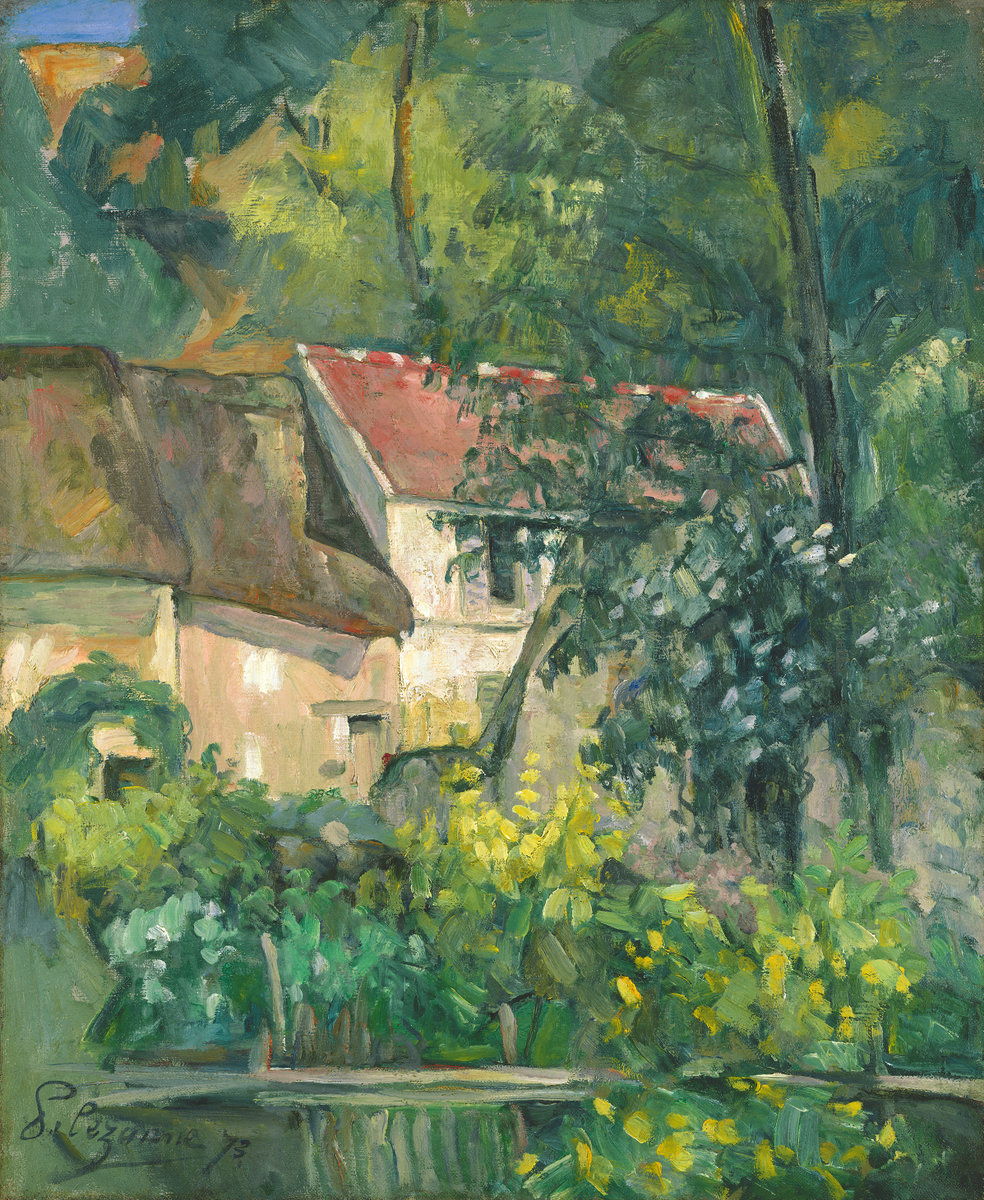
Some paintings whose shadows haven’t quite worked out as intended.
Further reading
Michael Baxandall (1995) Shadows and Enlightenment, Yale UP. ISBN 978 0 300 07272 4.
Roberto Casati and Patrick Cavanagh (2019) The Visual World of Shadows, MIT Press. ISBN 978 0 262 03958 1.
EH Gombrich (2014/1995) Shadows. The Depiction of Cast Shadows in Western Art, Yale UP. ISBN 978 0 300 21004 0.

