
While landscape painters wrestled with their challenge to depict shade and shadows in their views, some figurative artists became fascinated with their use in the studio. Perhaps the best known of the eighteenth century is Joseph Wright of Derby (1734–1797), who combined contemporary science in the Age of Enlightenment with impressive chiaroscuro effects.
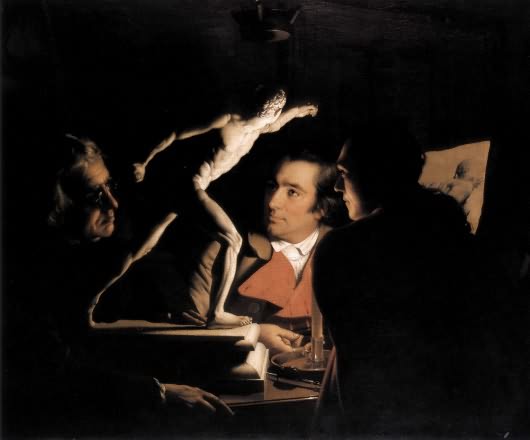
Three Persons Viewing the Gladiator by Candlelight (1765) was Wright’s first exhibited painting, and shows three men studying a miniature replica of the Borghese gladiator sculpture as a canonical classical work of art. The two younger men are Wright himself on the right, and Peter Perez Burdett, a Derby man who was a cartographer and progressive spirit, the inspiration for more of Wright’s paintings. The light source is a single candle, carefully occluded by the left shoulder of the man on the right.
It has been proposed that Wright’s frequent use of such deep chiaroscuro wasn’t merely stylistic, but reflected the influence of John Locke’s metaphor of the mind as a darkened room into which the eye lets in images to be reflected upon and stored.
Wright then developed his chiaroscuro images by adding a little narrative.

The following year, he exhibited one of his most enduring images of the period, A Philosopher Giving that Lecture on the Orrery, in which a Lamp is Put in Place of the Sun (1766). The orrery, a miniature planetarium showing the movements of the planets and their moons, is an impressive high-end Grand Orrery, an expensive device that would undoubtedly have captivated the minds of those able to gaze at it. Its single light source is once again in the middle of the scene, covered by the child with their back to the viewer. Cast shadows from the orrery are particularly complex, but appear to be faithful.
There are numerous cues here to different narratives: to Locke’s educational theories with their emphasis on geography, understanding of astronomy, and Newton’s gravitation and mechanics. It has been proposed that the philosopher in the red gown is modelled on Newton, and the figure at the left taking notes is the ever-present Peter Perez Burdett.
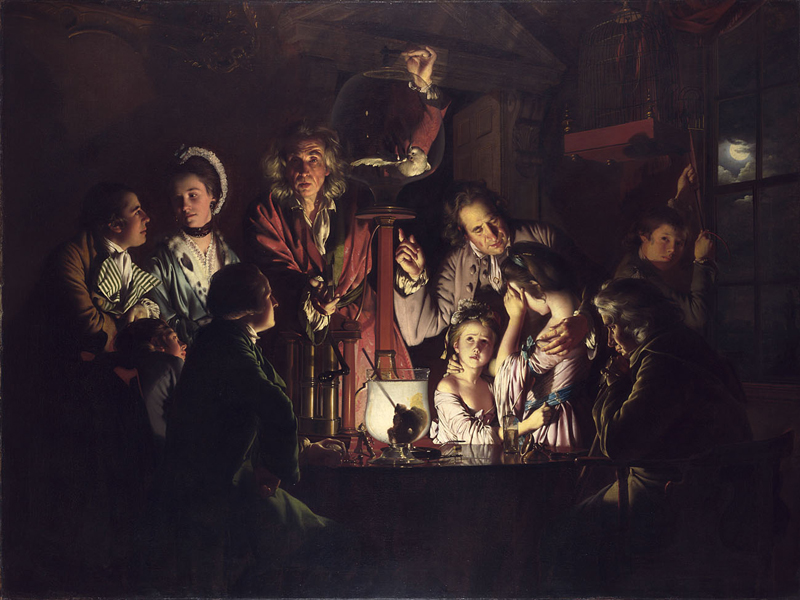
An Experiment on a Bird in the Air Pump (1768) is another of his famous works epitomising the culture of the enlightenment with a stronger narrative. Here the philosopher (red gown again) is seen at the climax of his lecture on pneumatics, inspired by the radical chemist Joseph Priestley. A precious white cockatoo has been taken from its cage at the left of the table, and placed inside the large glass jar at the top. A vacuum pump has then been used to evacuate the air from within the jar, and the cockatoo has collapsed near death.
Wright shows the moment of peripeteia, as the philosopher is about to open the tap at the top of the jar and restore air to the bird, hopefully resulting in its revivification, and transformation of the anguish and horror being expressed by the two girls at the table.
This too appears to be lit by a single point source out of direct view. More of its background is shown in dim lighting, and outside a full moon is partly obscured by cloud.
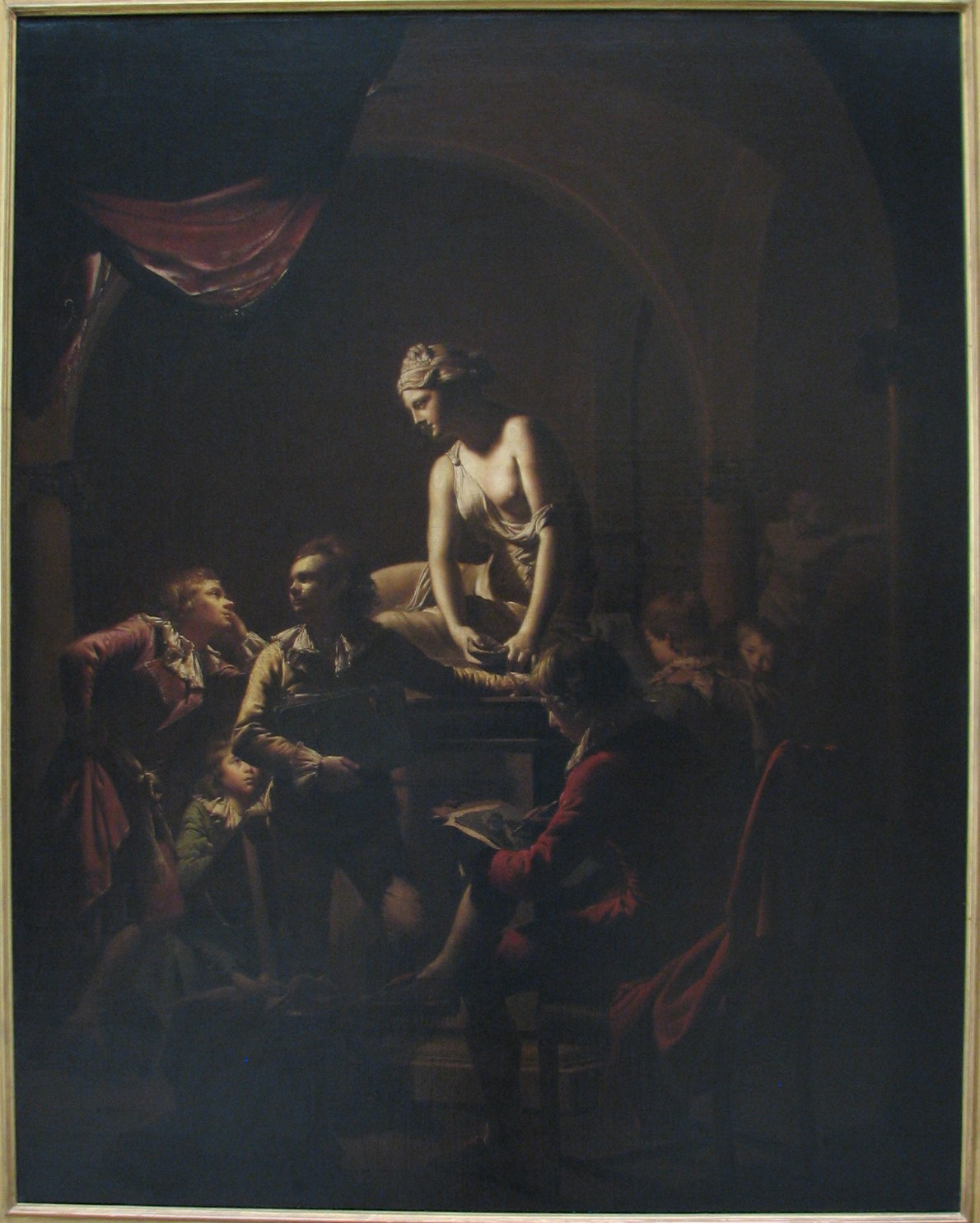
Wright also developed the theme of improvements in access to art education, and encouragement of drawing and painting skills. Academy by Lamplight (1769) was the first of a pair of paintings devoted to this, and making pointed commentary about the newly-founded Royal Academy. Here students at different stages of their artistic development are gathered round a full-scale reproduction of the Hellenistic sculpture Nymph with a Shell (the original was and remains in the Louvre in Paris). Wright clearly saw this more egalitarian scenario preferable to the establishment of the Royal Academy under its first president, Sir Joshua Reynolds.
His lighting has become more suffuse and complex, with the main light source at the upper left, as had become conventional with Caravaggio.

His Philosopher by Lamp Light (1769) was still more pointed a reference to the Royal Academy, being a reworking of a Salvator Rosa style painting, perhaps warning the new members of the Academy of the transience of earthly glory. For the first time its main source of light is revealed.

Today’s concept of alchemy as a mixture of magic and charlatanism hadn’t become established in Wright’s day. The Alchymist, in Search of the Philosopher’s Stone, Discovers Phosphorus, and Prays for the Successful Conclusion of his Operation, as was the Custom of the Ancient Chymical Astrologers (1771-95), which summarises its narrative in the title, is far more sympathetic.
Wright created this image in 1771 from a variety of sources, including drawings provided by Peter Perez Burdett from his new chemical laboratory in Liverpool, and classical engravings. It’s particularly appropriate in depicting the purification of phosphorous, which was seen as a productive and positive outcome from the ancient pursuit of alchemy.
His lighting has become more complex, with a dominant source in the alchemist’s glass vessels, a secondary point source in a visible flame behind and to the left, and another full moon seen through the window. These bring play in cast shadows, such as that of the boy in green at the left.
The culmination of his series of Enlightenment narratives, it wasn’t well-received, and towards the end of his career he reworked the painting.
Instead, Wright turned to more traditional narratives. The first is based on the classic story of Dibutades, the maid of Corinth, who ‘invented’ painting. The daughter of a potter, her boyfriend was due to leave the city. In order to remember him, she traced the outline of his shadow cast on a wall, when he was sleeping. Once he had gone, she was left with his silhouette, and her father (sometimes claimed to be Dibutades) then filled it with clay, which he fired in his kiln, making the first relief sculpture.
This tale had recently been retold in Wright’s friend William Hayley’s poem An Essay on Painting (1778):
The line she trac’d with fond precision true,
And, drawing, doated on the form she drew …
Thus from the power, inspiring LOVE, we trace
The modell’d image, and the pencil’d face!
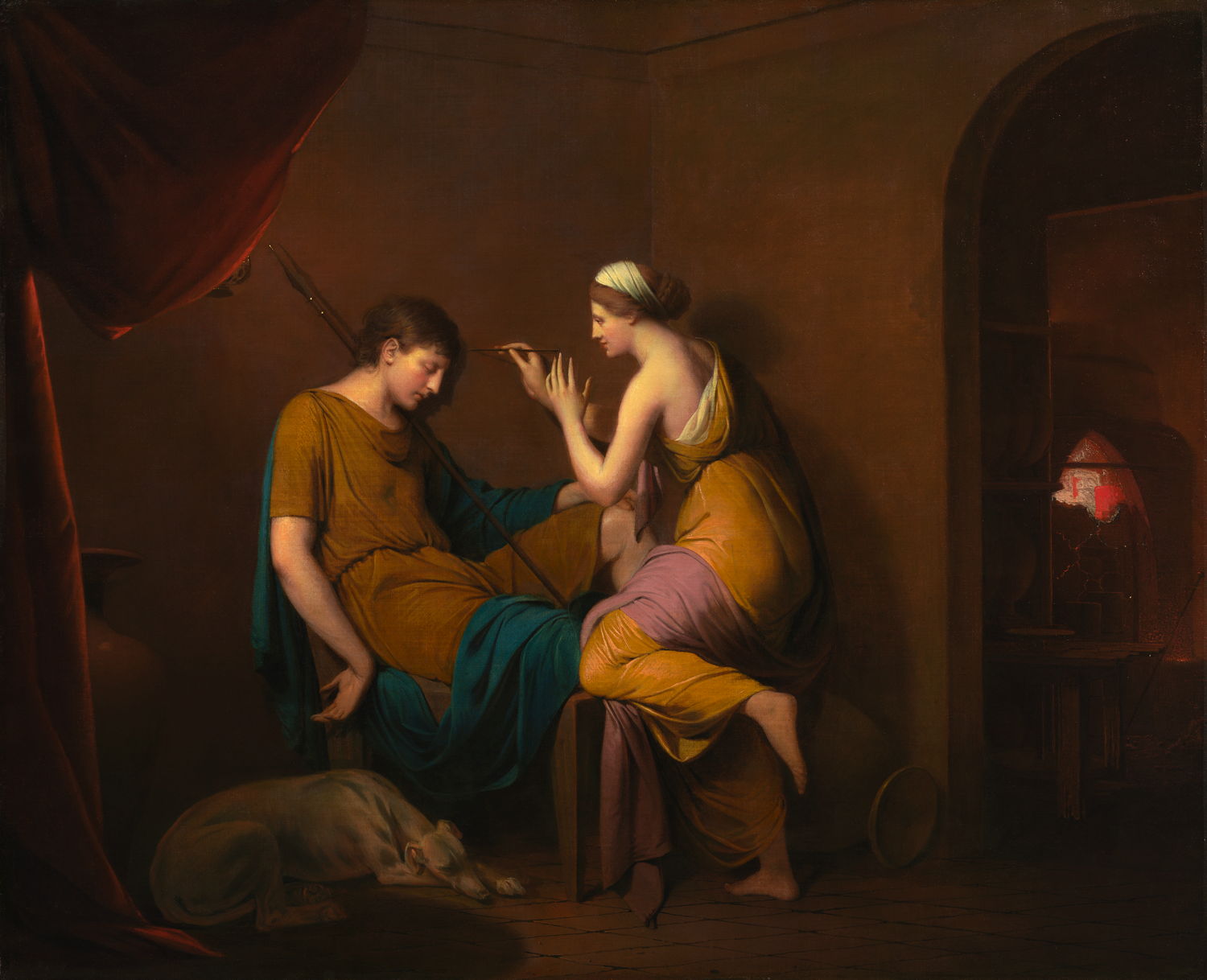
Wright’s The Corinthian Maid (c 1782-5) was painted for a commission by Josiah Wedgwood, affluent and successful founder of the local Wedgwood pottery. This appears to be have been the first commissioned narrative painted by Wright.
Its physical companion shares the theme of wifely fidelity, in showing the wife of Odysseus, Penelope. In the many years that her husband was away on the Odyssey, she told potential suitors that she couldn’t remarry until she had completed weaving a shroud for her father-in-law. Although they saw her weaving intently by day, she then unravelled her work each night.
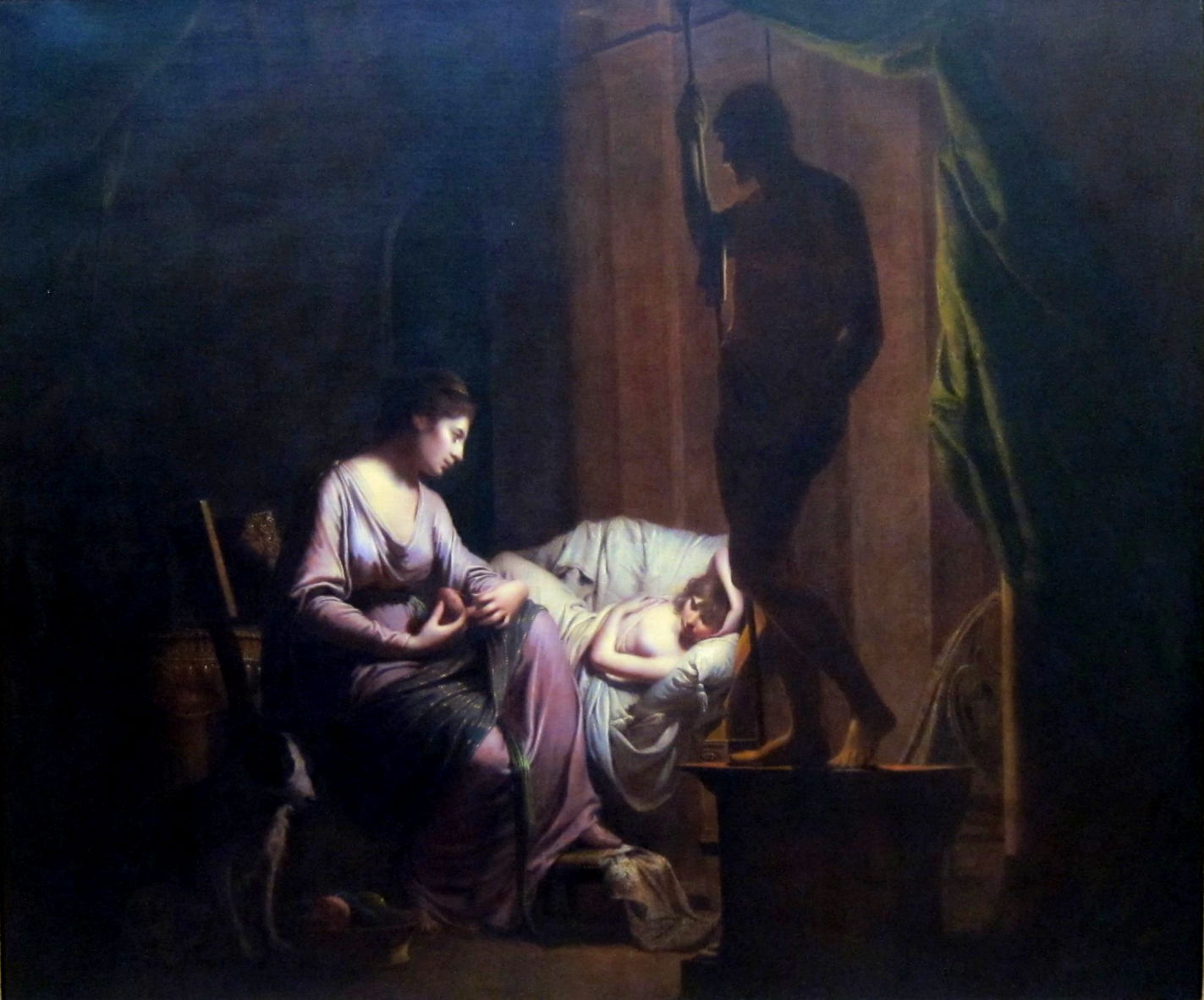
Penelope Unravelling her Web by Lamp-light (1785) shows Penelope watching over her sick child, while Odysseus’ statue watches her carefully unravelling her day’s work.
Shakespeare’s tragedy Romeo and Juliet (published in 1597) would have been familiar to the learned classes of the day. It reaches a climax when Juliet is discovered apparently dead, but in fact comatose from a potion which she took to avoid her arranged marriage. Her body is placed in the family crypt, but the messenger intended to inform Romeo of Juliet’s plan failed to reach him.
Instead, Romeo learns of Juliet’s apparent death from his servant, buys poison, and goes to the crypt in which Juliet is laid out. Meeting her fiancé, the two men fight, and Romeo kills her fiancé before taking poison himself. When Juliet awakens from her coma, she sees Romeo dead, and stabs herself with his dagger.

In Romeo and Juliet. The Tomb Scene (1790), Wright shows Juliet, still white from her coma and dressed in funeral attire, when she has just discovered Romeo’s dead body, and before she commits suicide with his dagger, the theatrical climax. However the artist hides both their faces from view, leaving Juliet’s body language to tell us of her anguish, and the cue of the cup from which he drank poison.
Again, this is lit from the upper left, and there’s an enigmatic shadow cast to the left of Juliet that could be interpreted as someone approaching.
References
The Joseph Wright Gallery, Derby.
Daniels S (undated) Joseph Wright, British Artists, The Tate Gallery. ISBN 978 1 854 37284 0.

