
For much of the Renaissance the emphasis in painting was on light rather than shadow, but the development of chiaroscuro changed that. It’s often assumed that its great exponents, particularly Caravaggio (1571–1610), came to master the optics of shadows.
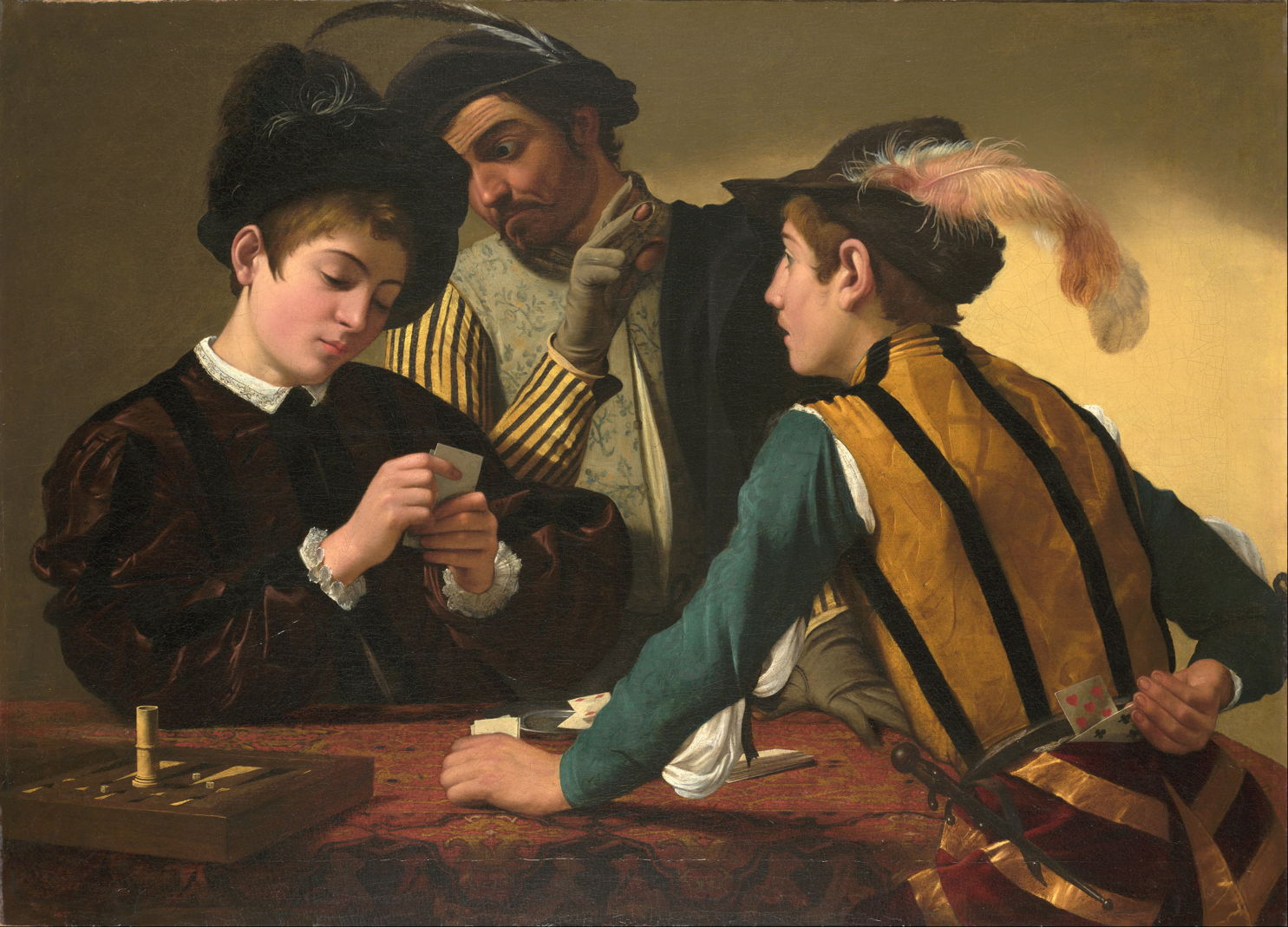
In The Cardsharps of about 1595, a well-heeled androgynous boy has been tricked into a game of cards with a pair of crooks. The older of the cheats stands behind the boy’s left shoulder, signalling the cards in his hand to his accomplice, a younger boy who is playing the game. The younger cheat has a couple of cards tucked behind him, and is reaching for one of them with his right hand. Secured very visibly to his belt is a small dagger.
At this early stage in his career, Caravaggio’s shade and shadows are still soft. However, with its main source of light coming from the left of the viewer, the shadow cast by the boy’s left arm on the tablecloth isn’t aligned consistently.

For his Judith Beheading Holofernes (c 1598-9), Caravaggio chose the moment that Judith has almost completed severing the neck, and has greatly increased the contrast to add drama. He lines the three figures up across the painting, brightly lit from high on the left against the near-black background. Shade and shadows here appear optically consistent.
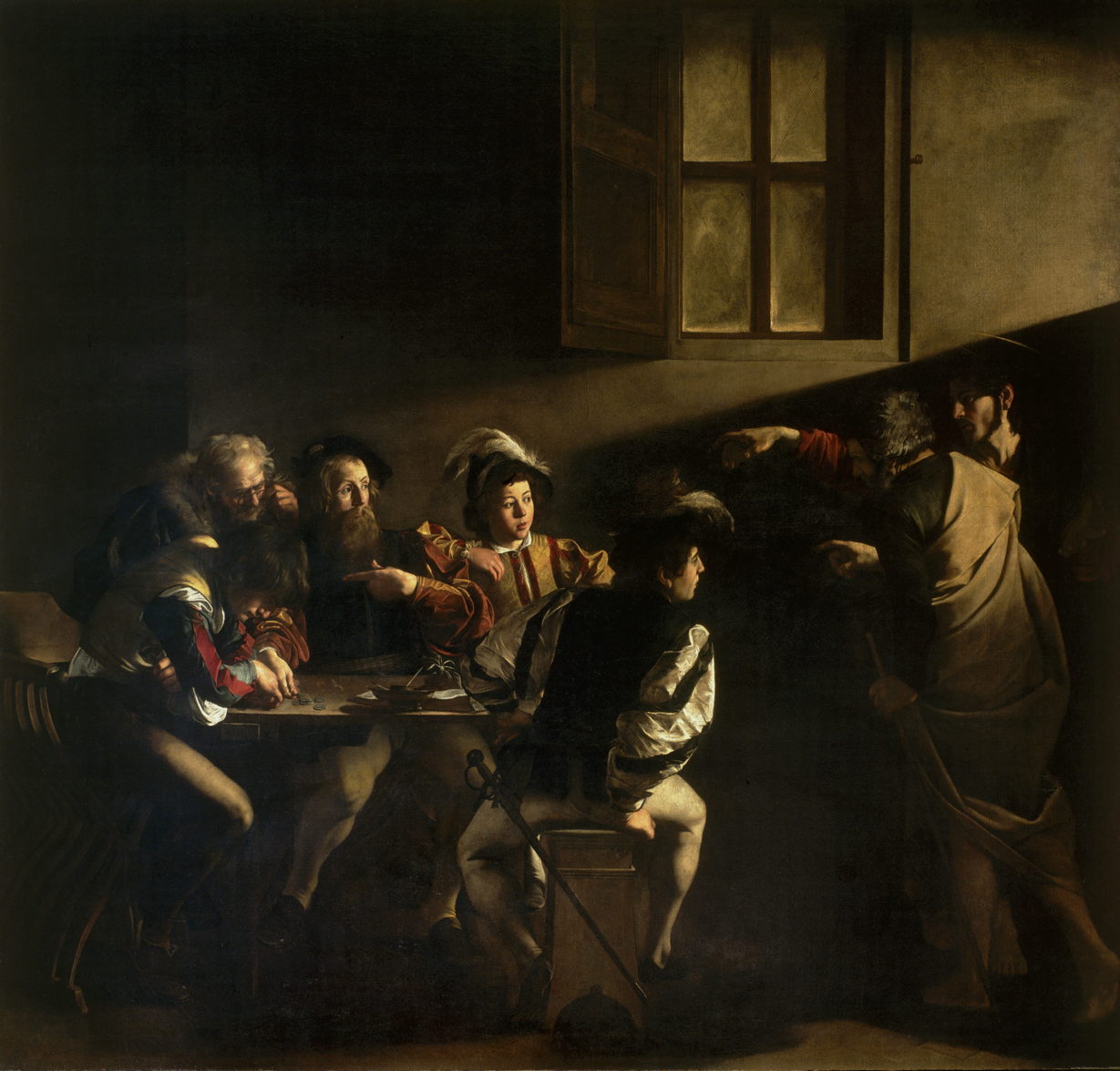
Looking at Caravaggio’s Calling of St Matthew from about 1599-1600 you could easily be convinced that it was faithful to optics. There’s an abundance of shade and attached shadow, but despite the group being sat close around a table, not one of its figures casts shadow on another. If a modern artist or photographer were to light a similar composition, they’d need several lights and possibly reflectors too. For example, the head of Christ at the right is lit dramatically, but sufficient for his face to be recognisable, in spite of that part of the room being within strong cast shadow according to the wall immediately behind. What might look right could in fact be largely contrived.
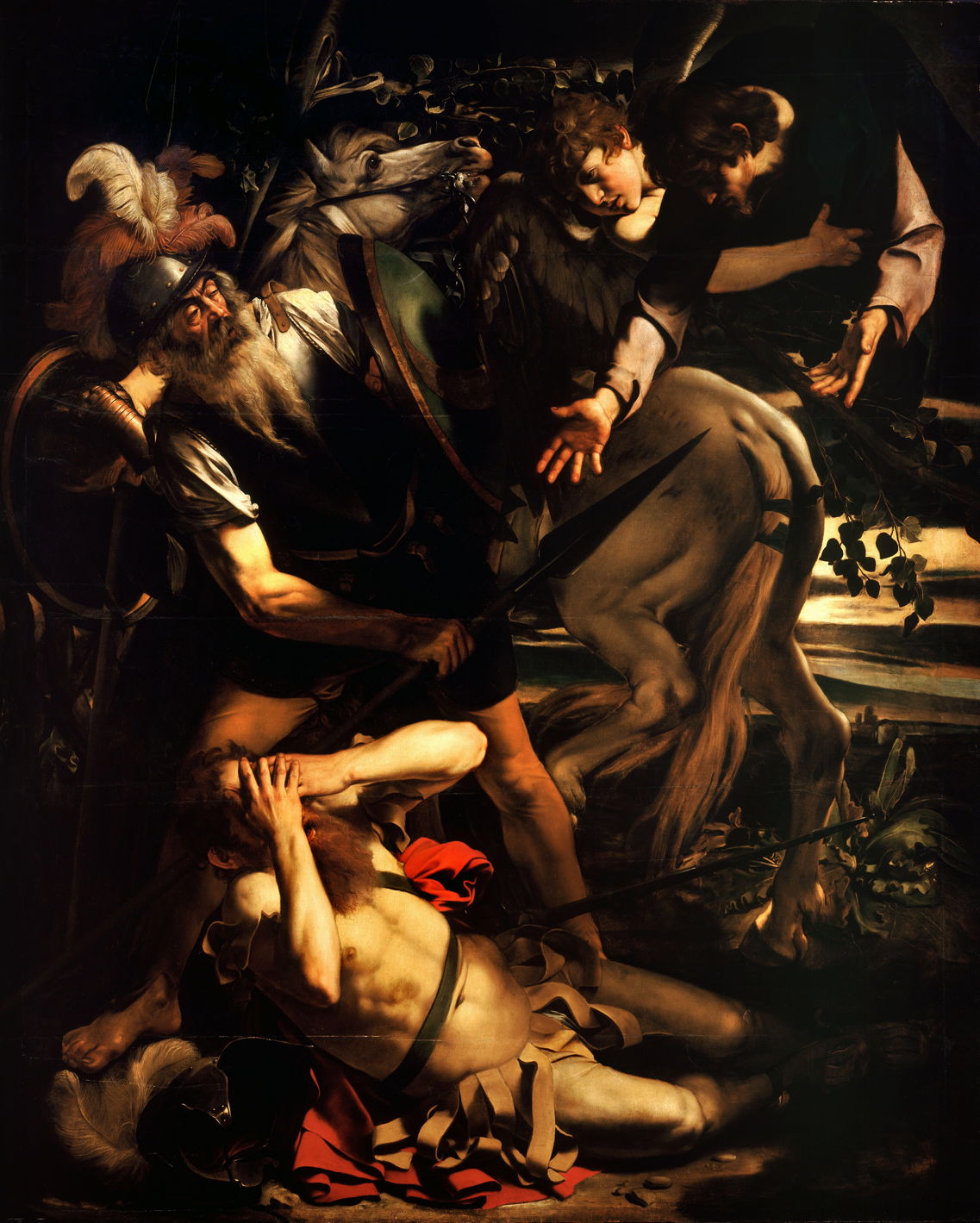
The Conversion of Saint Paul (1600) shows a small, intertwined group struggling in impenetrable blackness. Paul reclines on the ground at the front, both hands covering his face, his body language more than making up for the absence of facial expression. Behind him horses have become spooked, and arms are held out to help Paul back up to his feet.
The light from which Paul is shielding his eyes is clearly coming from the sky, but we aren’t shown its heavenly origin. It illuminates fragmented patches, hands reaching down from the upper right, the wizened face of a bearded soldier, a horse’s head, all adding to its confused dynamics. Shade and shadows are Caravaggio’s compositional tools.
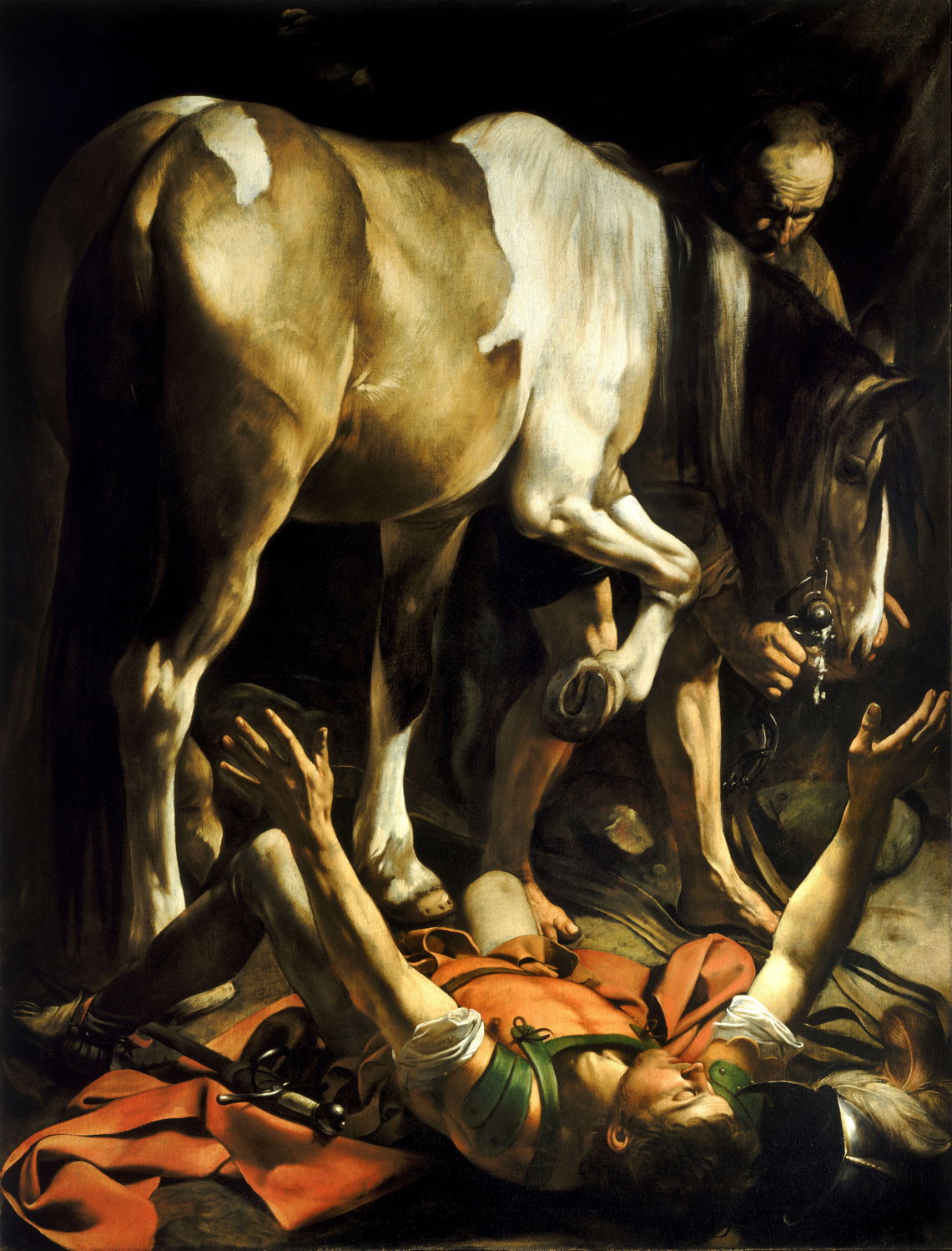
Caravaggio’s second version uses a similarly-dressed figure for Paul, but otherwise is completely different. In his Conversion on the Way to Damascus (1600-01), Paul lies back, eyes closed, arms held up to the heavens. His horse stands more peacefully, its bridle held by another in the party. It’s lit more evenly, and lacks the impact of his earlier version.

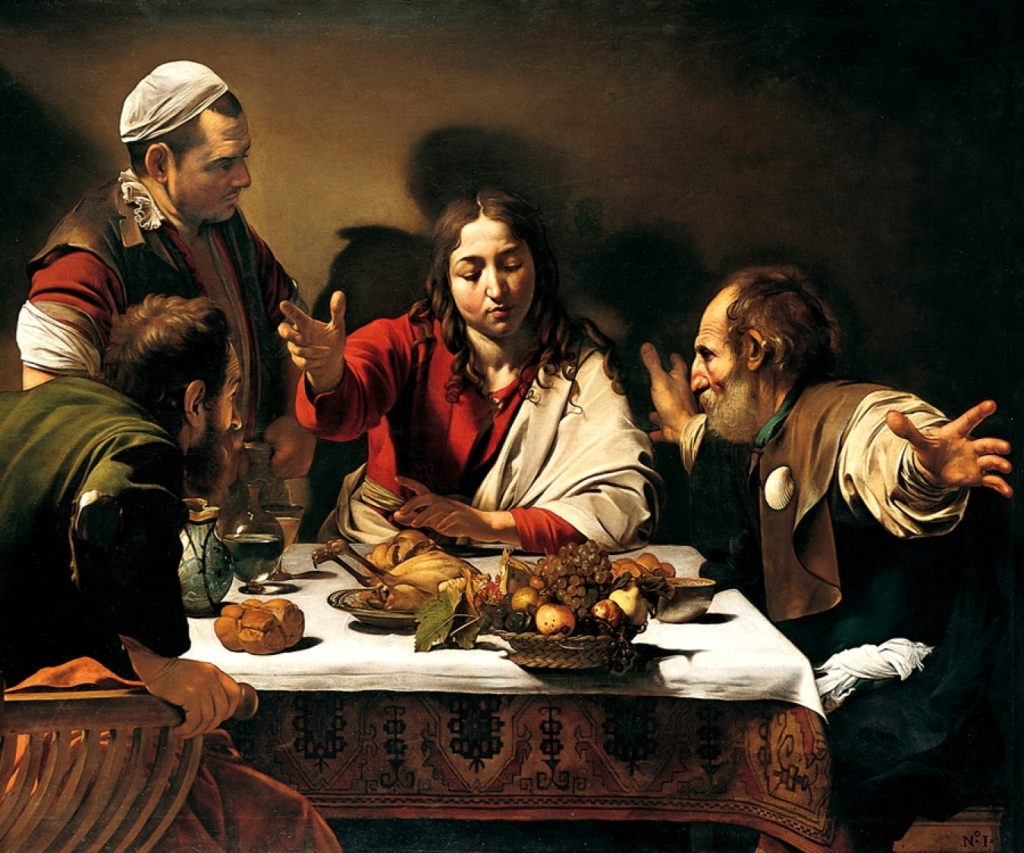
His Supper at Emmaus from 1601 isn’t as optically consistent as it might appear. Its lighting is simpler, with the main source high to the left of the viewer, and highlights on the upper left surfaces of figures and objects. Quite crisp cast shadows with no visible penumbra are seen on the white tablecloth. Yet again no figure casts any shadow on another figure in this tight group. Christ’s right arm does cast a shadow across his right chest, but the main shadows cast by the figures fall on the wall behind Christ, which would require another light source lower on the left, which isn’t consistent with the shadows cast on the tablecloth.
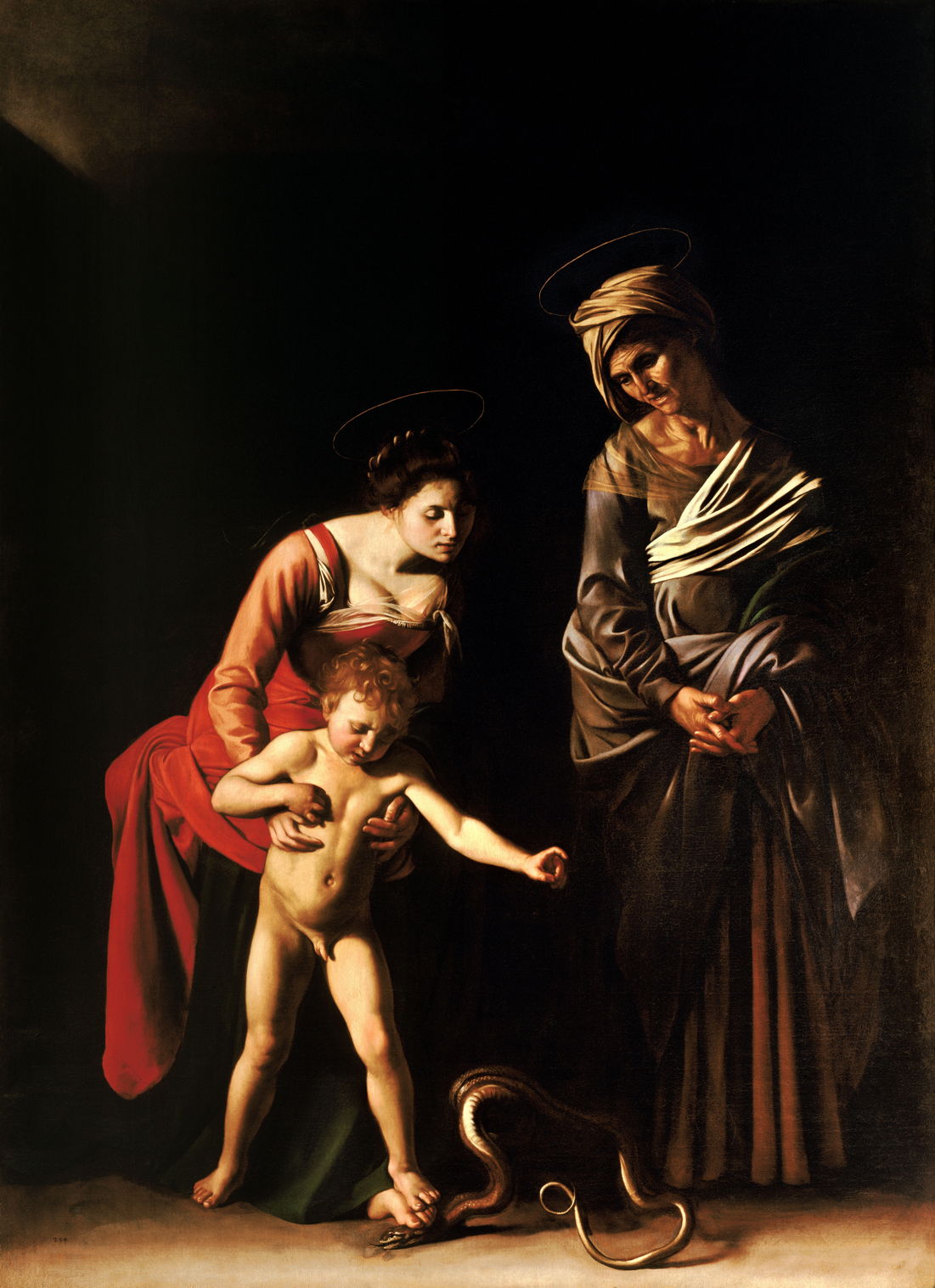
In 1605-06, Caravaggio painted what had been expected to be a fairly conventional depiction of the Virgin Mary, her mother Saint Anne, and the young Jesus Christ, for the altar of the confraternity of the Papal Grooms, in Saint Peter’s Basilica. What they got instead was his Madonna and Child with Saint Anne, which so shocked that it was only briefly shown in the parish church of Saint Anne in the Vatican, before being sold to Cardinal Scipione Borghese, in whose palace it still hangs.
At a time when even showing the Virgin’s feet was considered quite tacky, her low-cut dress was definitely beyond the pale, and Saint Anne is hardly flattered in her appearance. But look at what Mary’s left foot is doing, with support from Christ’s foot: treading on the head of a snake. Judging by its highlights, and the cast shadow of the snake, its primary light source is again high on the left, but there are conflicts seen with the left leg of Christ and the arched coil of the snake just below the knee.
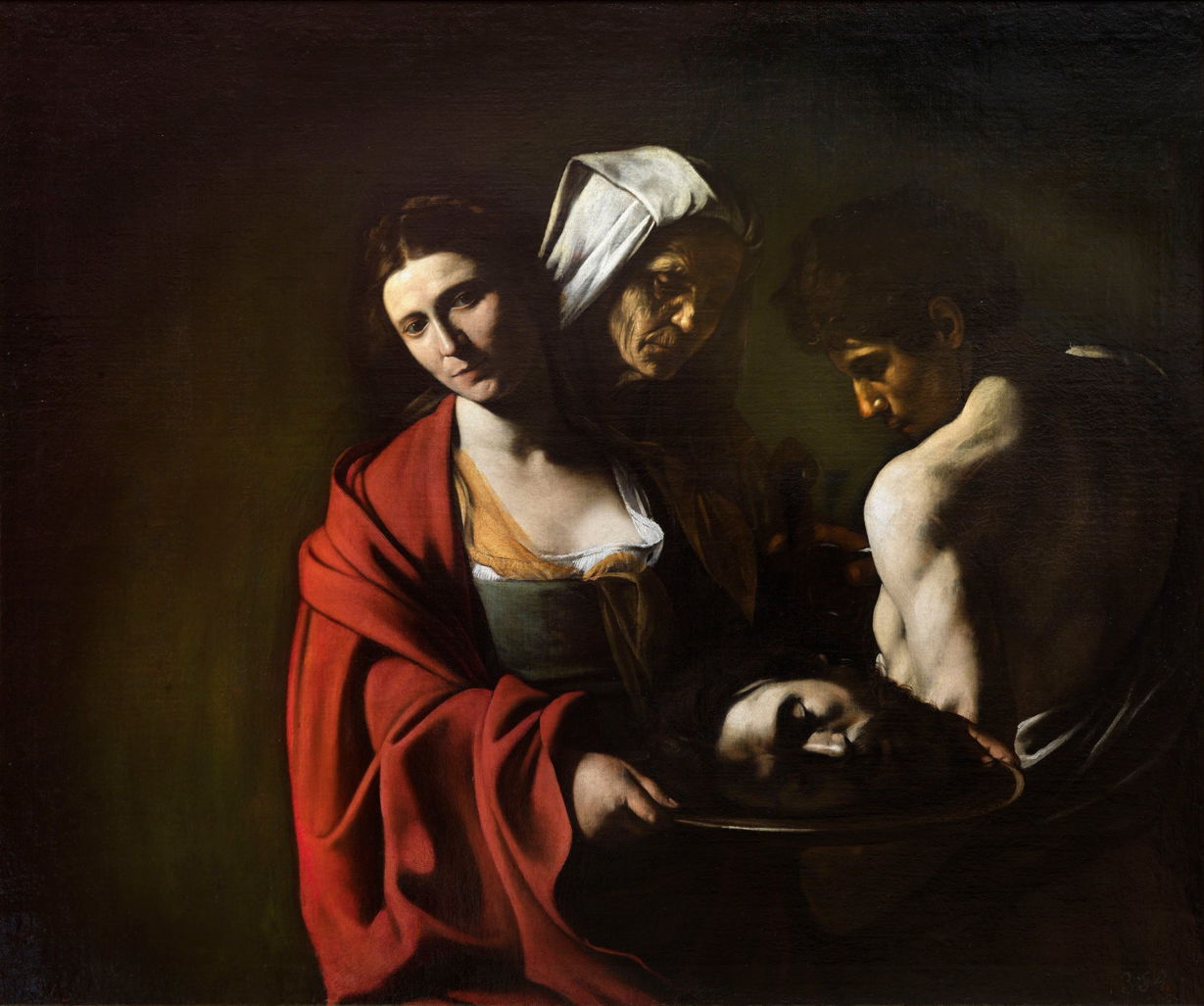
The story of the execution of John the Baptist became an obsession with Caravaggio in his final few years of painting. His first work, Salome with the Head of St. John the Baptist (c 1607), now in Madrid, shows the muscular executioner, Herodias, and Salome grouped tightly around John’s head (with its eyes closed). Herodias and the executioner look down at the head, but Salome looks decidedly uncomfortable, even distressed, and averts her eyes. This is again lit from the upper left and uses four pools of light to heighten its dramatic effect.
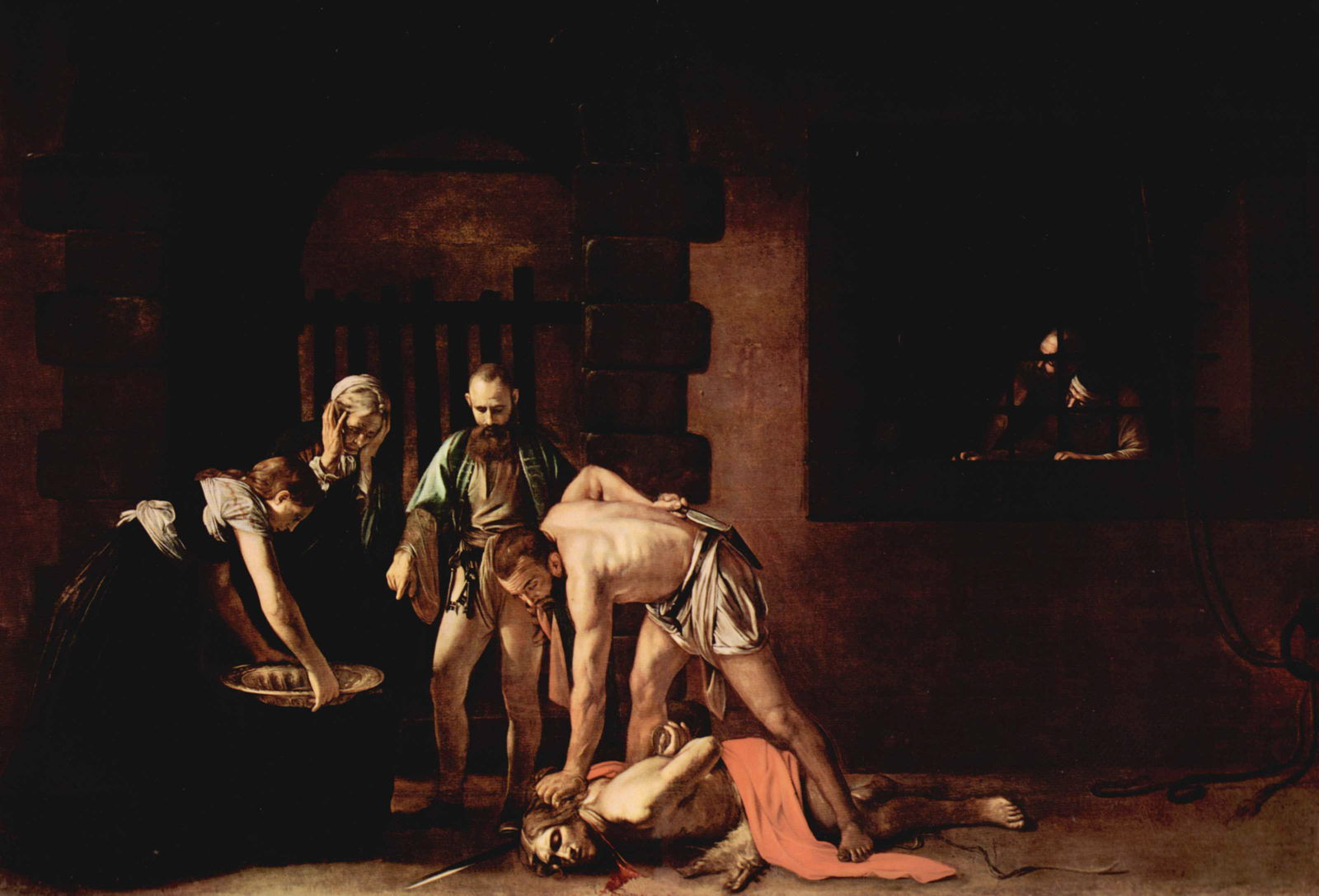
In his second painting, The Beheading of St. John the Baptist (1608), now in Malta, the executioner has already killed John, and is just about to lift his head onto the platter that Salome has put down in front of her. She looks down at her platter, and avoids looking at the corpse beyond. An older woman with her, presumably her mother Herodias, clutches the sides of her head in grief, which is puzzling. Others look from their cell through bars at the scene, and Herod’s agent stands behind the executioner, pointing down at the platter, to direct the head to be placed in it.
Shade and shadows are inconsistent here as well. The shadows cast by the right side of the doorway behind the group of figures show the light source to be directly to the left, but that lighting the figures comes from higher.

Caravaggio’s third painting, completed shortly before his death, is a more closely-framed variant of the first: in Salome Receives the Head of John the Baptist (c 1609-10), now in London, Salome averts her eyes as the executioner places John’s head on the platter. Herodias looks down at the head, but its eyes are closed and it too faces the viewer. Its lighting is also similar to that initial version.
Caravaggio’s mastery and manipulation of shade and shadow set the standard for the many that followed his pioneering lighting effects.

