

Given the technical difficulties posed by shade and shadow, it’s sometimes comforting to know that some highly accomplished painters haven’t depicted them quite right, despite trying to do so. Unlike reflections, which can always be revisited in similar conditions, cast shadows can be fleeting and lost without a photograph.

The two events depicted in this fresco in the Brancacci Chapel are recounted in the Acts of the Apostles, although separated in both time and place: the healing of the cripple took place in Jerusalem (Acts 3:1-10), and the raising of Tabitha in Joppa considerably later (Acts 9:36-43). Masolino sets both events pictorially in the same town and apparently as consecutive events.
One day Saints Peter and John were going up to the Temple in Jerusalem together for mid-afternoon prayer. A man who had been lame from birth was there; each day he used to be carried to the Temple gate known as Beautiful, so that he could beg there. As Peter and John were passing, the lame man asked Peter for money. Peter replied that he had none to give him, and instead told him to walk. The lame man jumped to his feet, and walked into the Temple courts, jumping for joy and praising God for his healing.
In the town of Joppa, there was a disciple named Tabitha (or Dorcas), who was renowned for always doing good and helping the poor. She became sick and died; her body was washed and placed in an upstairs room. Saint Peter was sent for, and when he arrived, he was taken up to the room in which Tabitha’s body lay. Peter sent everyone out of that room, then prayed, and told her to get up. She opened her eyes, sat up, and was alive again.
The painting incorporates both stories at the same location, which isn’t the Temple of Jerusalem. Saints Peter and John are shown with the cripple at the left, and Saint Peter again having raised Tabitha from the dead at the right. Between the two images of Saint Peter are two probably Florentine figures who look out of place.
In integrating the two scenes into one, and applying novel one-point linear perspective, Masolino didn’t quite co-ordinate their cast shadows. That of the cripple at the left, and the two saints to the right of him, together with most of the other figures, are cast in different directions and angles of illumination.
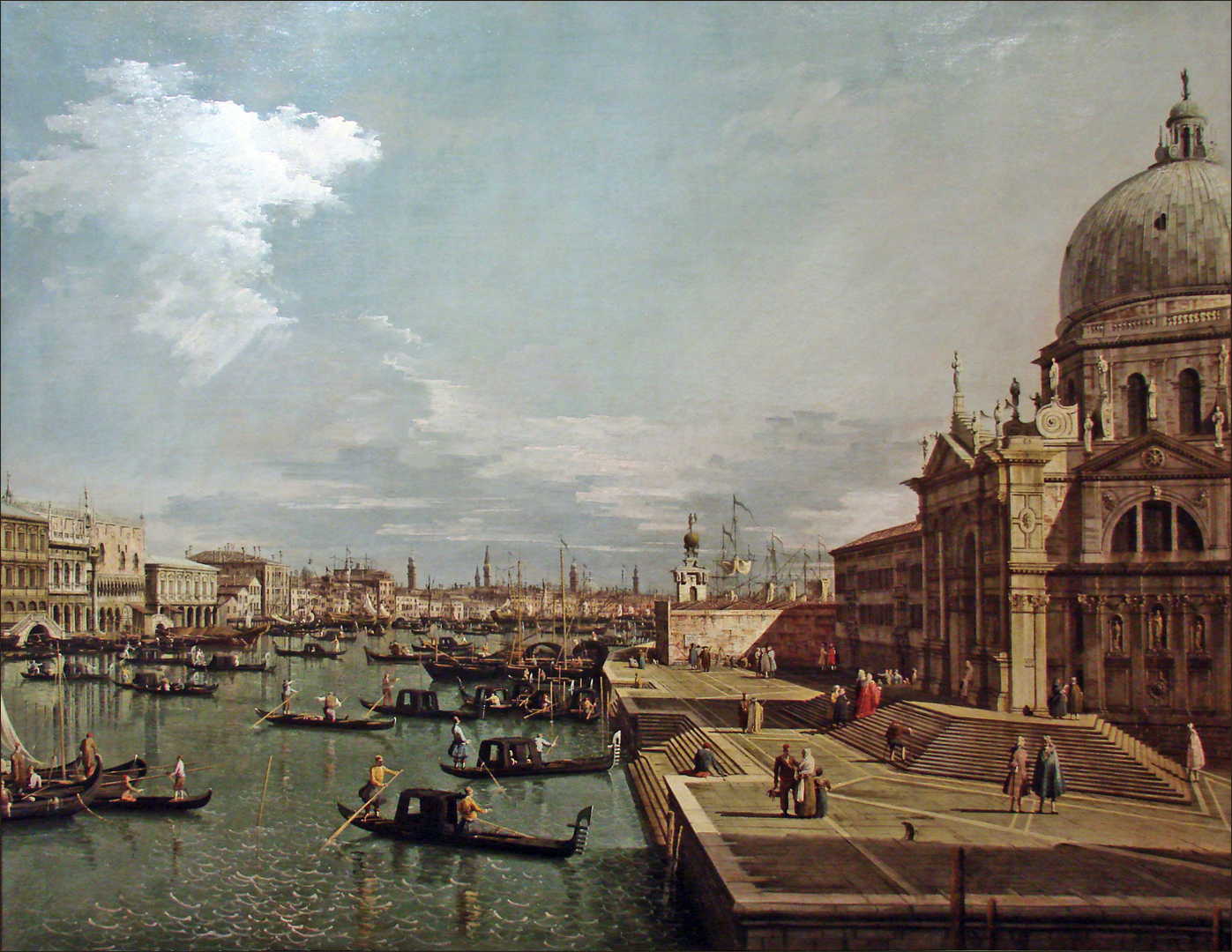
Canaletto wasn’t always as careful with cast shadows as he should have been, as his view of The Entrance to the Grand Canal and the Church of Santa Maria della Salute, Venice, made between 1735-40, demonstrates. He shows the shadows cast by the church at the right and the figures around it: the light source is the sun, which is at the right and at an elevation of around 45 degrees above the horizon. Cast shadows therefore fall in the picture plane from right to left.
Look at any of the many gondolas on the water, such as that near the centre, closest to the viewer. Its reflection is shown clearly in the water, including those of the two occupants with their golden yellow clothing, but neither the boat nor its occupants show any shadow cast to its left.
Canaletto knew the buildings well, and would have compiled preparatory sketches and studies, in which shadows would have been included, or would be easy to add according to the time of day. Adding them for figures is also quite straightforward. In general, the gondolas shown are staffage, invented and added purely in the studio, where their shadows would be more difficult to estimate. In addition, showing them with both reflections and shadows was significantly more difficult, and potentially confusing.
We’re accustomed to looking at the world under diffuse light, when it’s overcast, and there are at best only faint shadows. But there are paintings that largely omit shadows when we would expect to see them.

The American Post-Impressionist Maurice Prendergast painted many watercolours of Venice in the final years of the nineteenth century. The Piazza of Saint Mark’s, Venice (c 1898-9) shows a small scene in the north-east corner of this famous Piazza, with the facade of the north side in the background, and the Basilica on the right.
An original view and composition, this shows almost no sky, and the shadows of the flags and their poles suggest that it’s set in the early afternoon. The Piazza is packed with people, most shown taking shelter from the harsh sunlight under brightly coloured parasols, intended to cast their shadows. But the artist’s patchwork of bright colours is matched by few weak shadows.

The solitary umbrella in Eric Ravilious’ unpopulated Tea at Furlongs from 1939 and crockery laid out on its table are strangely free of significant cast shadows, particularly for the time of day, in the late afternoon, and the highlights on the legs of the table. In this case, the artist may have omitted shadows to augment its appearance of unreality, although his other works are relatively free of shadows as well.
Painting a landscape faithfully when in front of the motif is one of the greatest challenges, and I suspect most destroy their first few attempts. Unless you can capture the whole of the view in less than an hour, and commit it to paint, changing light and shadow will have unwanted consequences. One of the few major artists brave enough to allow us to see their early attempts was Paul Cézanne.
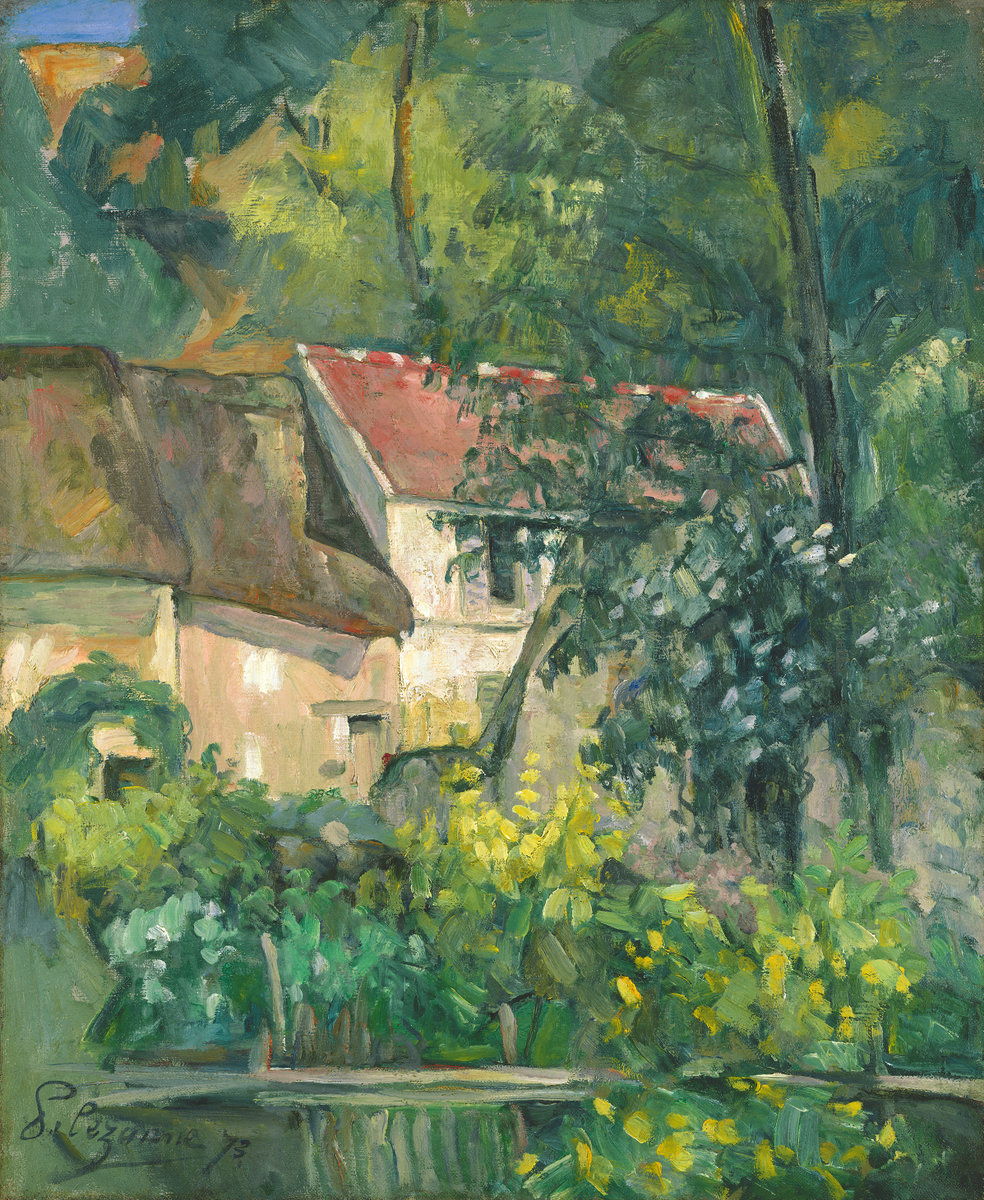
For Cézanne learning to paint en plein air alongside Pissarro’s easel in 1873, cast shadows weren’t left until last, but painted as he completed each section of this view of The House of Père Lacroix, Auvers-sur-Oise. However, as with all beginners, he took a long time getting the painting to look right, so different sections of the roof were painted several hours apart.
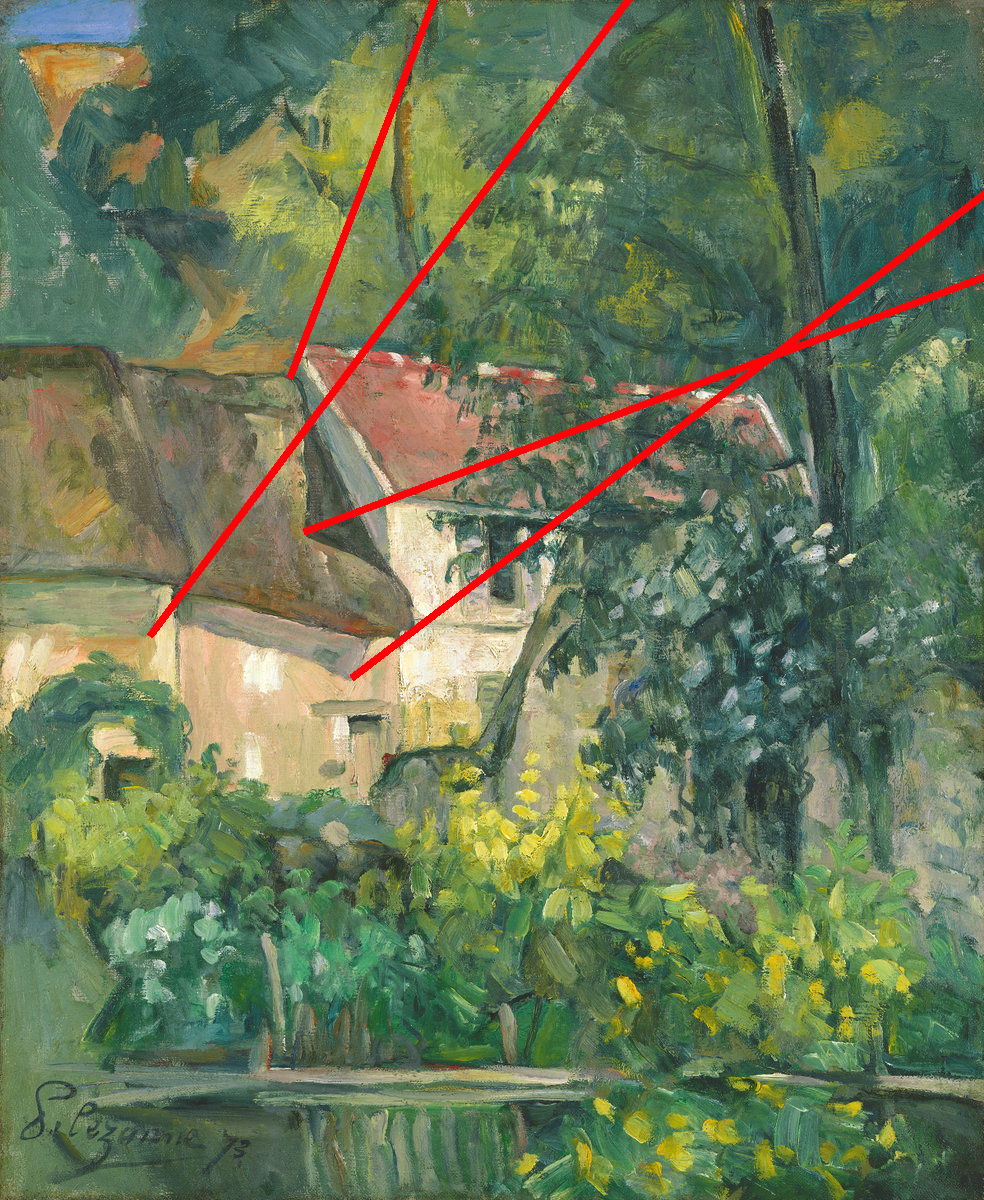
As shown in the marked-up image below, the angles subtended by cast shadows are inconsistent. In some, the sun is high in the sky, close to its zenith, but in others rather lower. These imply a wide range of solar elevations, a challenge to those still learning how to paint en plein air without the aid of photographs.
Early plein air painters in the Roman Campagna knew that they had to capture their motifs as quickly as possible, as the light changed. If you take more than an hour or so to paint a view, you have to make a decision as to when you depict light conditions and shadows, and ‘freeze’ the image in your mind at that point. If you don’t, as time passes, so the light and shadows change, and your painting becomes internally inconsistent.
Later in his career when he was painting close to his home in Aix in the Midi, Cézanne apparently walked round a series of easel paintings each day, painting on each for a short period at exactly the same time of day until they were complete.

Another famous artist who had a struggle with cast shadows is Georges Seurat, in his famous Sunday Afternoon on the Island of La Grande Jatte from 1884-6, whose painstaking deliberation is the antithesis of the plein air view. During the hundreds of hours he spent applying small marks of paint to construct this monumental work of Divisionism, his lighting conditions wandered.
The woman standing fishing at the far left of the painting casts her shadow at an approximate angle (viewed from above) of 01:30-02:00 by the clock face, and hers is quite a long shadow too. Follow her shadow back until you meet a man standing wearing a ‘pith’ helmet, and he casts almost no shadow, as if the sun was almost vertically above him.
Continue to the right and towards the foreground there is a woman holding a red parasol, walking towards the viewer, with a small girl beside her. Their shadows are cast in a different direction, closer to 02:30-03:00. Although most of the figures beyond the immediate, shaded foreground are seen to cast their own shadows, there are almost no corresponding shadows cast by the trees closer to the water, leaving most of the grassy area in unbroken sunlight.
I don’t know how or why that came about, but once you have seen it, it’s a striking anomaly.

