
Schools of landscape painting are often known by their location, such as those of the Hudson River in New York State and Newlyn in Cornwall. That named after the tiny hamlet of Barbizon should really have been a whole forest, that of Fontainebleau, which inspired its members, and provided them with its finest trees to paint.
The Forest of Fontainebleau covers an area of about 250 square kilometres (almost 100 square miles) to the south-east of Paris. It’s mixed deciduous woodland, much of it ancient, with a royal castle at its centre. It has been a favourite hunting ground for French kings, and for the Emperor Napoleon.

Among the paintings of François Flameng showing the Napoleonic period, one of the most striking is this scene of Napoleon Hunting in the Forest of Fontainebleau, where the pack is closing in on a cornered stag as the sun sets behind its ancient trees.

Achille Etna Michallon was one of the first great landscape artists to paint en plein air in the forest. His study of The Fallen Branch, Fontainebleau from about 1816 anticipates the Barbizon School in its motif, style and location. This large branch looks more like a dying animal.

A decade later, the British artist Richard Parkes Bonington visited briefly and both sketched and painted In the Forest at Fontainebleau (c 1825). The rocks here are particularly painterly, suggesting that this may have been started, if not completed, in front of the motif.
Towards 1830, inspired by the paintings of John Constable, several young French landscape painters started visiting the forest. The first was probably Camille Corot, who first painted there in 1822, and returned in earnest in the Spring of 1829, after his long stay in Italy to learn plein air painting technique in the Roman campagna.

In Corot’s Fontainebleau Forest (The Oak) from about 1830, the twisted limbs of the oak have taken time and care, sufficient to give texture and shadows to the trunks and branches. Where the canopy is more broken he painted the leaves in considerable detail.
Corot was joined by Théodore Rousseau, Constant Troyon, Jean-François Millet, Paul Huet, and later Charles-François Daubigny and Henri Harpignies. Although many of their paintings were made in the forest, few have been located with certainty.

When Harpignies was on the edge of the Forest of Fontainebleau, he painted largely en plein air, including this fine view of Fir Trees in Les Trembleaux, near Marlotte from 1854.

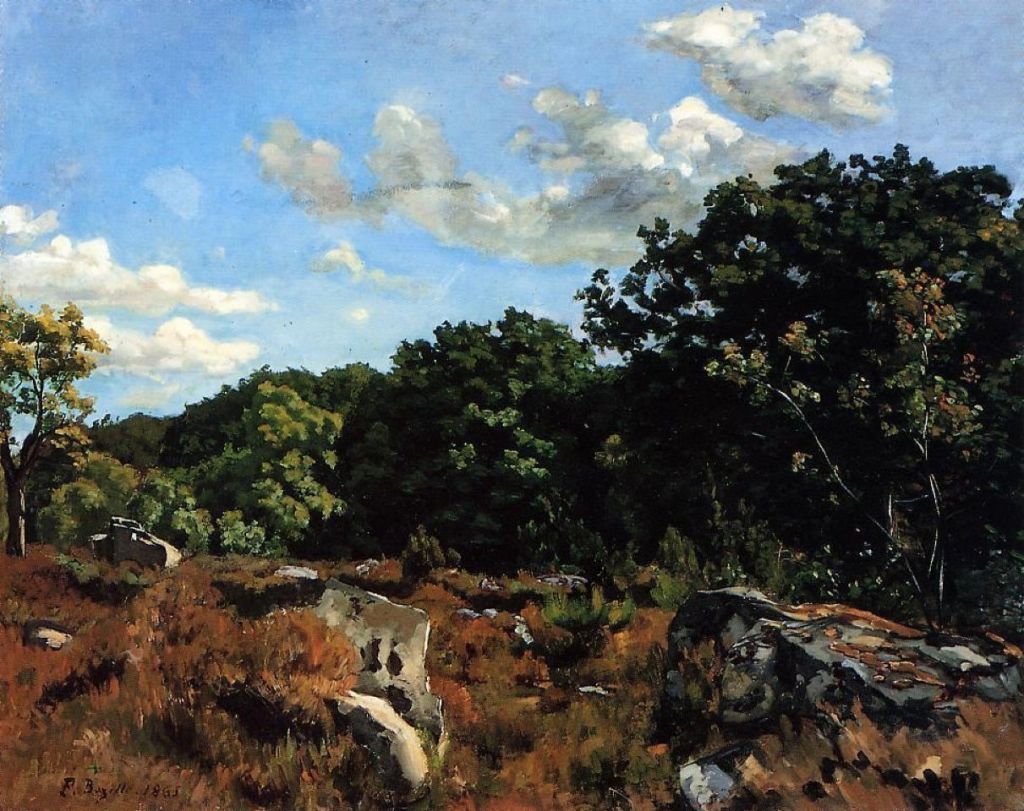
In May 1865, the young Frédéric Bazille left the city of Paris for the Forest of Fontainebleau, where he painted Landscape at Chailly (1865) in company with Claude Monet, and possibly Auguste Renoir and Alfred Sisley. Although clearly influenced by the Barbizon School, his colours are brighter, and escape the sombre browns and greens dominating much of that earlier art.

Sisley painted this Avenue of Chestnut Trees in La Celle-Saint-Cloud to the west of the forest in 1865, again in Barbizon style. He didn’t submit it to the Salon until 1867, when it was refused.
The following year, Sisley walked through the forest with Renoir. He then stayed in the village of Marlotte, where Renoir, Monet, Bazille, Pissarro and Cézanne also visited to paint.

The following year Renoir painted his friend Jules Le Coeur and his Dogs in the Forest of Fontainebleau. This is unusual among his works, as it was preceded by two studies, and all three were made using the palette knife rather than brushes. This makes it most likely to have been painted before Renoir abandoned the knife and returned to the brush, by the middle of May 1866.

A decade later Abbott Handerson Thayer, an American artist who trained in Paris, painted this wonderful oil sketch of Landscape at Fontainebleau Forest (c 1876). This is probably the loosest and most Impressionist painting of his career.

John Ferguson Weir was another American painter who had trained in Paris, and became the first director of the School of Fine Arts at Yale University. He visited in about 1902, when he painted Forest of Fontainebleau, with its tiny solitary figure against the fallen trunk.

