
Like all living organisms, trees are designed to reproduce and propagate their species. Unlike many animals, they are capable of doing that over periods of hundreds of years. Around the world, wherever man and nature have allowed trees to grow to great ages, they demonstrate their skills in staying alive despite the toll of ageing and disaster.
Some of the tree skills for survival are surprising and well-hidden. Among the most remarkable is root fusion, where the roots of trees of different sizes and species can merge together to mutual benefit. As individuals, many trees are amazingly robust in the face of what might appear fatal injuries. So long as a fallen tree can retain some of its former roots, shoots can rise vertically from its resting trunk, and one large fallen tree is turned into a whole thicket of youthful saplings. These paintings illustrate the decline and fall of once great trees.

Jacob Isaakszoon van Ruisdael showed a deep understanding of the stages in the life and looks of oak trees. In Road through an Oak Forest (c 1646-7) he captures the later life of a stag-headed oak, which long ago lost its crown, on the left, a flush of new growth on a fallen trunk, and another still clinging onto life despite a great split at its base.

Gentle rural decay is shown not only in the ruined buildings in van Ruisdael’s Landscape with a Mill-run and Ruins (c 1653), but also in the stag-head tree in the centre.

Van Ruisdael’s most detailed essay on the effects of advanced age on trees, Three Great Trees in a Mountainous Landscape with a River dates from 1665-70. Although its mountains are borrowed or imaginary, the three trees of the title seem almost impossibly intertwined. The nearest is struggling to survive, remains of its former glory resting, limbs in the air, at its foot.

John Brett, the leading Pre-Raphaelite landscape artist, painted The Stonebreaker (1857-58) at a popular beauty spot in the North Downs, near Box Hill, which dominates the distance. The milestone at the left shows the distance to London as 23 miles, and David Cordingly considers this places it along a historic track known as Druid’s Walk, leading from the Pilgrim’s Way over the Leatherhead Downs to Epsom and London. At the right are the remains of a near-dead tree that can still manage a small flourish of leaves at the top, and to provide a perch for a little bird.

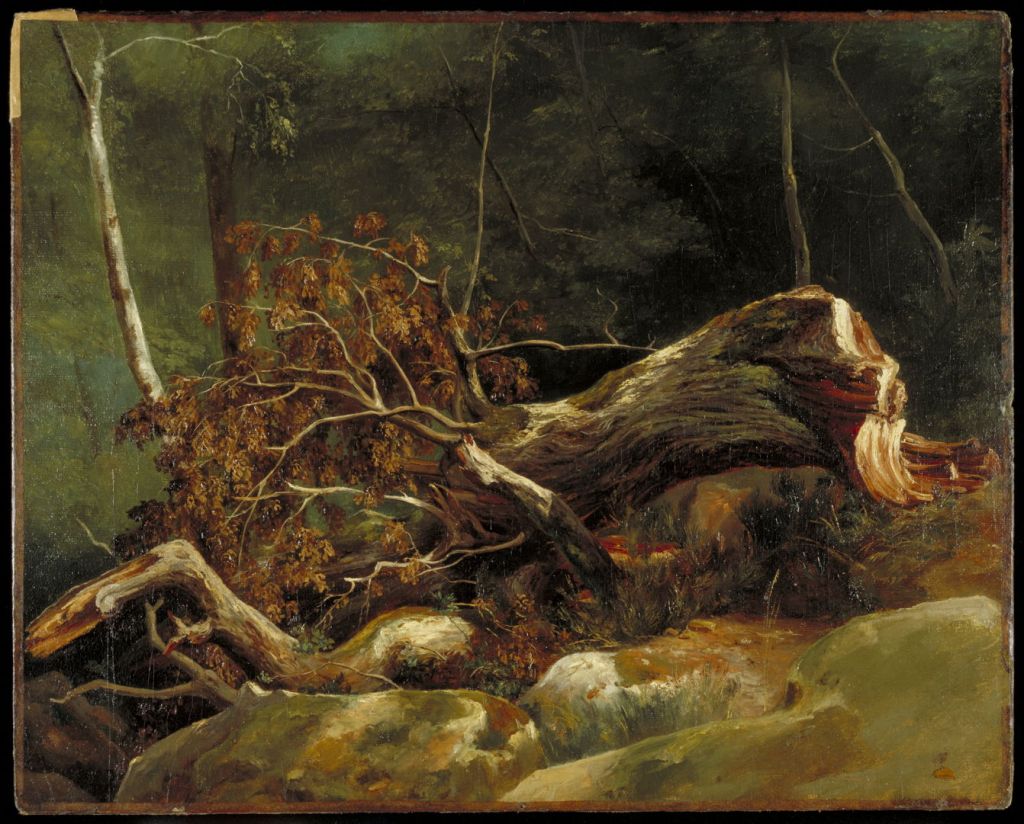
Achille Etna Michallon was one of the first great landscape artists to paint en plein air in the forest of Fontainebleau with its many ancient trees. His study of The Fallen Branch, Fontainebleau from about 1816 anticipates the Barbizon School in its motif, style and location. This large branch looks more like a dying animal. Without any roots to provide its leaves with water and nutrients, they quickly brown and wither.

John Ferguson Weir’s Forest of Fontainebleau (c 1902) features a tiny and solitary figure against a massive fallen trunk. This appears to have lost all continuity between trunk and roots, with fatal consequences.
Many trees that meet their end do so as a direct result of humans, either to use them for timber, or in the course of wilful destruction.

Odds and Ends (1939) is one of Emily Carr’s most important paintings, showing young and very high trees left behind as being of no commercial value after felling. She describes the low stubs left on the stumps as being the trees’ tombstones.
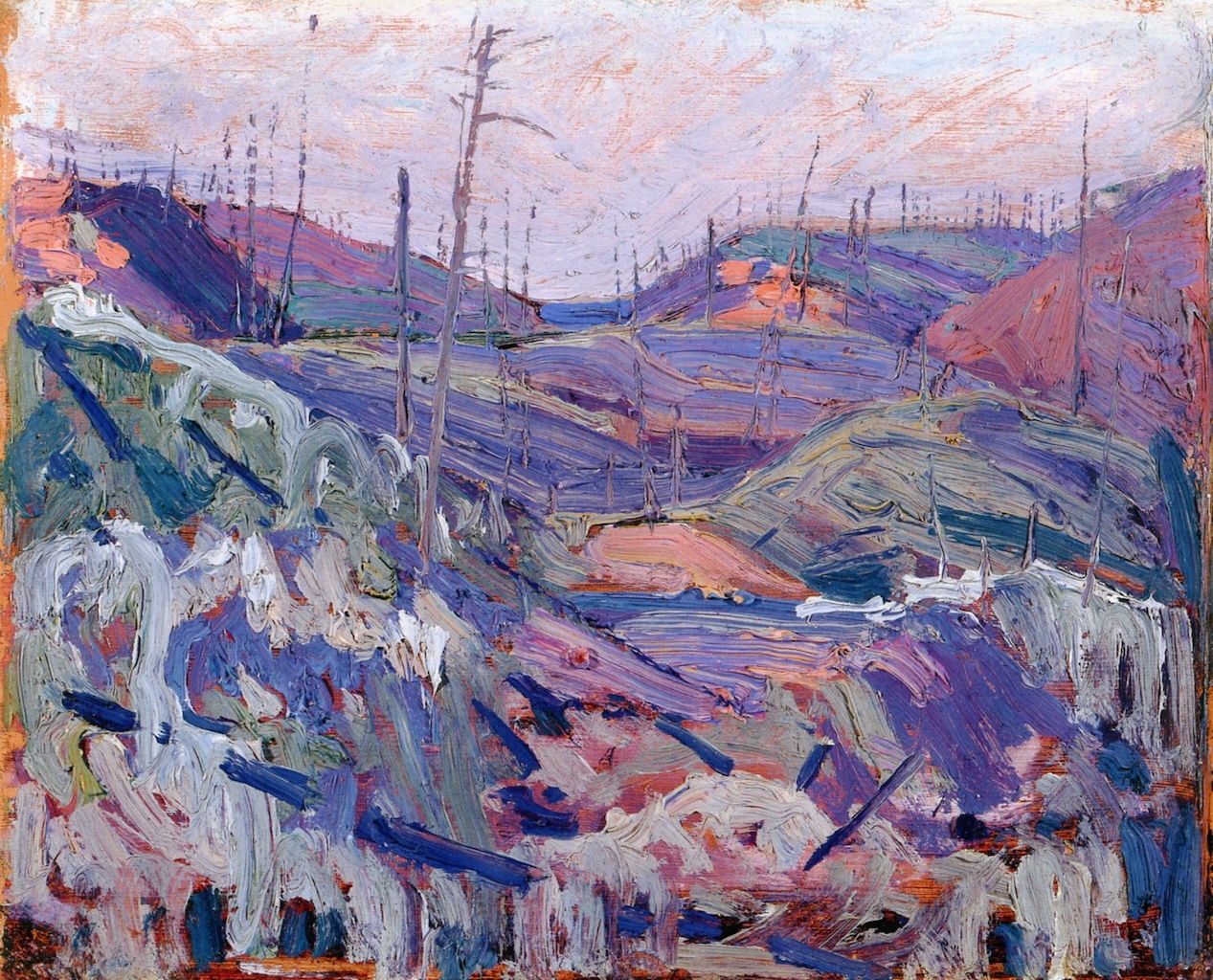
As early images were returning to Canada of the appalling conditions in the trenches in Europe during the First World War, those may have inspired Tom Thomson to paint his Fire-Swept Hills (1915), showing the consequences of wildfires in the forests of Canada.

Typical of Paul Nash’s paintings of the Western Front is his watercolour Wire (1918). It shows a characteristically deserted and devastated landscape, the mud pockmarked with shell-holes and festooned with wire fencing and barbed wire. Its only landmarks are the shattered stumps of what had been leafy trees in pleasant countryside.

