
Polymythic paintings are probably the least common type of narrative art, as they are single images containing two or more distinct stories. However, they’re among the most distinctive and fun to read, particularly when they contain many small tales, and are still featured in some popular illustrated children’s books.
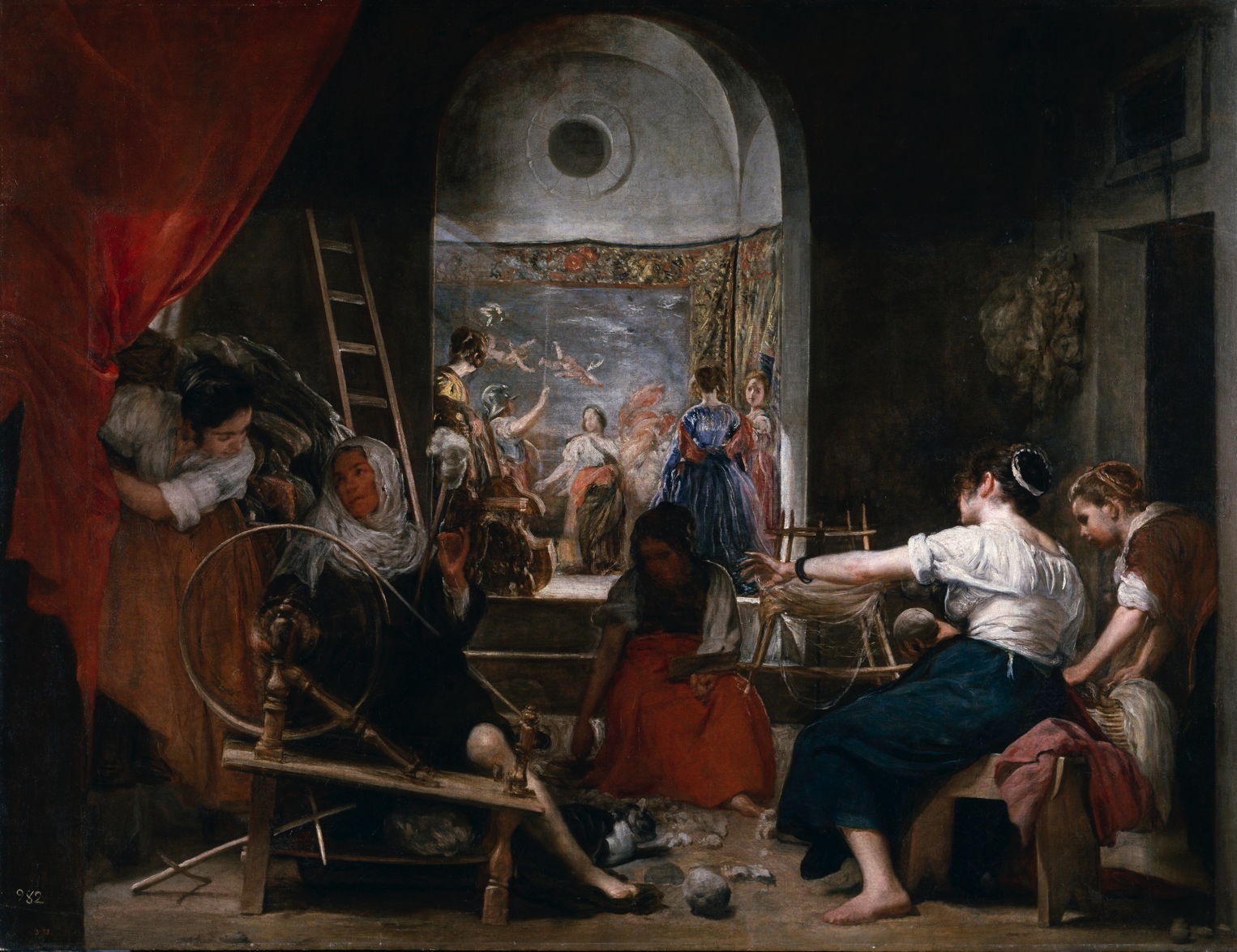
Diego Velázquez’s Las Hilanderas (The Spinners) contains one narrative in the foreground where a group of women are spinning, a second in the background with the weaving contest between Minerva and Arachne, and a third in the painting of The Rape of Europa in the far background. I discuss this painting here.

Although linked and often told together, the stories of Echo and of Narcissus can be separated, and it’s therefore reasonable to classify John William Waterhouse’s Echo and Narcissus (1903) as showing polymythic narrative.
One of the earliest and grandest of all polymythic paintings in Western art is the central panel of Hieronymus Bosch’s Garden of Earthly Delights, a triptych he painted between 1495-1505.
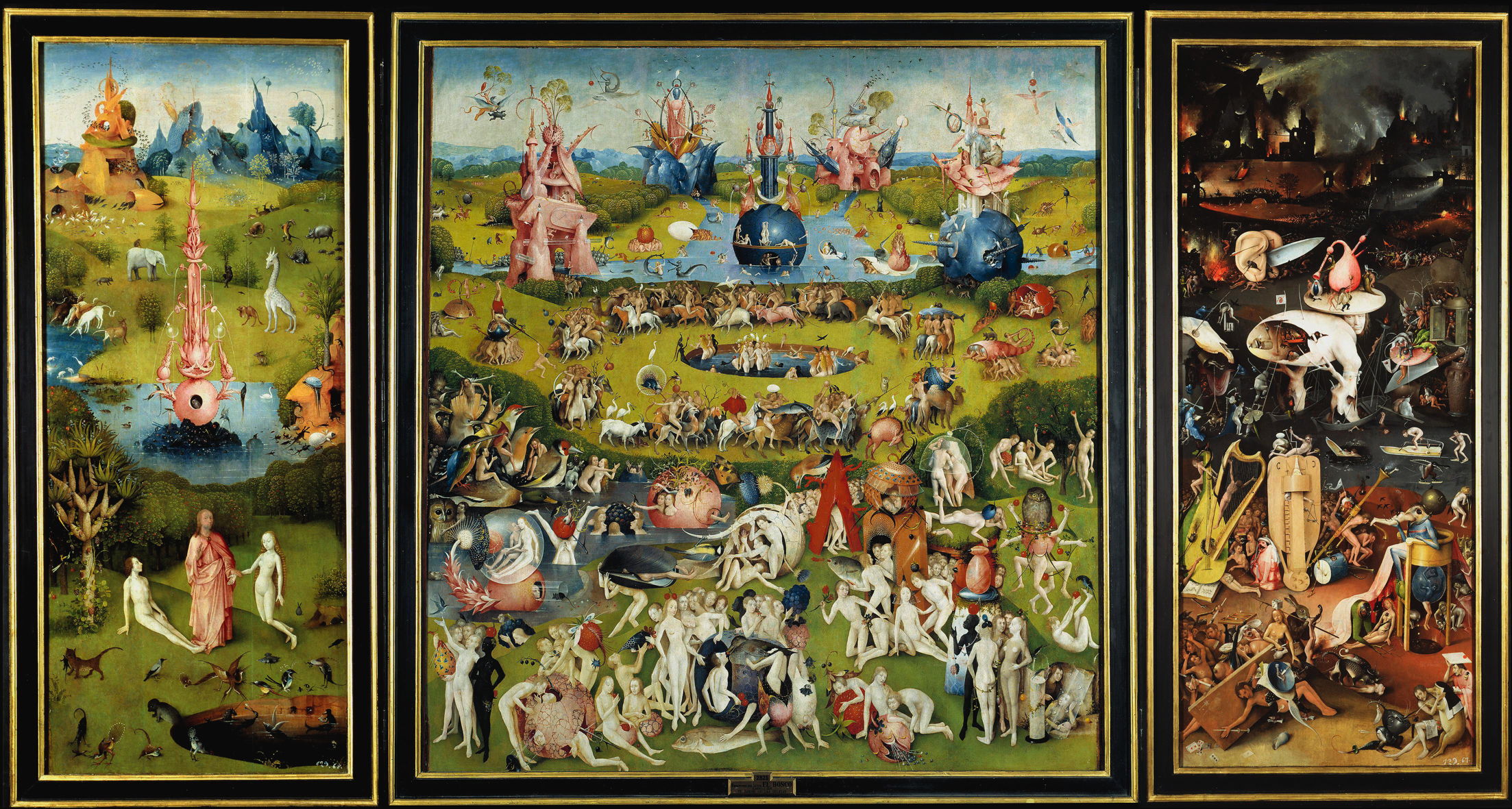
It’s also his most documented painting, first recorded only a year after his death, and described by a succession of viewers ever since. Although its commissioning isn’t recorded, it appears to have been painted as a conversation piece for the well-educated nobility, specifically Count Henry III of Nassau-Breda (1483-1538), in what is now Belgium. Ilsink and others consider that Bosch’s main inspiration and source for the material in this painting was Hartmann Schedel’s extensively illustrated Weltchronik (history of the world) published in Nuremberg in 1493, a perfect polymythic source.

Its centre panel shows a rolling deer park with lakes, overrun by a dense mass of naked men and women, and bizarre objects, engaged in innumerable small stories. You can read more about this painting here.
Just over fifty years later, Pieter Bruegel the Elder compiled a visual encyclopaedia of Netherlandish Proverbs, in which he catalogues well over a hundred popular proverbs of the day. They’re set in what appears to be a bustling coastal village, but the closer you look at it, the more contrived and extraordinary are its figures.
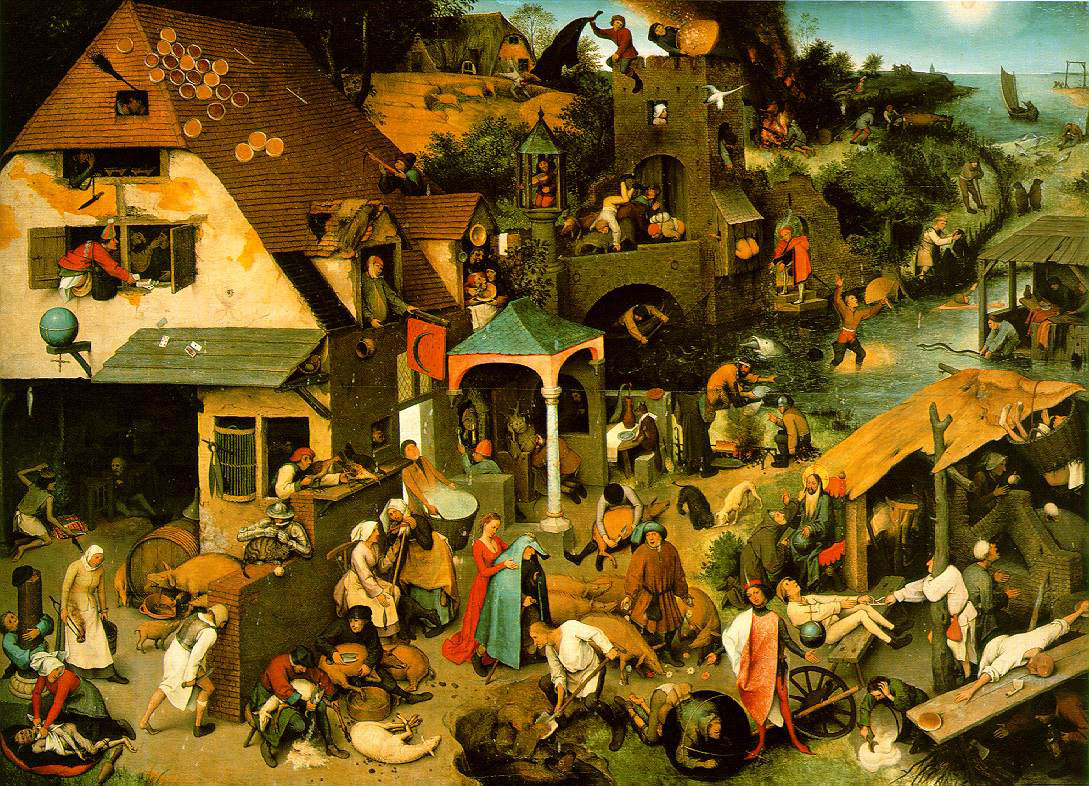
Armed with a compendium of proverbs of the day, the painting finally makes sense, and is explained in detail in its entry in Wikipedia, with a detail view for each of the proverbs so far identified.
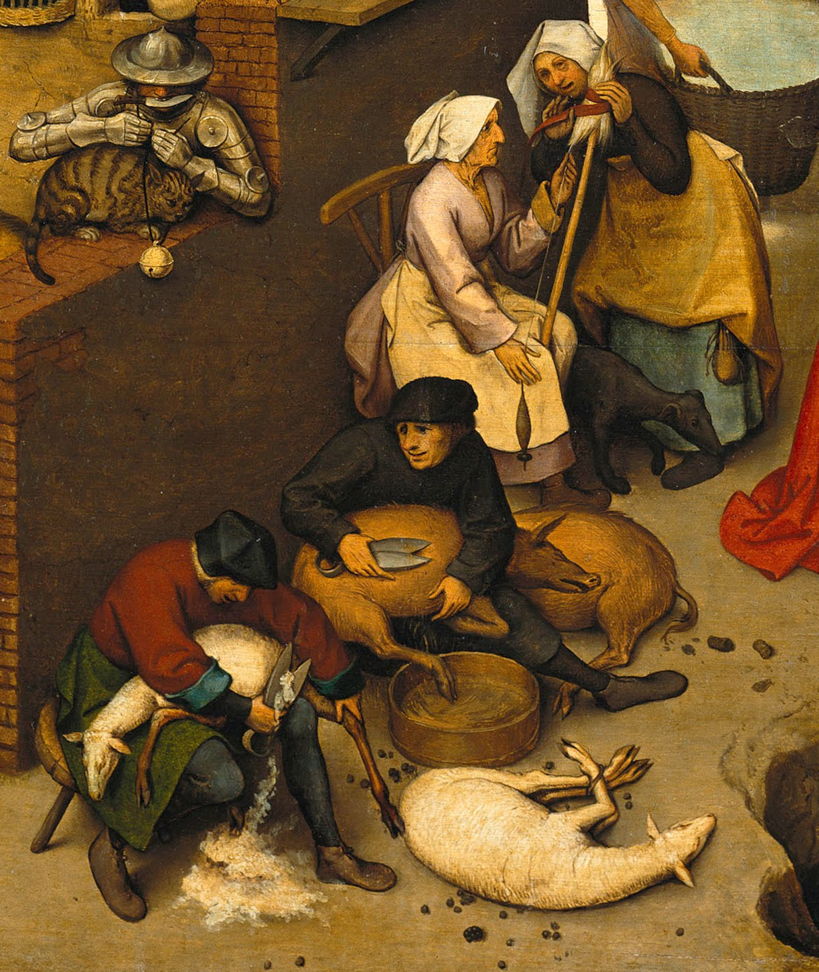
In this small detail, these figures represent:
- to be armed to the teeth,
- to be an iron-biter (boastful and indiscreet),
- to bell the cat (being indiscreet about secret plans),
- one winds off the distaff what the other spins (spreading gossip),
- watch out that a black dog does not come in between (two women together do not need a barking dog to add to the trouble),
- one shears sheep, the other shears pigs (one has all the advantages, the other none),
- shear them but do not skin them (don’t press your advantage too far),
- to be as tame as a lamb (very obedient).
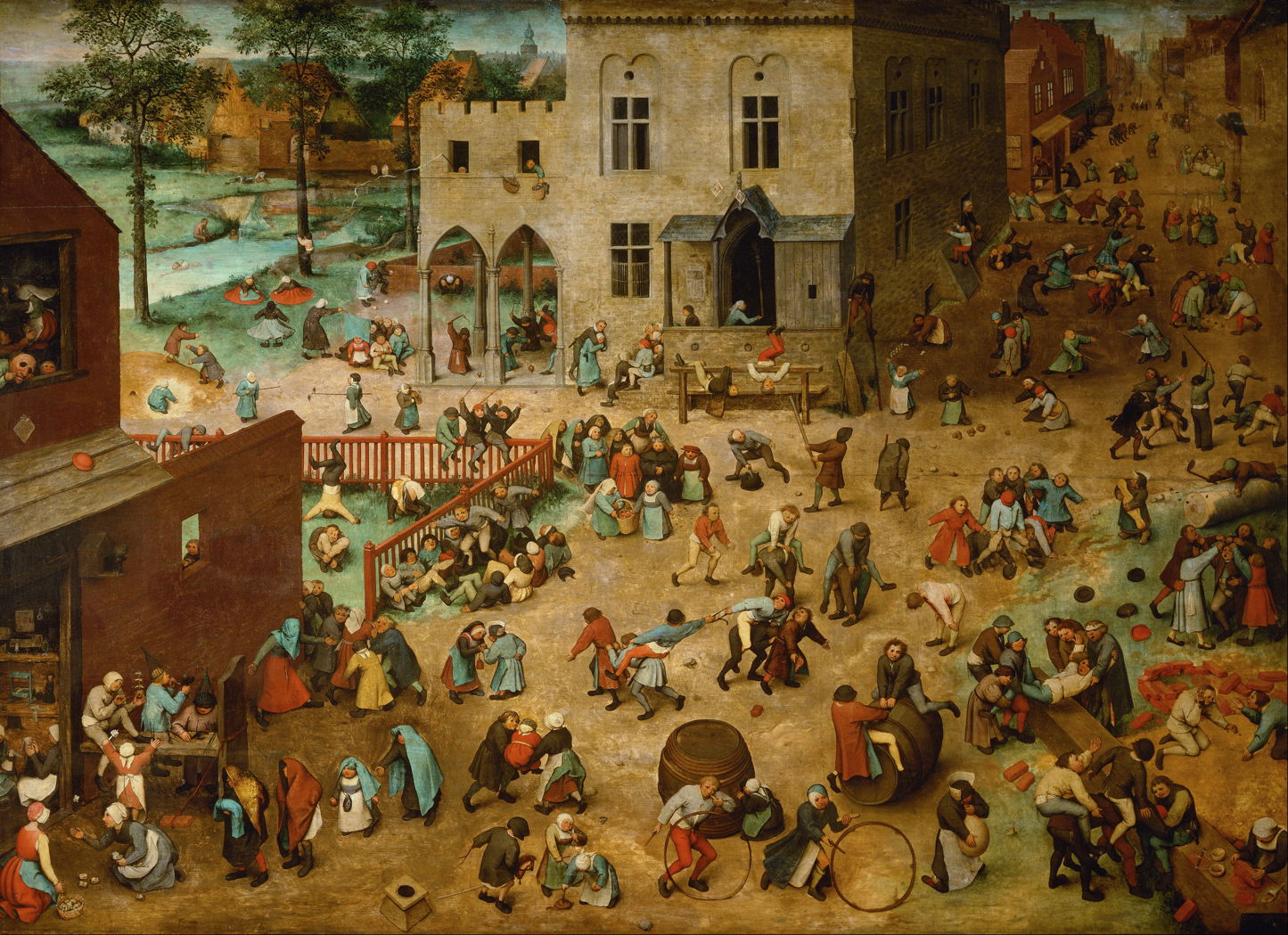
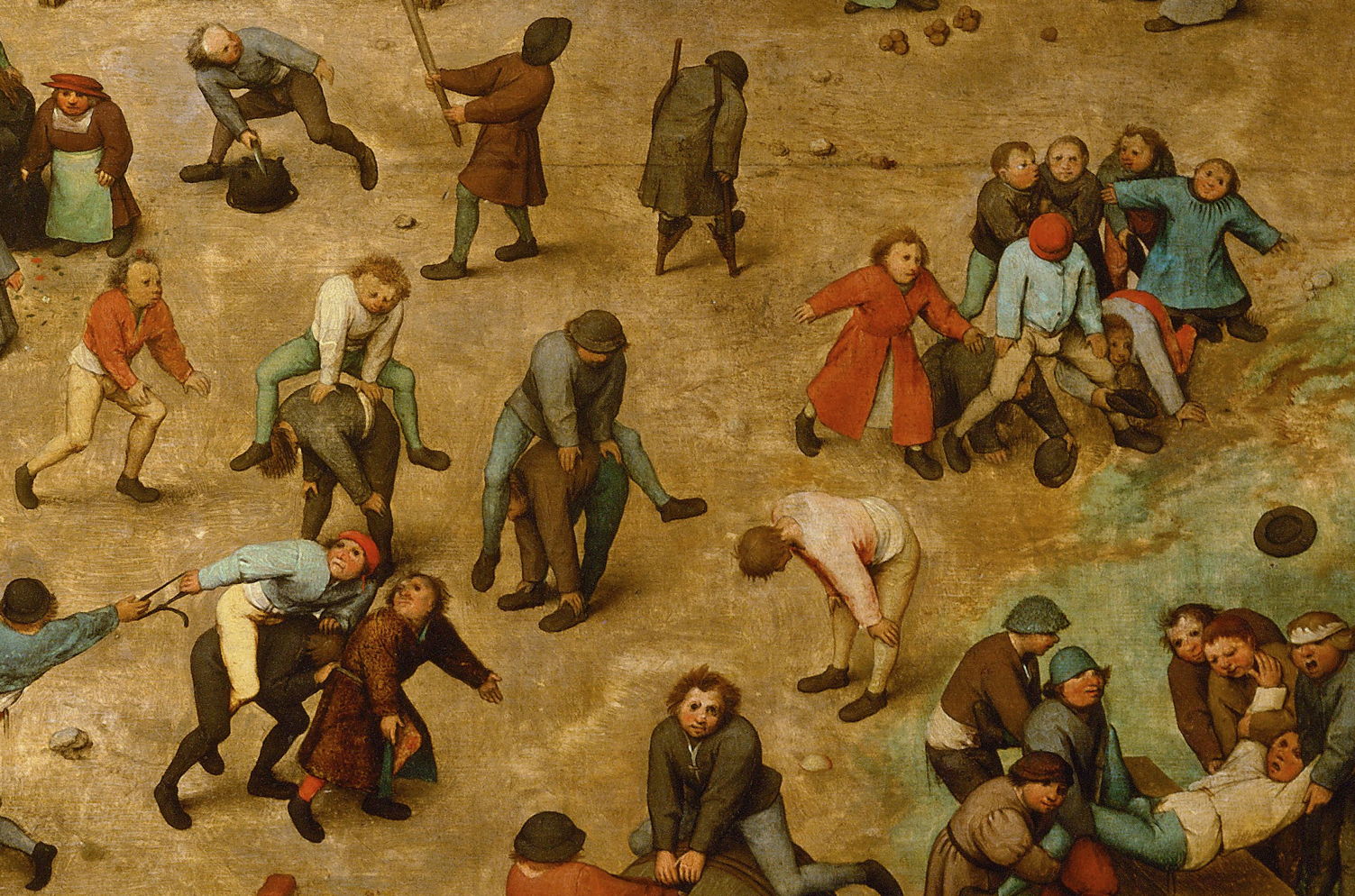
Bruegel’s Children’s Games from the following year appears less contrived, and until you study its figures carefully, you might not notice its systematic compilation of the games played by children, as shown in the detail below. Many remain popular today.
Polymythic paintings then vanished from sight until they reappeared in the nineteenth century, and my final examples are from the same few years in the middle of the century.

On the strength of a sketched proposal, Jacob Bell commissioned William Powell Frith to paint his finished Derby Day between 1856-58, showing the crowds attending horse races at Epsom, just to the south of London. It was exhibited at the Royal Academy in 1858, and proved so popular that a guard rail had to be installed in front of it to protect the work from the admiring crowds. Within its mass of people, there are innumerable scenes and visual anecdotes concentrated into a human landscape epitomising the moment and the whole era. I give a fuller account of this painting here.

Frith followed that with The Railway Station, painted in 1862, and set in the crowded and busy Paddington railway station in London. Frith was not only thoroughly modern and commercial in its exhibition – it wasn’t shown at the Royal Academy, but in a private gallery charging one shilling (£0.05) per visit – but he used photographs in its execution. It’s rich with little social vignettes, and among its many faces are associates and friends of the artist, including the dealer who paid for it.

The centre of action is at the right of the painting, where an arrest is being made. A man dressed in brown clothes is about to board the train, within which a woman stares aghast at the scene. Two Scotland Yard detectives, complete with top hats, are in the process of serving a warrant for his arrest, the other stood ready with a pair of handcuffs. At the far right is the train’s guard, who is holding the carriage door open. You can read more about this painting here.
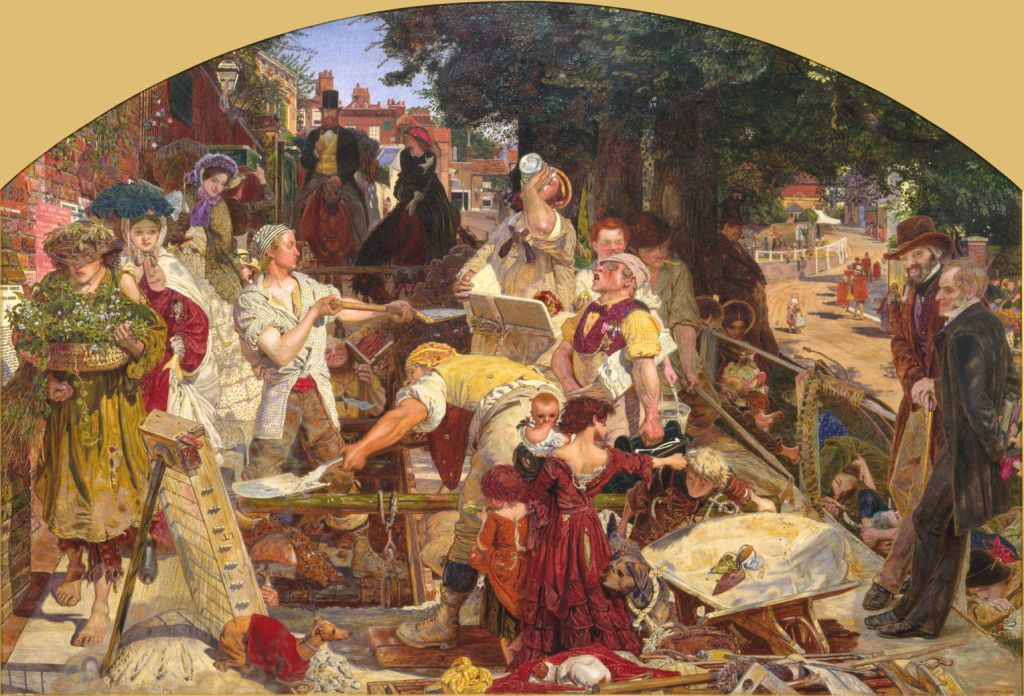
While Frith was busy with his Derby Day, Ford Madox Brown was working on a commission for the collector Thomas Plint, who died in 1861, four years before it was completed.

This is the Birmingham (second) version of Work, painted between 1859-63, which is rather lighter and richer in colour, making it easier to read than the first, completed in 1865.
This crowded street scene is set in Heath Street, Hampstead, one of London’s ‘leafy’ suburbs at the time, in which Brown has crammed references to many aspects of contemporary Victorian society, including an election campaign.
At its centre is a gang of navvies, the term originating from the word navigators, usually Irish labourers, who had dug the canals during the previous century. Here they’re engaged in digging up a road to lay a sewer as part of the campaign to improve the hygiene of Victorian London. Inspired by the social satirical comment of William Hogarth’s many prints and paintings, Brown is effectively giving a meticulously detailed account of the breadth and depth of contemporary society, using multiple interwoven narratives in this single image. You can read fuller details in Wikipedia’s excellent article.

