
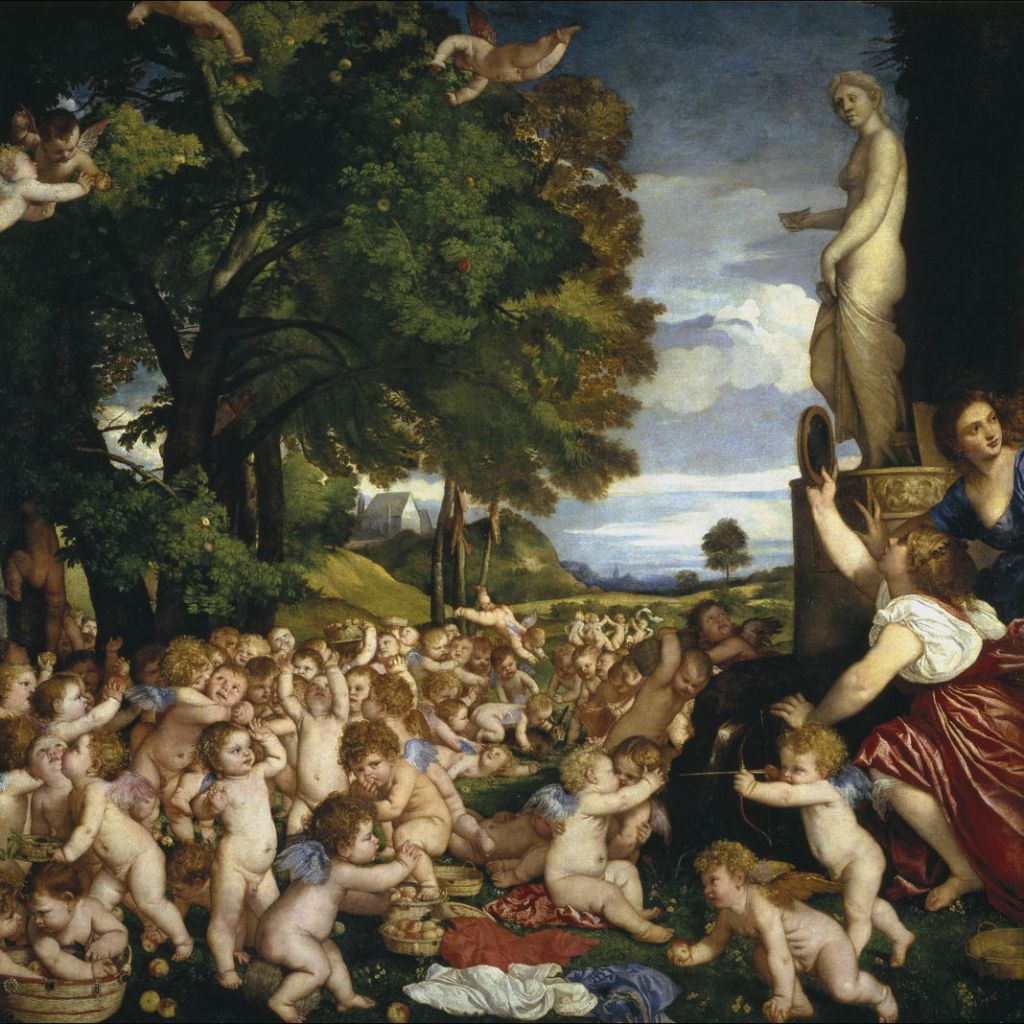
Chubby infants with wings are common adornments of paintings, and are often more than mere decoration. Is that a Cupid (or even the Cupid), a putto, amorino, or cherub? Only when we know which, can we work out what they’re up to, and how to read them.
Originally, the Greek god Eros wasn’t an infant at all, but a young man.

This detailed depiction of Eros on an Apulian red-figure Oinochoe from about 320 BCE shows splendid detail in the young god’s wings. He here holds a mace, presumably to knock his victims senseless in order to get them to fall in love.
It was the Romans who recast Cupid in more modern terms, as a chubby infant armed with a bow and arrow. A few artists have stayed with the original Eros, though.
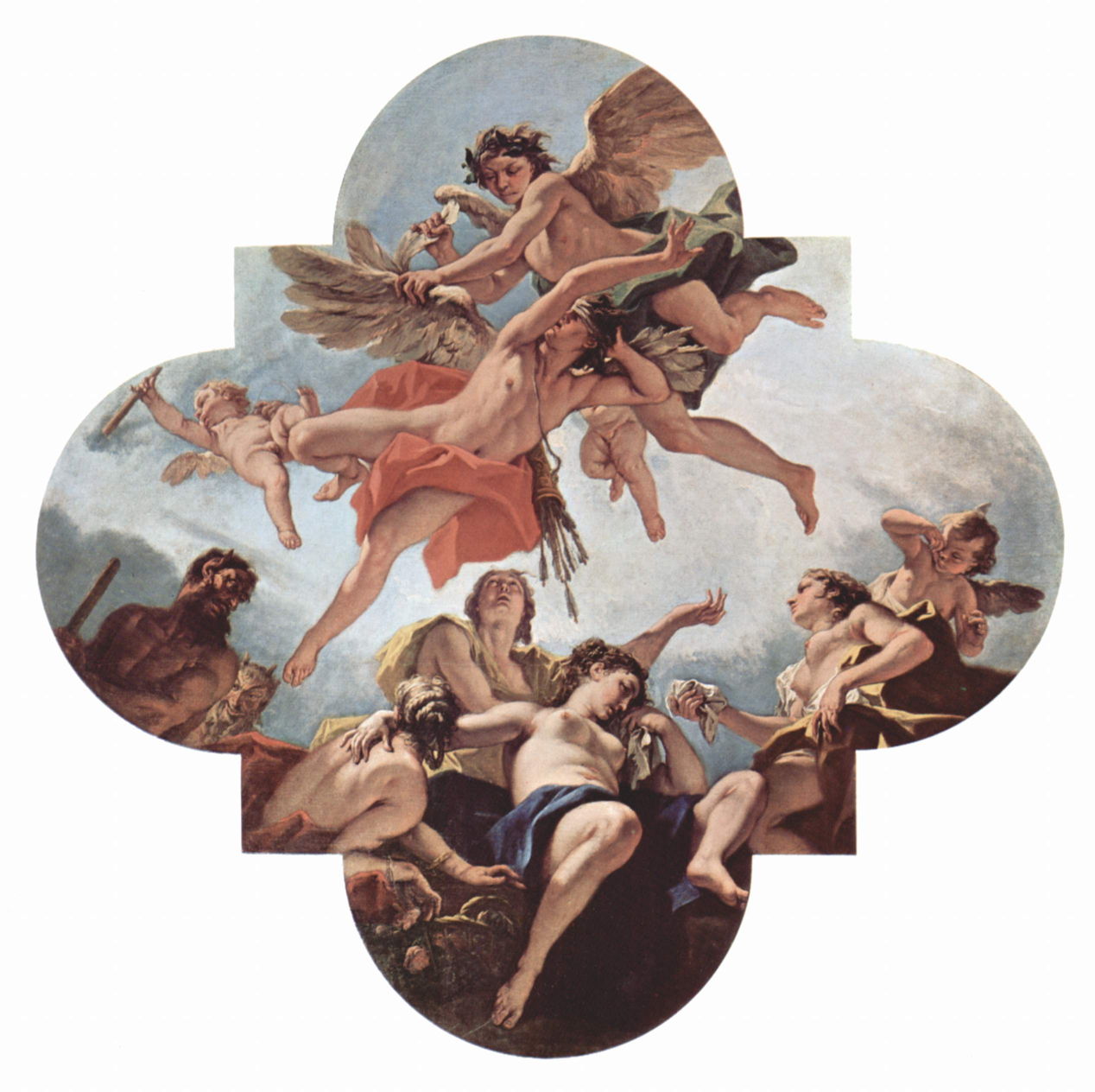
My favourite painting of this is Ricci’s dizzying ceiling showing The Punishment of Cupid (1706-7), which also turns out to be an allegory of sacred and profane love. At its centre, Cupid is blindfolded, and his quiver about to empty its arrows to the earth beneath. His mother Venus looks on from a group of goddesses below. Tearing feathers from Cupid’s wing is Anteros, who represents sacred love. The putto to the right carries a torch, an attribute of Cupid, but its flame has gone out, as profane love is also transient.
In classical mythological terms, this is a curious and contradictory painting. Anteros was Eros/Cupid’s half-brother in Greek myth, and a childhood companion. He was the god of returned (requited) love, and the complement of Eros/Cupid rather than his competitor. He was more typically depicted as a young man with the wings of a butterfly, and bearing a golden club or leaden arrows.
You’re probably already familiar with one of the few modern statues of Anteros: Alfred Gilbert’s famous Anteros (1893) stands on top of the Shaftesbury Memorial in London’s Piccadilly Circus. More usually and mistakenly thought to show Eros, it has the distinctive butterfly wings of Anteros, and wields a bow and arrows.

John Roddam Spencer Stanhope also has no time for infants or nudity in his Love and the Maiden (1877), and keeps to the Greek Eros.
In general, though, from the Renaissance on, it’s the later Roman interpretation that appears in paintings.

The Cupid shown at the top of Botticelli’s Primavera (Spring) (c 1482) is complete in all details: winged like a bird, taking aim with his bow and arrow, but with his eyes blindfolded, as love is blind.
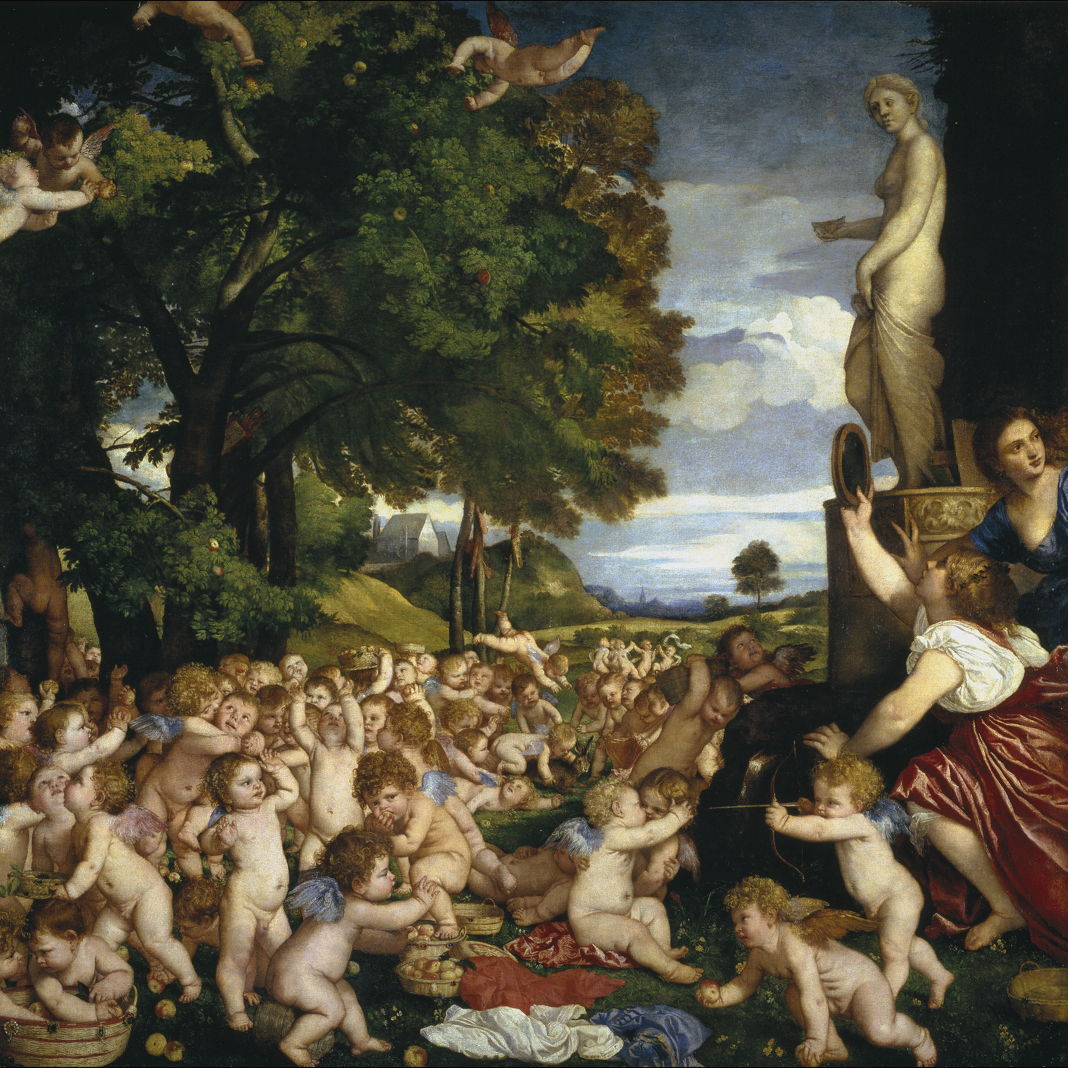
If you thought that one or two Cupids might be overdoing it, Titian’s Worship of Venus (1518-19) shows a whole convention of winged infants. But only one, at the lower right corner, is armed with his bow and arrow, and a true Cupid. The others, who seem to be up to all sorts of mischief, are more properly amorini, (singular amorino), Cupid’s helpers. They’re also termed putto (singular) and putti (plural), but however cherubic they might appear, they remain distinct from cherubim, sacred creatures derived from the Old Testament.
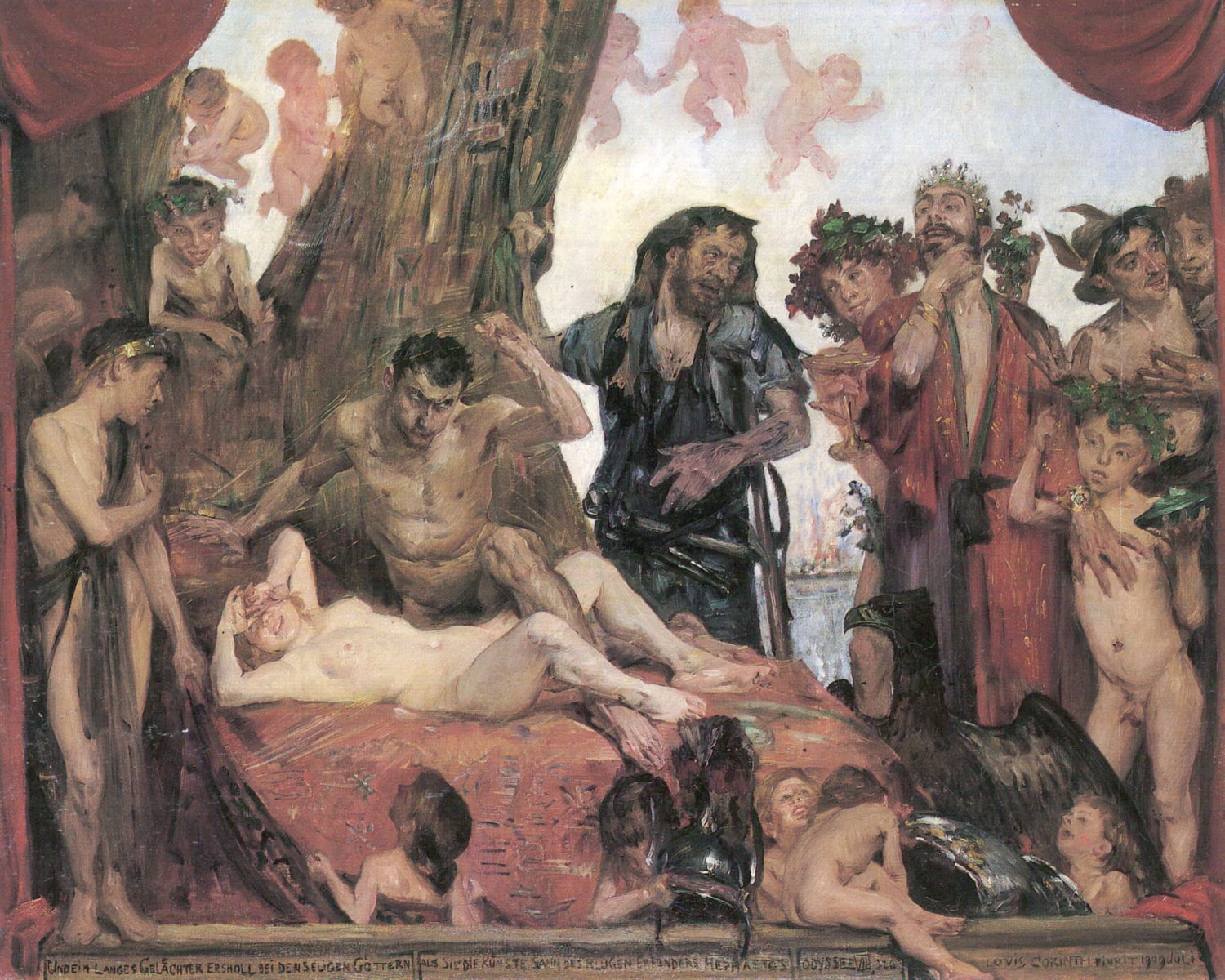
Lovis Corinth adorns his Homeric Laughter (1909) with several mischievous young children, who could well be amorini or putti, and decorates the sky behind with a chain of putti.
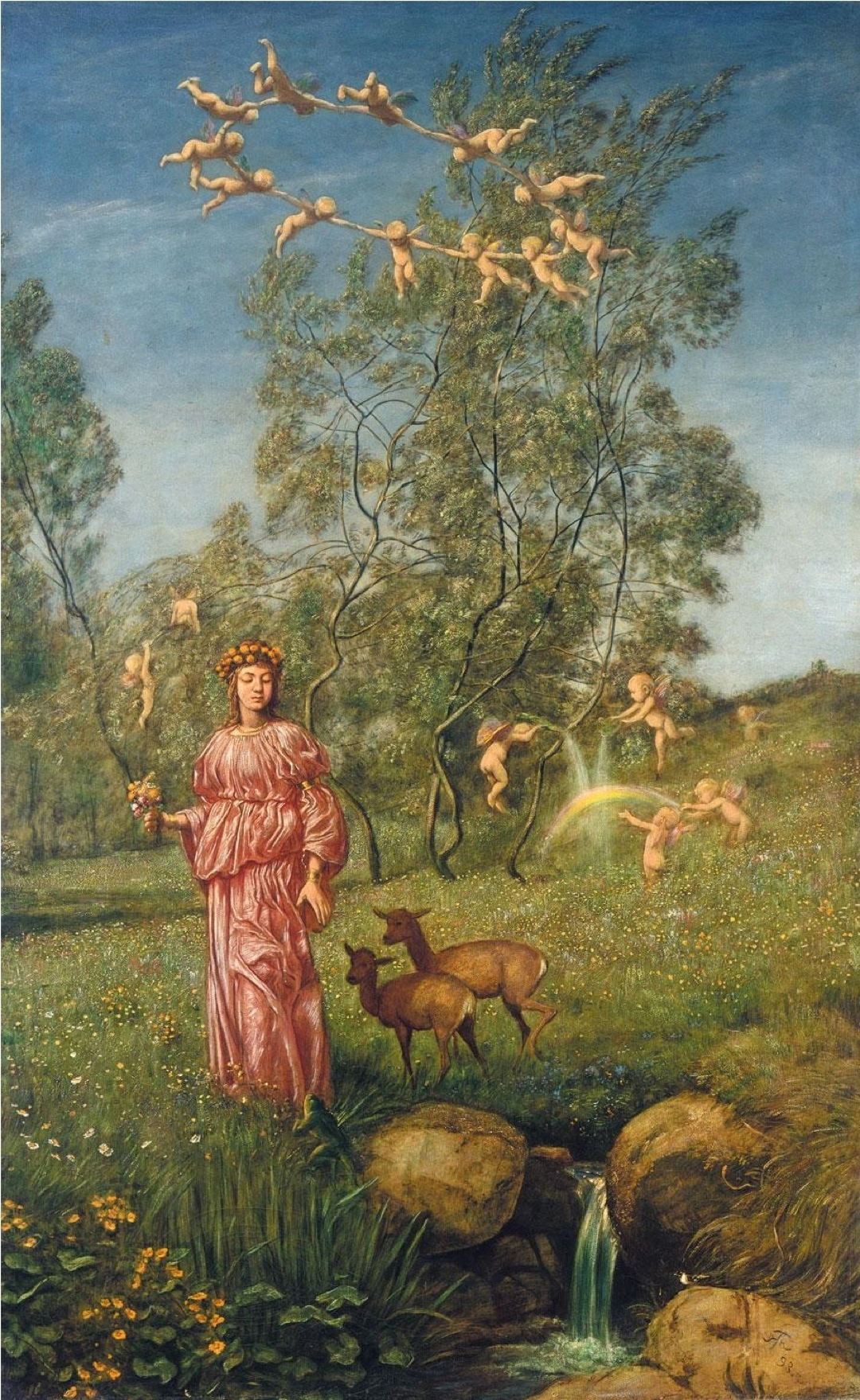
A few painters have depicted putti more unconventionally. Hans Thoma, in his Spring Fairytale, An Allegory from 1898, which appears to have been influenced by Botticelli’s Primavera, preferred to give them insect or butterfly wings, with their rich colours.
Cherubim (or cherubs, with the singular cherub) have their origins in the Old Testament, but are widely seen in paintings of New Testament events, particularly those involving the Virgin Mary.
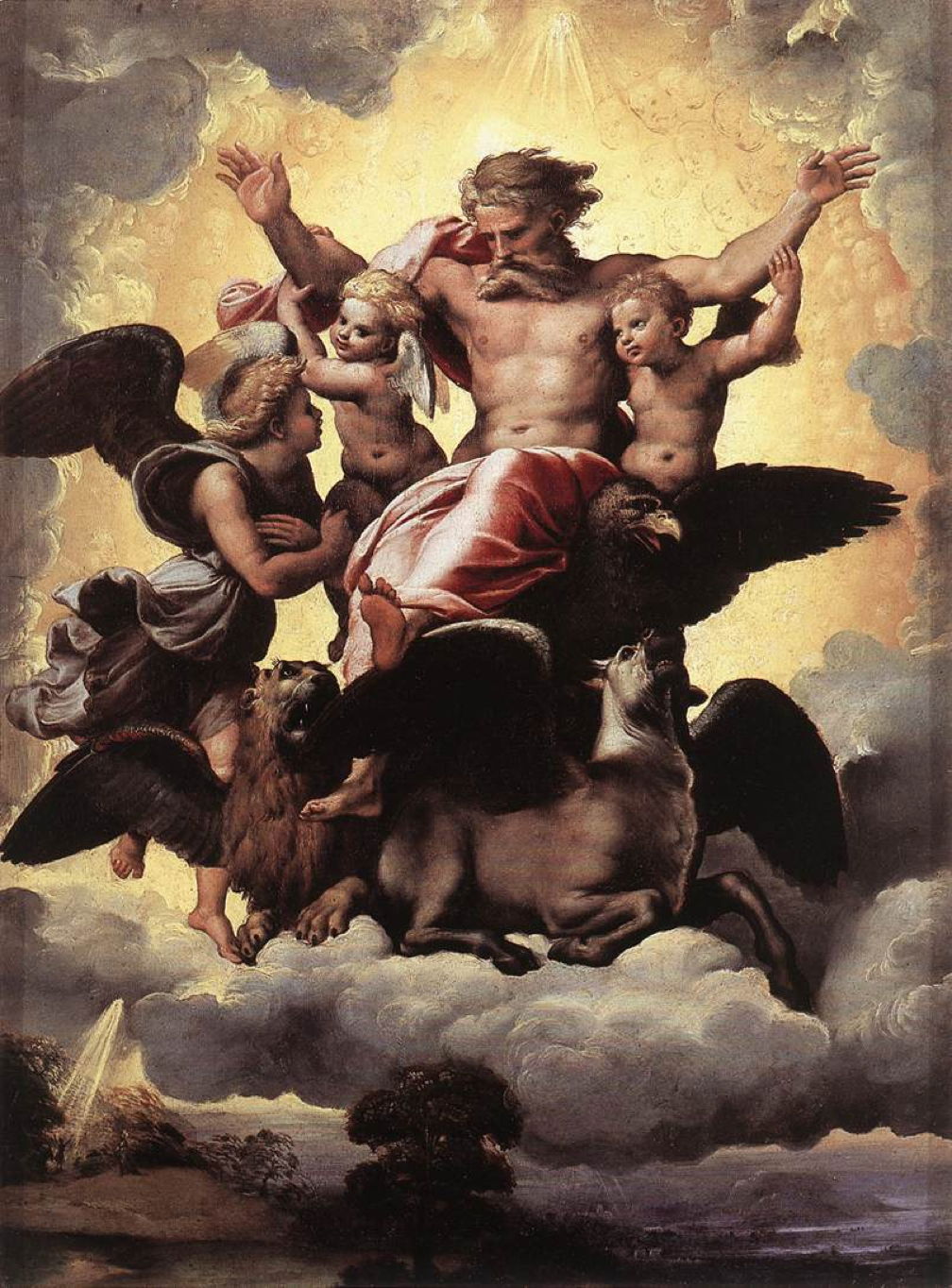
The opening chapter of the first book of Ezekiel describes an elaborate vision, in which the prophet drives a battle chariot drawn by four creatures, each of which has four faces, of a man, lion, ox and eagle, and four wings. Raphael simplified that for his Vision of Ezekiel (1516-17), settling for the prophet being borne on the back of a large eagle with two winged mythical beasts underneath, two cherubim supporting his arms, and more embedded in the clouds above.

Raphael’s Sistine Madonna (1512-13) was donated by Pope Julius II to the Benedictine basilica of San Sisto in Piacenza. The two saints shown are Saint Sixtus II and Saint Barbara, whose relics were preserved there. The Madonna and saints are painted superbly, but it’s the rest of the image that I find most fascinating. The two cherubs with tousled hair at its foot are gentle touches of humour for a congregation probably appearing much the same as they looked at this image. Its vaporous background also forms a host of cherubim.
Cherubim are often mentioned alongside seraphim, but are completely different.

Mikhail Vrubel’s Six-winged Seraph (Azrael) from 1904 shows the Judaeo-Islamic Angel of Death, responsible for transporting the souls of the dead. Their right hand holds a long dagger, and the left holds what I think is a light.
 The Eclectic Light Company