
Linear perspective is one of the most controversial topics in the theory of painting, and few issues about it are generally agreed. Even its history is disputed: the standard account is that it was ‘discovered’ or ‘invented’ by the Italian Renaissance architect Filippo Brunelleschi in about 1420. However there are also various claims that Classical Roman painters used linear perspective as faithful as Brunelleschi’s.
The truth is, as is often the case, somewhere between those two extremes. Yes, several Roman painters came very close to ‘discovering’ linear perspective as we know it today. However there is no known Roman painting that demonstrates accurate 1, 2 or 3 point linear perspective consistently throughout the image. Careful geometric analyses of those paintings that look as if they are correct shows that there are invariably multiple vanishing points, much like those of Renaissance paintings that hadn’t quite reached the geometrical perfection apparently demonstrated by Brunelleschi.

It has been claimed that the first painting made using an accurate linear perspective projection is Ambrogio Lorenzetti’s Annunciation (1344), also his last known work. This is on the basis that it includes a floor which does appear to have been correctly projected. Unfortunately the floor is the only object included in the projection, and others such as the chair on which the Virgin Mary sits don’t appear to conform to the same vanishing point.

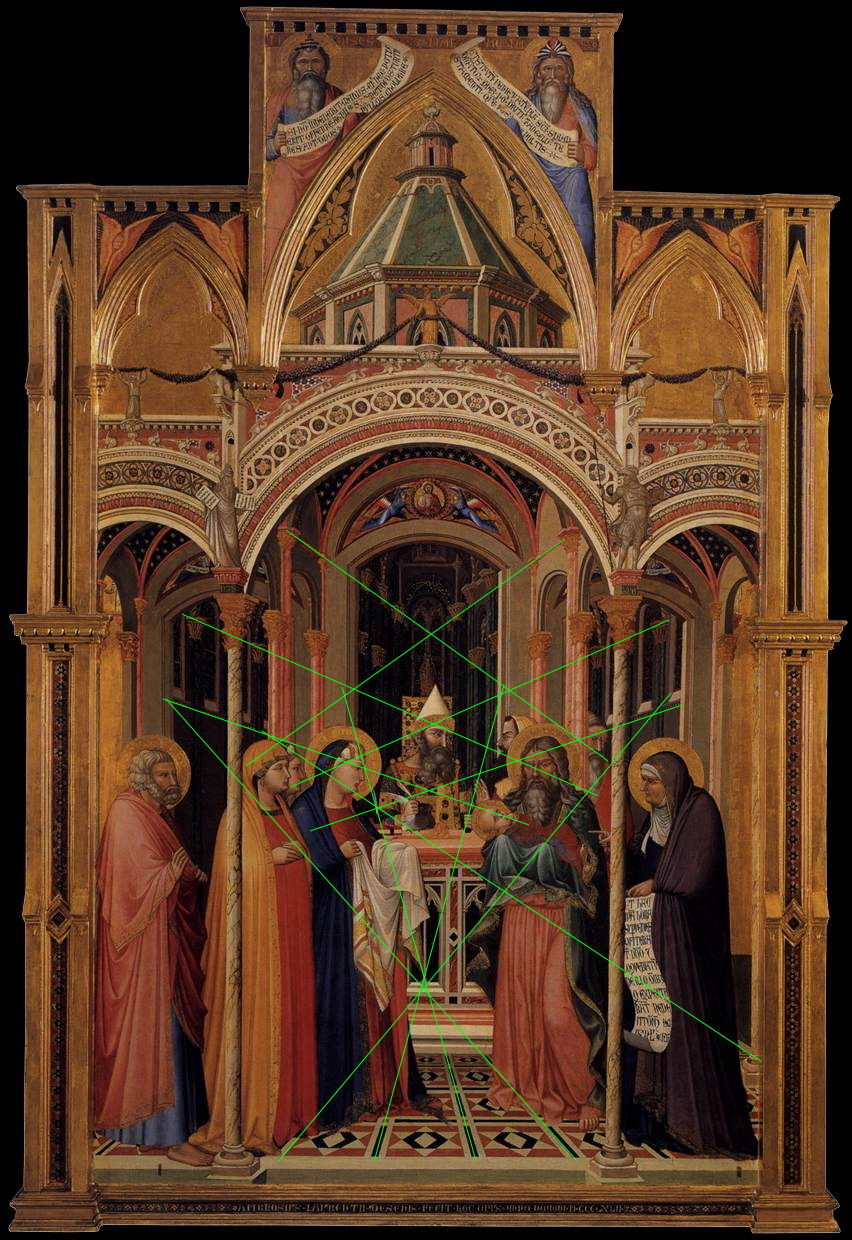
Lorenzetti’s earlier Presentation in the Temple (1342) also uses a geometric pattern in the floor that appears to have been projected in accordance with principles which weren’t known until Brunelleschi discovered them. However, as is common in paintings made by the Romans earlier and prior to about 1420, it too has multiple vanishing points.
The first truly correctly projected painting that survives is Masaccio’s fresco of The Holy Trinity in the Basilica of Santa Maria Novella, Florence, Italy.

This shows the traditional Christian Trinity of God the Father (top), God the Son or Christ (on the crucifix), and God the Holy Spirit (white dove flying from God the Father). At the foot of the crucifix are the Virgin Mary (left) and Saint John the Evangelist. The tomb at the bottom of the painting is that of Adam, the first man, with the inscription Io fui gia quel che voi siete e quel ch’io sono voi anco sarete: ‘I once was what now you are and what I am, you shall yet be’.
For all his youth, Masaccio was an experienced and successful fresco painter by this time, and had completed a series of superb paintings in the Brancacci Chapel, for example. He was mastering the use of linear perspective projection, and must have made the decision to make this work a showpiece for this new technique.
The two principle sources of information about perspective in Florence in the period 1425-1435 were Filippo Brunelleschi its ‘inventor’, and Leon Battista Alberti, who was in exile in Genoa and wasn’t allowed to return until 1428. It was Alberti’s later book which was to lay the geometric foundation for most linear perspective in the Renaissance.
Donatello, the sculptor, was a close friend of Brunelleschi and might have been able to work with Masaccio on perspective, but he was probably away most of the time working on commissions in Pisa and Siena. It’s therefore most likely that Masaccio worked with Brunelleschi himself on the drawings, to ensure that his showpiece was projected correctly.

Masaccio relied on conventional techniques to implement the projection: a nail had been inserted into the plaster at its single vanishing point, and he stretched lengths of string from that to align projected objects, according to his large scale drawing of the structure of the finished painting. This proved relatively simple, as his projection relied on the single vanishing point shown just above the tomb at its foot.
Masaccio’s linear perspective projection was implemented brilliantly giving the painting its breathtaking three-dimensional effect. But within a few months of its completion, Masaccio had vanished somewhere in Rome, and was presumed dead. Word spread of this first and highly successful example of perspective projection, and painters from all over northern Italy came to study the fresco.
The first written account of linear perspective projection was quite basic, and integrated into Leon Battista Alberti’s Della Pittura (On Painting), published in Italian in 1436. It took the artist, mathematician and geometer Piero della Francesca to produce the first comprehensive account by about 1500, before the geometrical techniques were fully established.

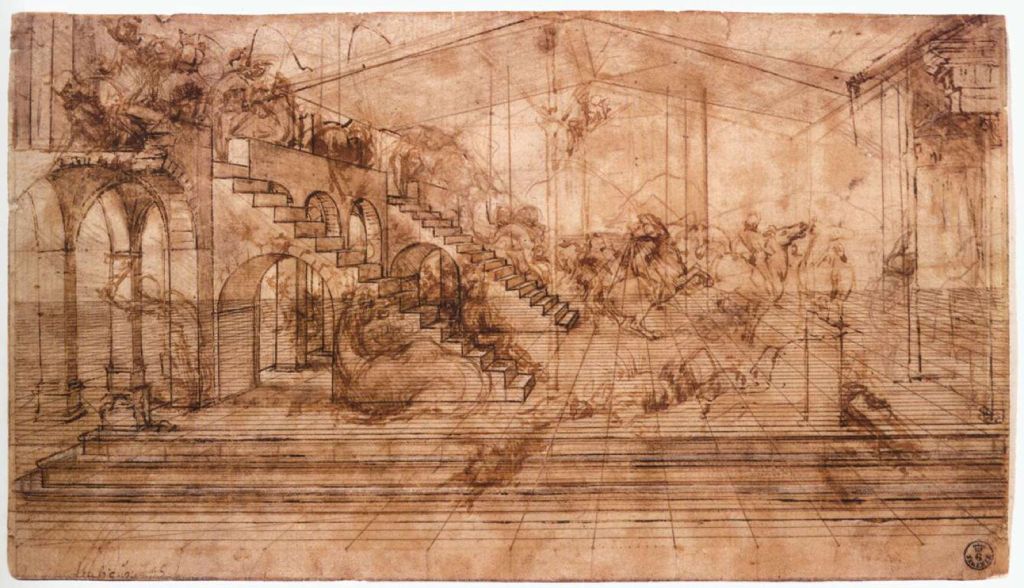
Little more that fifty years after Masaccio completed his demonstration, Leonardo da Vinci, who also wrote his own description of the technique, made this perspective study for his Adoration of the Magi, a painting he later abandoned unfinished.
Brunelleschi’s geometry and Masaccio’s techniques were passed on from master to master, across much of Europe.
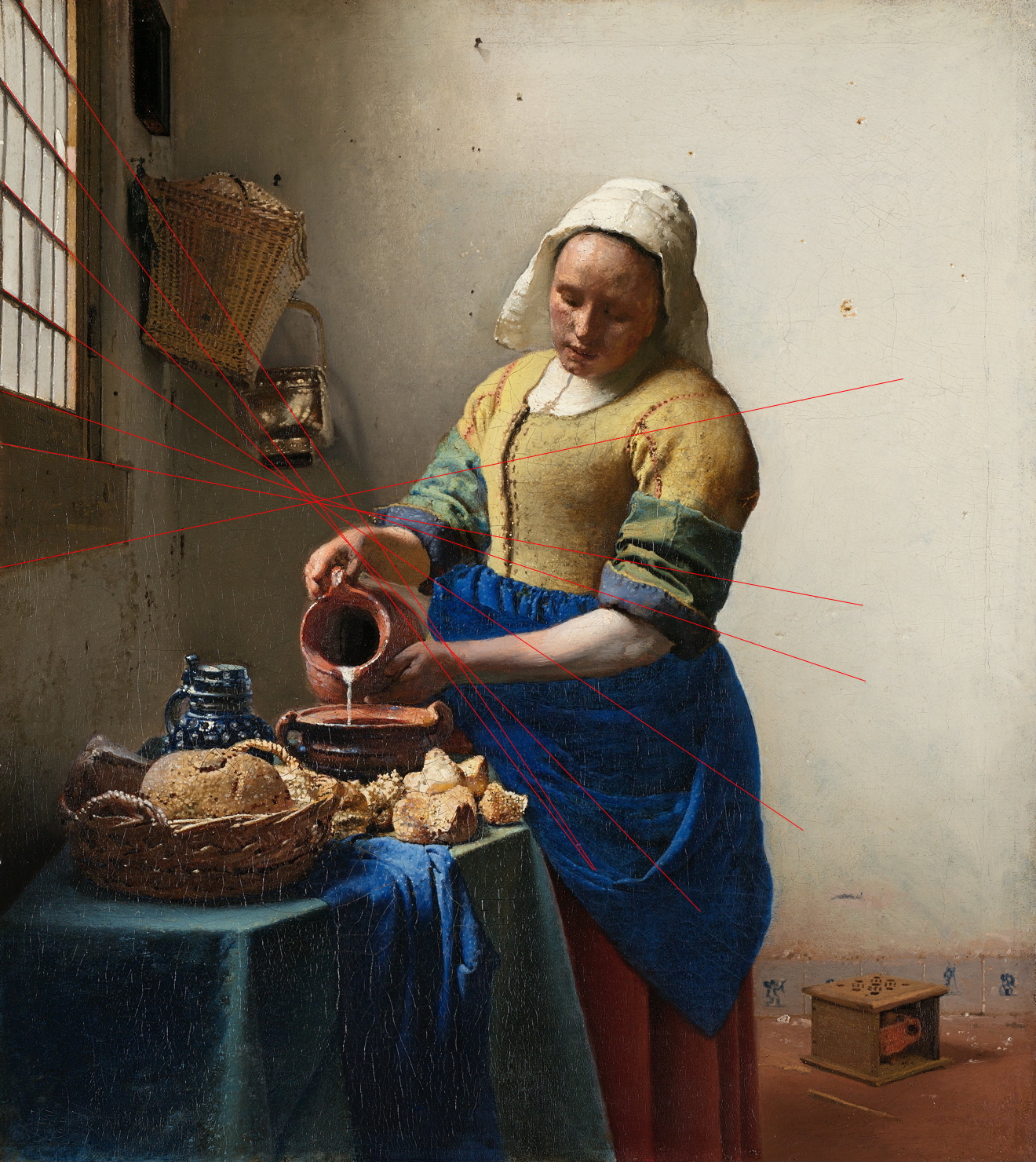
As Vermeer’s Milkmaid shows, vanishing points weren’t always as tight as they could have been. Examination of this painting has revealed that there was originally a large map covering most of the back wall, which was later painted over to leave the wall almost bare. At the foot of that wall, Vermeer had originally painted a basket of clothes, but this too he painted over later, leaving just the foot-warmer and Delft tiles. A small depression in the paint just above the woman’s right hand marks the vanishing point used for its linear perspective projection, following Masaccio’s example.
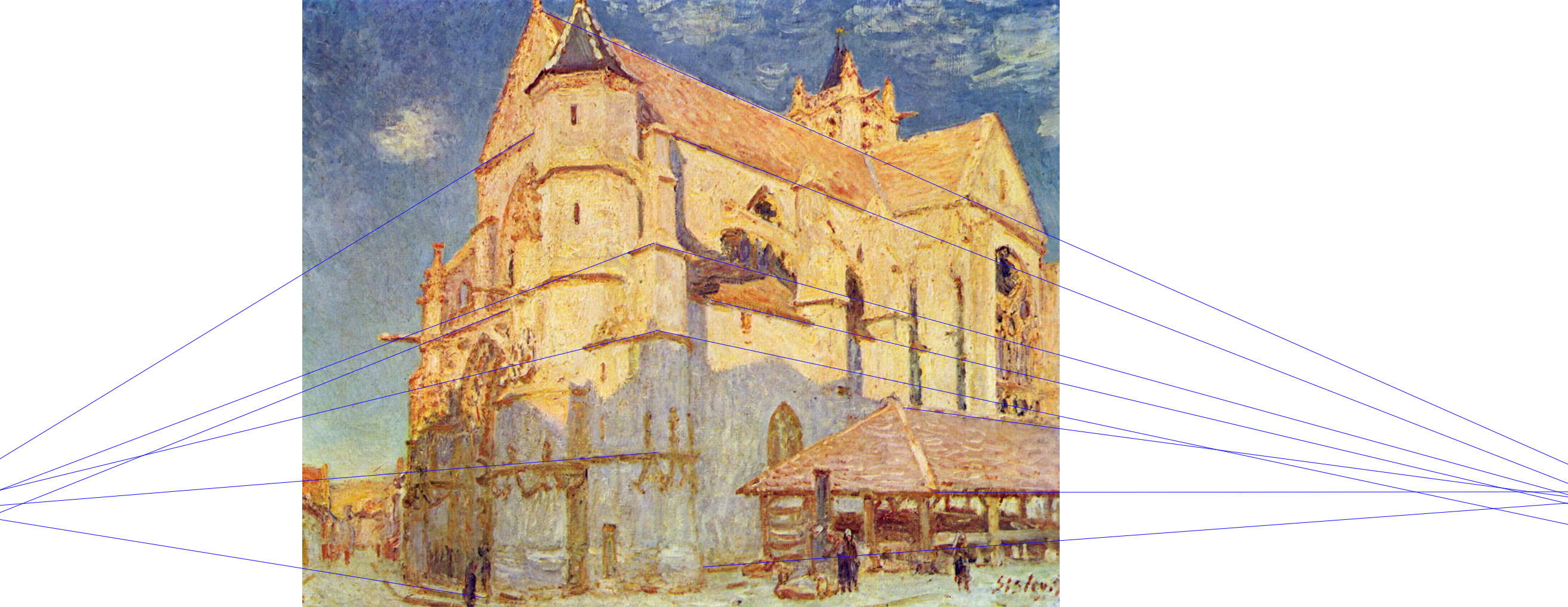
Here Alfred Sisley has used two-point perspective with vanishing points far away from his canvas.
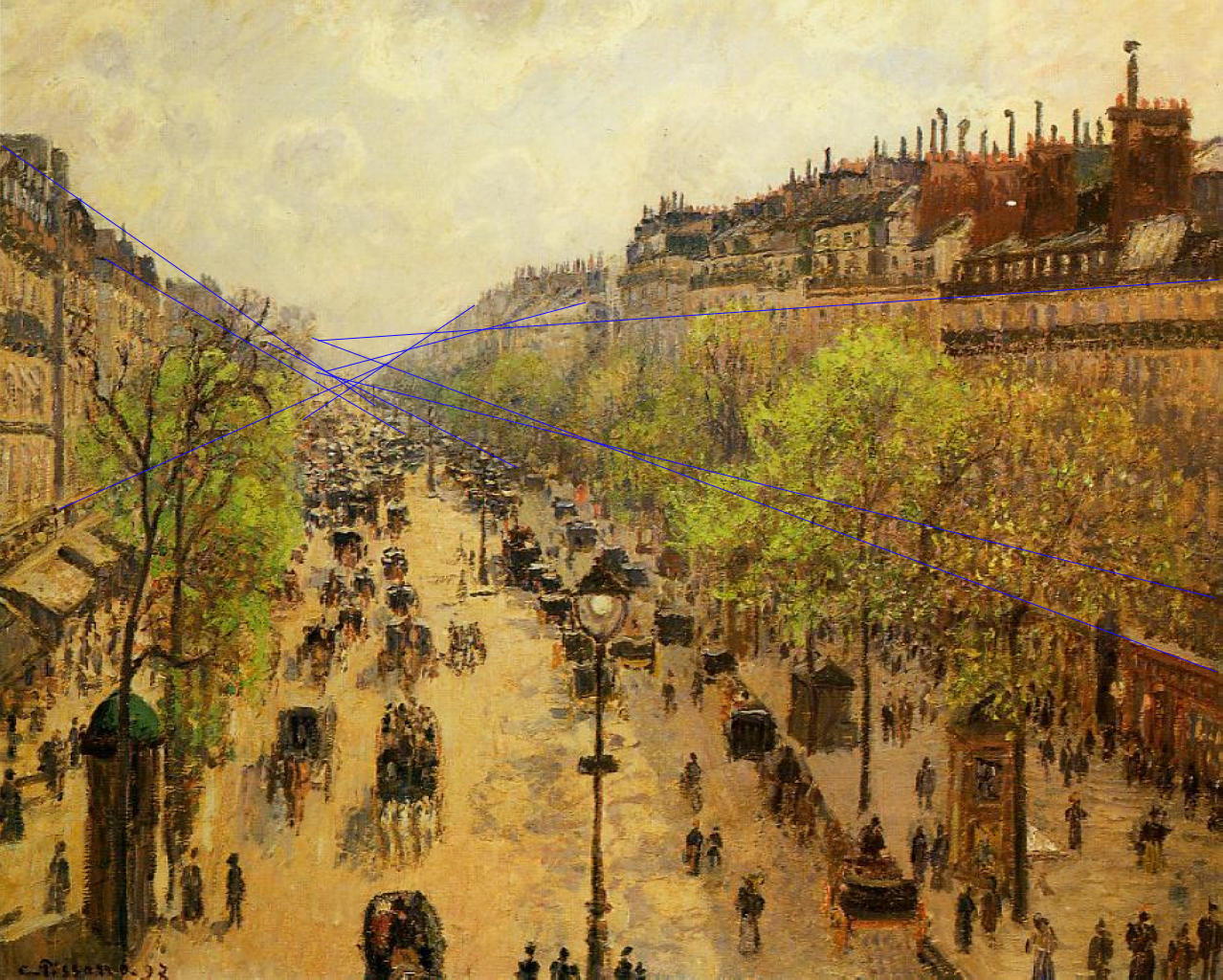
Some cityscapes by Pissarro and others, here his Boulevard Montmartre, Spring, had less well-defined vanishing points, but still preserved a sense of depth and looked right to those accustomed to such projections in paintings and photographs.
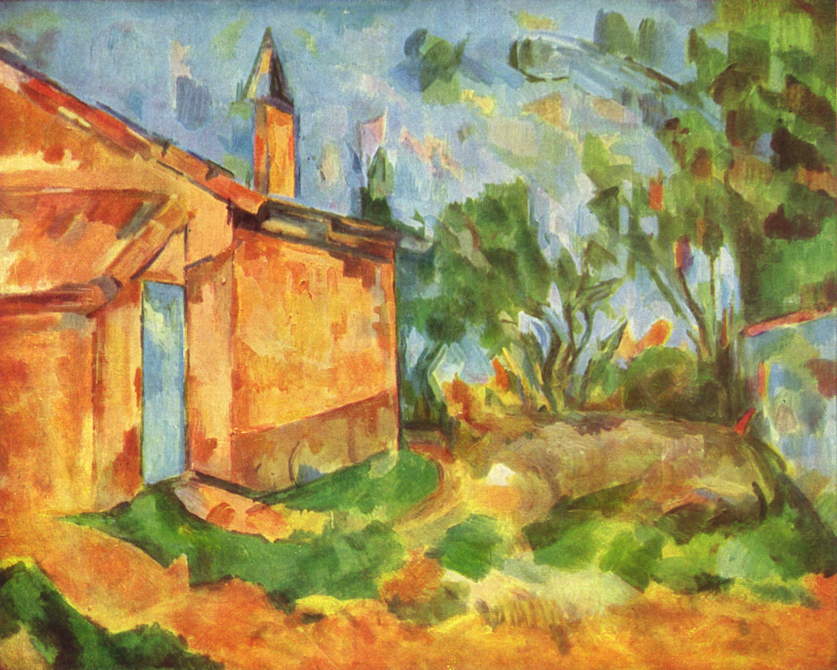
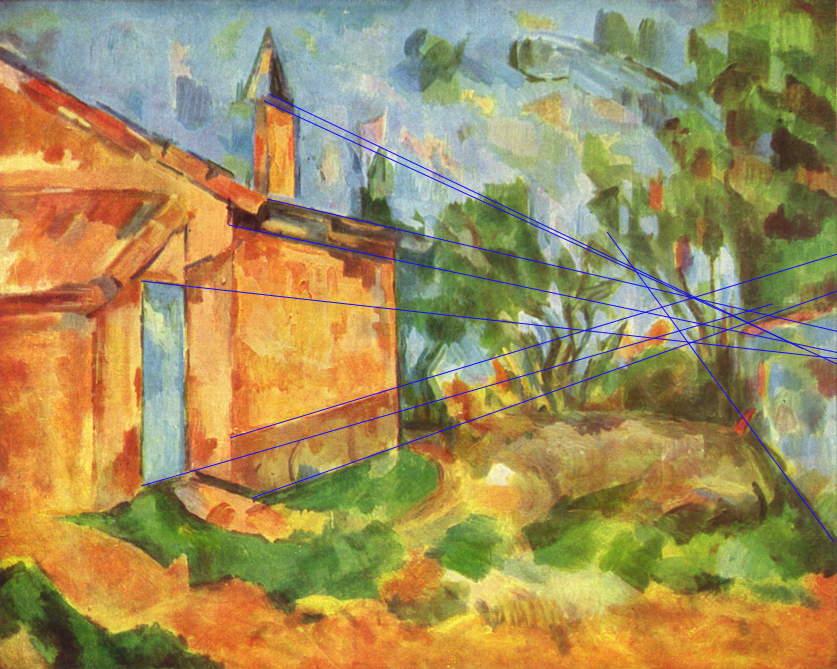
Even the high priest of nineteenth century anti-perspective, Paul Cézanne, seems to have brought his construction lines together on occasion, as shown in this plein air oil sketch of Jourdan’s Cabin completed in the last months of his life.
Linear perspective projection and its geometric methods also enabled painters to change the projection in the same way that lenses do for cameras, the subject of the next article.
Further reading
Bruce MacEvoy’s Handprint site gives what is probably the most thorough and detailed account of linear perspective for painting.
Andersen K (2007) The Geometry of an Art. The History of the Mathematical Theory of Perspective from Alberti to Monge, Springer. ISBN 978 0 387 25961 1.
Brener ME (2004) Vanishing Points. Three Dimensional Perspective in Art and History, MacFarland. ISBN 978 0 7864 1854 1.
Dunning WF (1991) Changing Images of Pictorial Space. A History of Spatial Illusion in Western Painting, Syracuse UP. ISBN 978 0 8156 2508 7.
Gombrich EH (1976) The Heritage of Apelles. Studies in the Art of the Renaissance, Phaidon Press, Oxford. ISBN 0 7148 1708 2.
Panofsky E, tr Wood CS (1997) Perspective as Symbolic Form, Zone Books. ISBN 978 0 9422 9953 3.
Sinisgalli R (2011) Leon Battista Alberti On Painting, A New Translation and Critical Edition, Cambridge UP. ISBN 978 1 107 00062 9.

