
Trees are amazing survivors. Some species of conifers including the Jack pine have developed so their serotinous cones only unseal and open in the high temperatures of forest fires, ready to grow in the ashes. So long as a tree keeps in contact with at least some of its root system, when its trunk is blown flat new branches can rise vertically to extend its life. It’s easy to dismiss some deciduous trees as dead when barren in the winter, only to see them come into leaf the following Spring.
In the early nineteenth century, barren trees became associated with bleakness and the sinister.

This appeared in Caspar David Friedrich’s early success, The Abbey in the Oak Wood from 1808–10, giving a dark vision of death, gloom, and the depths of Gothic horror. This shows the ruins of a church amid gnarled and barren trees, silhouetted against a twilight sky.

In his Tree of Crows from about 1822, the birds are only doing what they normally do around dusk, but Friedrich’s wonderfully wizened trees and the eerie light play tricks with us, giving them a thoroughly sinister look.

Friedrich painted several variants of a Man and Woman Contemplating the Moon, including this in about 1827. A man and a woman, dressed in clothes from a century earlier, their right shoulders and backs towards the viewer, are looking at the moon. They’re at the edge of a clearing in a forest, an old and part-felled twisted tree to their right, filling much of the upper right of the painting. The tree is barren of leaves and appears dead.

JC Dahl developed this further. In 1829, he painted this Winter Landscape at Vordingborg, showing barren trees and snowy fields near the town of Vordingborg, in the south of the Danish island of Sjælland (Zealand). Plenty of sinister crows in the air and on the ground help build a sense of grim foreboding.

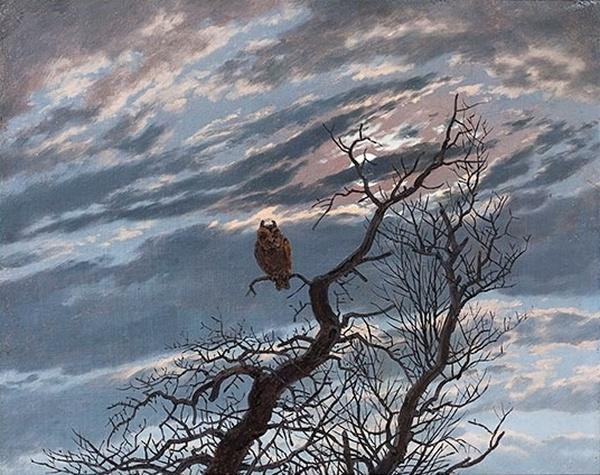
Friedrich occasionally included owls in his paintings for their association with night, as in his Owl on a Bare Tree (1834), although this night is hardly a time for peaceful slumber and pleasant dreams.

JC Dahl continued to paint barren trees, in his Danish Winter Landscape with Dolmen from 1838, again with crows and ancient stone tombs in the snow.

In 1853, towards the end of his career, Dahl revisited barren trees in this Oak Tree by the Elbe in Winter.
Barren trees in a typically wet English winter became a common theme in John Atkinson Grimshaw’s paintings later in the century.

Northern British cities like Leeds were among his favourite settings for nocturnes. At The Park Gate from 1878 (above) and November from 1879 (below) are glistening examples.


John Everett Millais’ view of Christmas Eve from 1887 is bleak. Bare trees, barren snow with just tracks, and those few crows foraging. The lights may be lit in the house behind those trees, but out here it feels pretty grim.

At the end of the nineteenth century Piet Mondrian was exploring the twisted forms of barren branches and twigs in this view of St. Jacob’s Church, Winterswijk from about 1898.
But there are some portraits of barren trees that bring the hope of Spring.
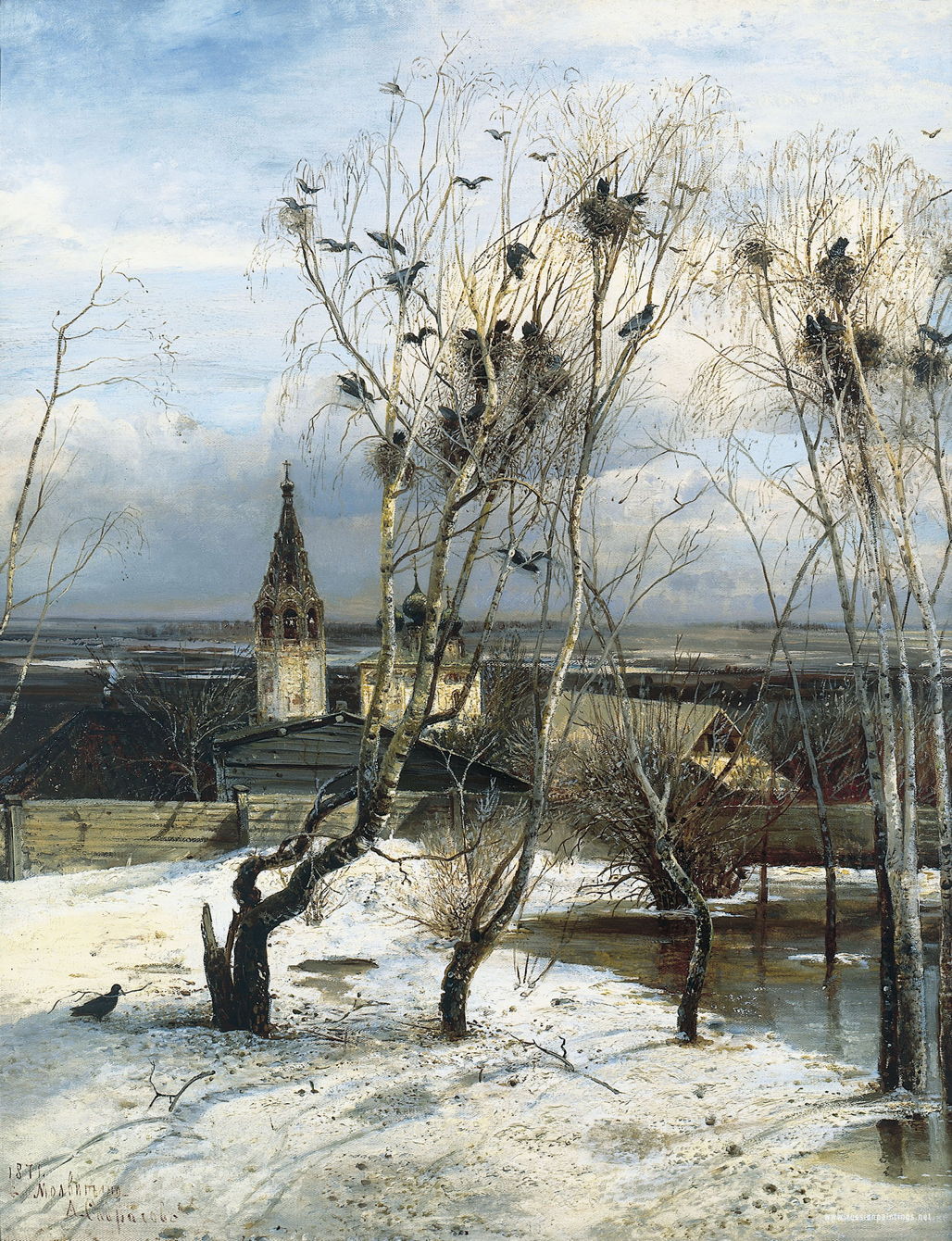
In Alexei Kondratievich Savrasov’s Rooks have Returned (1871), these birds are heralds of the Spring, returning to their nests before the winter’s snow has thawed fully, or the buds have appeared on these barren birches. Across most of Europe, rooks are resident throughout the year, but towards the northern edge of their range, they abandon the snowbound areas and overwinter where food remains more abundant, returning in the early Spring.

