
We like to take photos when we’re out with friends and family, to enable us to remember and relive those moments. Four centuries ago, group portraits were also among the most important visual records, for the select few who could afford them. By the late nineteenth century, as photography became more commonplace, group portraits enjoyed a revival, but had become so different they are weird by comparison. This weekend I trace their journey.

This remarkable family Portrait of Bianca degli Utili Maselli with six of her children, painted by Lavinia Fontana in 1604-5, shows this nobleman’s wife, five of her sons, and her daughter Verginia. For most of her children, this would have been their only clear memory of her, as she died a few months later after giving birth to her nineteenth child.
The emphasis changed in the Dutch Golden Age, when guilds and other professional groups commissioned social group portraits.

A decade later in 1617, Michiel van Mierevelt and his son Pieter, specialists in portraiture, painted The Anatomy Lesson of Dr. Willem van der Meer, one of the earliest portraits of a social group from the Dutch Golden Age. Members of this group are all ignoring the cadaver in front of them, preferring to look at the painter, and are thought to be members of the Surgeons’ Guild of the city of Delft, who commissioned this work.

Soon after his arrival in Amsterdam, Rembrandt was commissioned in 1632 to paint his Anatomy Lesson of Dr. Nicolaes Tulp. This group portrait of distinguished members of the Surgeons’ Guild shows them in their working environment. Most remarkable again is the fact that its principal, Dr Tulp, and most of his colleagues aren’t looking at the dissected forearm.
Among the organisations that commissioned the most paintings were local civic militia or schutterij, who also operated using the guild model, with local men appointed to military rank for their command. Their roles included helping defend their town or city in the event of attack or revolt, and manning a night watch, in which members took turns to patrol the streets.

Painted a decade later, Rembrandt’s vast group portrait of The Night Watch (1642) is perhaps the most famous of them all, although it’s more correctly titled Militia Company of District II under the Command of Captain Frans Banninck Cocq. It features the commander and seventeen members of his civic guard company in Amsterdam, and took the artist three years to complete from his first commission to paint this for display in the great hall of the guards.
Captain Frans Banninck Cocq (in black with a red sash), followed by his lieutenant Willem van Ruytenburch (in yellow with a white sash) are leading out this militia company, their colours borne by the ensign Jan Visscher Cornelissen. The small girl to the left of them is carrying a dead chicken as a symbol of arquebusiers, the type of weapon several are carrying.

Portraits of royal families have been regular commissions for their court painters. Diego Velázquez’ Las Meninas, translated as The Maids of Honour, from about 1656-57 is another well-known example of a group portrait. In what is overtly a depiction of eleven people and a dog in a room in the Alcázar Palace, he uses composition and gaze to tell us more. Much depends on what we believe most of the figures are looking at. Reflected in the rectangular plane mirror on the far wall are King Philip IV and his wife Queen Mariana of Austria.
There has been dispute over whether the reflection shows the royal couple stood where the viewer is, or the mirror is reflecting their painted images on Velázquez’s canvas. How their images were generated is probably of secondary importance, as either way the gaze of most of the other figures is clearly directed not at the viewer, but at the King and Queen, who may be getting up to leave after sitting for Velázquez to paint them. In this reading, the most important people not in the painting only appear in reflection and in the gaze of others.

In April 1800, Francisco Goya was commissioned by King Carlos IV to paint a family portrait, which proved to be the last of his royal commissions before the war with France, and his most important. It’s often said that Goya’s inspiration for his large canvas of Carlos IV of Spain and His Family (1800-01) was Las Meninas, but what he has painted is different in almost every respect, other than the fact that the artist has taken the opportunity to include a self-portrait of himself painting the painting, as it were. Goya captures a moment of optimism when Spain and France were allies, and portrays his royal figures in stark reality.

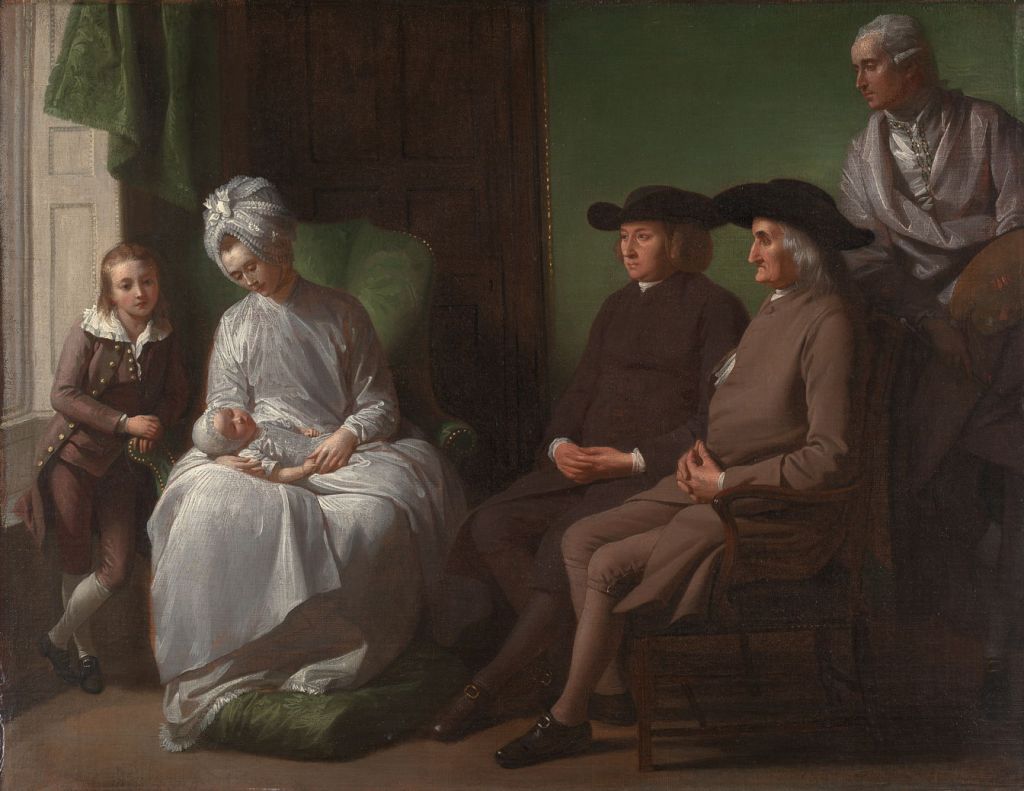
Some of these later family portraits became a little stranger. Benjamin West’s group portrait of The Artist and His Family from about 1772 casts a little light on his peculiar circumstances. It shows, from the left, the Wests’ older son, Benjamin West’s wife Betsy, cradling their newborn second son in her lap, Benjamin West’s brother Thomas, and father John (who had been born in England), and standing in his lavender gown, holding palette and maulstick, is the artist himself. Looking at the directions of gaze, and the extraordinary detachment of Thomas and John West as they stare into the distance, domestic happiness seems as distant as those stares.
By the middle of the nineteenth century, group portraits had taken an even odder turn.

Gustave Courbet’s Painter’s Studio from 1855 purported to be an allegory, and remains enigmatic today. Its figures include individuals who had influence over Courbet’s life and artistic career, including the artist’s first patron and key critics of the day, but on the left are a motley crew who could well be allegorical representations of the Emperor Napoleon III and his supporters.

Seven years later, Édouard Manet’s Music in the Tuileries (1862) drew many of the artist’s circle into its crowd, including the poet Baudelaire, novelist Gautier, composer Offenbach, the artist’s brother Eugène, and Henri Fantin-Latour, whose group portraits were going to be the weirdest of them all, as I’ll show tomorrow.

