
During the nineteenth century more landscape painters took on the challenge of depicting invisible air when it’s blowing in a howling gale, becoming more inventive as to what gets blown in the wind.

Although it depicts extreme conditions, Jean-François Millet’s Gust of Wind from 1871-73 must be the canonical painting of a storm. Its lone and distant figure is being blown almost double, as he’s nearly struck by the large branch torn from a tree to the left. Indeed, that tree is being uprooted, and its leaves pepper the storm sky at dawn.
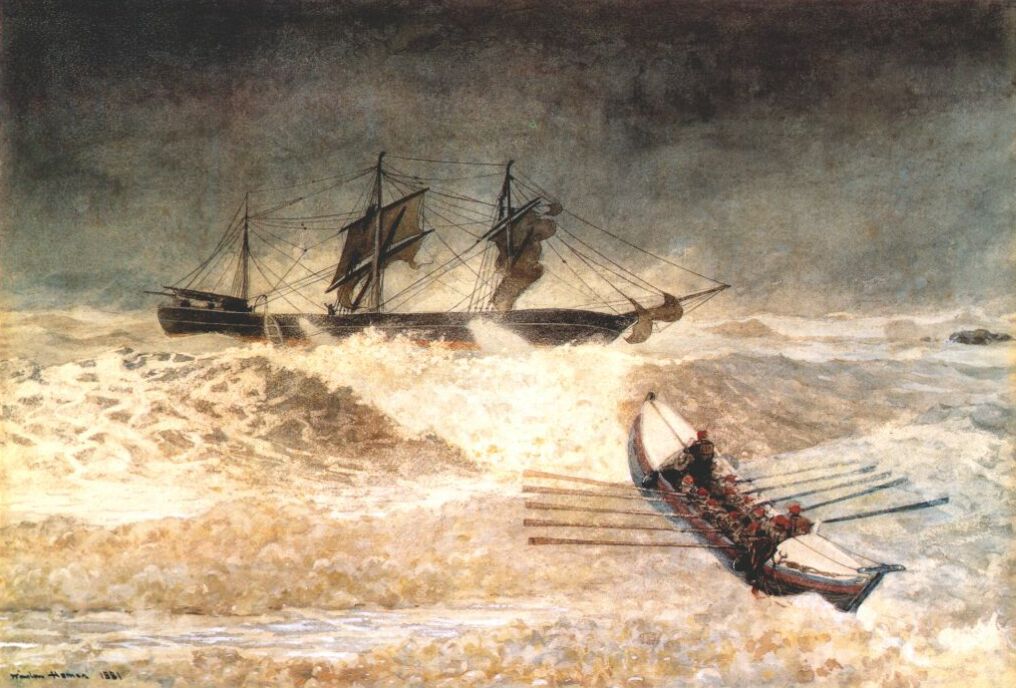
Winslow Homer’s Wreck of the Iron Crown from 1881 may have been painted in response to a real-life wreck Homer witnessed when he was living at Cullercoats, on the north-east coast of England. In the early morning of 21 October 1881, the thousand-ton barque, the Iron Crown, was driven aground in a storm. In the next hours, the ship’s crew were rescued, following which the derelict broke up. Homer later painted a watercolour showing the rescue, probably constructed from sketches, witness accounts, and photographs. The moment he shows is a second and final pass of the lifeboat, required to rescue the last member of the crew on board in the nick of time.

Antônio Parreiras’ wonderful Ventania (The Windstorm) (1888) is not as extreme, but just as eloquent, again using a leaning sky to accentuate the arcs formed by the trees.

With the Impressionist emphasis on transient effects of light rather than weather, their paintings tend to be more subtle again, as shown in Claude Monet’s Poplars (Wind Effect) from 1891.

Some of the most effective aids for the depiction of wind are flags and drying washing. While Sisley used the former, Gustave Caillebotte painted two views in which a washing line gives the strongest clue as to the wind. This is his Laundry Drying, Petit Gennevilliers (1892), the windier of the two.

For serious wind, though, you should walk on the coast of Scotland, here with William McTaggart’s A Westerly Gale, Machrahanish from 1897, showing the rough conditions in this bay on the west coast of Kintyre.

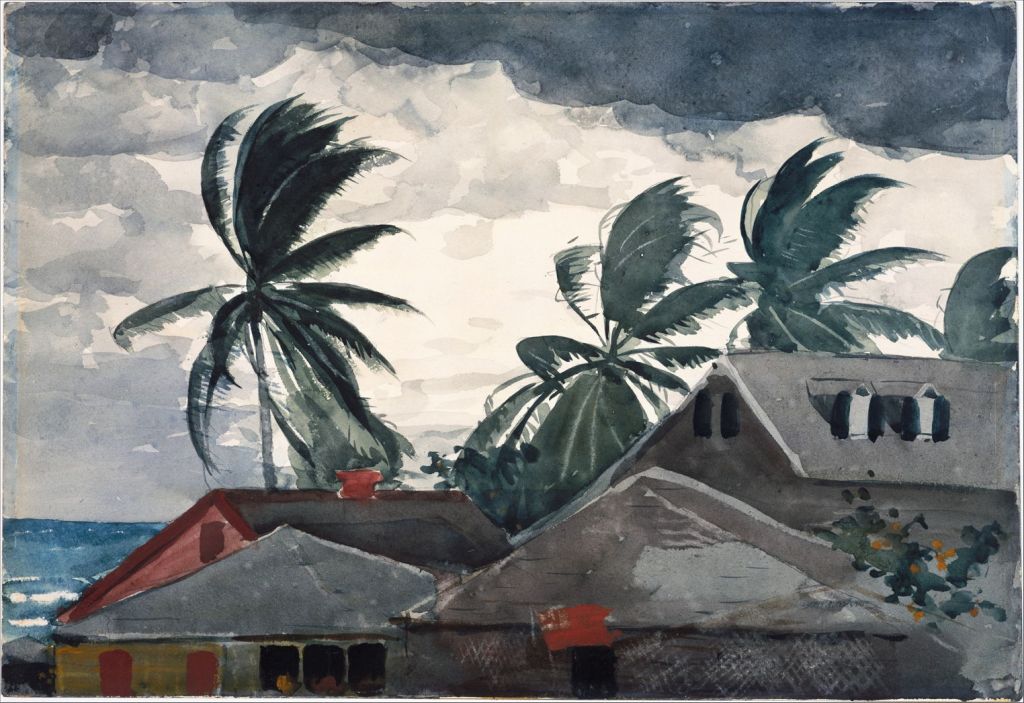
Following his time at Cullercoats in England painting fisherfolk there, Winslow Homer’s simple and effective watercolour of Hurricane, Bahamas (1898) should come as no surprise.

The Norwegian painter Christian Krohg (1852–1925) died just over a century ago. His unusual painting of The Umbrella from 1902 looks down on a lone woman walking up a rough earth track, strewn with rocks, in windy weather.

Granville Redmond’s early paintings of the coast of California are in Tonalist style, with muted colours. His Coastal Storm from 1905 contrasts the wind and heavy rain sweeping in from the right with the distant view of the coast in much fairer conditions. He appears to have used fine scratching in the diagonals of the falling rain.

Although not famous as a landscape painter, Franz von Stuck’s Storm Landscape (c 1920) leaves the viewer in no doubt.

