
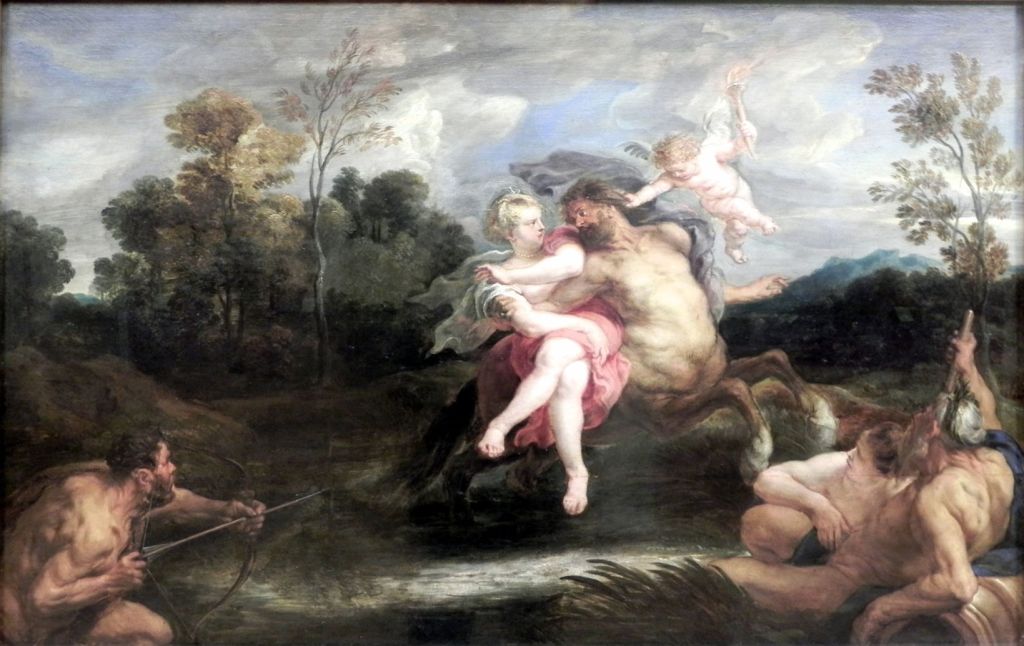
Having won her hand by defeating Achelous at wrestling, Heracles married the beautiful Deianira, and was returning with her to his native city when the couple reached the River Euenus, still in spate from the winter’s rains. Heracles feared for his bride trying to cross the river, but the centaur Nessus came up and offered to carry her across.
Heracles had thrown his club and bow to the other bank and had swum across the river when he heard Deianira’s voice calling. He suspected Nessus was trying to abduct her, so shouted warning to him before loosing an arrow at the centaur’s back.
Ovid’s description of these events in his Metamorphoses poses a problem for their painting, in choosing the right point of view and composition to remain faithful to that account.
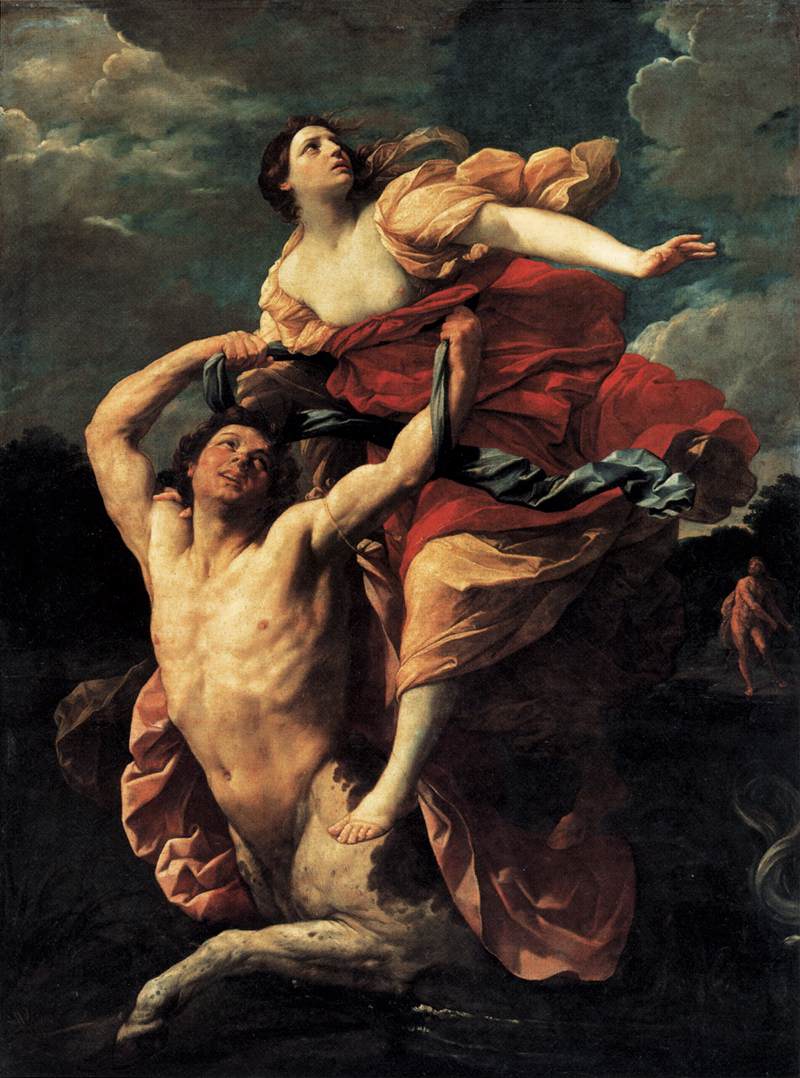
Guido Reni’s masterly painting from around 1620 almost fills the canvas with Nessus, who looks worryingly heroic, and Deianira, who seems to be flying. The small and distant figure of Heracles is well-lit, but loses the crucial details of his bow and arrow, which look unlikely to be able to strike Nessus in the chest.

Paolo Veronese’s painting from about 1586 also picks this early moment, as Heracles is readying his bow and arrow, with Nessus just reaching the opposite bank. He shows the scene from Heracles’ position, but demonstrates the problems with that point of view. Nessus and Deianira are now small, and the centaur is looking away with his chest concealed, and even Heracles’ face is turned from the viewer. The unfortunate result makes its hero look more like a furtive stalker.

This marvellous painting was probably made by Rubens’ workshop around the time of the Master’s death in 1640. It views the events from the bank on which Heracles is poised to shoot his arrow into Nessus. This has the centaur running across the width of the canvas, his face and body well exposed for Heracles’ arrow to enter his chest. To make clear Nessus’ intentions, a winged Cupid has been added, and Deianira’s facial expression is clear in intent. An additional couple in the right foreground are the river-god and water nymph providing compositional balance.
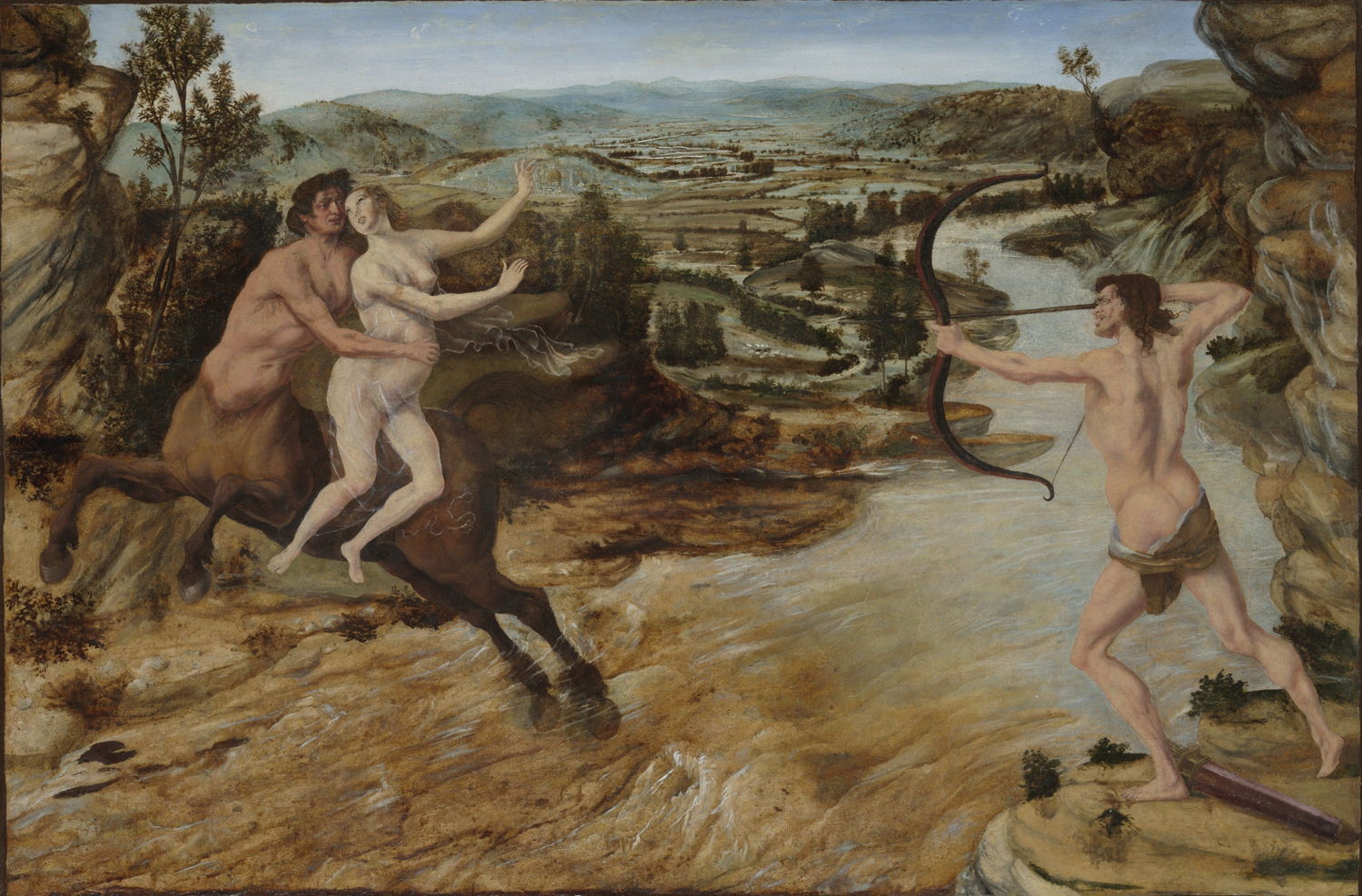
Antonio del Pollaiolo’s painting from about 1475–80 tries a side-on view, requiring Nessus to be shot while still in the river, in a slight adjustment to Ovid’s account. Deianira appears precariously balanced, and must be grateful that Nessus’ muscular arms save her from being dropped into the river below. The artist also leaves it to the viewer to know that Heracles’ poisoned arrow strikes Nessus rather than Deianira.
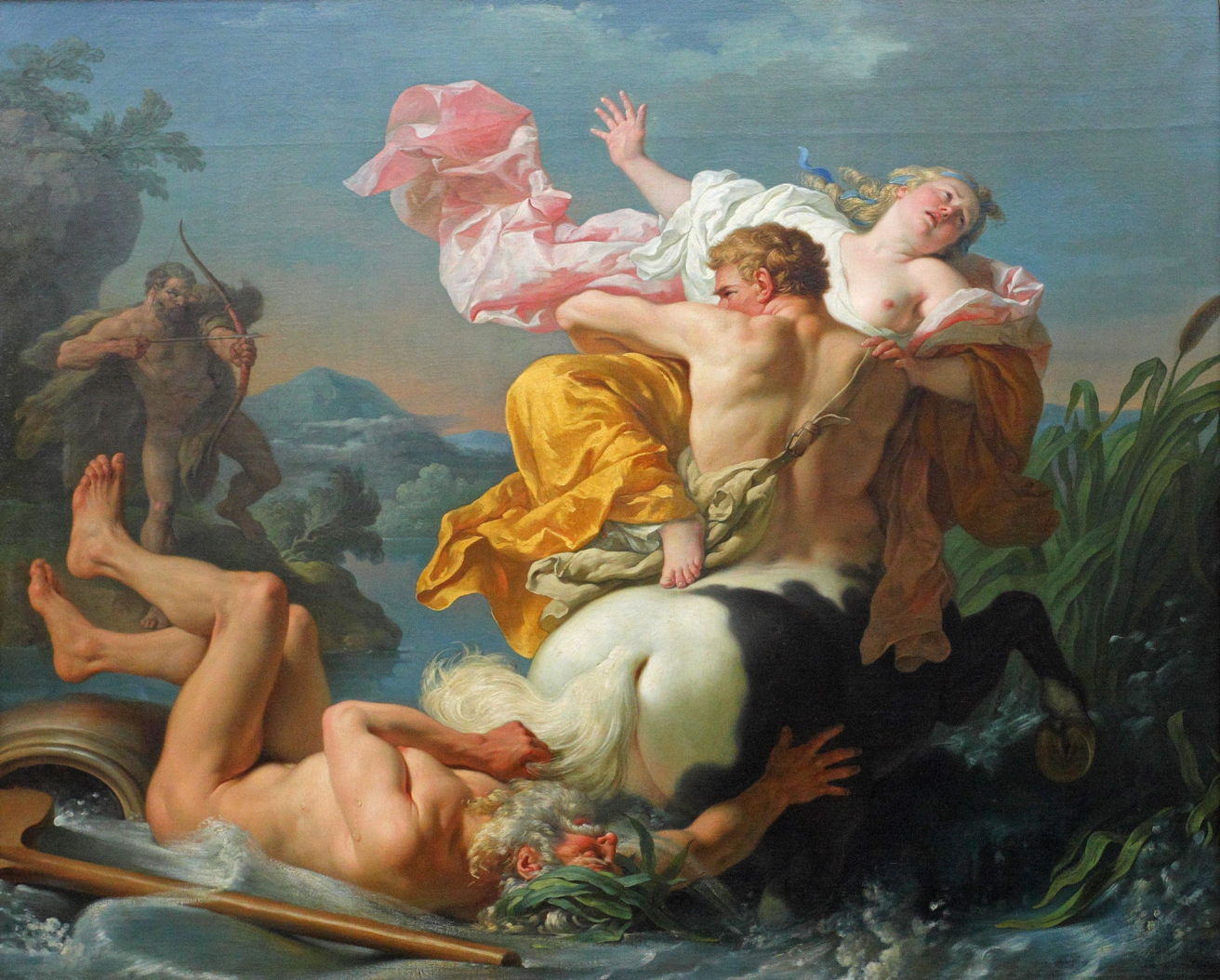
Nearly three centuries later, Louis-Jean-François Lagrenée clearly understood the compositional problem, but didn’t arrive at such a good solution. Nessus, bearing a distressed Deianira in his arms, has just reached the opposite bank, in the foreground. Heracles is on the left in the distance, and we can at least see his face, bow and arrow. There appears to be no way that Heracles’ arrow could impale Nessus’ chest, without first passing through some of the abundant Deianira, nor his back. Lagrenée also adds a river-god, who seems to have been knocked over in Nessus’ haste to make off with his captive.

Gustave Moreau’s final drawing of about 1860, squared up and ready to transfer to canvas for painting, alters the story to make its composition feasible. He puts Nessus in the foreground, with the attendant risk of making him appear the hero, somehow supporting the raised body of Deianira. In the right distance, Heracles has already loosed the fatal arrow, which is prominently embedded not in the front of Nessus’ chest, but in his back. The centaur’s legs have collapsed under him, and his head and neck are stretched up in the agony of death.
Gustave Moreau and Jules Élie Delaunay seem to have worked on a compositional solution together, resulting in Delaunay’s brilliant painting of 1870, which is sadly not available for use here.
That single arrow ran Nessus through. He tore it out, and his blood spurted freely, mixing with poison from the Lernaean hydra that Heracles had put on the arrow’s tip. Determined to avenge his own death, the centaur gave Deianira his tunic soaked with that poison, telling her to keep it to “strengthen waning love.”

In about 1706, Sebastiano Ricci embroidered this story further, showing Heracles, his left hand grasping Nessus’ mouth, about to club the centaur to death, while a slightly bedraggled Deianira watches in the background. There’s no arrow in Nessus’ chest, and Heracles’ quiver is puzzlingly trapped under Nessus’ right foreleg. Three other figures with uncertain roles are at the right, and a winged putto hovers overhead, covering its eyes with its right hand.

In Arnold Böcklin’s puzzling painting from 1898, Nessus is far from part-human, and Deianira isn’t the beauty she was claimed to be. As those two wrestle grimly, Heracles has stolen up behind them, and is busy pushing a spear into Nessus’ bulging belly. Blood pours from the wound, but Deianira is in no position to collect it.
Years passed after Nessus’ death, and Heracles was away in Oechalia, intending to pay his respects to Zeus at Cenaeum. Word reached Deianira that her husband had fallen in love there with Iole. Initially, she was upset, but then tried to devise a strategy to address his rumoured unfaithfulness. It was then that she recalled the blood of Nessus, and his dying words to her. She therefore impregnated a shirt with that blood, and gave that to Lichas, Heracles’ servant, to take to her husband.

This is shown in this beautiful miniature accompanying Octavien de Saint-Gelais’ translation of Ovid’s Heroides from about 1510.
Heracles donned the shirt as he was about to pray to Zeus. He felt warmth spreading throughout his limbs, quickly growing into intense pain. Trying to rip the shirt off, he obtained no relief, and only tore his burnt skin from the burning flesh underneath. Heracles roamed through Oeta like a wounded beast, still trying to rip the shirt from his body. He came across Lichas, and accused him of being his murderer. His servant tried to protest his innocence, but Heracles picked him up, swung him around, and flung him out to sea, where he was transformed into a rock pinnacle.
Heracles then cut down trees to build himself a funeral pyre. Ordering this to be lit, he climbed on top, and lay back on his lion-skin.

Francisco de Zurbarán’s powerful Death of Hercules (1634) uses chiaroscuro as stark as Caravaggio’s to show a Christian martyrdom, with its victim staring up to heaven, commending his soul to God.
Zeus came to the aid of the dying hero, calling on the gods to consent to Heracles being transformed into a god; they agreed, and his immortal form was carried away on a chariot drawn by four horses, into the stars above.

Tiepolo’s wonderful Apotheosis of Hercules (c 1765) portrays this as a saintly ascension, which seems thoroughly inappropriate.

