
The French Impressionist who was most influenced by Camille Corot’s paintings of trees was Camille Pissarro (1830-1903), who had been born and brought up on the Caribbean island of Saint Thomas, in a mixed Portuguese Jewish and Creole family, of Danish nationality. When at boarding school in France he showed himself to be an able artist, and at the age of 21 he travelled with friend and painter Fritz Melbye to Venezuela, where he worked as an artist for two years.
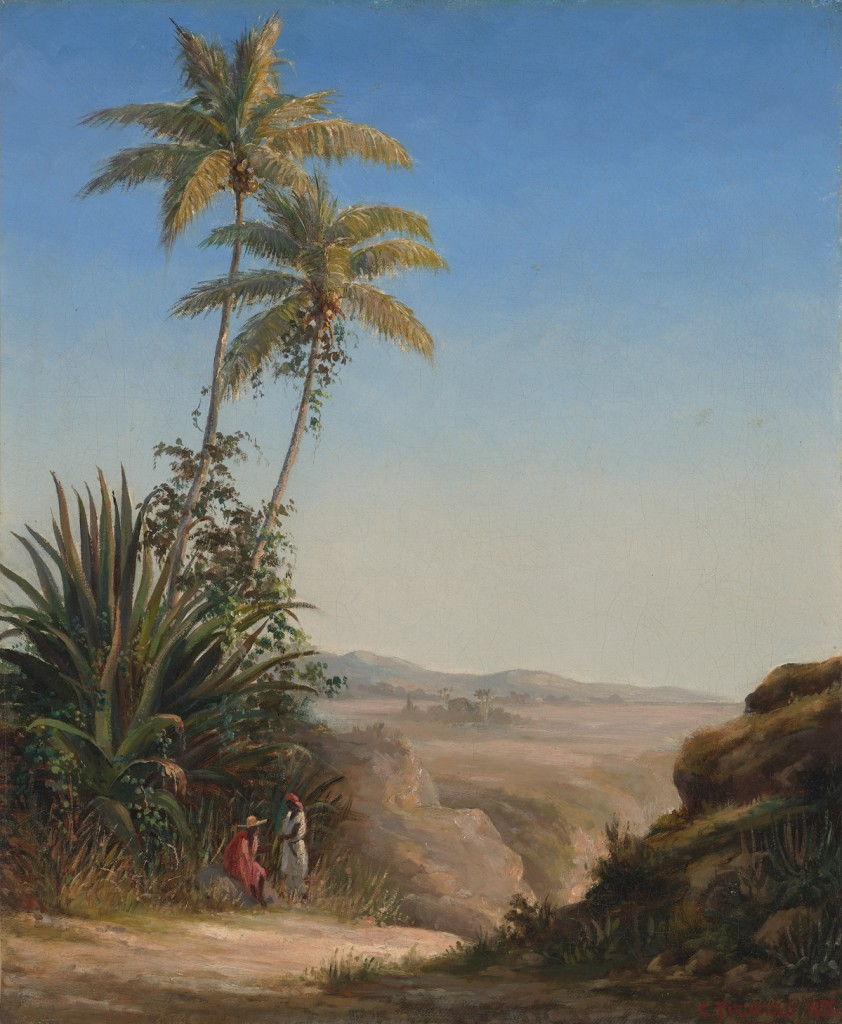
As early as 1854 the young Pissarro painted a tropical forest, and trees appear increasingly frequently in his early landscapes, including this of Two Figures Chatting by a Roadside from 1856. From the outset, his approach was thoroughly anatomical, and only in the briefest of sketches did he ever bulk in their canopies as a solid mass.
In 1856 he moved to Paris, where he tried classes at the École des Beaux-Arts and the Académie Suisse, but settled with instruction from Corot.

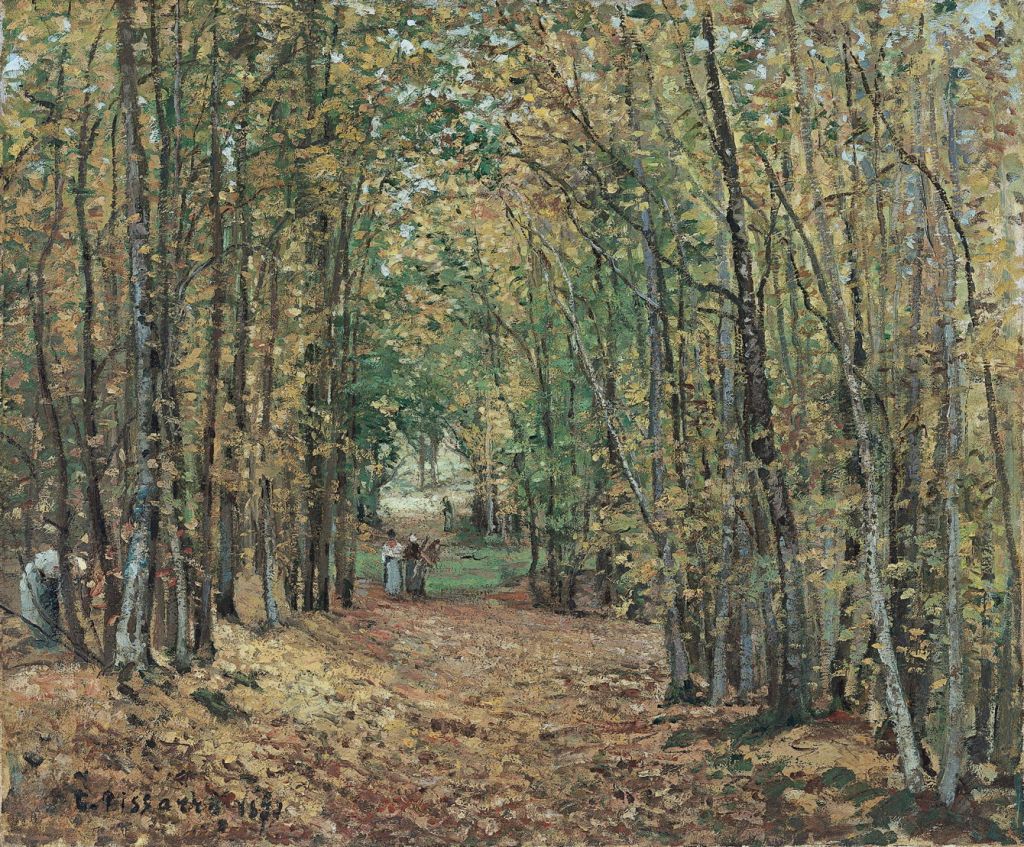
He soon became an almost compulsive painter of trees. At first, when painting them around Paris in 1856, they were depicted sketchily, but as his Barbizon-like style developed the following year, he devoted more time to their details, as seen in this Forest Path from about 1859. By 1862 he was painting his first road motifs featuring rows of tall poplars.
He met Claude Monet and others who were, with him, to form the French Impressionists, and in 1863 was among those whose work was included in the Salon des Refusés.
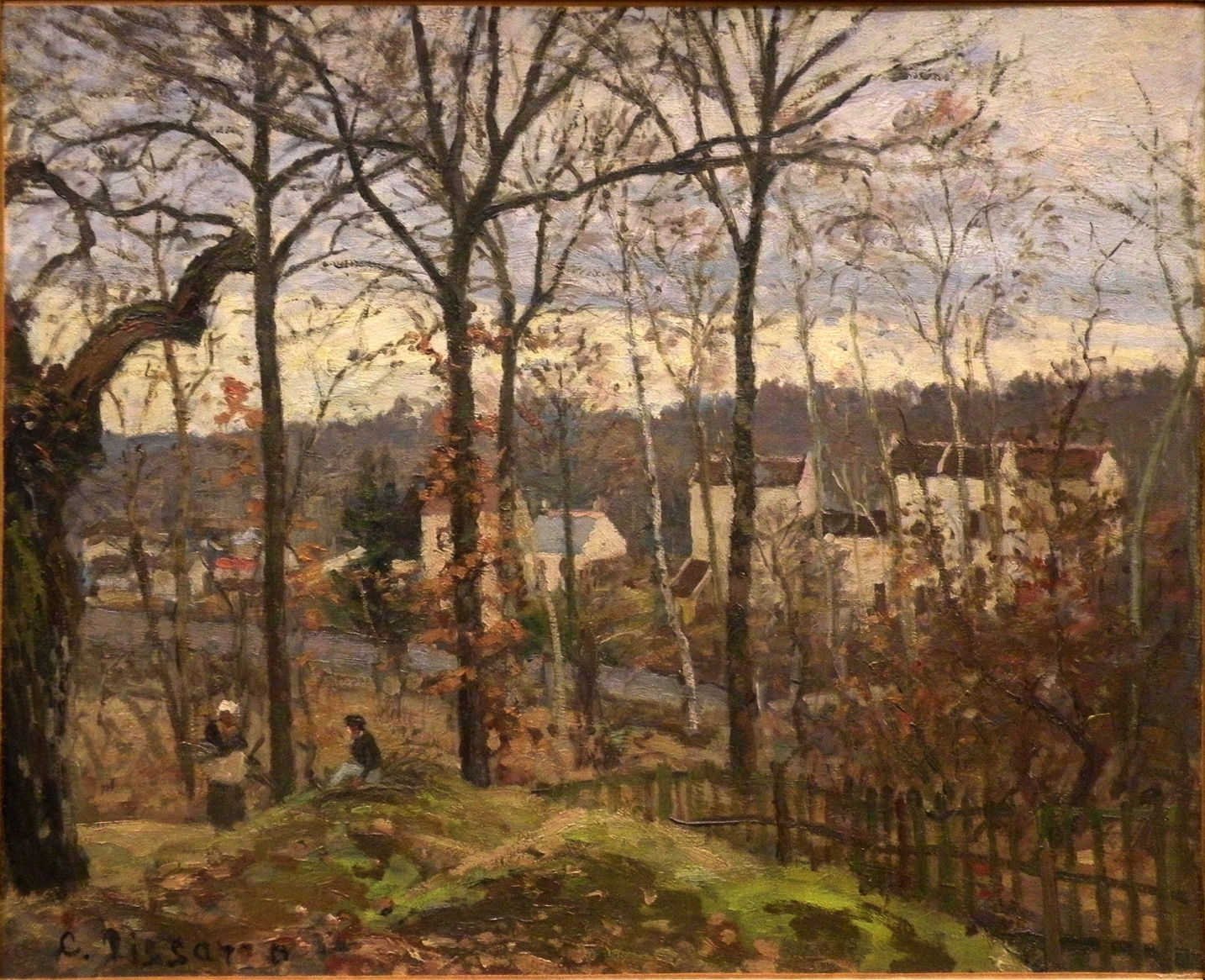
Where other artists might have put trees at each side to frame a view in repoussoir, Pissarro’s trees often formed the foreground, as in his Winter Landscape at Louveciennes from about 1869.

That same year, his winter paintings concentrated on road scenes, with attendant trees, around Louveciennes, a theme he continued for many years, spanning the seasons. The following year his rushed and more sketchy trees resolved into finer and more subtle representations, as he started to use brighter colours too, as in Route de Versailles, Louveciennes, Winter Sun and Snow (c 1870).
At the outbreak of the Franco-Prussian War in 1870, he fled with his family to Norwood, then an outer suburb of London. He met Paul Durand-Ruel, who became his dealer, and Monet again, who had also fled to London.

This View of Alleyn Park, West Dulwich from about 1871, parts the trees more conventionally to allow the distance to be uninterrupted.

Avenue in the Parc de Marly (c 1871) is a finely detailed classical composition showing this forest near Versailles, to the west of Paris.
In 1873 he was the central figure in the establishment of the French Impressionists, and was seen as their father figure. He was also a prime mover in the First Impressionist Exhibition of 1874.

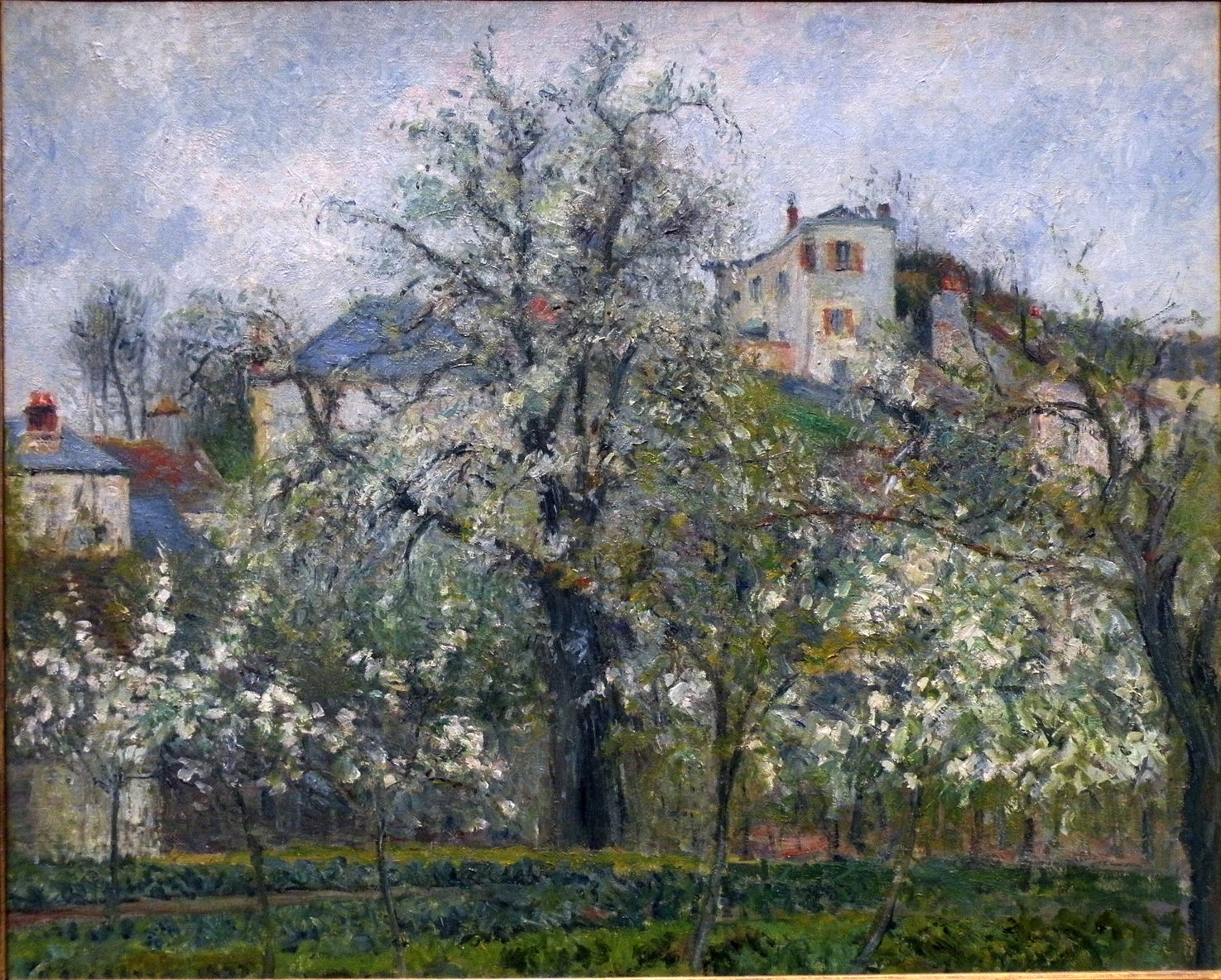
Chestnut Trees at Osny (c 1873) refers back to his View of Alleyn Park, West Dulwich. This steady torrent of landscapes with trees eased in 1874, when he painted several fine portraits and concentrated more on rustic genre scenes. But by 1877 the trees were back in full spate, with a couple of remarkable paintings featuring pear trees in flower, almost occluding the motif behind, in The Jardin de Maubuisson, Pontoise, Spring below.
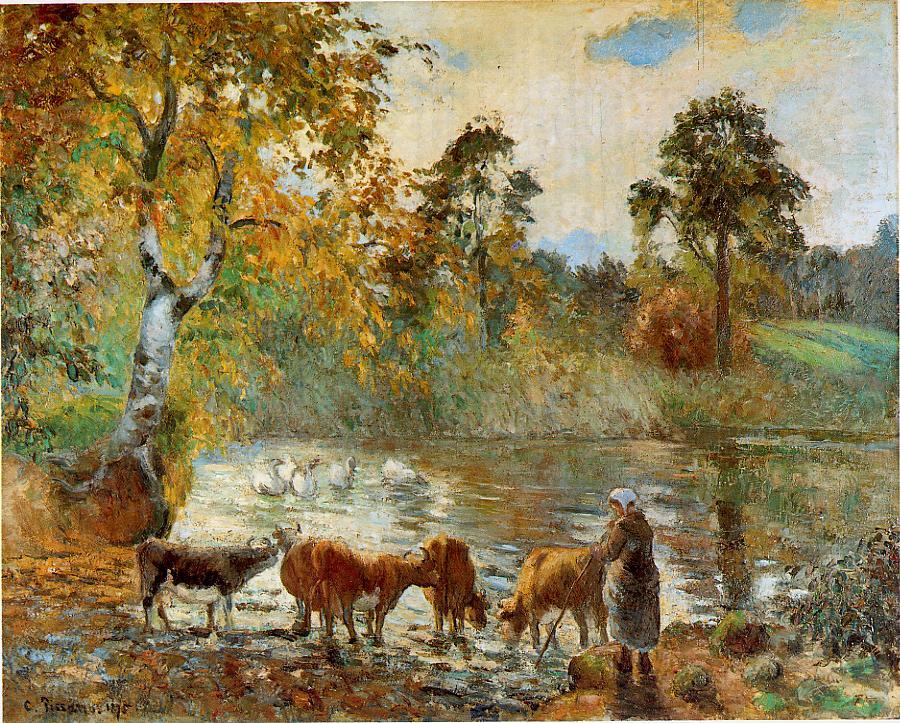
Cows Watering in The Pond at Montfoucault (1875) is one of a pair of paintings, this one painted en plein air, the other a studio version. Its subject and composition are typical of some of Corot’s earlier paintings, as a pastoral landscape rich in trees.
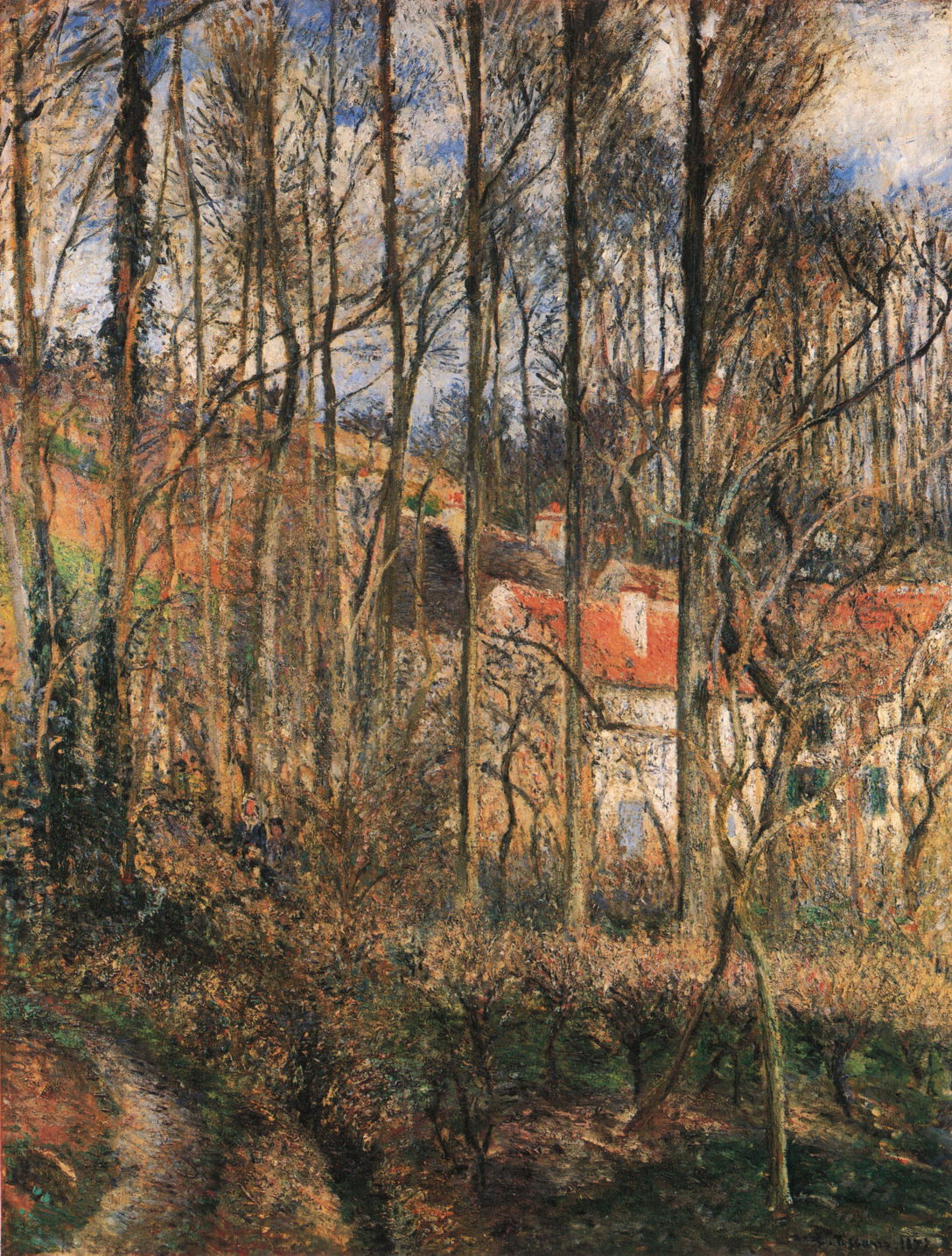
Around 1877 he hid Côte des Bœufs, Pontoise behind a dense row of trees. During the 1880s his paintings became increasingly Divisionist in form, paralleling Seurat’s development of first chromoluminarism then Neo-Impressionism. From about 1883, this was accompanied by a marked increase in both brightness and chroma in his work.
Once Pissarro settled at Éragny in 1884, his depictions of trees settled into a more consistent and mature style, with trunk, branches, and canopy finely constructed in bright, rich colour. He kept to this even when painting quite dense canopies, producing some of the most textured and leafy foliage of the day.
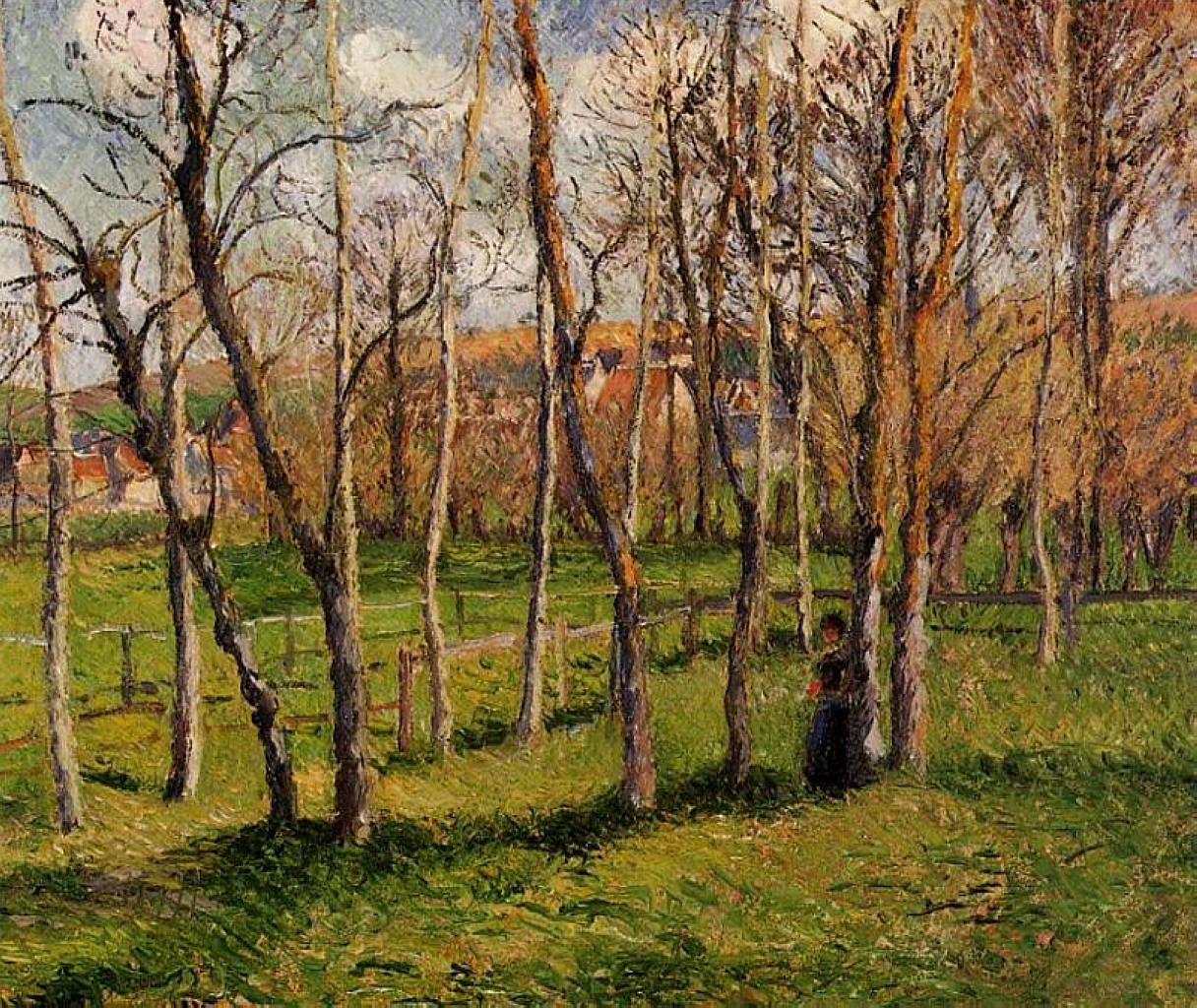
In the late 1880s Pissarro’s fine detail became increasingly Pointillist, as he painted many hundreds of landscapes in and around Éragny, showing every subtlety of season, time of day, and light, such as this Meadow at Bazincourt (1885).

Landscape at Saint-Charles, Sunset from 1891 marks the high point of his Pointillism.

Following that, his style moved in the opposite direction, and trees (as with the rest of the painting) are built from coarser strokes. Once he returned to his beloved Éragny he resumed ferociously painting landscapes with trees, as in Autumn, Poplars, Éragny, above, and The Big Walnut Tree in Spring, Éragny, below, both from 1894.

During the last few years of his career, Pissarro experienced problems with his eyes that prevented him from painting in the cold outdoors. On the advice of Monet he undertook campaigns of series paintings, made from carefully chosen hotel rooms or apartments, and largely forsaking portraits of trees.
References
Brettell RR (1990) Pissarro and Pontoise, Yale UP and Guild. ISBN 978 0 300 04336 5.
Pissarro J (1993) Pissarro, Pavilion Books and Harry N Abrams. ISBN 1 85793 124 6.
Pissarro J and Snollaerts CD-R (2005) Pissarro. Critical Catalogue of Paintings, 3 vols, Wildenstein Institute and Skira. ISBN 88 7624 525 1.
Rothkopf K ed (2006) Pissarro. Creating the Impressionist Landscape, Philip Wilson, London. ISBN 0 85667 630 6.
 The Eclectic Light Company