
The apple tree grew wild in ancient times, and appears to have been domesticated first in central Asia, to form the species Malus domestica with in excess of 7,500 varieties worldwide. The last few thousand years have seen the development of sophisticated methods of cultivation to increase the fruit crop and make it easier to harvest.
Several features of wild apple species posed problems for their cultivation. Among those are a tree’s requirement for pollination from a different tree, leading to the domestication of bees for the purpose, and the failure of apples to breed ‘true’ by resembling their parents. Because of that, apple trees for fruit production are seldom grown from seed.
Instead they are the result of grafting cuttings made from other trees on a rootstock growing in the ground. This enables the grower to control many properties of the resulting tree, such as its size, by selecting a particular rootstock, and the qualities of its fruit from the cutting used. These practices were well developed by about 300 BCE, when Alexander the Great sent dwarf apple trees from Persia and Asia Minor back to Athens.
Although now more strongly associated with the flowering of cherry trees, apple trees share blossom time in the Spring, typically through the month of May in England, for instance.
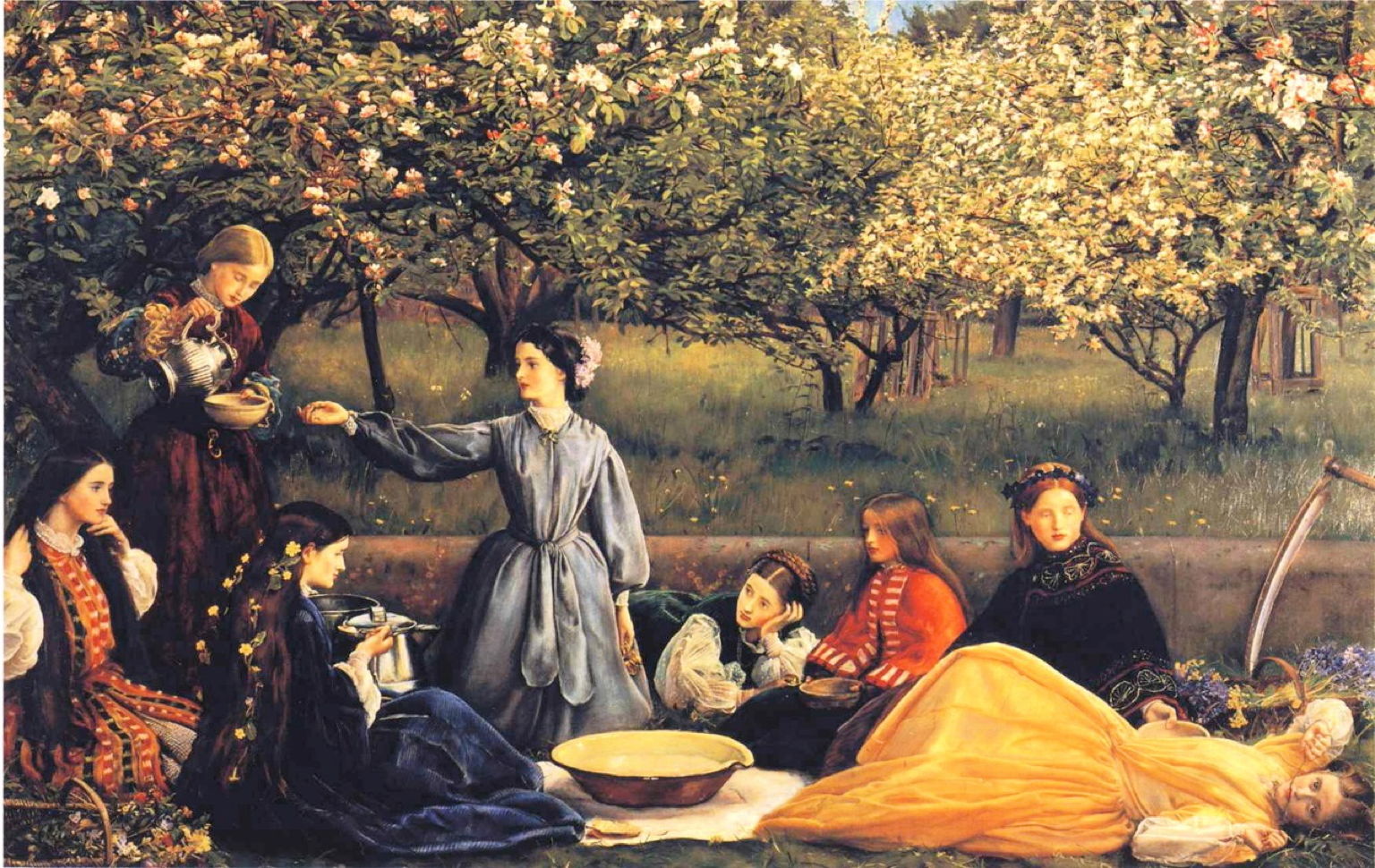
When John Everett Millais came to paint Flora and her Spring, in 1856-59, he added subtle allusions to Botticelli’s famous Primavera and classical myth. The blossom here is on apple trees, which are probably second only to May or Hawthorn in the English countryside at this time of year. These trees have been grown on miniature rootstocks making them little more than low shrubs, as was popular at the time.
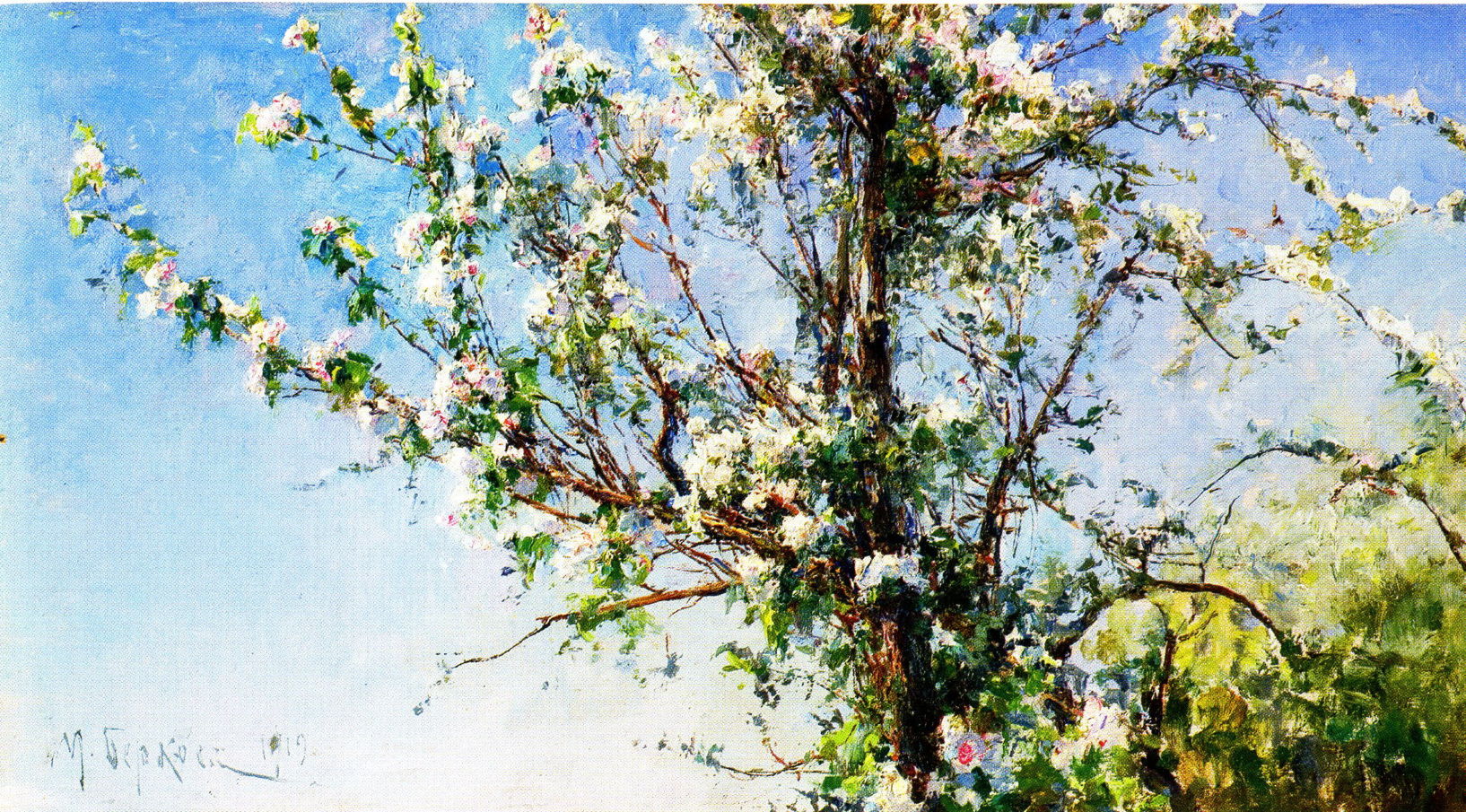
Ukrainian artist Mykhaylo Berkos painted this classic Impressionist motif of an Apple Tree in Blossom in 1919.
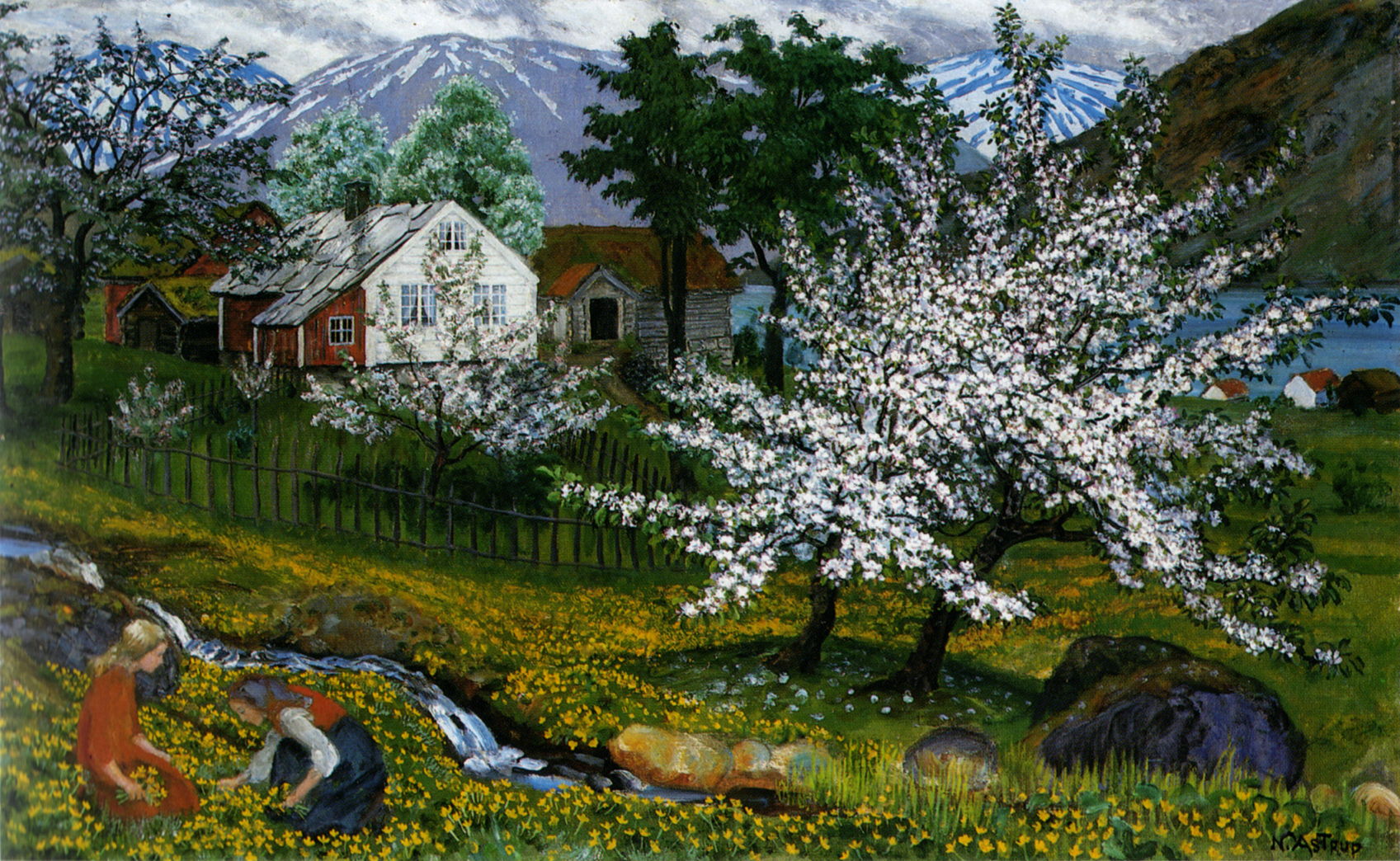
In the far north of Europe, Nikolai Astrup includes blossom in many of his paintings of Spring and early summer in the Norwegian fjords, as in his Apple Trees in Bloom, painted after 1920.
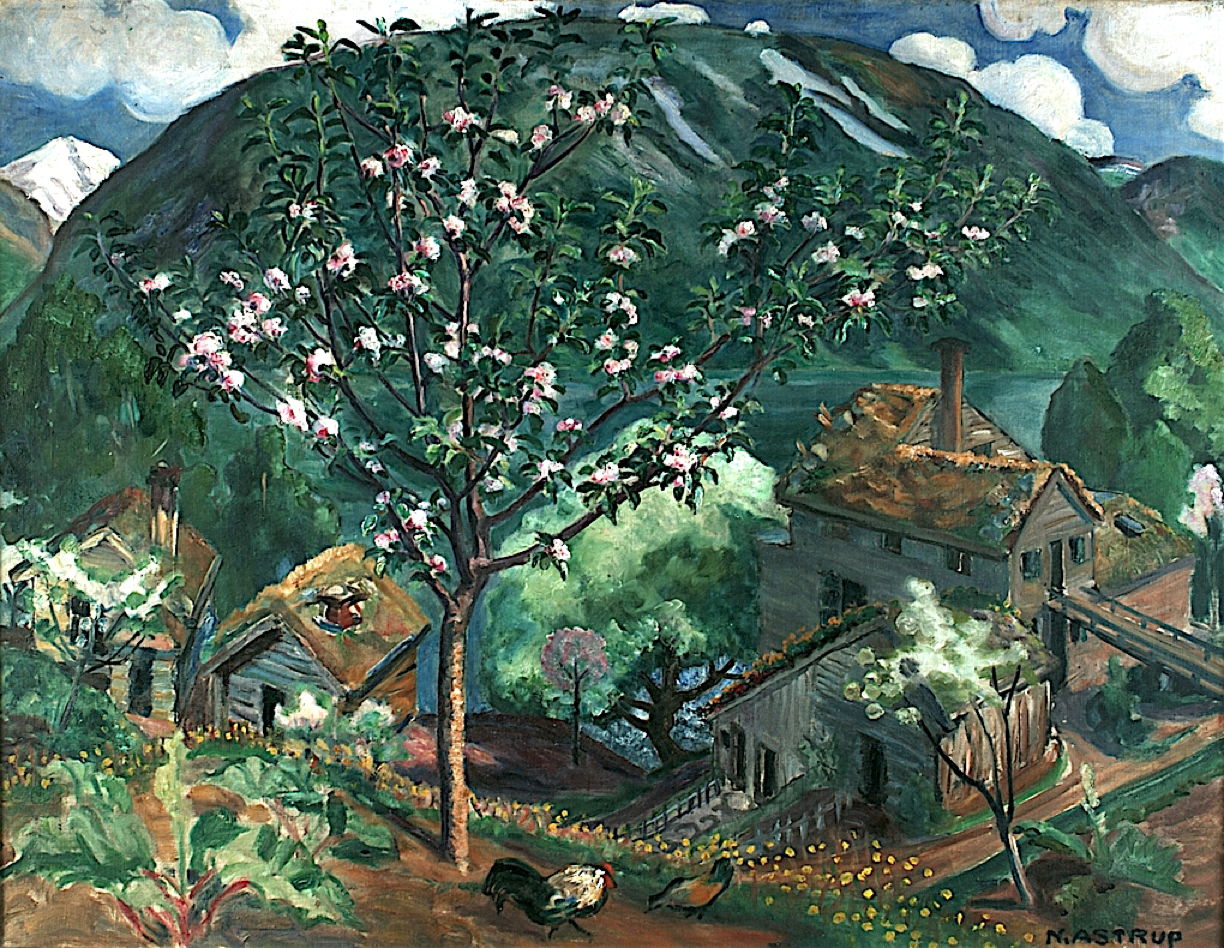
In about 1927, Astrup painted Apple Tree in Bloom showing the trees in full blossom and marsh marigolds in flower.
Because of their antiquity and popularity throughout Europe, the apple tree and its fruit feature in myths and legends, among them the golden apples guarded by the Hesperides.
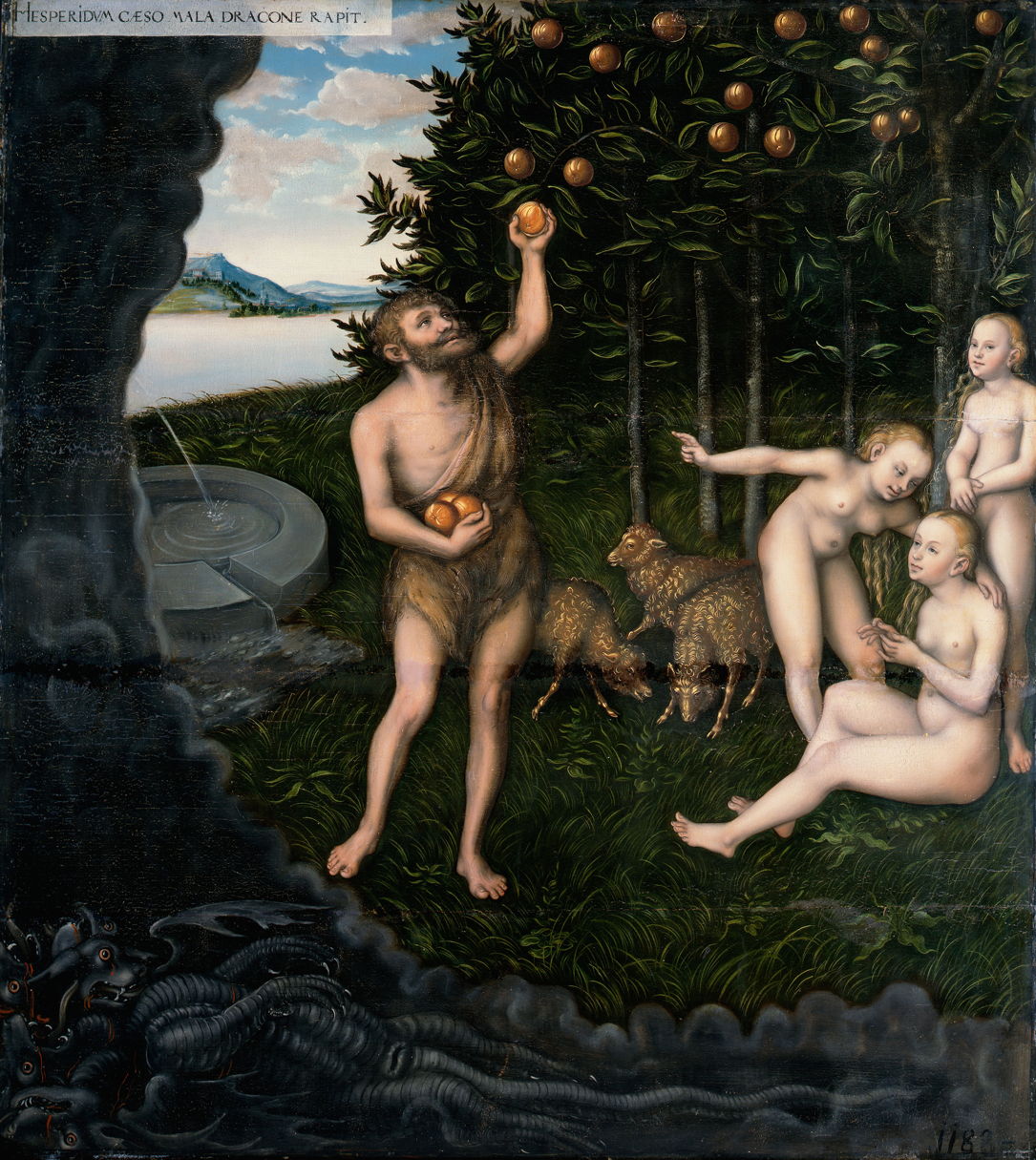
Lucas Cranach the Elder’s workshop painted Hercules Steals the Apples of the Hesperides after 1537, mixing several different myths into one. Here it’s Heracles himself who picks golden apples, as the three Hesperides look on passively. Ladon is laid out in the foreground, with plenty of heads and eyes, instead of being a snake. Behind the figures are three sheep, which appear in lesser-known myths about the Hesperides.
The apple is also central to the Judeo-Christian account of the Fall of Man from the garden of Eden, featured in a great many European religious paintings.
From late summer through the autumn, depending on location and variety, crops of apples are ready to be picked.
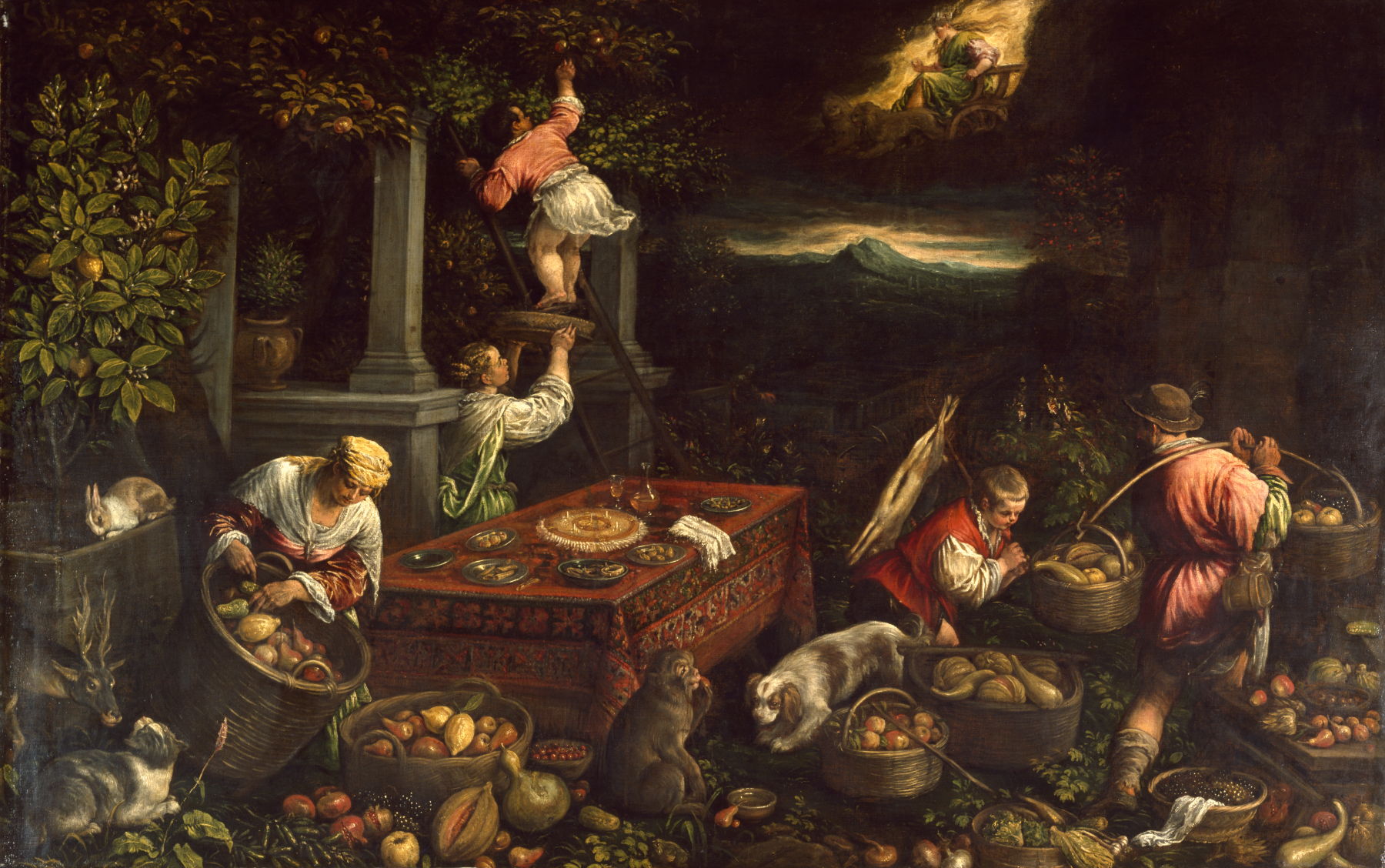
Leandro Bassano’s Allegory of the Element Earth from about 1580 is a copy of a work originally painted by his better-known father Jacopo. With the foreground full of the fruit of the earth, and a child up a ladder still picking more apples, in the distant sky is Cybele in her chariot drawn by lions.

Nicolas Poussin’s reference to a story from the Book of Numbers in Autumn, one of the late series of seasons he painted in 1660-64, shows Israelite spies who first visited the Promised Land, returning with grapes as evidence of what lay ahead. Behind them is a picker up a ladder, reaching for apples.
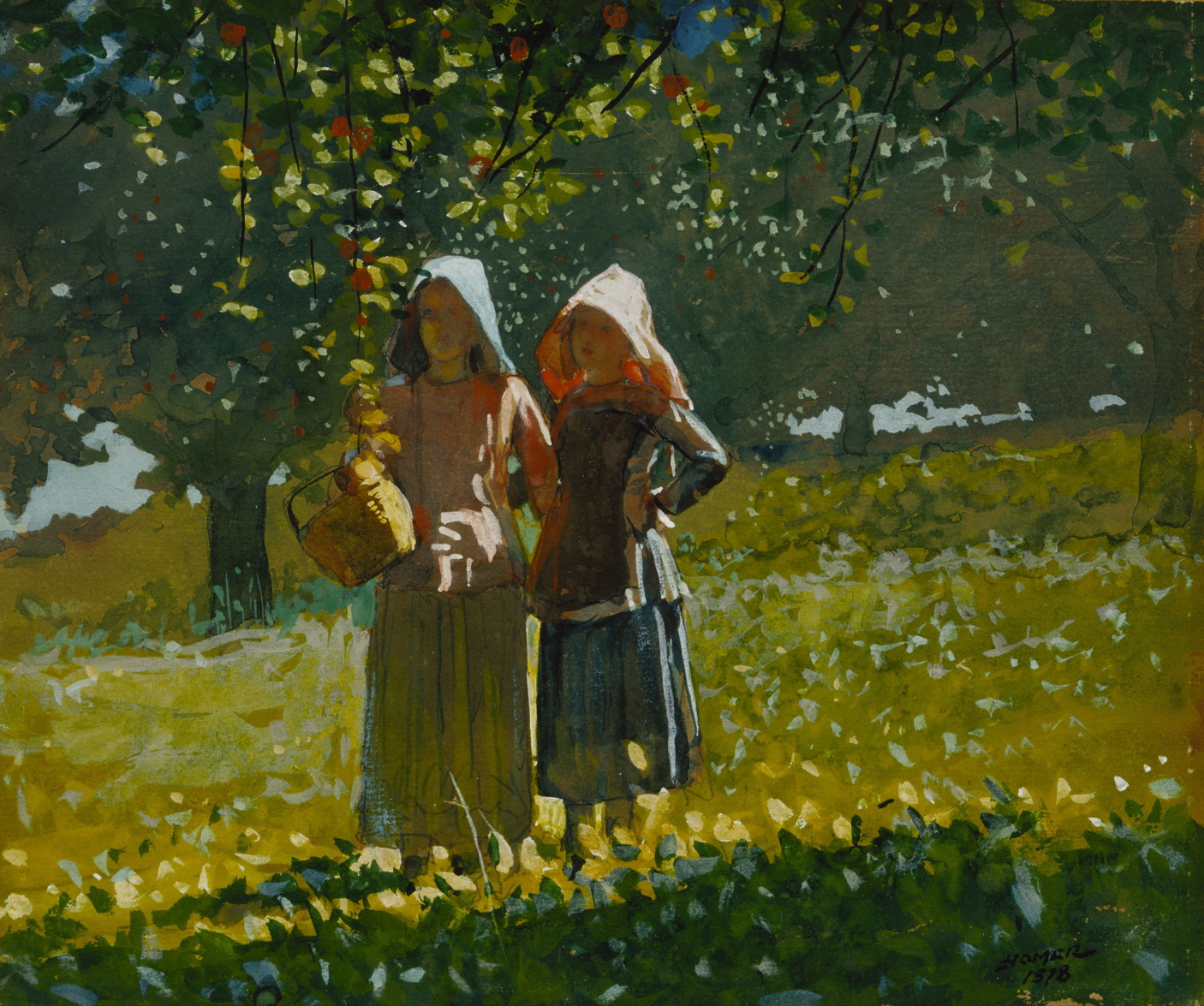
Domesticated apple trees were introduced to North America in the seventeenth century, from Europe. By the time that Winslow Homer painted this watercolour of Apple Picking in 1878, they had become a major food crop in both the USA and Canada.

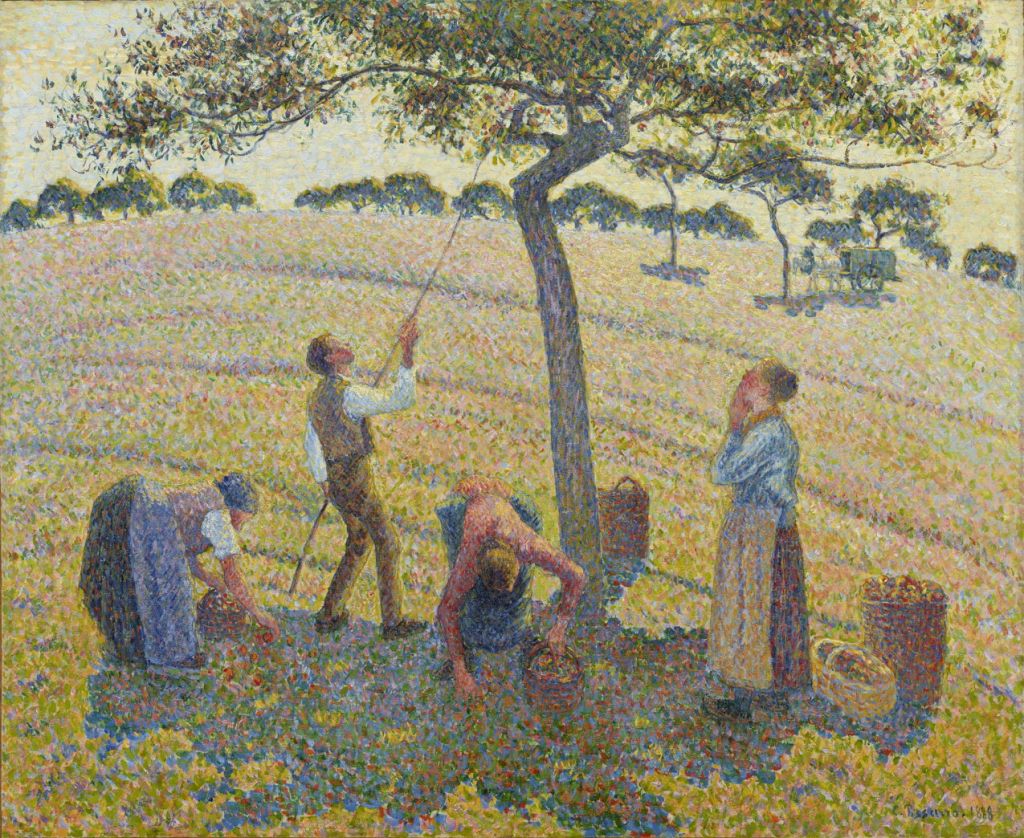
Camille Pissarro started to paint this large studio work Apple-Picking in 1881, but ran into problems with its size and composition, and didn’t complete it until early in 1886. Meanwhile, he completed a similar composition in distemper as early as 1882. This later oil version was one of his works shown at the eighth Impressionist Exhibition, where its unusual square canvas and more Divisionist style proved popular with the critics.

His later version of Apple Picking, Éragny had been largely completed in the autumn of 1887, but may have required further work early the following year. One of the canonical works of Neo-Impressionism, it was exhibited to favourable reviews at the Cercle de XX in Brussels in 1889, and was bought by the dealer Théo van Gogh in March 1888.
While both of Pissarro’s paintings show apples being removed from full-size trees using a hook on a long pole, ladders have remained the most popular means, as the fruit can be harvested without the risk of bruising.

Maurice Denis painted four women climbing The Ladder in the Foliage in 1892, a popular motif at the time, typically showing young women picking fruit in fine weather. He has replaced their patterned dresses by flowing curves more typical of art nouveau illustrations. There are no fruit visible either, and the poses of these women suggest a more spiritual purpose in their ascent.

Henry Herbert La Thangue painted In the Orchard in 1893, presumably in Sussex, England.

A Masque for the Four Seasons, painted between 1905-09, was possibly Walter Crane’s last major work in oils. This too draws on Botticelli’s Primavera, in its frieze before a dense woodland background, and copious seasonal wild flowers. Its four Grace-like women are colour-coded from the Spring on the left, with the apple tree in full blossom, through summer and autumn, with apples being harvested, to be consumed by the winter, on the right.
Depending on their variety, apples are eaten raw or cooked, or can be pressed to extract their juice, which can be fermented to make cider, then distilled to apple brandy. When stored carefully apples can remain palatable until well into the following winter, and can be dried to extend storage even longer.

Léon Lhermitte’s detailed realist style brought scenes such as this Apple Market, Landerneau, Brittany (c 1878) to life. With a cart on the move in the background, and sellers ready with their scales, it shows the small-scale bustle of an otherwise quiet country town and its trade in the fruit of the apple tree.
This tree is also one of the few to attain fame with its use as a corporate name, together with varieties such as Macintosh, Newton and the ill-fated Pippin.

