
Odysseus and his crew had made haste to depart from the island where he had blinded Polyphemus to escape being eaten by him.

JMW Turner’s Ulysses Deriding Polyphemus (1829) is faithful to the Odyssey, although the distant form of Polyphemus is hard to discern high on the top of the cliffs towards the left. He shows the entire crew, led by Odysseus brandishing two large flags, arrayed up the masts and rigging to deride the blinded giant. The orange flag on the mainmast bears the Greek word Οὖτις (Outis), referring to the trick name that Odysseus had told the Cyclops was his.

Arnold Böcklin shows Odysseus’ crew rowing frantically through large waves, as Polyphemus prepares to hurl a huge rock at them from the shore. His detailed realism and tight composition make this one of Böcklin’s most dramatic and active paintings.
After their escape from Polyphemus, Aeolus, god of the winds, gave Odysseus a bag containing all the winds except that of the west, with the intention that it would ensure their safe return to Ithaca. When Odysseus was asleep, his crew released the winds, which promptly drove the ships back, and all apart from Odysseus’ ship were destroyed by cannibals.
The remaining ship sailed on to reach the island of Aeaea, home of Circe, the goddess of magic, adept at all manner of potions and spells. She invited Odysseus’ men to a feast, at which they drank wine laced with her magical potion from an enchanted cup. She then turned the men into pigs, apart from one who escaped and warned Odysseus and others who had stayed to look after their ship.
Hermes, messenger of the gods, told Odysseus to use a herb to protect himself from Circe’s potion, then draw his sword and act as if to attack her with it. Odysseus did that and was able to free his men, who remained on the island for another year, feasting and drinking wine.

Jan van Bijlert’s Ulysses and Circe from around 1640 shows the couple at the feast, looking intently at one another. Circe holds her wand, and between them is the goblet containing her magic concoction. At the right, one of the serving maids looks straight at the viewer. At her heels are Odysseus’ crew, in the form of pigs.

Salomon de Bray makes this a more intimate meeting, in his slightly later Odysseus and Circe (1650-55). Here it’s Odysseus who is seated, clutching a krater-like goblet into which a maid is pouring clear liquid from a bottle. The hero looks quite haggard, and decidedly unimpressed with Circe. Below Odysseus’ left arm, two pigs are drinking more of Circe’s concoction.

Giovanni Andrea Sirani, the father and teacher of the great Elisabetta Sirani, painted his account of Ulysses and Circe at about the same time as de Bray, and advances the story a few moments to the point where Odysseus is about to draw his sword. Circe still holds the glass she’s trying to get him to drink from, with her wand in the other hand. The crew, in the form of pigs, are seen in the background. Another woman holding a wand is with them: this could represent their transformation into pigs, or back into humans, in multiplex narrative.

Matthijs Naiveu’s Circe and Odysseus (1702) is set in a grand banquet inside Circe’s palace, with some peculiar clusters of figures alluding to Circe’s role as a sorceress. For example, there’s a table just to the left of the couple where a satyr and a demon are engaged in conversation. Circe has moved forward from her throne to embrace Odysseus, whose sword is pointing at her body to force her back. The goblet from which she has been trying to get him to drink is held by a maid at the far right. A couple of boars are feeding from fruit laid on the marble floor.

In his Circe Offering the Cup to Odysseus (1891), John William Waterhouse shows Circe true to Homer’s account, offering Odysseus the enchanted cup containing wine laced with her magical potion. Her facial expression fits this well, and her left hand wields her magic wand, ready to transform Odysseus into a pig, as cued by the sight of a pig resting peacefully at her feet. Her right hand offers Odysseus and the viewer the enchanted cup.
Waterhouse uses a large circular mirror to great effect, showing Odysseus reflected in the mirror, and putting the viewer invisibly within the painting. Scattered around Circe are various flowers and berries, as she might use in her potions.

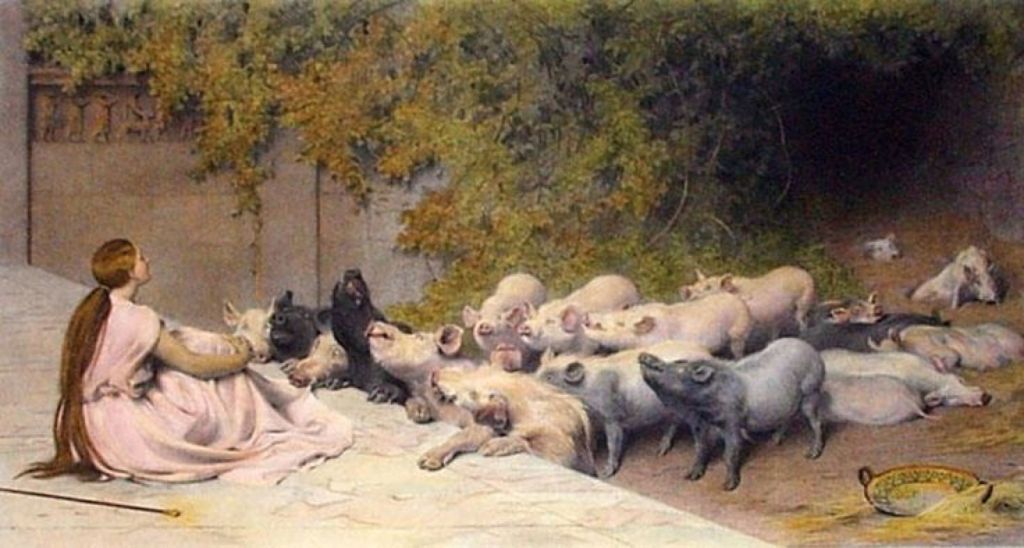
Briton Rivière’s simpler painting of Circe and her Swine (before 1896) has been used as an illustration for several versions of the Odyssey, and unusually casts Circe as a magic swineherd, her wand resting behind her.

Alice Pike Barney’s painterly portrait of Circe from about 1915 was most probably made in pastels. Her streaming golden hair almost fills the painting, and wraps the head of a large boar she is embracing.

Dossi’s Circe and her Lovers in a Landscape (c 1514-16) is a remarkably early and realistic mythological landscape, with deep rustic lanes, trees, and a distant farmhouse. Circe leans, naked, at the foot of a tree going through spells on a large tablet, with a book of magic open at her feet. Around her are some of the men whom she took a fancy to and transformed into wild creatures. There’s a spoonbill, a small deer, a couple of dogs, a stag, and up in the trees an owl and what could well be a woodpecker, in the upper right corner. That’s the fate that might have awaited Odysseus and his crew.
After a year spent with Circe, she helped Odysseus reach a harbour at the western edge of the world. There he sacrificed to the dead, and summoned the spirit of Tiresias to prophesy his future.

Henry Fuseli’s Tiresias Appears to Ulysses During the Sacrifice (1780-85) shows this dramatic scene, featuring the strange character of Tiresias, the blind prophet of Apollo in Thebes, who had apparently been transformed into a woman for seven years.
Odysseus then returned to Circe before setting sail on his journey towards Ithaca.

