
In 1866, Charles Daubigny’s sketchy landscapes had earned him sufficient reputation that he was elected to the jury for the Paris Salon. He was there able to defend paintings submitted by Impressionists, including those of Pissarro, Renoir, and Cézanne. The following year he signed Bazille’s petition to hold a second Salon de Refusés, and in 1868 was able to persuade the jury to accept paintings from seven of the mainstream Impressionists. However, in 1870 he resigned from the jury when it decided to reject a painting by Monet.

Orchard (1865-69) is another fine example of his pioneering paintings of fruit trees in blossom, long before Japonisme became popular in Europe. Daubigny had met Claude Monet near Honfleur for the first time by 1866.
It was in 1868 that the term impression seems to have been first applied to Daubigny’s landscapes, when Odilon Redon referred to him as “the painter of a moment, of an impression”. It wasn’t until 1873 that Monet applied the term to one of his own paintings, Impression: Sunrise, shown at the First Impressionist Exhibition in 1874.
The Franco-Prussian War in 1870 drove Daubigny to flee to Britain with his family. While there, he introduced Monet and Pissarro (who had also fled to London at the time) to Paul Durand-Ruel, Daubigny’s dealer who had just opened a gallery in London. Daubigny co-arranged an exhibition of paintings there including some of Monet’s. These relationships with Durand-Ruel were to prove decisive in Monet’s and Pissarro’s careers.
In 1871, Daubigny exhibited nine paintings at the International Exhibition in London. After that and the end of the Paris Commune, he and his family returned to France, where he resumed painting from his floating studio.

During the 1870s, he painted an experimental series of twenty-five moonlit landscapes, among them this undated Banks of the Oise, exploring the chromatic effects of light.

The Cooper from 1872 shows the increasing looseness in his skies.
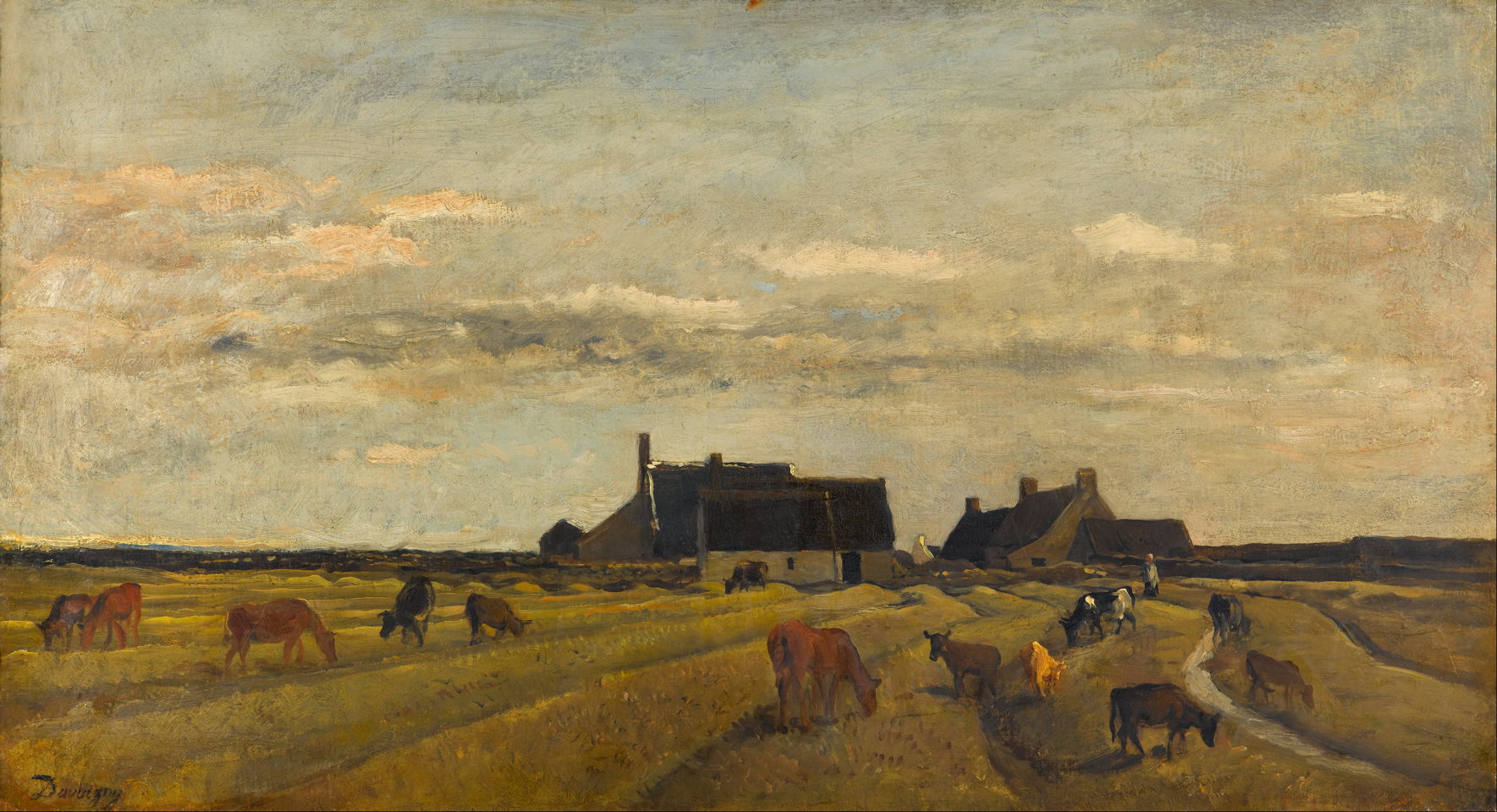
Although undated, this painting of a Farm at Kerity, Brittany continued his transition to a more Impressionist palette.

Daubigny’s undated October is an unusual and effective depiction of stubble-burning on a grey and windy autumn day.

Few of Daubigny’s paintings show central Paris, but this undated cityscape of Pont Marie is a thoroughly urban riverbank.

By the time of the First Impressionist Exhibition in 1874, when Daubigny was 57, his landscapes had become extremely painterly, as shown here in The Coming Storm; Early Spring from that year.

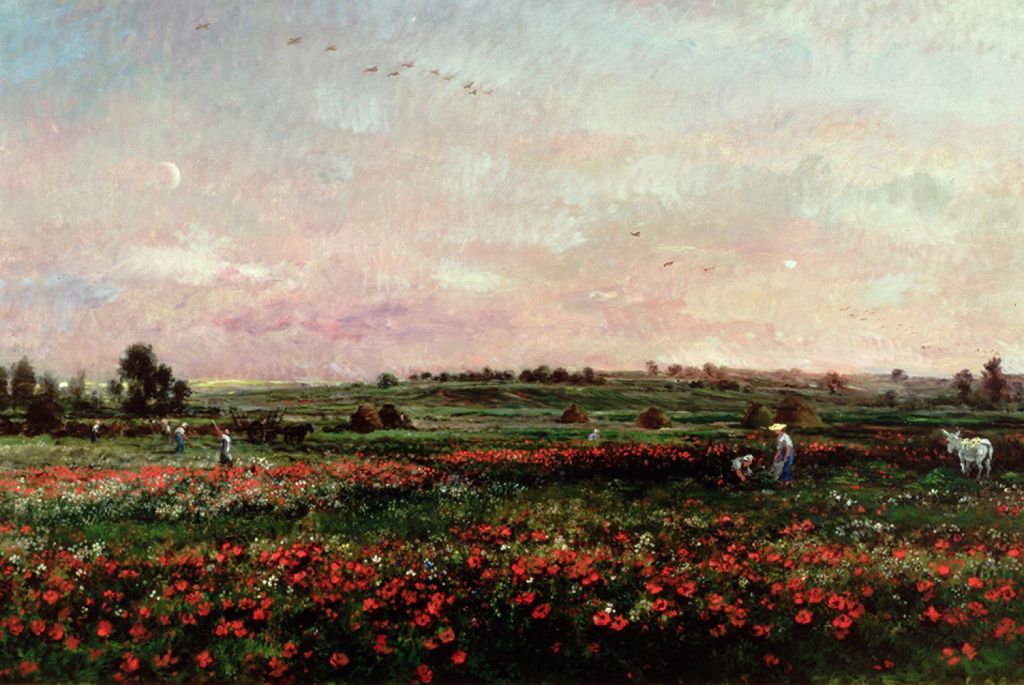
Daubigny was an innovator in his depiction of what was later a popular motif for the mainstream Impressionists: fields of flowers, particularly poppies. He painted Fields in the Month of June in 1874, which compares with Monet and de Nittis in 1881, and Vincent van Gogh in 1890. When van Gogh was working for Goupil in 1874, he compiled a list of his favourite artists, which included Daubigny, and it was in Auvers-sur-Oise, where Daubigny’s former house and studio were, that van Gogh spent the last two months of his life in 1890.

Far from becoming staid or repetitive, the final years of Daubigny’s career and life saw him pressing on to explore the transient effects of light. Landscape with a Sunlit Stream from about 1877 retains detail, but in its light and colour is gloriously Impressionist.
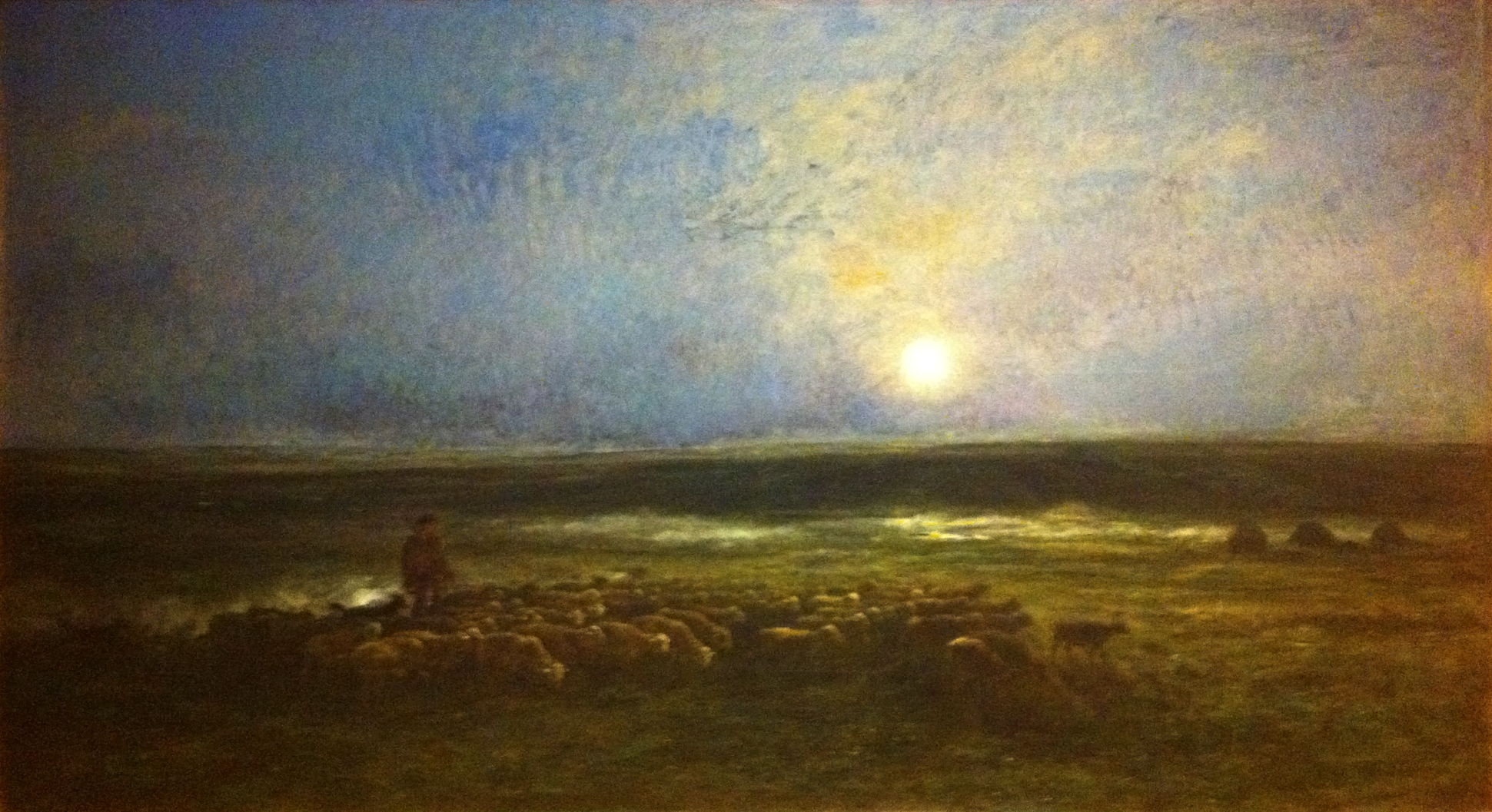
Moonrise at Auvers (1877-78) is the culmination of his experimental nocturnes, the last painting he completed, and bears comparison with later views by Pissarro.
Daubigny’s health had started to deteriorate in 1875, the year that his great friend Corot died. By that time he was suffering from gout, asthma, and chronic bronchitis. These worsened each year, constraining his painting. He was still able to work in his floating studio during the summer of 1877, but had to cancel plans to do so when it was colder. He died in Paris on 19 February 1878, having just reached the age of 61.
Initially his work was revered rather than forgotten, and its influence on the mainstream Impressionists and Vincent van Gogh was acknowledged. However, as the mainstream Impressionists became first better accepted then highly popular later in the century, Daubigny’s work faded into the pre-Impressionist past. That does him and his art a great injustice.
Reference
Ambrosini, Lynne et al. (2016) Inspiring Impressionism: Daubigny, Monet, van Gogh, National Galleries of Scotland. ISBN 978 1 906270 86 5.

