
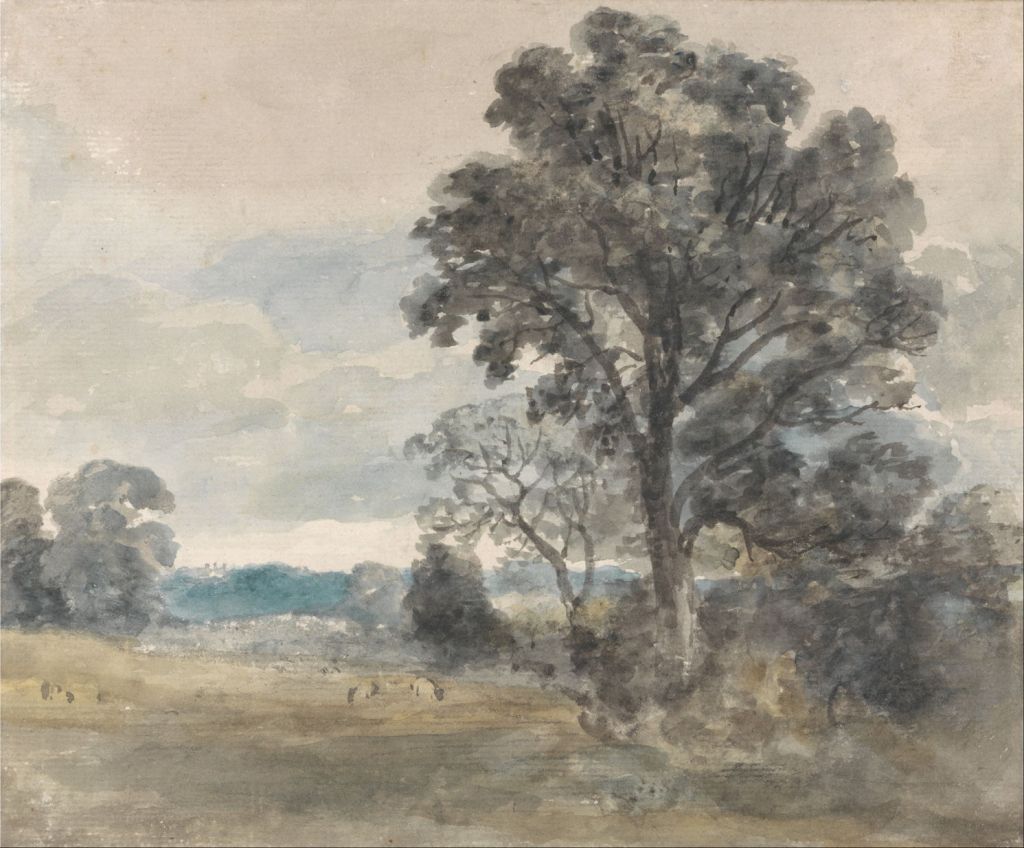
John Constable’s (1776–1837) paintings of trees form a bridge between the tradition leading to Gainsborough and the new approaches of the Barbizon School, Corot, and Impressionism. Through his long friendship with the collector George Beaumont, Constable was attracted to the landscapes of Claude Lorrain, Rubens, van Ruisdael, and Gainsborough.
He exhibited at the Royal Academy by 1803, and toured the British coast and Lake District, sketching and painting avidly. Determined to be a landscape painter, he paid the bills from commissioned portraiture work, and established a routine of painting portraits in London during the winter, and landscapes back in Suffolk in the summer. His preparatory work for those landscapes was more systematic than those of his predecessors, and many of those sketches and studies have survived in good condition.
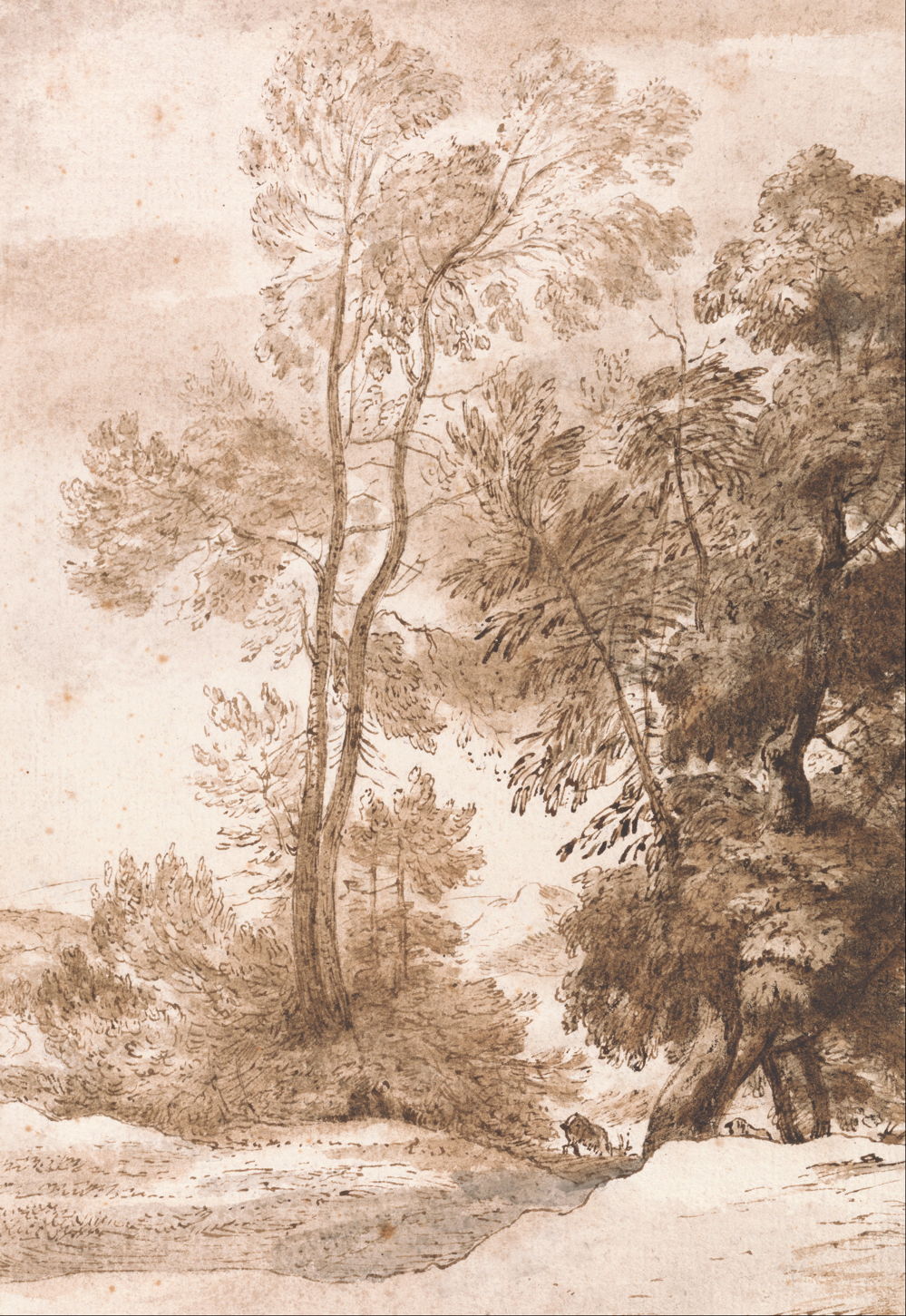
Constable was trained and skilled in the use of traditional sketching media, such as a pen, brown ink, and wash, which had been the mainstay for Poussin. These enabled him to construct the anatomy of each tree carefully, to indicate the main areas of foliage, and to superimpose marks for textural detail.
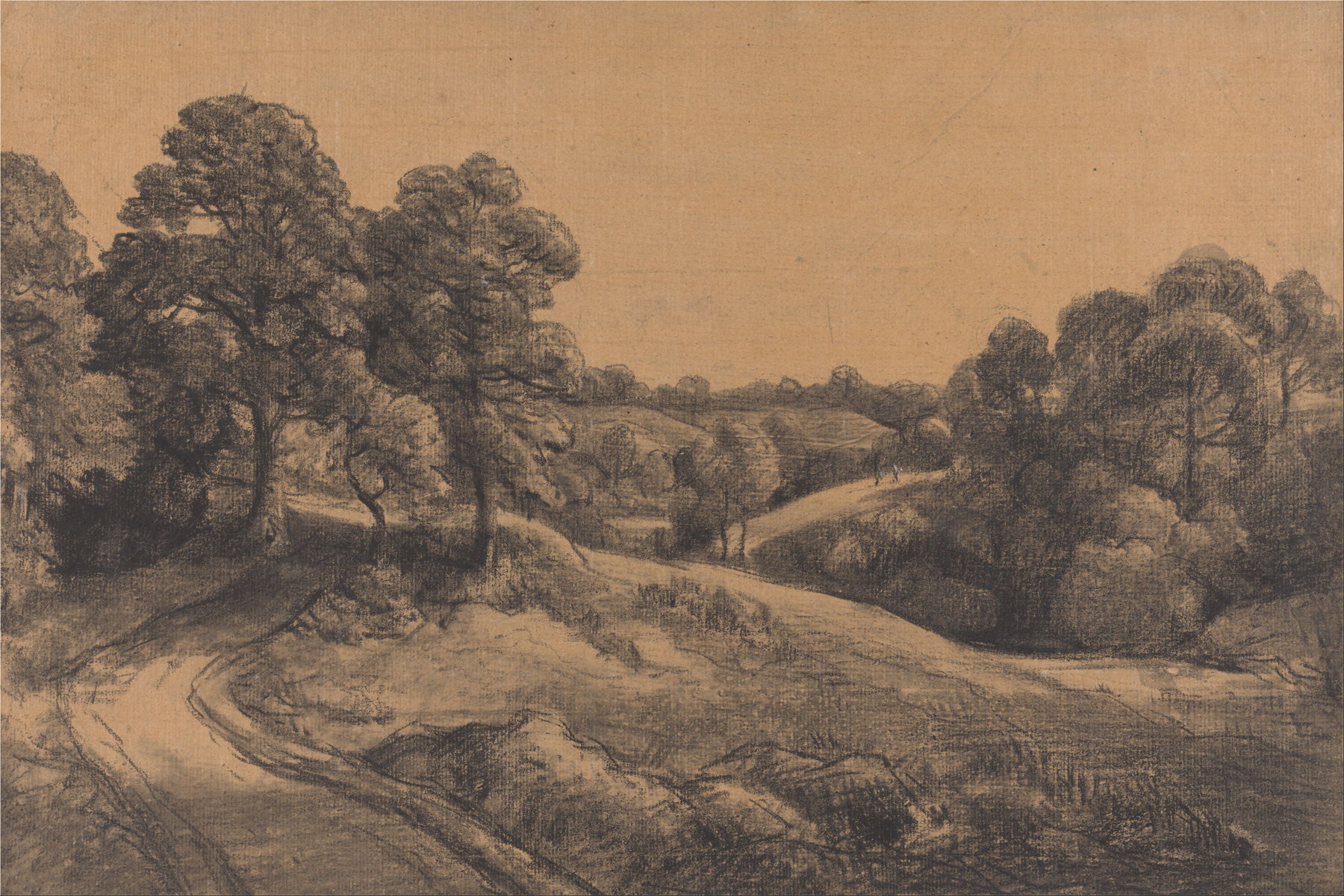
He used graphite and black chalk (a black, chalk-like mineral) for other studies, particularly those aimed more at composition. Here the trees are indicated more notionally, with less attention to their anatomy.

He was also adept at more modern sketches using graphite and watercolour wash, here recording structural detail in the closest cluster of trees, but blocking in the outlines of more distant trees.
His earlier watercolour sketches were often precise in their depiction of tree anatomy, enabling meticulous detail when used for a finished work.
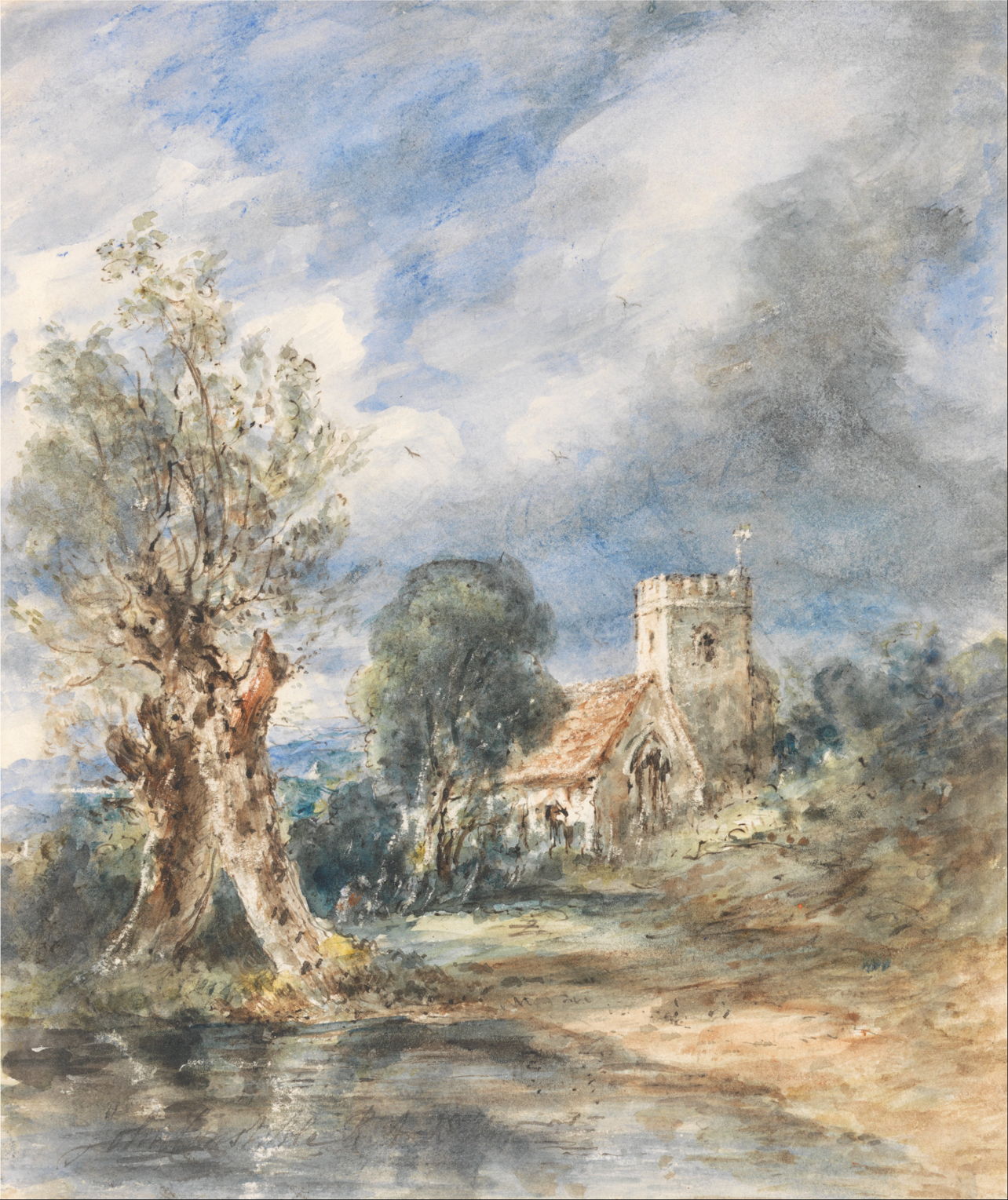
Some of his watercolours were brought to more finished form. This rapid sketch captures the unique character of the ancient pollard in the foreground, with its gnarled and conjoined trunk, remaining stumps, and the vigorous regrowth above.
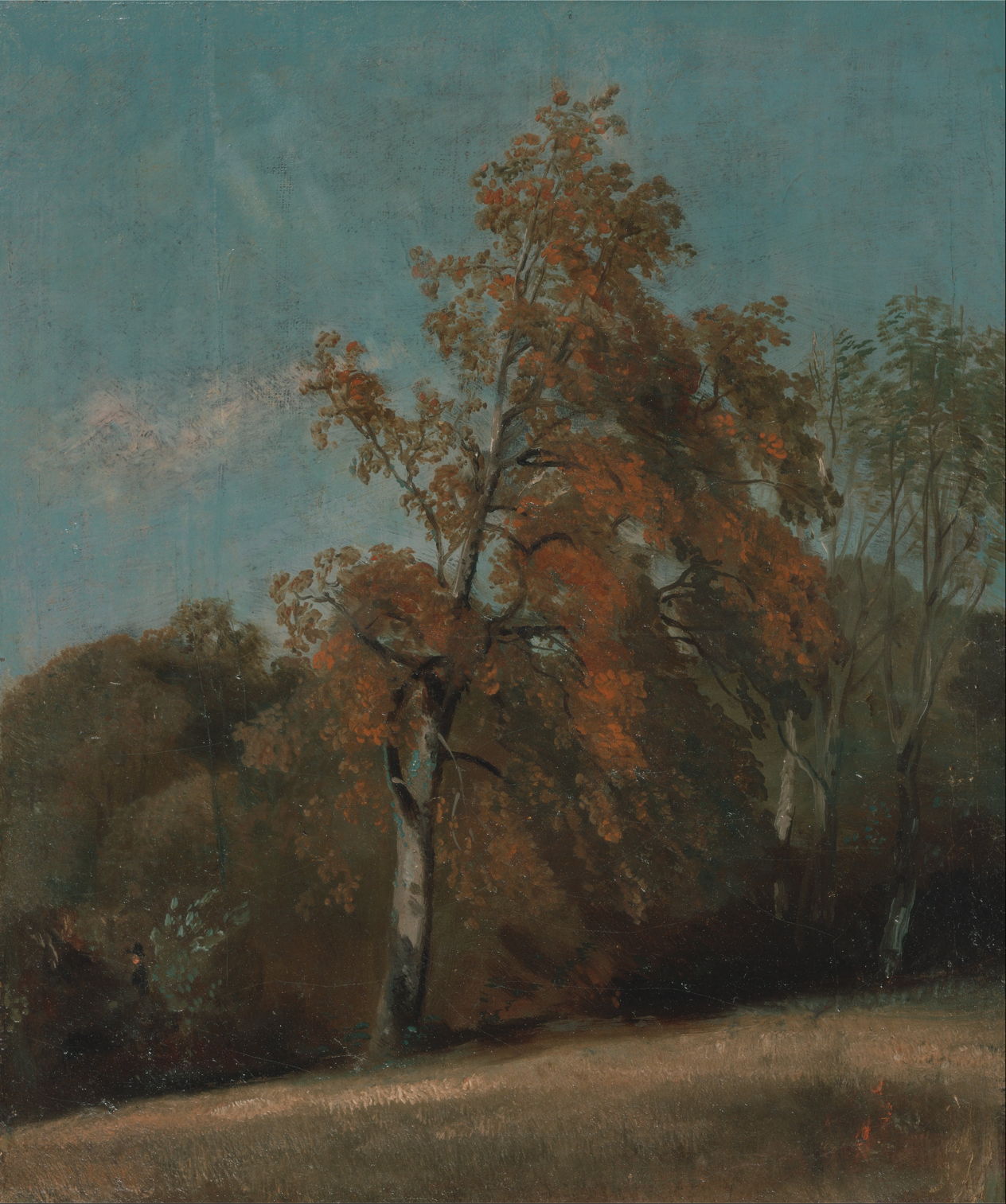
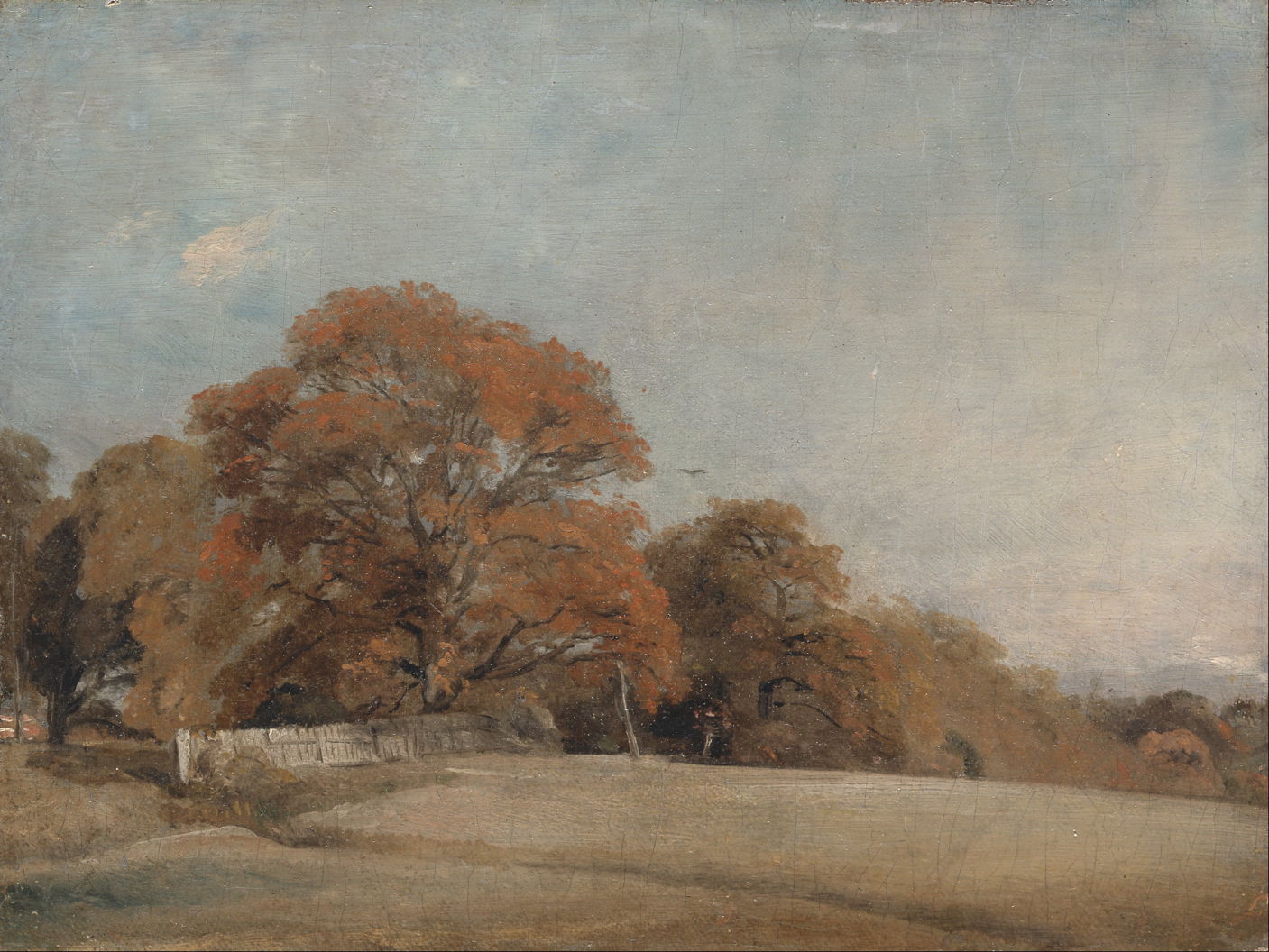
He learned to create plein air sketches in oils early in his career, which he used extensively for ‘skying’ particularly around Hampstead Heath near London, and for remarkable studies of trees, such as this ash, seen in its autumn colours. Despite the challenges posed by his medium, he has taken the time to construct the tree anatomically, and to detail its foliage.
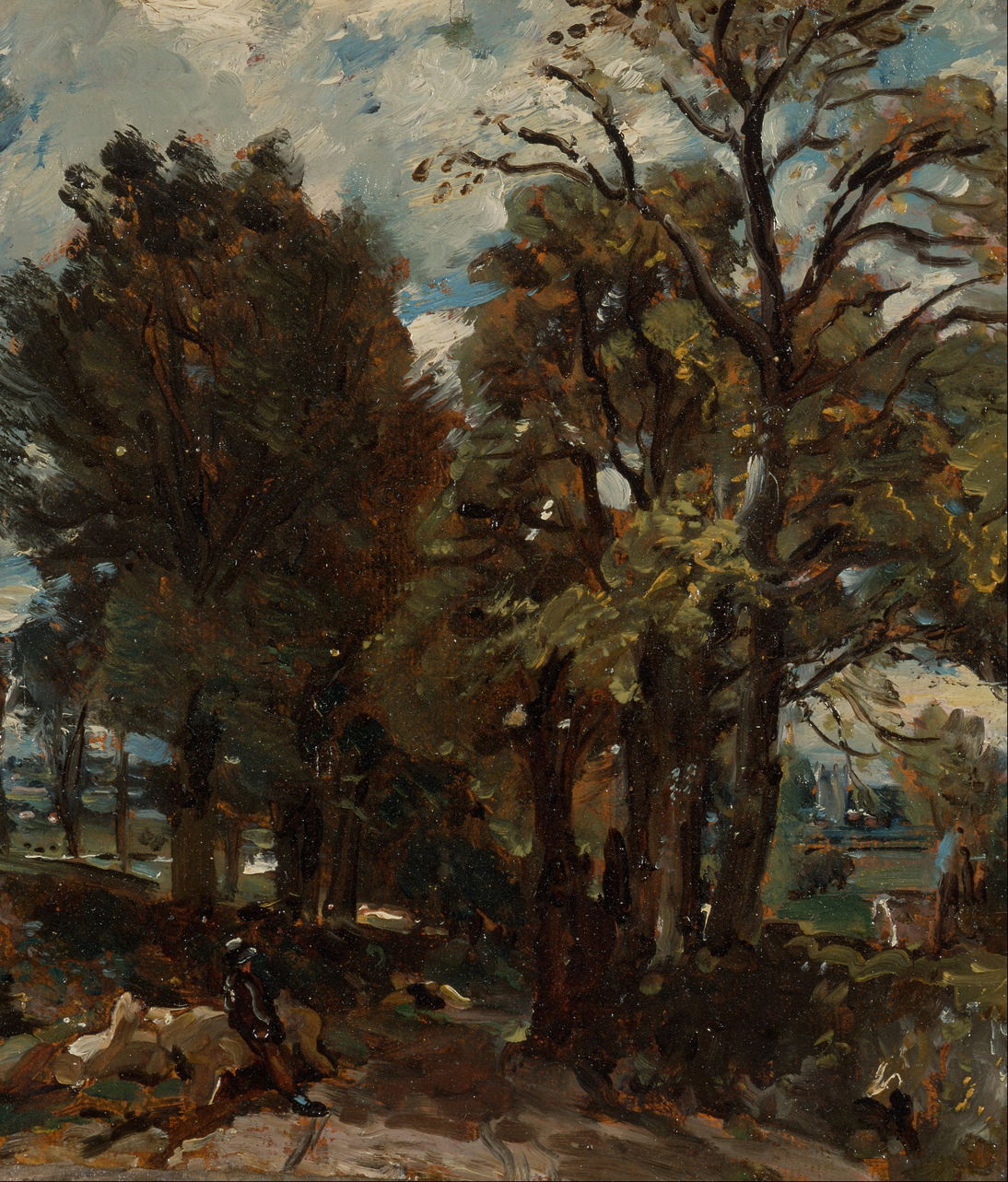
Working this time on paper, later laid on a canvas support, the trees in this plein air sketch are much rougher, with his marks more gestural. He doesn’t appear to have developed this sketch of Fen Lane, East Bergholt from about 1811 into a finished work for fifteen years, when it appeared as The Cornfield (1826) below.
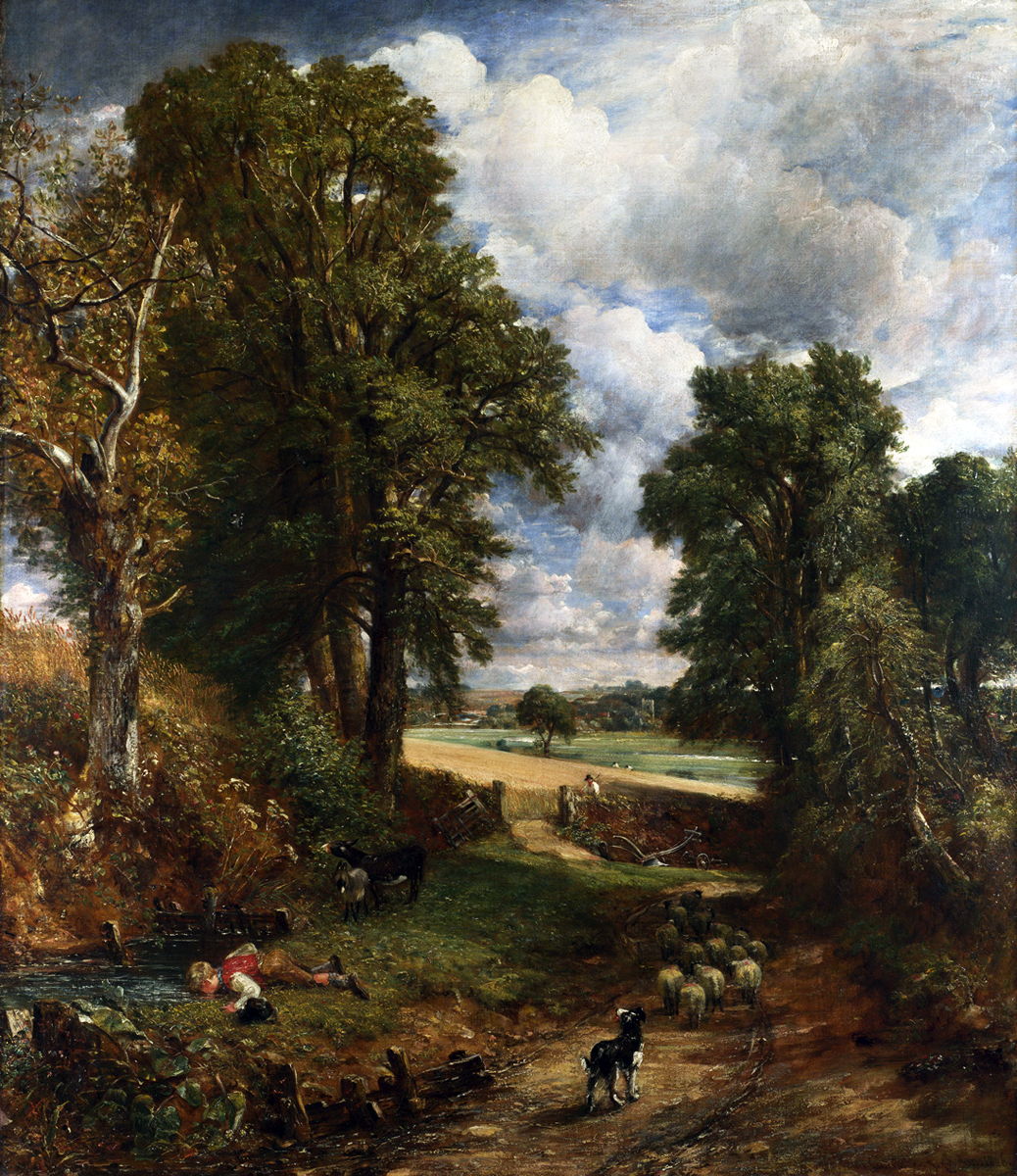
As was his common practice, he made various adjustments to his original ‘natural’ view, inserting a church in the distance, for example. Without any obvious narrative, this flopped: it was shown at the Royal Academy in 1826, and in the Paris Salon of 1827-8, but remained unsold at the time of his death. It finally became sufficiently popular to be purchased by public subscription, and has been in London’s National Gallery ever since.
As with his watercolours, some of these oil sketches were developed more slowly and carefully into paintings that may have been intended for others to see. The nearest tree has been built in detail, with highlights shown on the trunk and branches. In this case his use of canvas rather than paper suggests this wasn’t as ephemeral as other studies.

This highly detailed study of an elm trunk couldn’t have been completed in a single plein air session, and was probably undertaken in part as a standard exercise: painting the trunk of a tree had become a set piece expected of landscape painters, and remained popular among the Barbizon School.
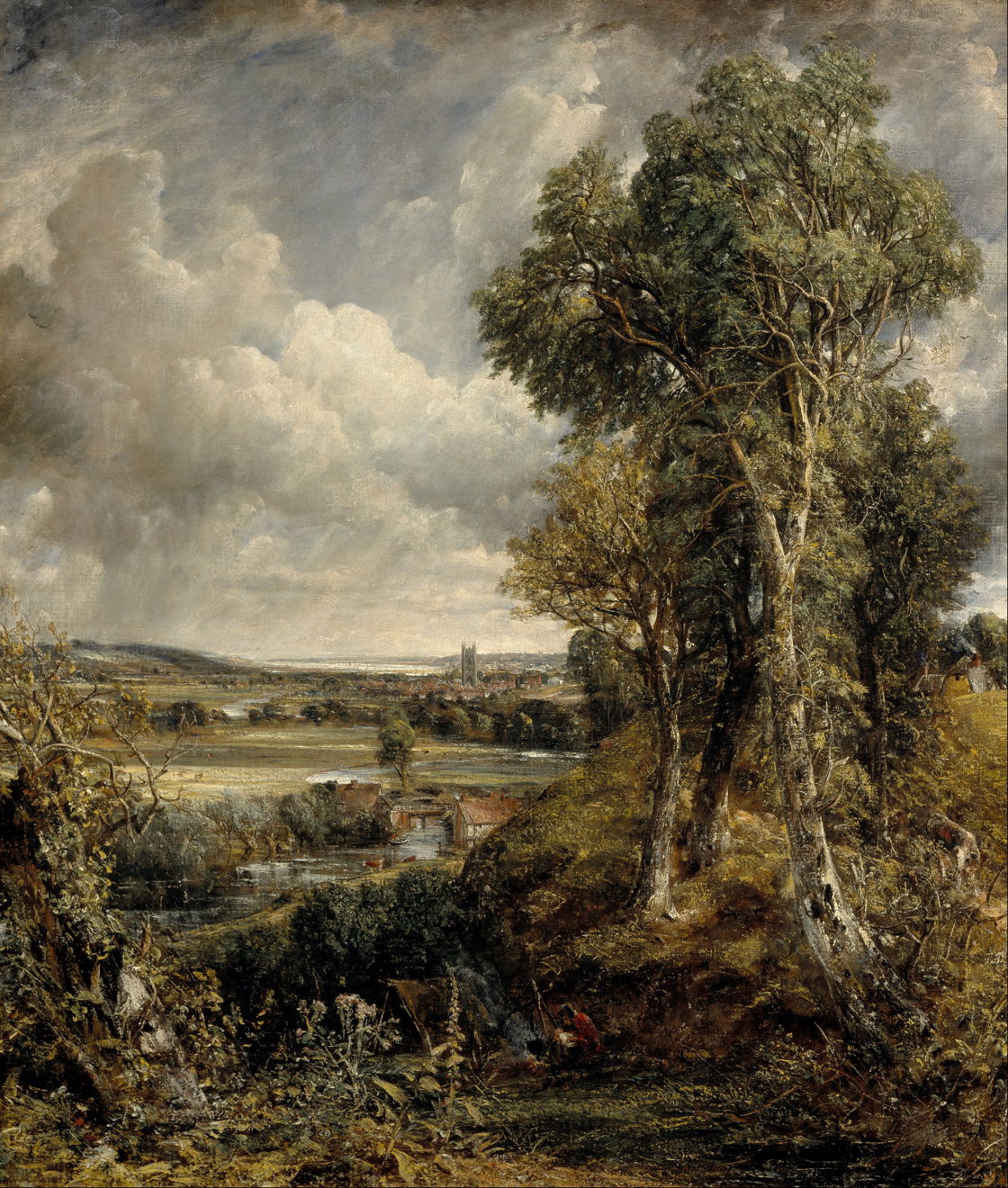
In The Vale of Dedham, or Dedham Vale, (1828) Constable reworked a finished painting of his from 1802, heightening its drama, and losing some of the naturalness of the trees. It has been suggested that this reflected the increasing disquiet in the countryside, but the twisted limbs of the high stand of trees on the right may simply have had a more ‘romantic’ touch added, as he tended to do increasingly after about 1825.
Constable first visited Salisbury in 1811, and for the next 18 years frequently visited his friends Bishop John Fisher and his nephew Archdeacon John Fisher there. This sequence of paintings provides insight into Constable’s changing approach to painting trees.
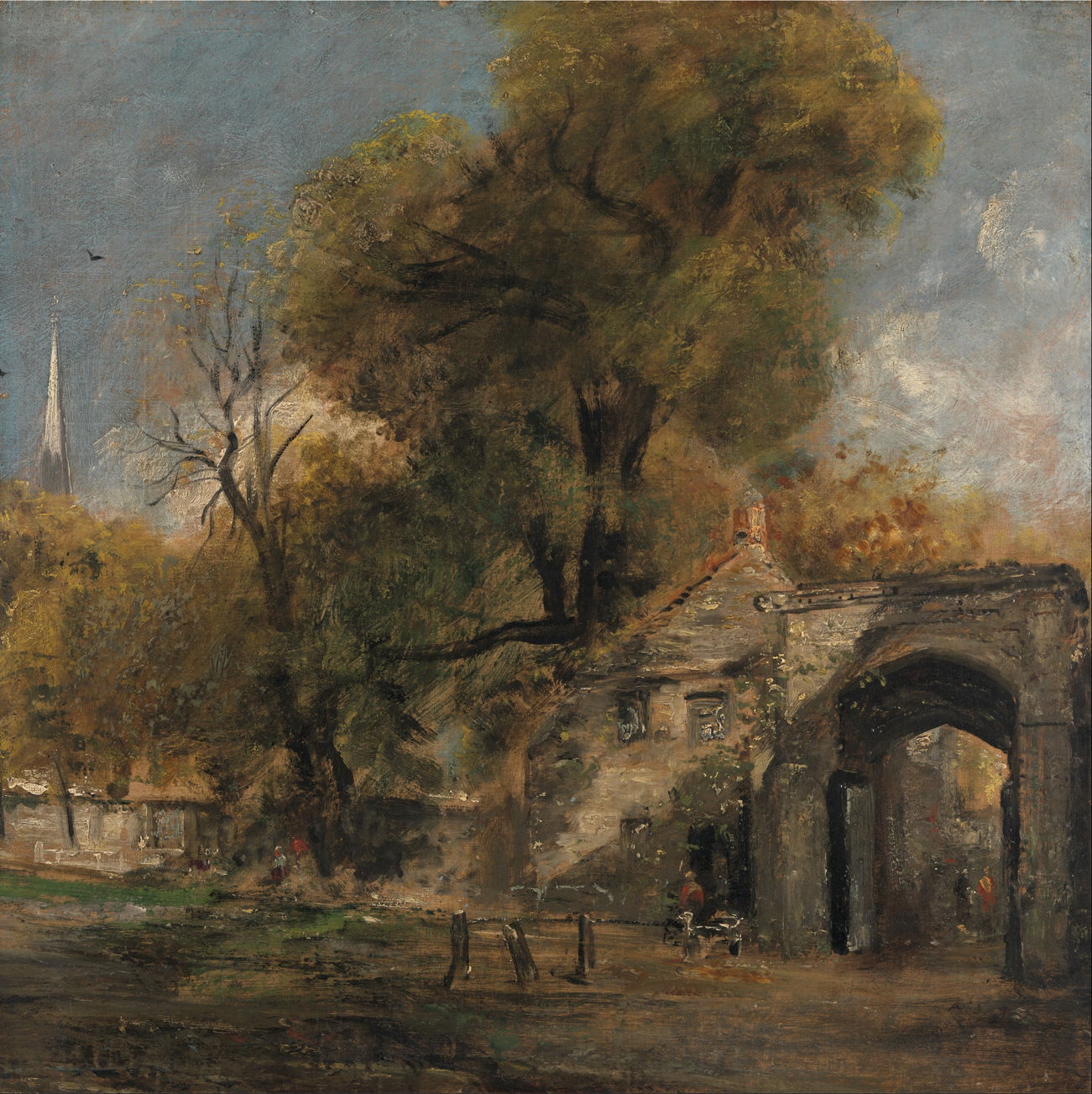
In about 1820, Bishop Fisher commissioned Constable to paint Salisbury Cathedral from the grounds of the Bishop’s Palace, and Constable started to prepare sketches and studies for that medium-sized painting, which he completed in 1823. He also painted some near-copies.

The trees are shown here in rich and almost botanical detail, complete with lichens and textured bark, in anatomical perfection.
In 1829, when Constable was still battling with depression after the death of his wife, Archdeacon Fisher encouraged him to paint a larger and more ambitious view of the Cathedral from the nearby meadows on the banks of the River Nadder. He started preparatory work then, completing the finished painting for exhibition in the Royal Academy in 1831. Despite several showings, it too remained unsold when Constable died.

This half-size and well-developed study for the finished work gives a good idea of how Constable developed from sketches towards completion. The large group of trees shown at the left is quite natural in appearance, and not fully detailed.

In the finished painting, the trees have lost their natural appearance and become more gnarled and twisted, afflicted by the same ‘romantic’ tendency that brought the rainbow (whose end is over Archdeacon Fisher’s house) and the bolt of lightning.
References
Clarkson J (2010) Constable, Phaidon Press. ISBN 978 0 7148 4295 0.
Lambert R (2005) John Constable and the Theory of Landscape Painting, Cambridge UP. ISBN 978 0 521 82738 6.
Rosenthal M (1987) Constable, Thames & Hudson World of Art. ISBN 978 0 500 20211 1.

