

You may know the English painter Thomas Gainsborough (1727–1788) from his portraits, but he was originally a landscape painter specialising in trees, whose work was greatly admired by John Constable. His great rival, Sir Joshua Reynolds, surpassed him in becoming the first president of the Royal Academy of Arts, in being knighted, and in writing a theoretical treatise on art. But Gainsborough was the more successful portraitist, the more versatile, and was a co-founder, with Richard Wilson, of the British school of landscape painting. As Constable remarked of their common home countryside in Suffolk, England: “I see Gainsborough in every hedge and hollow tree.”
Gainsborough was born in Sudbury, Suffolk, near where Constable was born 49 years later. As he showed an early aptitude for drawing and painting, he went to London in about 1740 to study art, first under Hubert Gravelot, then in St Martin’s Lane Academy. He worked as a studio assistant to Francis Hayman, then in 1744 set up his own studio. His earliest surviving paintings date from the following year, when he was already thoroughly competent in oils.
In 1746, he married the illegitimate daughter of the Duke of Beaufort, who settled an annuity on the couple, providing them with financial stability. They returned to Suffolk in 1749, where he established a practice in portraiture. In 1752, he moved to the county town of Ipswich to expand his work.
In 1759, he moved to Bath, where he studied van Dyck’s work and developed a much more successful studio that attracted the wealthy and fashionable. He was a founding member of the Royal Academy of Arts in London in 1768, but quarrelled with its leaders, and ceased exhibiting there in 1773. Nevertheless he moved to London the following year, where he lived in Schomberg House, Pall Mall. He was commissioned to paint King George III, the King, and Queen Charlotte, and undertook further royal commissions as a result.
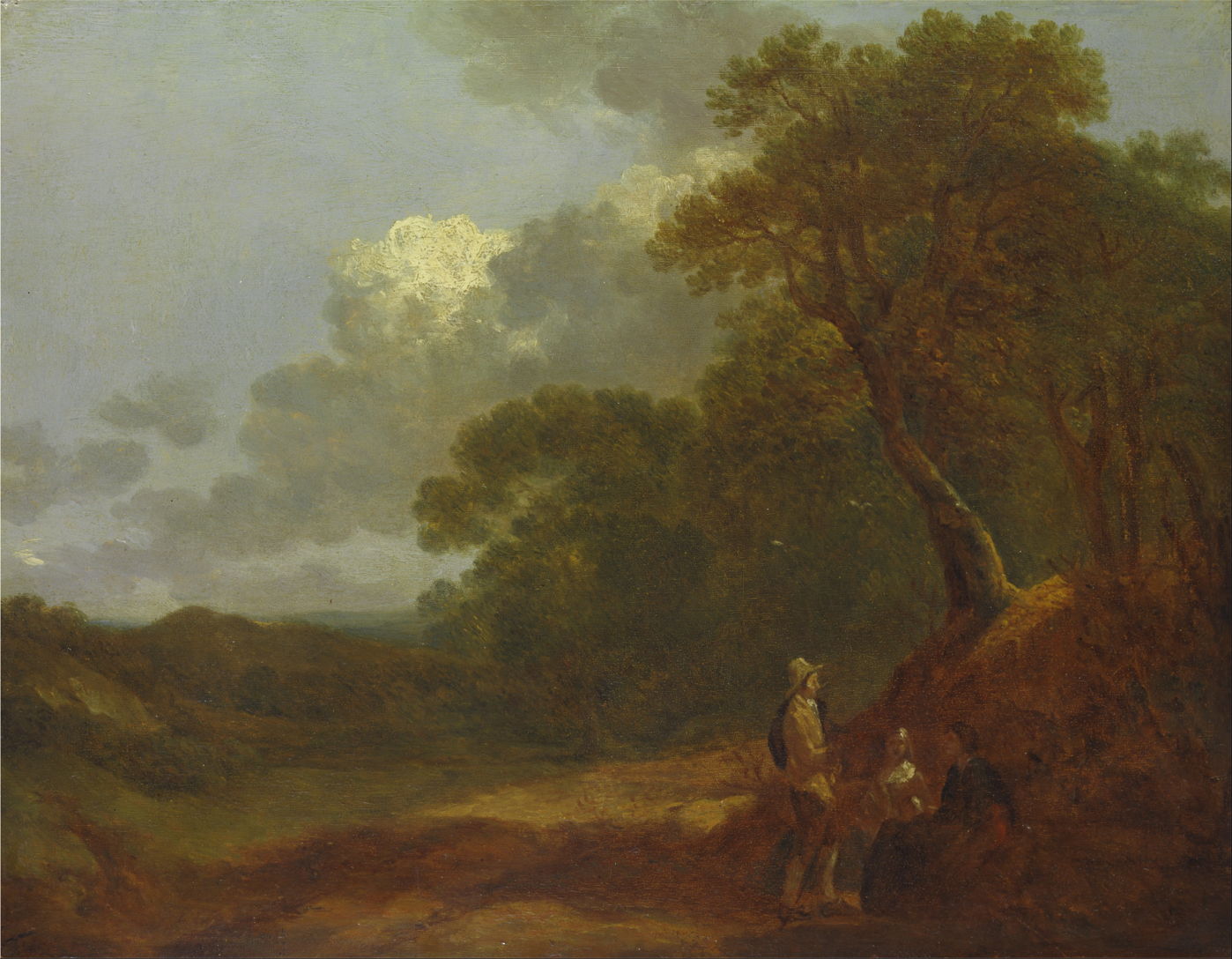
Painted within a year or so of setting up his first studio, Wooded Landscape with a Man Talking to Two Seated Women (c 1745) establishes two themes that recur in many of his landscapes: rhythmic forms in tree canopies and clouds, and a particularly gnarled old tree in the foreground. Although carefully constructed on their trunk and branch anatomy, the canopies of these trees appear solid, and don’t look as if they’re formed from small leaves suspended in air.

A couple of years later, in 1747, he painted one of his finest landscapes, Wooded Landscape with a Peasant Resting. There’s a more subtle rhythm in its canopies and clouds, and the gnarled tree is missing from its foreground. The foliage appears more convincing and less solid, bringing reality to this view of the flat countryside of Suffolk.
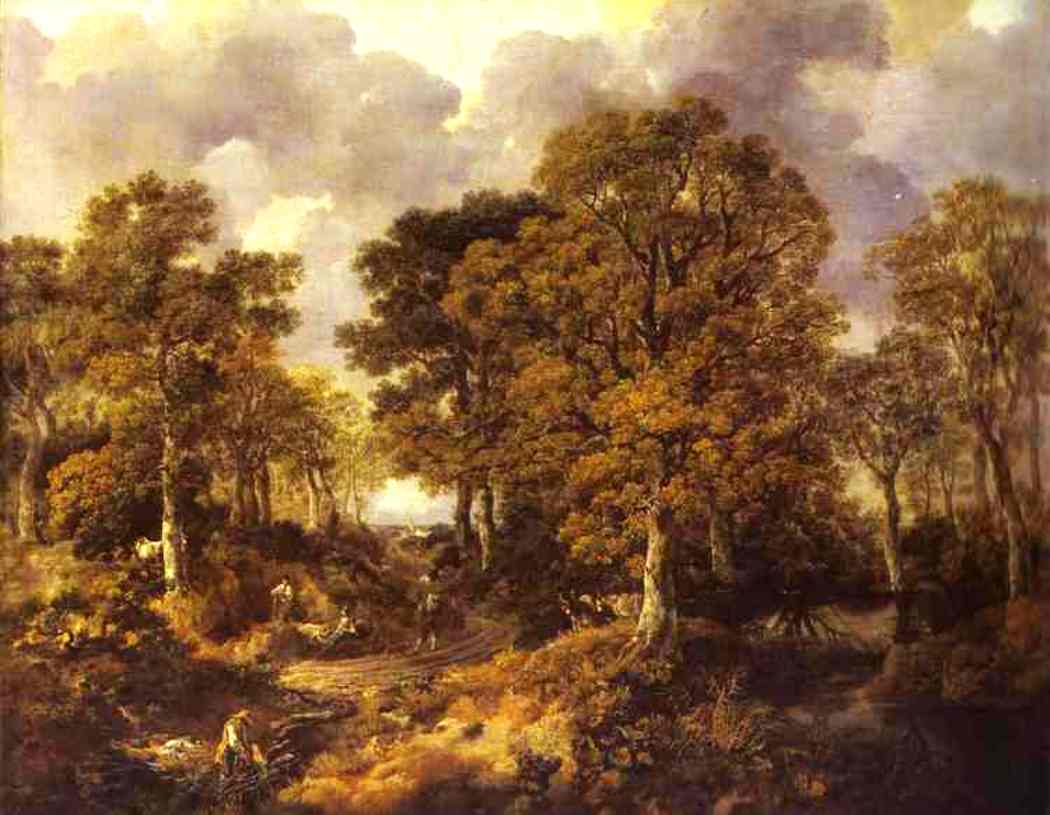
Cornard Wood, near Sudbury, Suffolk (1748) is another wonderful depiction of the countryside around his home, and one of Constable’s favourite paintings.
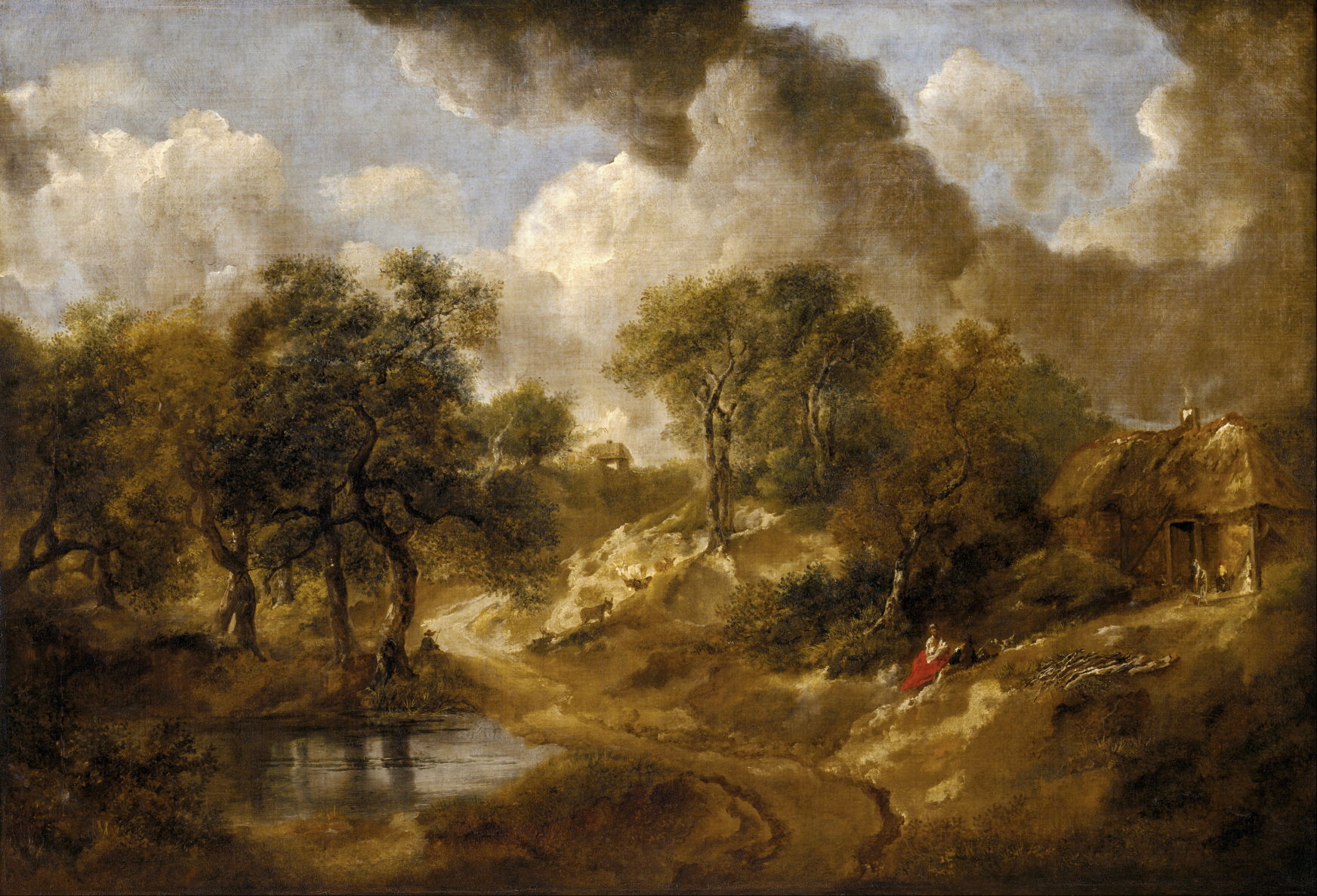
Landscape in Suffolk (c 1746-50) isn’t as successful, its cottages and staffage appearing over-contrived. The rhythm in the canopies and clouds has also broken down, and it lacks trees in the foreground.
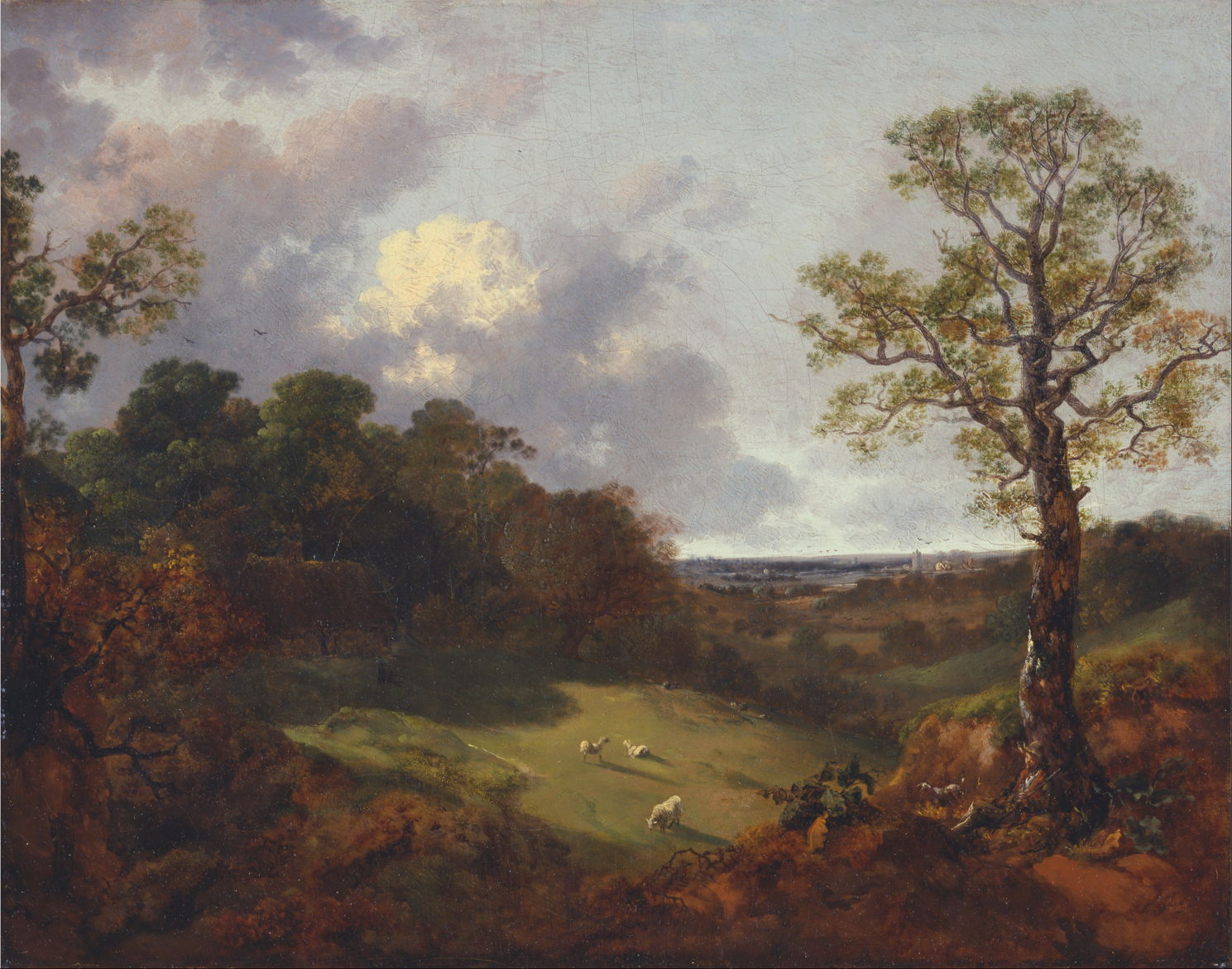
Wooded Landscape with a Cottage and Shepherd (1748-50) returns to a more classical composition, with a single dominant tree on the right, whose wonderfully gnarled and lichen-encrusted bark threatens to overwhelm the shepherd at its foot. The rhythm in canopies and clouds is more complex, and the contrast between the canopy at the right and the form of the patch of blue sky is intriguing.
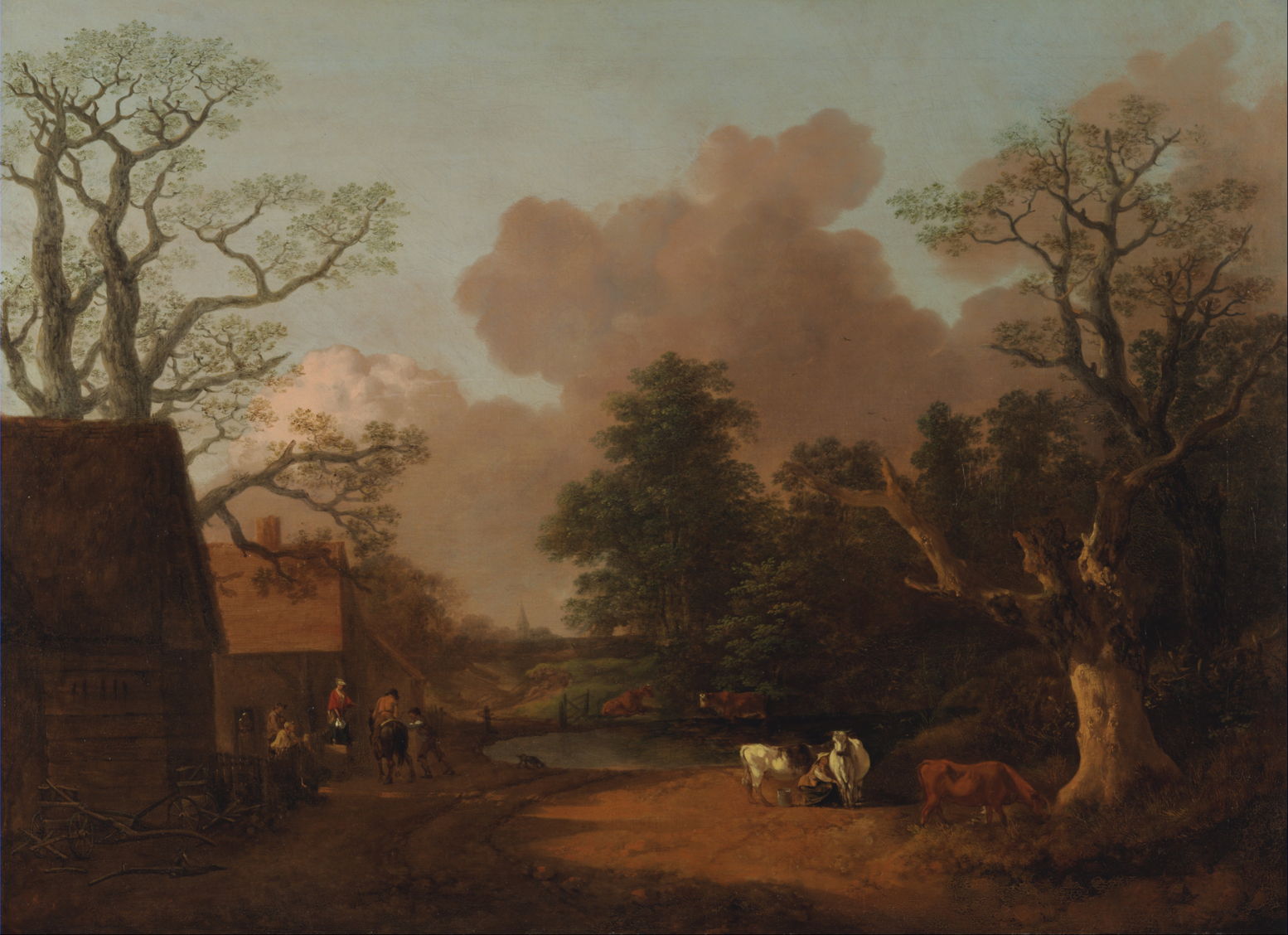
The last of these examples painted in Suffolk before he went to Bath and became portraitist to the rich and fashionable, Landscape with Milkmaid (1754-6) is a more successful composition of trees and cottages. The rhythm in canopies and clouds is subtle, and in the right foreground is the dead hulk of an old tree, the stumps of its branches held out to echo the canopies and clouds.
Although Gainsborough continued to paint landscapes in oils after he had become a successful portraitist, he also left many fine sketches in watercolour over that period.

Set far from the flatlands of his native Suffolk, Hilly Landscape with Figures Approaching a Bridge (c 1763) is a complex composition with a lot of detail. It lacks any rhythm in the canopies and clouds, and its foreground is dominated by a group of old twisted trunks almost obscuring the bridge. Foliage is painted more solidly than in his earlier oil paintings, and he appears to have used some gouache to paint in skylights in the large tree in the mid-left.
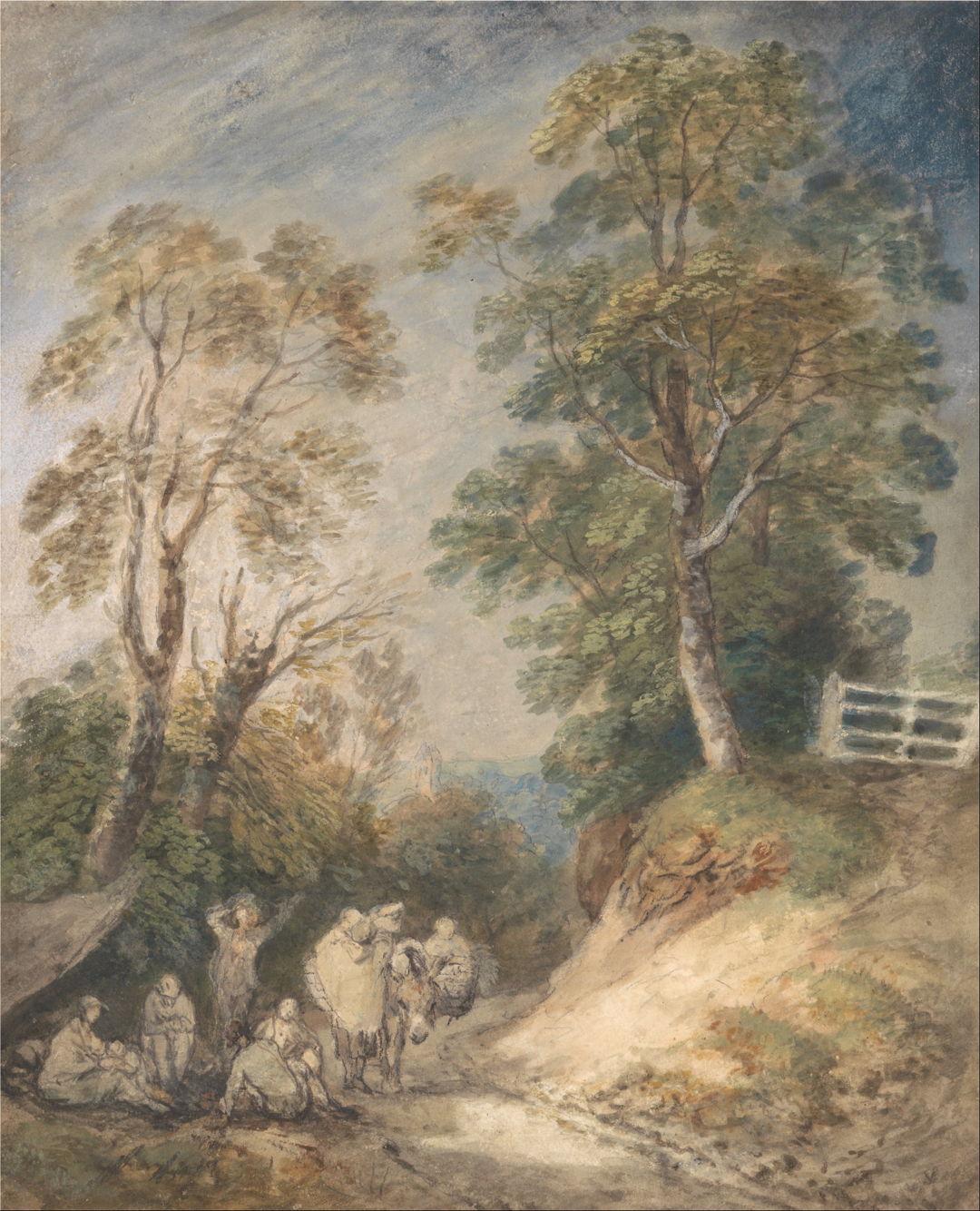
Probably set among the West Country’s rolling woodlands, Country Lane with Gypsies Resting (1760-5) is another fine watercolour, and is unusual for its lack of formed clouds. The gnarled stump of a tree has also been relegated towards the back, at the left.

The earlier of two oil paintings from this period, Wooded Landscape with a Woodcutter (1757-67), could be set in Suffolk, and its distant highlighted church tower is reminiscent of Suffolk paintings. Although largely overcast, the canopies on the right almost cut a hole in the clouds behind, a variation on his previous rhythms. In the foreground of those trees, at the right edge, is the hulk of another old tree.

The other oil painting, Road from Market (1767-8), is a variation with similar passages: dead hulks now appear at both edges, the track follows a winding course under the trees, and the church tower in the distance beckons the travellers home from market. The trees have fuller, and more solid, canopies, and no common rhythm between canopies and clouds.
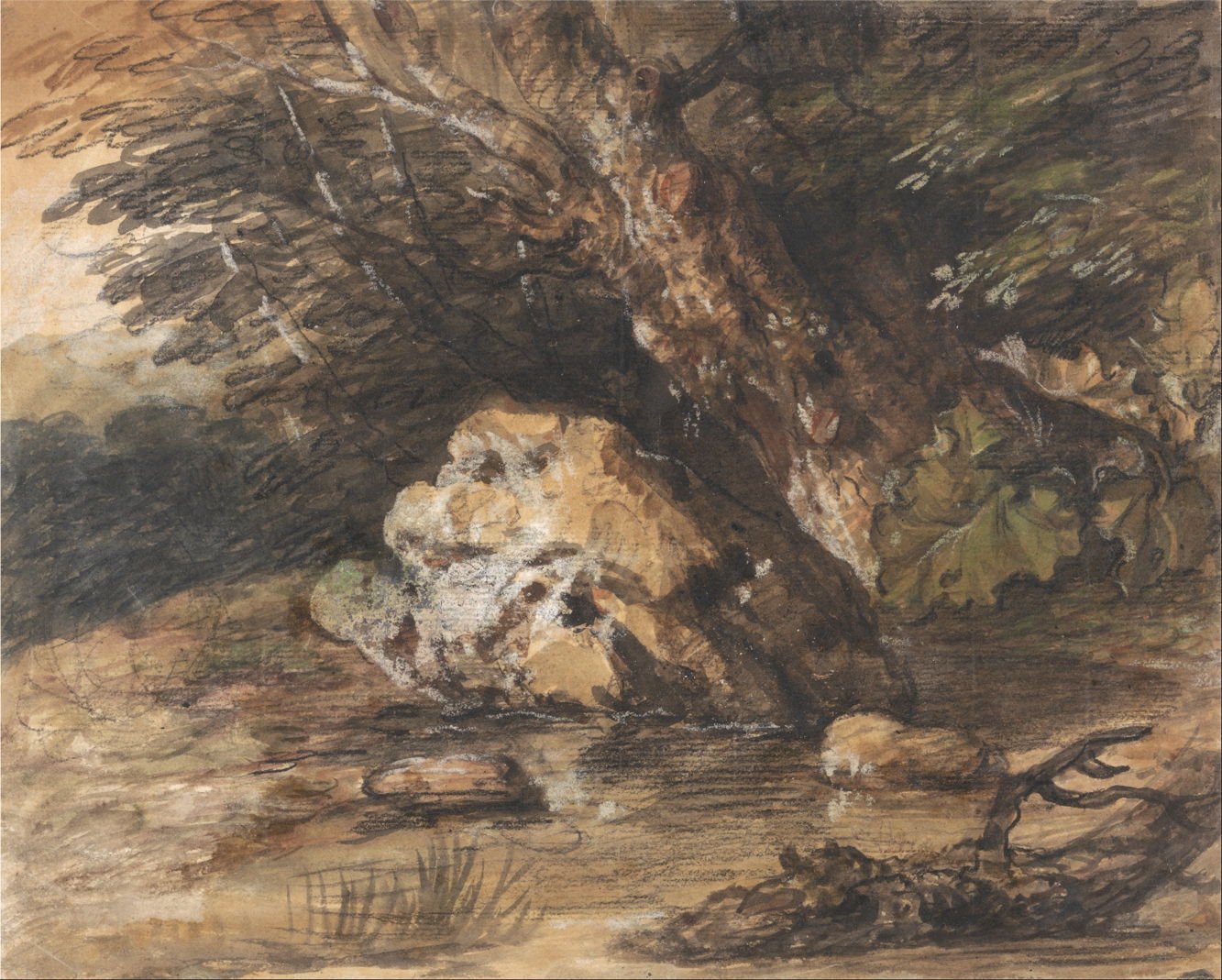
A Woodland Pool with Rocks and Plants (1765-1770) is a virtuoso watercolour study of one such gnarled relic, which may have appeared in finished form in a later oil painting. He has used opaque white (gouache) for painterly highlights to enrich the texture of the tree and rock, and foliage in the background has been loosely sketched en masse.
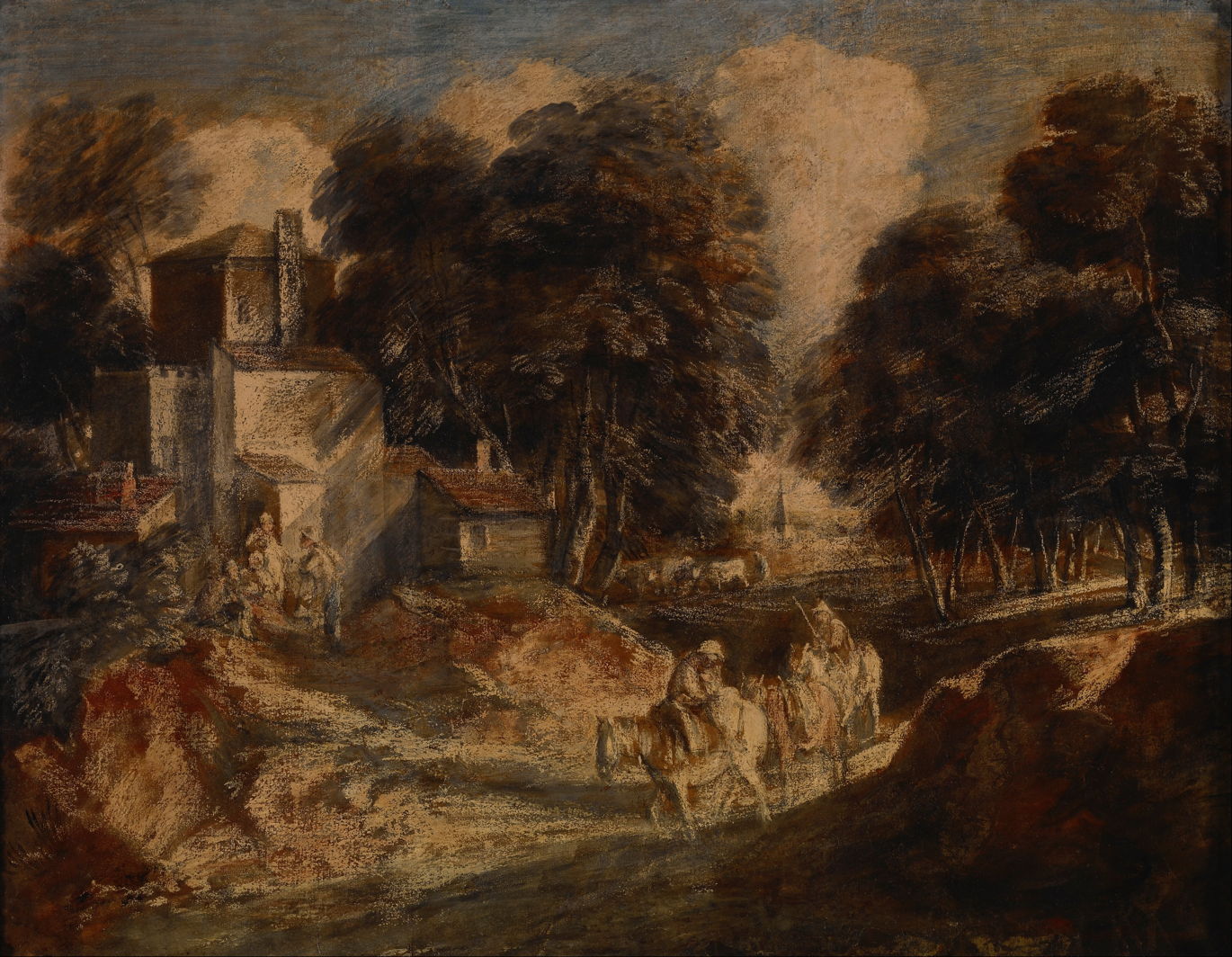
Wooded Landscape with Mounted Peasants (1772) appears to have been a compositional study, executed in ink, lead white, and gouache. Its massive trees have been sketched in quickly with solid canopies, but show rhythms with the clouds once more. The distant church is represented by a spire, which is less typical of his home country in Suffolk.
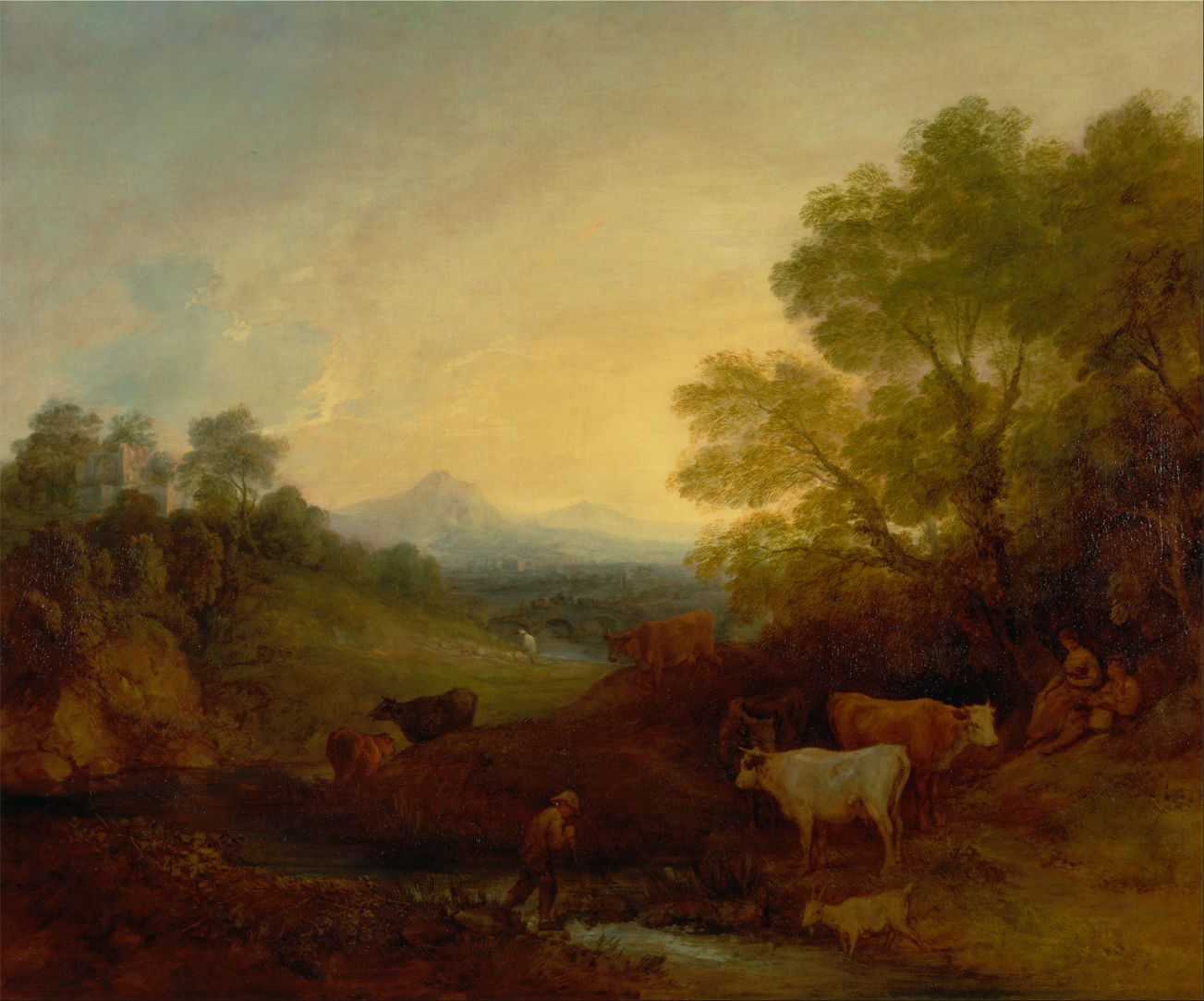
Landscape with Cattle (c 1773) shows a much more idealised, and less local, landscape, with distant mountains that are clearly neither in Suffolk nor the country around Bath. There’s a gentle rhythm between the canopies on the left and a break in the clouds, and no rotting hulk in the foreground.
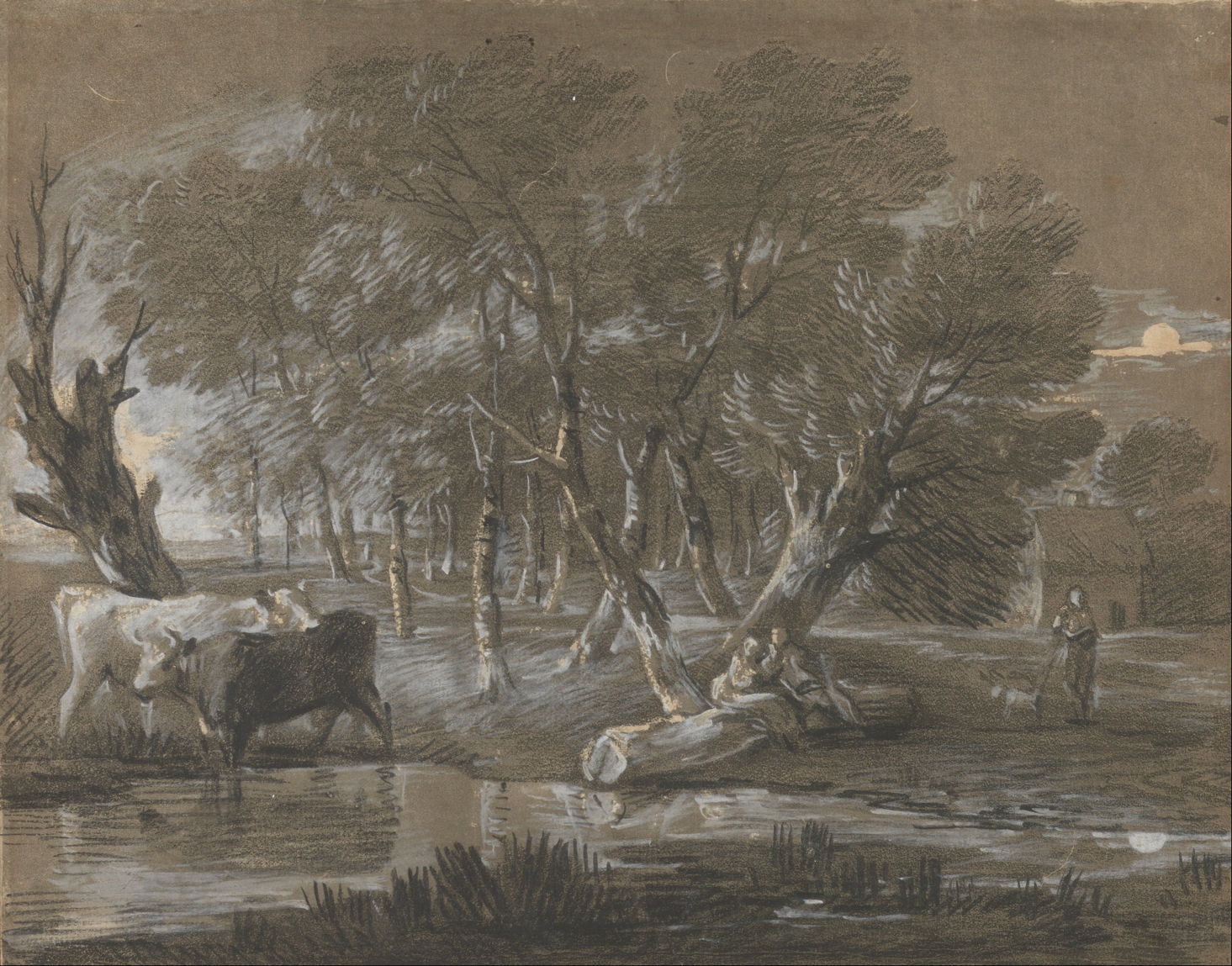
A Moonlit Landscape with Cattle by a Pool (c 1780) is a late etching with aquatint bringing together some of the features of trees seen in earlier studies, particularly the gnarled hulk at the left, and its near-mirror copy to the mid-right.
References
Wikipedia
Vaughan W (2002) Gainsborough, World of Art, Thames & Hudson. ISBN 978 0 500 20358 3.

