
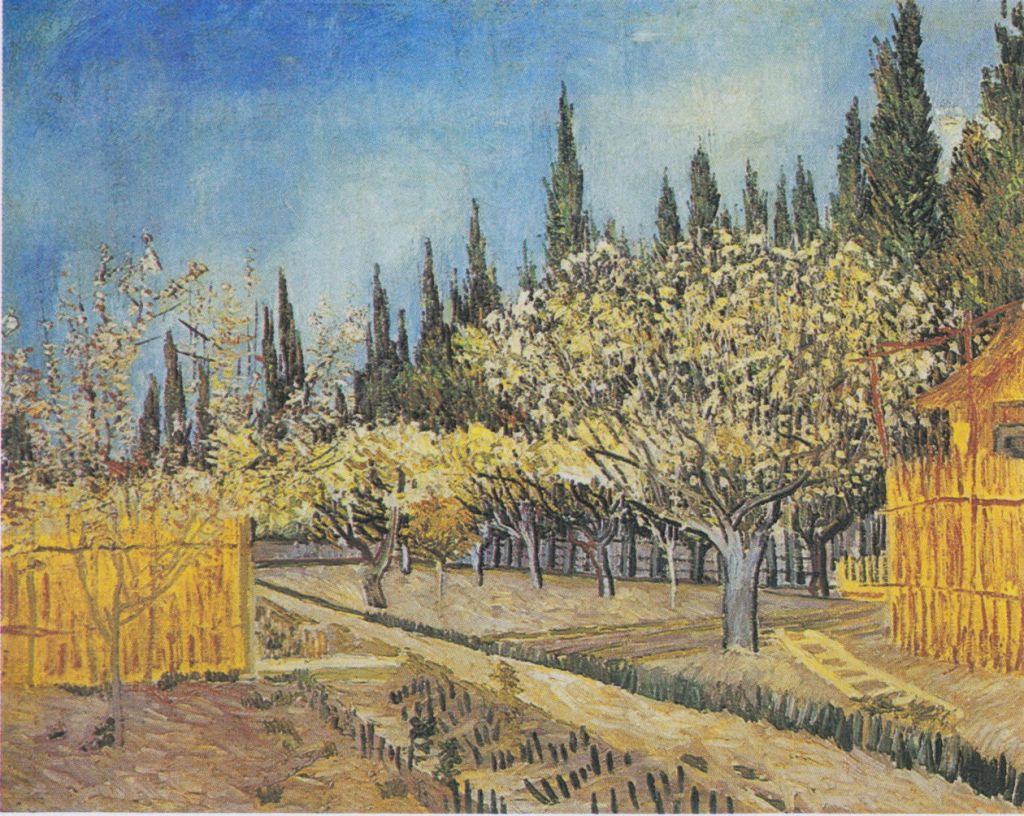
Visit an old church in the British Isles and you’ll most likely find an ancient yew in the yard, but across much of the more southern parts of Europe, the tree most strongly associated with churchyards and graveyards is the Italian cypress, Cupressus sempervirens. These can assume various shapes and forms, but their signature appearance in paintings is instantly recognisable; there is though a broader variety horizontalis that may pass unrecognised. These are evergreens with dark dense-packed ferny leaves, that produce small nutlike cones. They’re perhaps the most characteristic tree of the north coast of the Mediterranean.
Their origin is attributed in classical Greek myth to a pederastic relationship between the god Apollo and a boy named Kyparissos, Latinised to Cyparissus, best known from Ovid’s account in his Metamorphoses. Cyparissus had been the love of Apollo, and had befriended a majestic giant stag that he led to pasture and occasionally rode around. In the middle of a hot summer’s day, when the stag was asleep, Cyparissus accidentally killed it with his javelin. The youth was heartbroken, so was transformed into a cypress tree, which has since grown in and by cemeteries, and other places of grief.
Cypresses occur sporadically throughout landscape paintings, but their association seems to have largely passed uncelebrated until the late nineteenth century, when they came to feature in a succession of significant works. Among the first of these are Arnold Böcklin’s several paintings of Villa by the Sea, the first of which he completed in 1864.

In a later version painted between 1871-74, now in the Städel in Frankfurt, it is last light, with a band of cloud on fire with the last rays of the setting sun. Although the garden of the villa is well-grown, it appears in good condition, and a woman stands staring at the sea. Although its reading remains the subject of speculation, those stately cypresses tell of grief.
This led to Böcklin’s greatest painting, made in a total of five different versions over the period between 1880 and 1886: Island of the Dead.

Each shows a similar island, probably based in part on the English Cemetery in Florence, where Böcklin’s own baby daughter had been buried. Each shows the deceased being rowed across to the island, referring to the classical myth of Charon, who rows the dead over the rivers Styx and Acheron to the underworld. This fifth version was commissioned by the Museum of Fine Arts in Leipzig, and was painted in 1886.
Other contemporary artists incorporated prominent cypress trees for their association with death and grief.
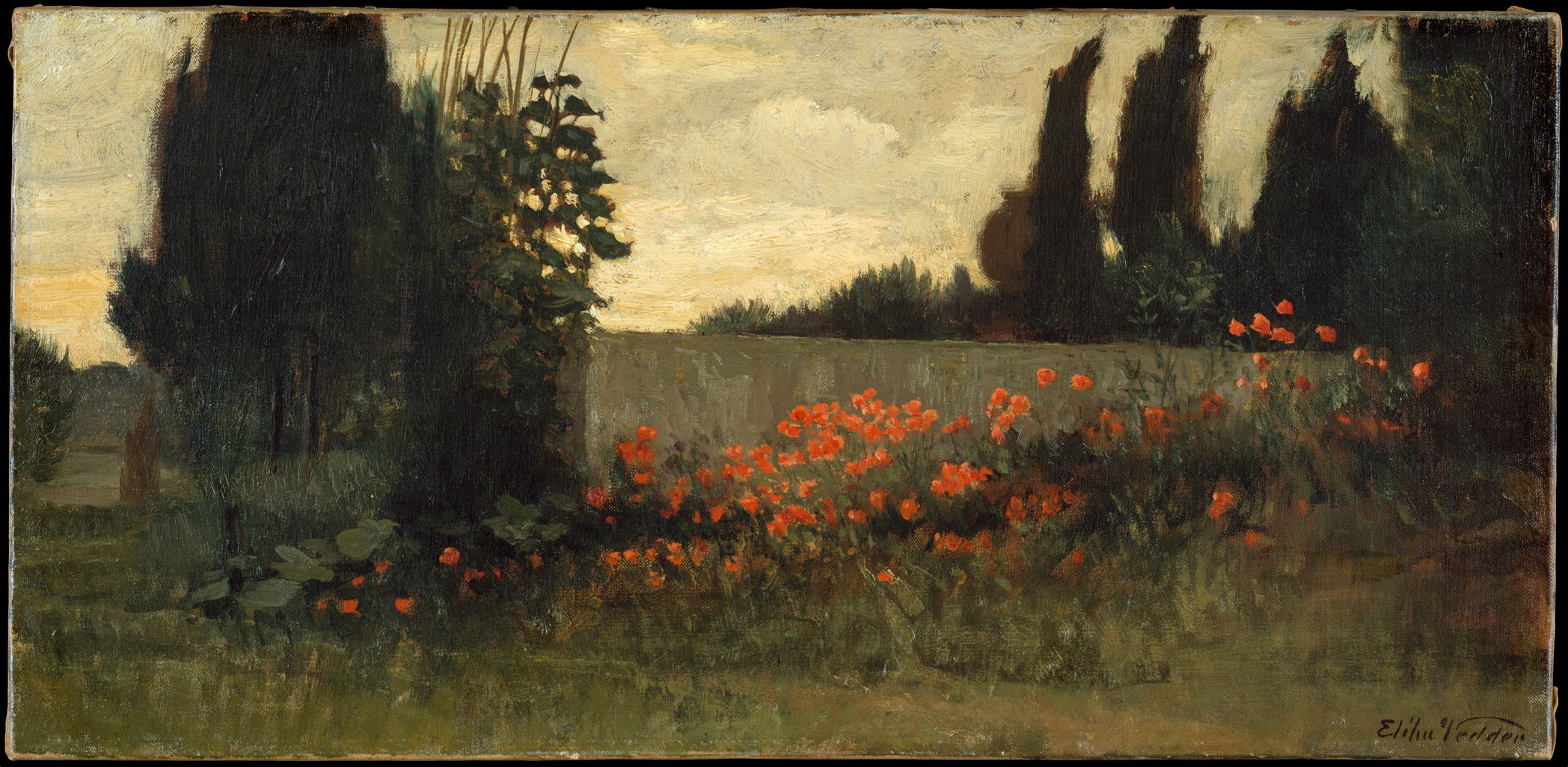
Not usually known for landscapes, when Elihu Vedder was living in Italy, probably during the 1880s, he painted this plein air oil sketch of Cypress and Poppies, a distinctive association.
At the same time Vincent van Gogh’s attention turned to the cypress.
In 1889 when he was in the Saint-Paul-de-Mausole mental asylum at Saint-Rémy near Arles, van Gogh could see through a window a view of wheatfields and dark Provençal cypress trees, with the Alpilles Mountains in the distance. During a period of intense creativity in June and July that year, he first drew parts of this view, then turned those drawings into paintings.

This pen-and-ink drawing may have been his first take, showing these two cypresses almost superimposed. From this, he made a painting in oils (below), following it closely.

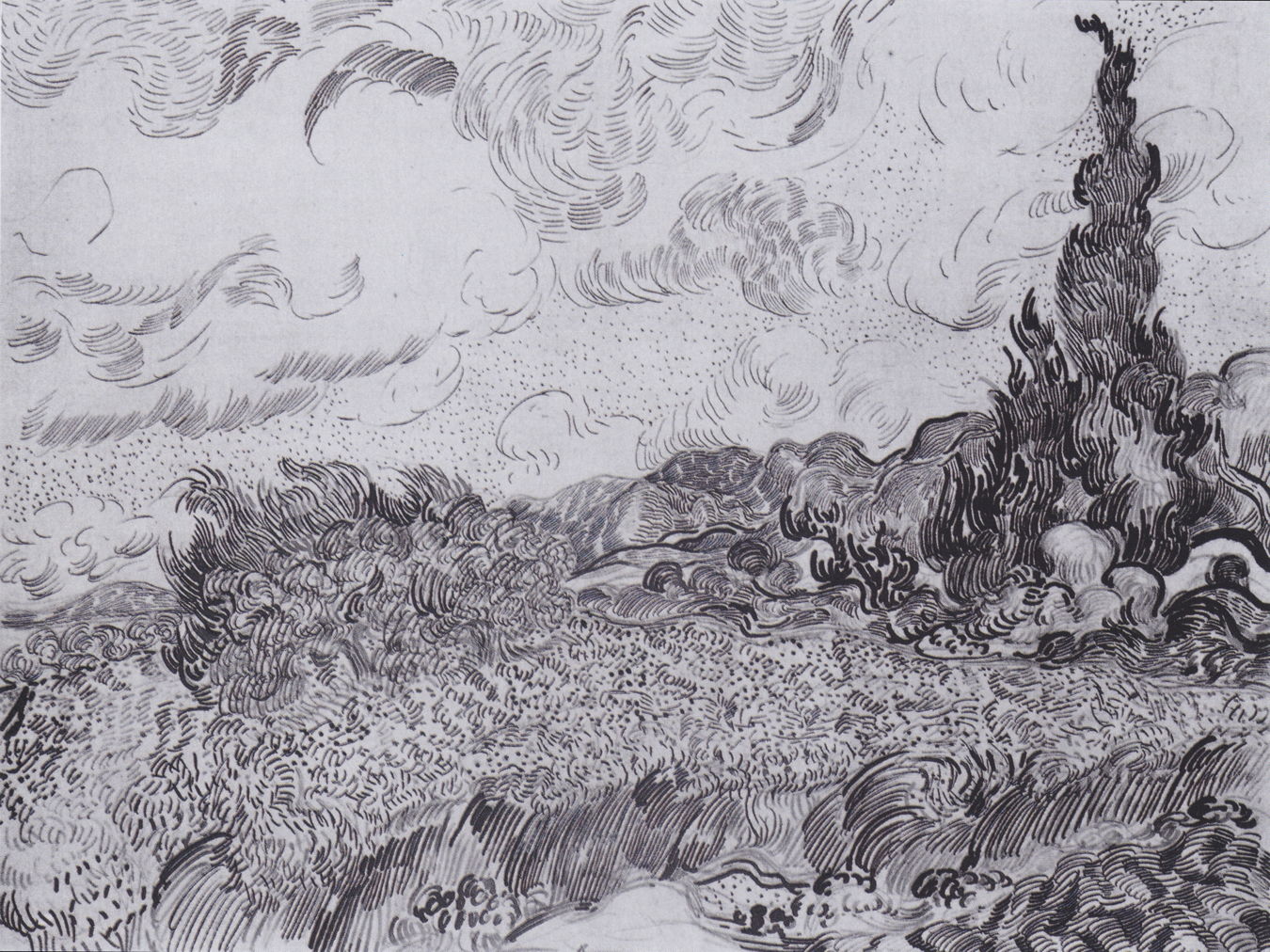
Another drawing followed, this time in black chalk and pen.

This, his first oil sketch, was finished by early July, when he wrote to his brother Theo, “I have a canvas of cypresses with some ears of wheat, some poppies, a blue sky like a piece of Scotch plaid; the former painted with a thick impasto like the Monticelli’s, and the wheat field in the sun, which represents the extreme heat, very thick too.”
In late July and early August, van Gogh had something of a psychiatric crisis, and didn’t return to paint his ‘finished’ version until late August.

He then made this second version in the studio; this is now in London’s National Gallery. He finally painted a third and smaller version in the studio, which he sent to his mother and sister as a gift; that is now in a private collection.
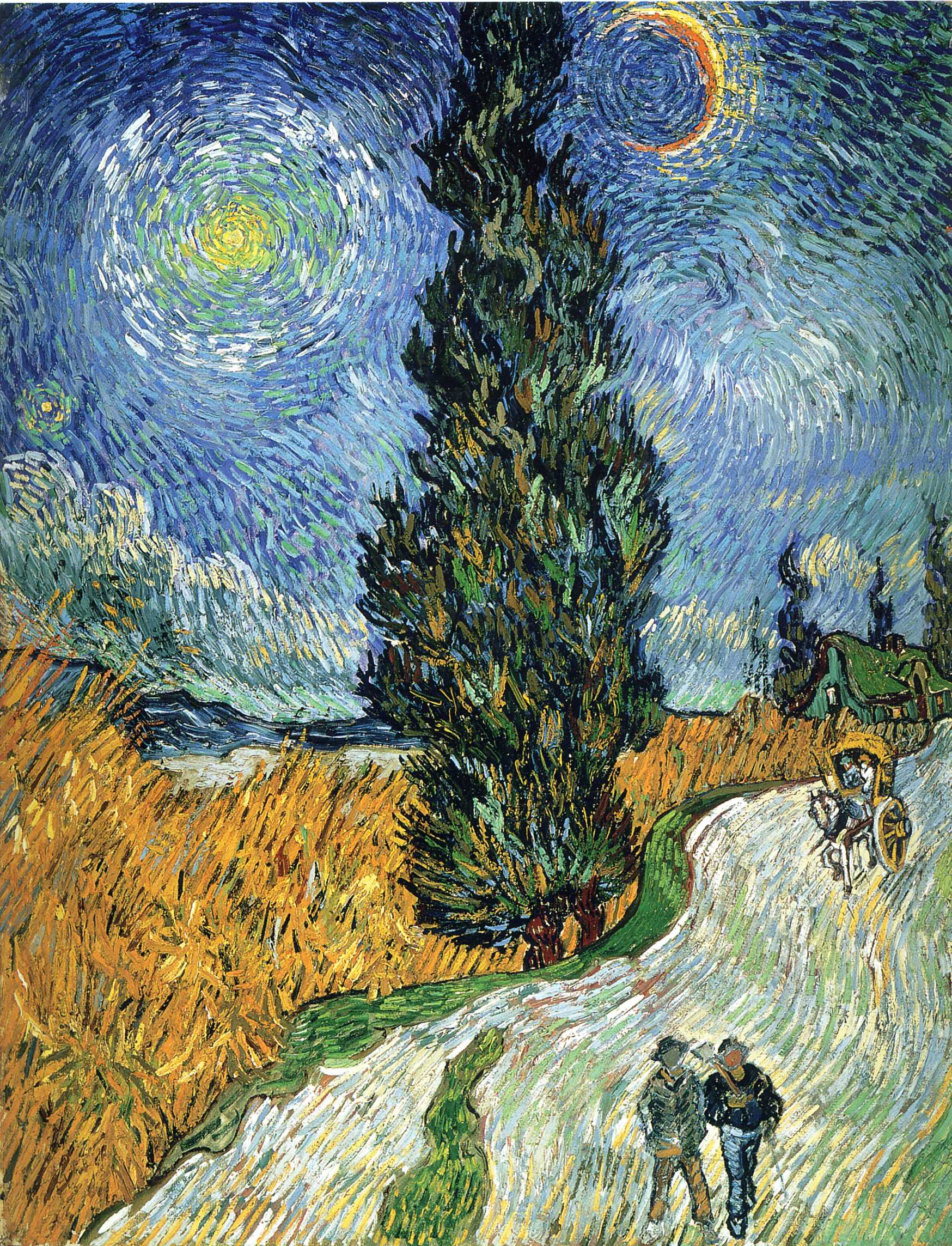
Van Gogh continued to paint his wonderful cypress trees almost up to the day of his death. Painted just two months before then, his Road with Cypress and Star from 1890 is perhaps his ultimate expression of the form, texture, and colours of cypress trees in Provence, its swirling brushstrokes rising to form halos around the crescent moon and solitary star.

In the early years of the twentieth century, the Ukrainian painter Ivan Trush travelled to Italy, Egypt and Palestine, and probably painted this Landscape with Cypresses in Italy in about 1900. Like many of his surviving landscapes it appears to have been painted en plein air, and makes good use of rich colour, with the popular ‘complementary’ combination of red poppies with green fields, as previously painted by Elihu Vedder and van Gogh.
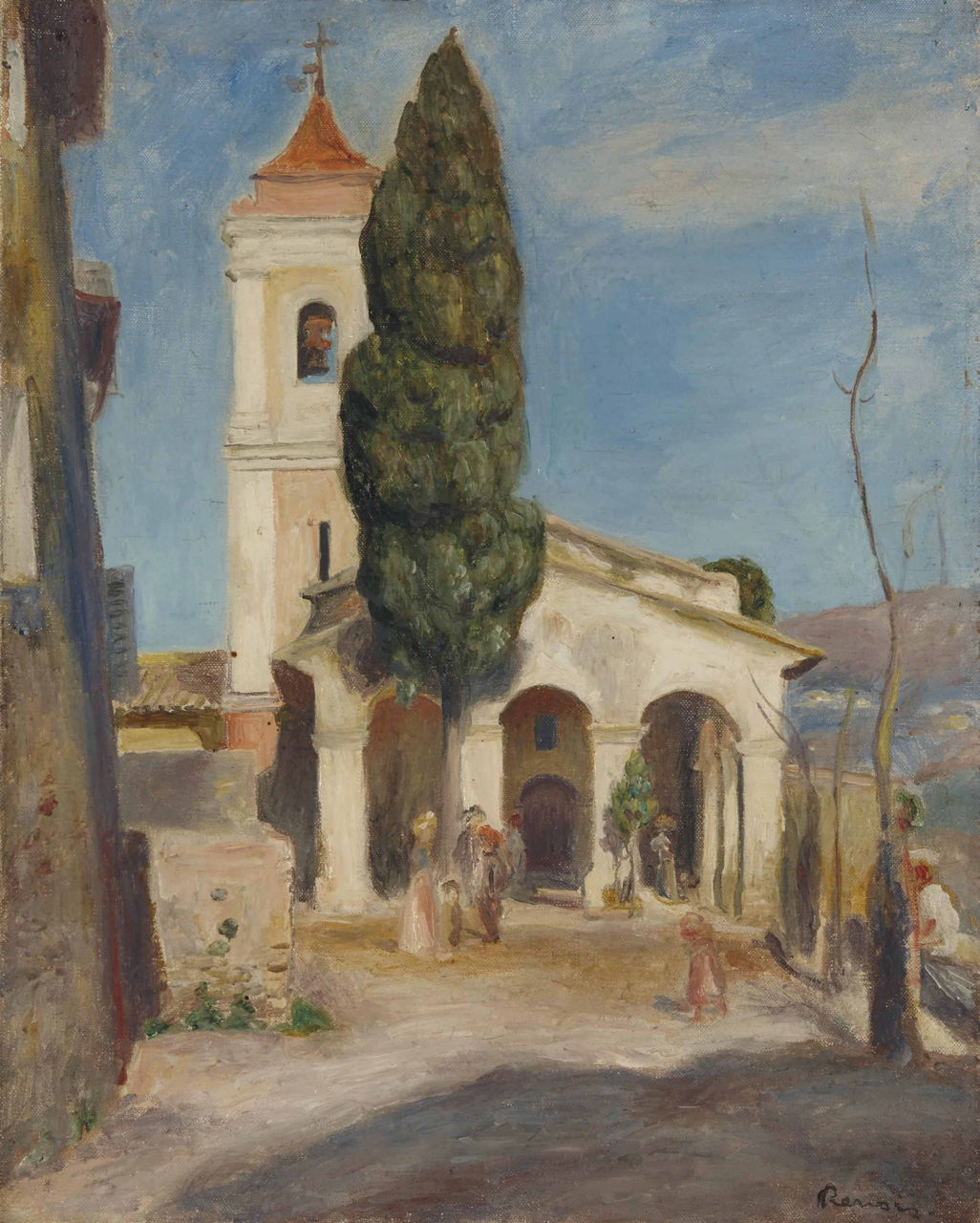
Pierre-Auguste Renoir’s view of The Church of Notre-Dame de Protection at Haut-de-Cagnes from 1905 shows this mediaeval village set a mile or two further inland and well above the Mediterranean seaside resort of Cagnes, where the artist spent his later years. The tall cypress tree echoing the church tower is more substantial than his previous sublime trees, and has its own echo in the stripped trunk at the right edge of the canvas.
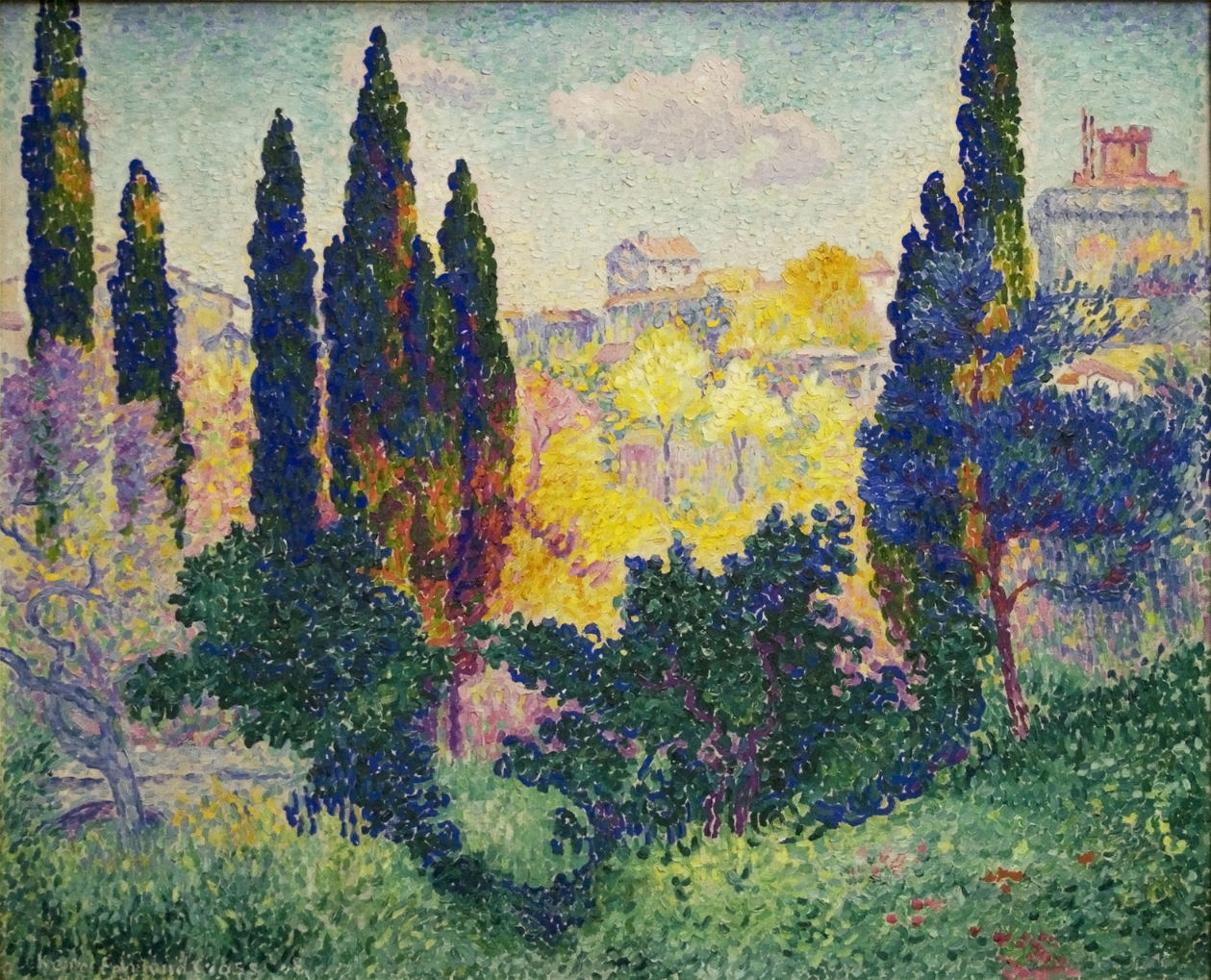
The small town of Cagnes-sur-Mer, to which Renoir had recently moved, is a couple of hours travel north-east along the coast from Henri-Edmond Cross’s home in Saint-Clair towards Nice. His view of Cypresses at Cagnes (1908) shows the dazzling vegetation there.
In July 1913, Gustav Klimt had holidayed with the Flöge family on Lake Garda, where he painted the landscape.
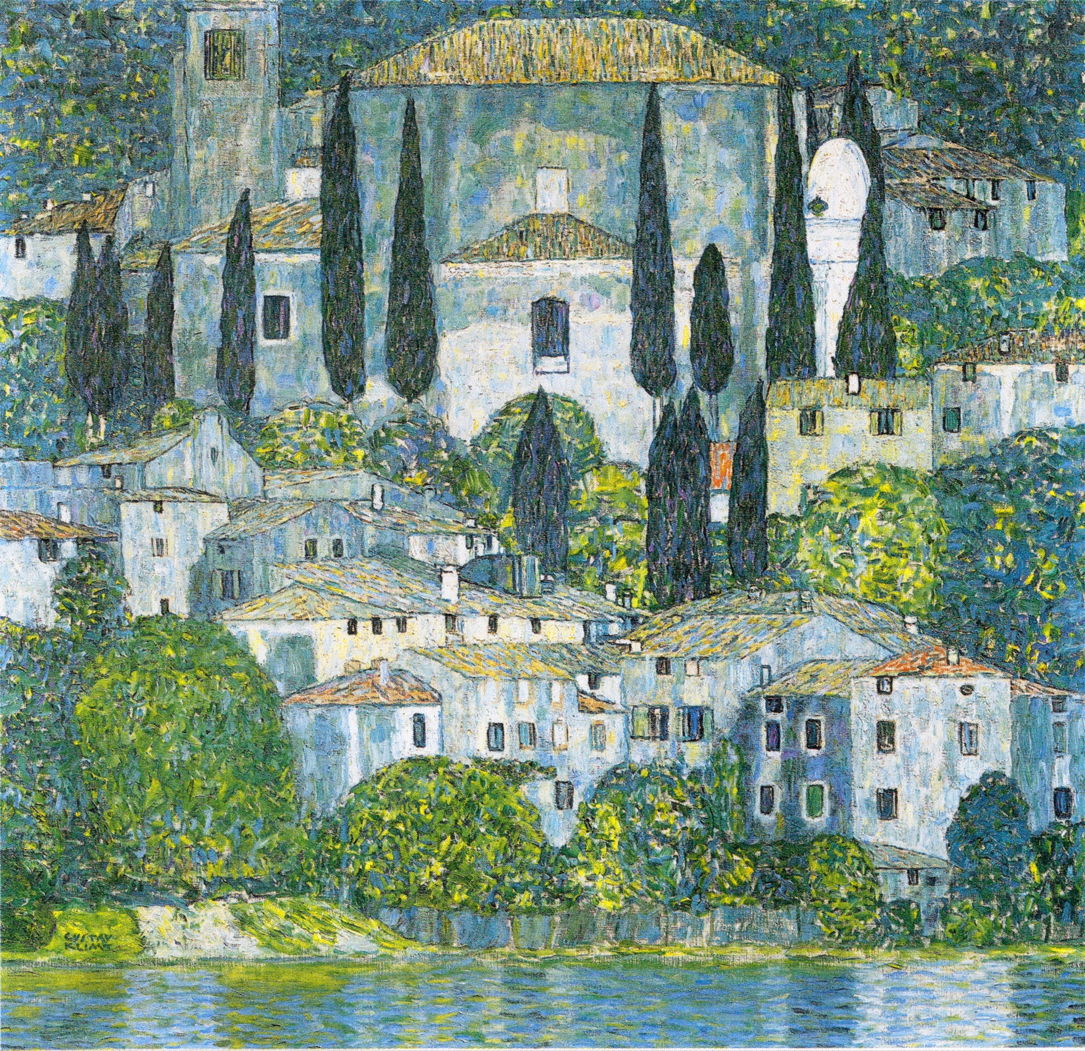
Klimt appears to have taken his telescope with him, through which he painted this view of the Church in Cassone (1913). It’s dominated by the distinctive forms of many cypress trees.
The following year the Great War broke out, and many more cypresses were to follow across the military cemeteries of Europe.

