
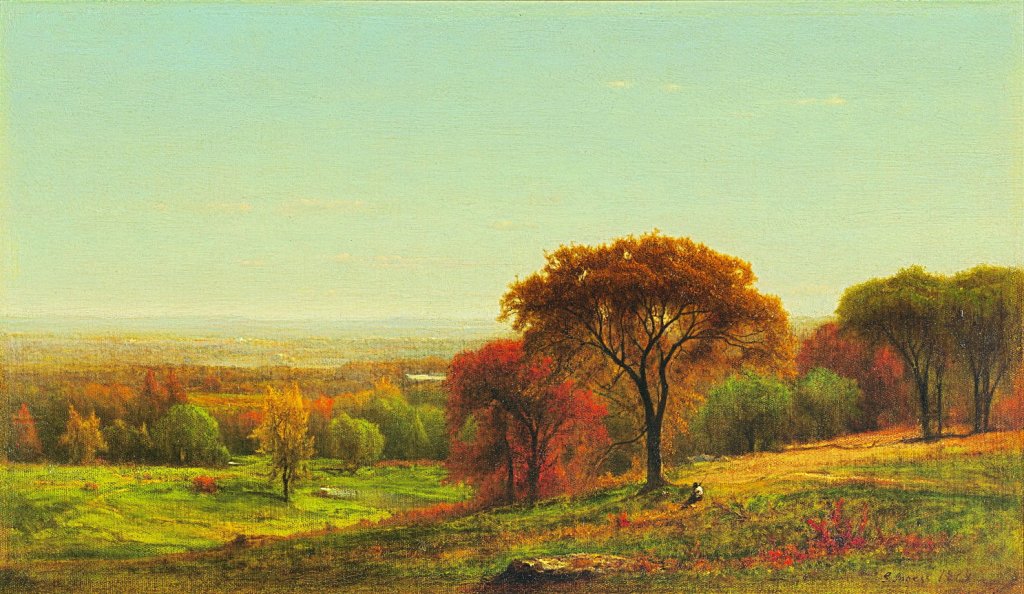
To celebrate the two-hundred and fiftieth anniversary of American Independence, this weekend I take a grand tour of some of the nation’s finest landscape paintings.

I begin with one of a series of paintings of flag parades started by the Impressionist Frederick Childe Hassam in 1916. These show flag parades, known then as “Preparedness Parades”, which were part of the war relief effort.

Many of Frederic Edwin Church’s epic landscapes were painted further south, well beyond the US border, but this early panoramic view made in 1857 remains one of his most important works. It’s now best read in its historical context, as a product of a time when secession of Southern states from the Union seemed imminent. Coupled with the significance of the Niagara Falls, and the unity of Church’s details, this painting became associated with the struggle to maintain that union, which broke down only four years later in the American Civil War.

My favourite of Albert Bierstadt’s huge paintings of apocalyptic landscapes is A Storm in the Rocky Mountains, Mt. Rosalie from 1866. Having already established a preference for painting grand views of mountains, Bierstadt first travelled west towards the Rocky Mountains in 1859. He established a pattern of sketching and photographing spectacular scenery, then returning to his studio in New York and turning that material into a series of paintings of the Burkean sublime.
He uses his full array of skills and sketches from his second expedition to the West in 1863, to express the sublime, and fill the viewer with awe and trembling. The foreground shows a pastoral valley floor with a native American camp, in mottled light. Some people and their animals are seen making haste to return from the pastures to the shelter of the camp. A small rocky outcrop has trees straggling over it, which are silhouetted against the brilliant sunlight on the lake behind, in the middle distance.
Behind the lake the land rises sharply, with rock crags also bright in the sunshine. In the background the land is blanketed by indigo and black stormclouds. Those clouds are piled high, obscuring much of Mount Rosalie (named by Bierstadt after his wife), but its ice-clad peaks show proud, high up above the storm, with patches of blue sky above and beyond them. A single large bird, an eagle perhaps, is seen in silhouette, high above the lake. Rosalie Peak, as it’s now known, is in the Colorado Rocky Mountains.
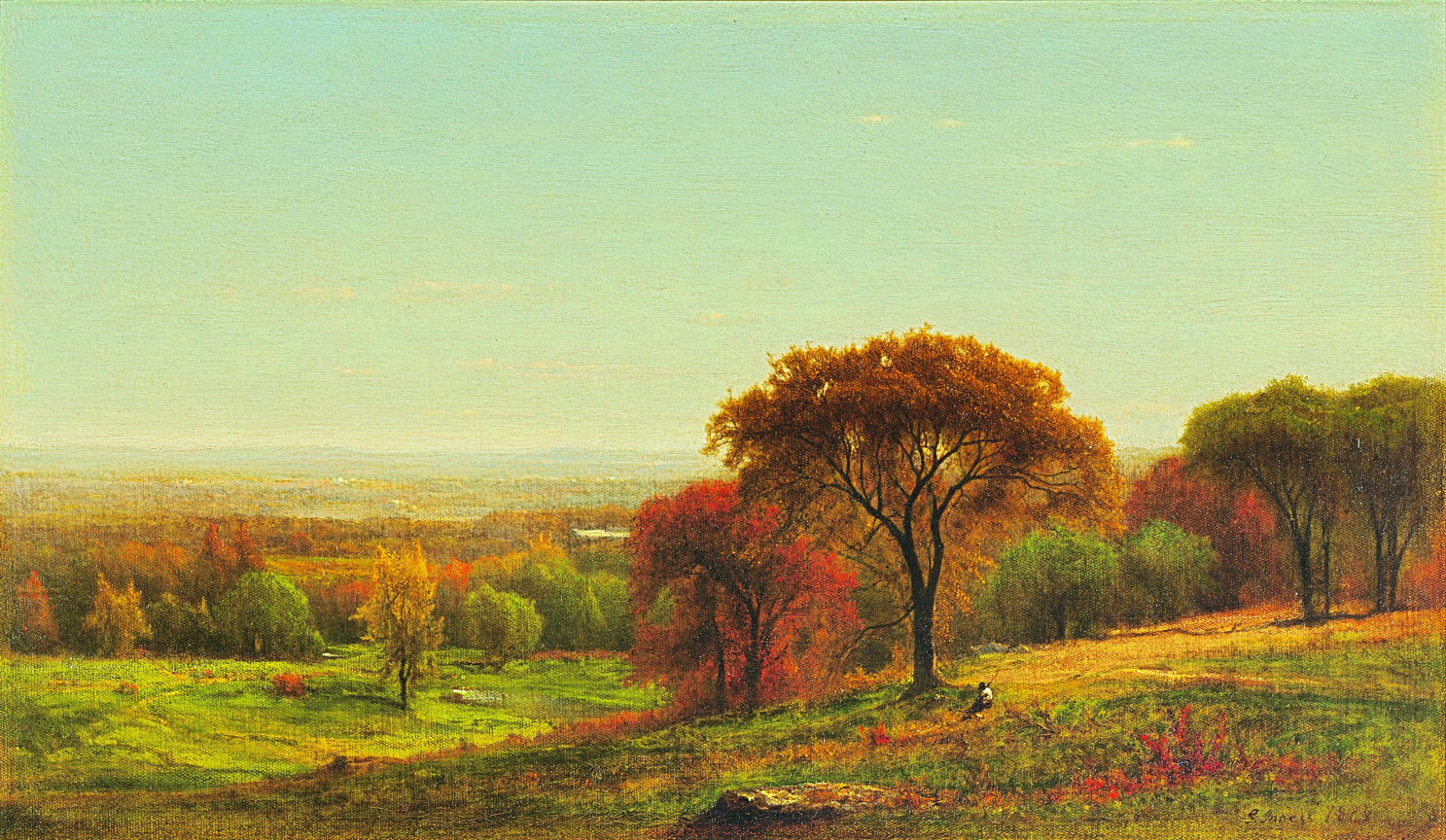
Like many artists of the time, George Inness obtained patronage to enable him to travel to Europe. He arrived in Rome in 1851, where he studied the paintings of Claude Lorrain and Poussin. He also travelled to Paris in the early 1850s, where he was influenced by the Barbizon School. He consequently developed a Barbizon style, but remained a realist. He moved his studio to Medfield, Massachusetts, in 1860, then to Eagleswood, New Jersey, in 1864, from where he painted this view over the Hudson Valley in New York State.
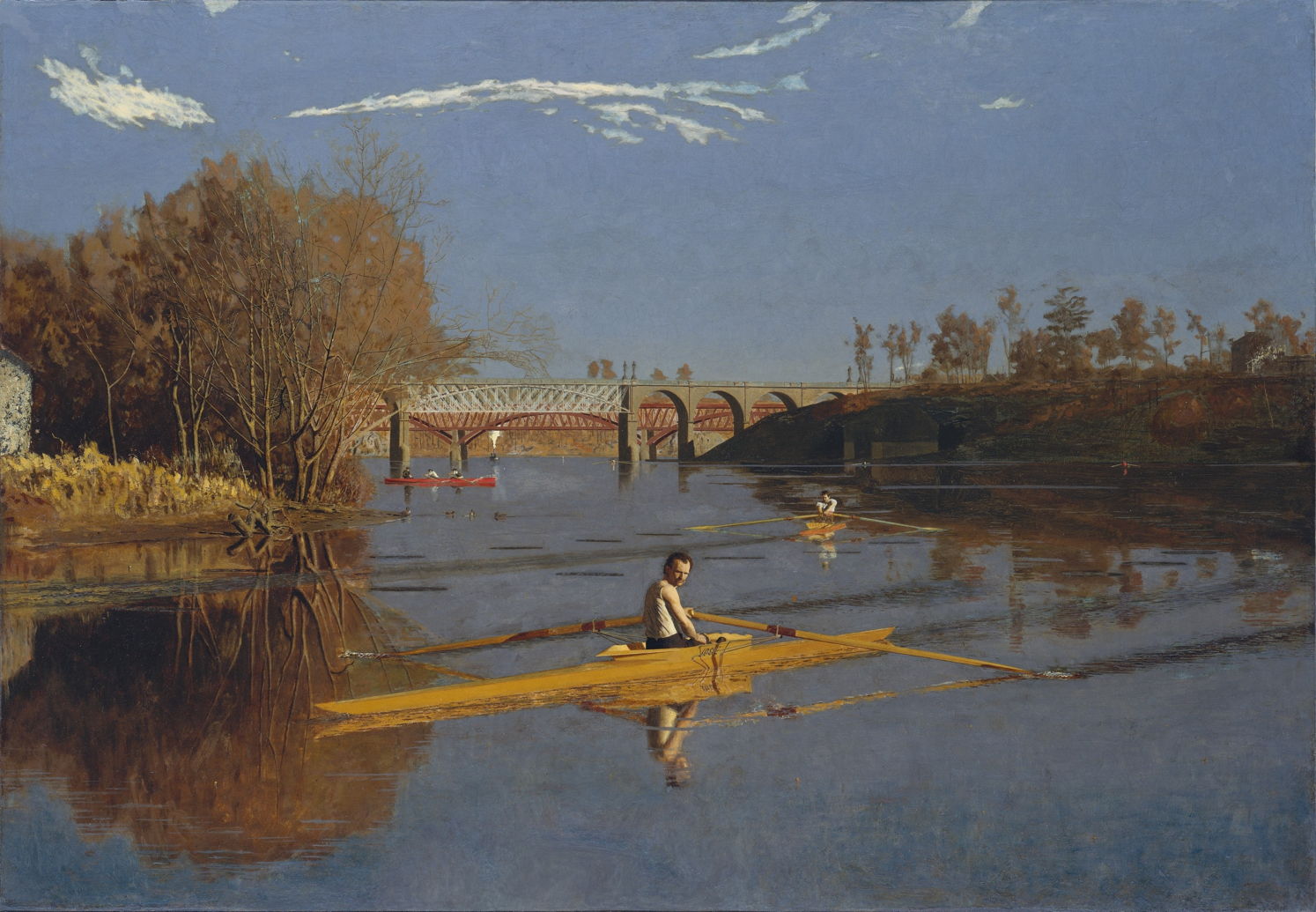
Thomas Eakins also studied in Europe. His first painting on his return to Philadelphia in 1871 is his masterpiece, The Champion Single Sculls (Max Schmitt in a Single Scull), the first in a series showing activities on the city’s Schuylkill River. Eakins’ friend and successful rower Max Schmitt is in the nearest boat, and Eakins (a keen oarsman himself) is the figure in the further single scull. It’s meticulously detailed, even down to the puddles in the water made by Eakins’ oars as he rows into the distance, and its clouds are calligraphic.
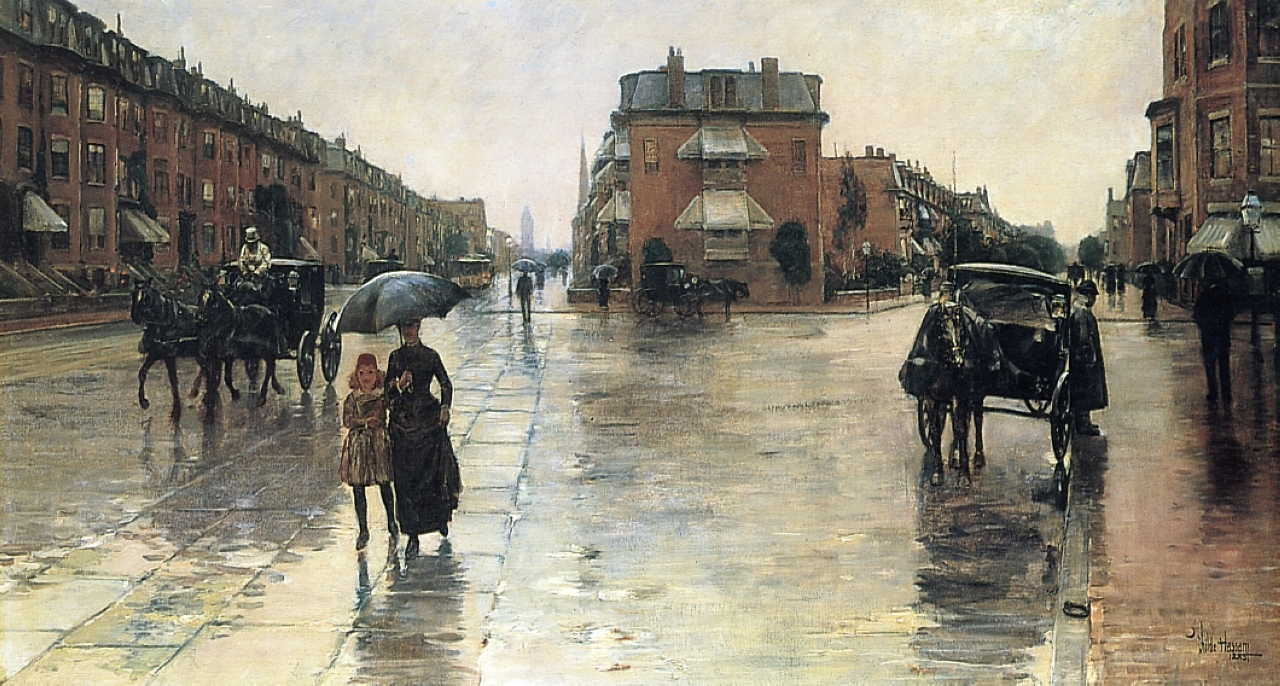
Throughout the early part of Childe Hassam’s career, some of his paintings appeared to borrow from those (now more famous) of the French Impressionists. For example, Rainy Day, Columbus Avenue, Boston (1885) has an uncanny resemblance to Gustave Caillebotte’s Paris, a Rainy Day (1877). However it’s not clear whether Hassam had seen the latter painting at the time, or this was mere coincidence.

The dome of the Massachusetts State House gives an Italian air to his wonderful view of Mount Vernon Street, Boston, Looking Towards the State House from about 1890.
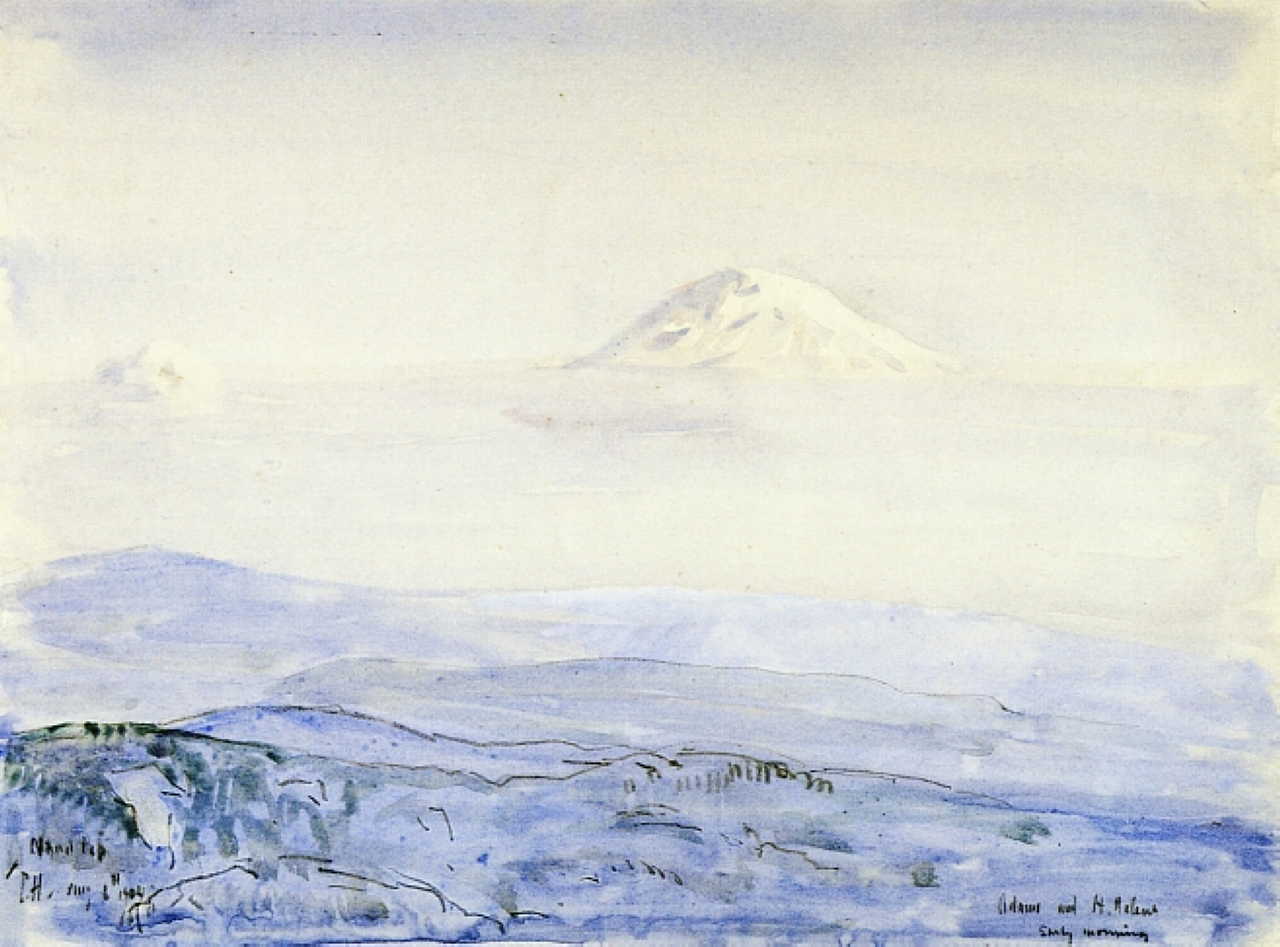
My last and contrasting landscape by Childe Hassam is an example of his plein air watercolours, showing the distant peak of Mount Saint Helens, in Washington State. This view reminds me of flying (not too near) this stratovolcano, which underwent a major eruption in 1980.
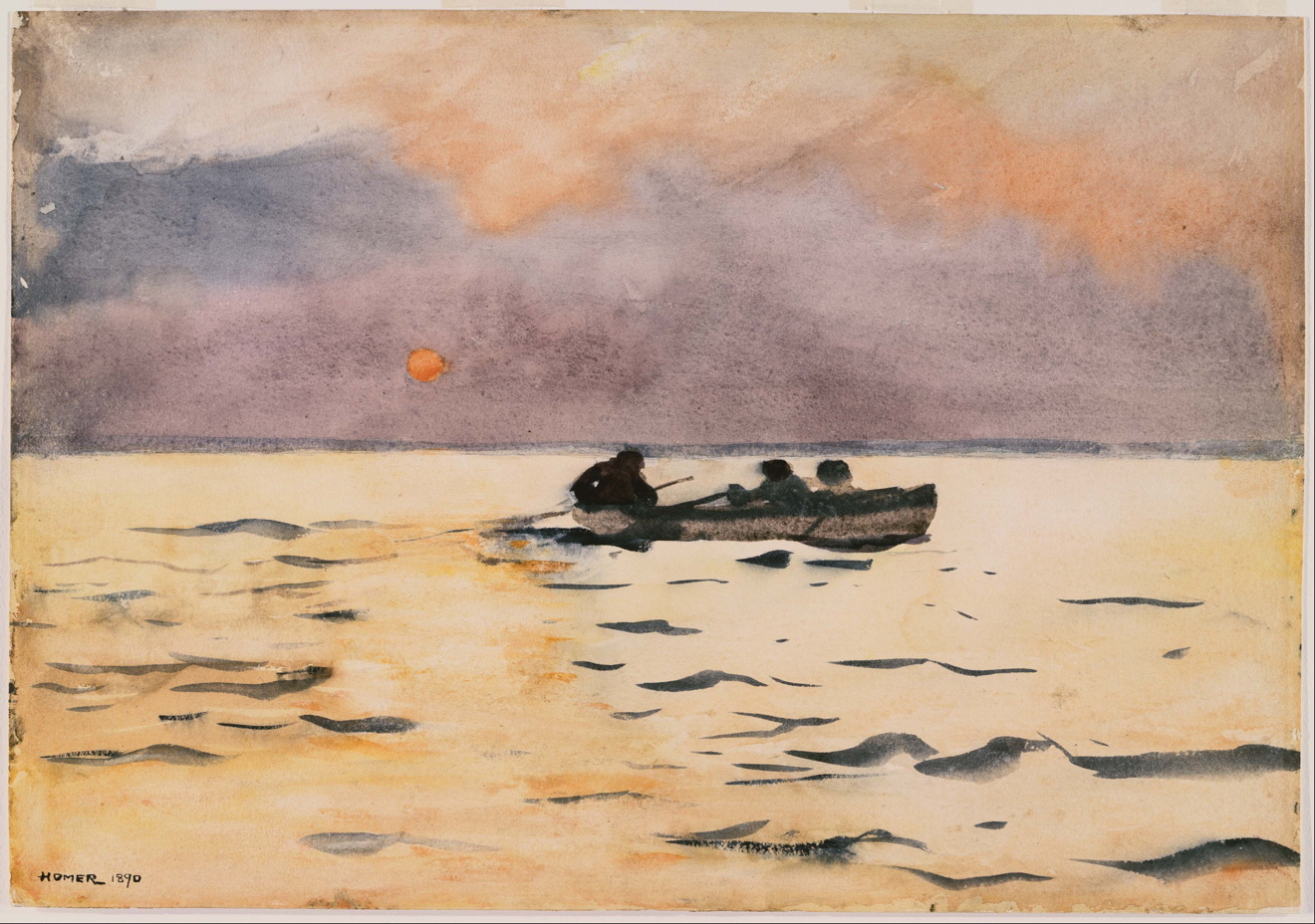
Winslow Homer was a brilliant watercolour painter of the late nineteenth century. His art was transformed by a stay in Europe, but not in the fashionable parts of France or Italy: he lived for two years in the small fishing village of Cullercoats in north-east England. This shows one of his many paintings made on the East Coast when he was living at Prouts Neck, Maine.
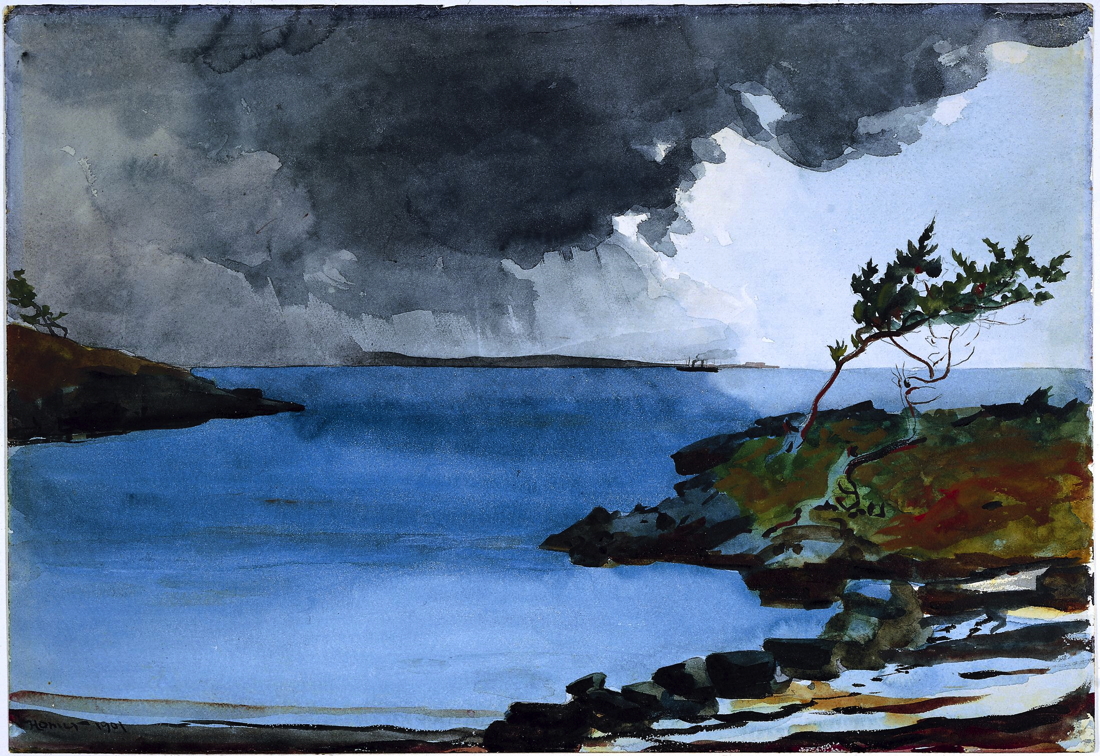
Homer’s The Coming Storm (1901) may have been painted in front of the motif when he was visiting Key West, Florida.

William Merritt Chase had studied in Munich, Germany, before settling in New York City. He bought a property in the Shinnecock Hills on eastern Long Island, New York, from where he also taught at his popular and influential Summer School for twelve years. The Big Bayberry Bush from about 1895 is one of his many views of this part of Long Island when it was still largely unpopulated.
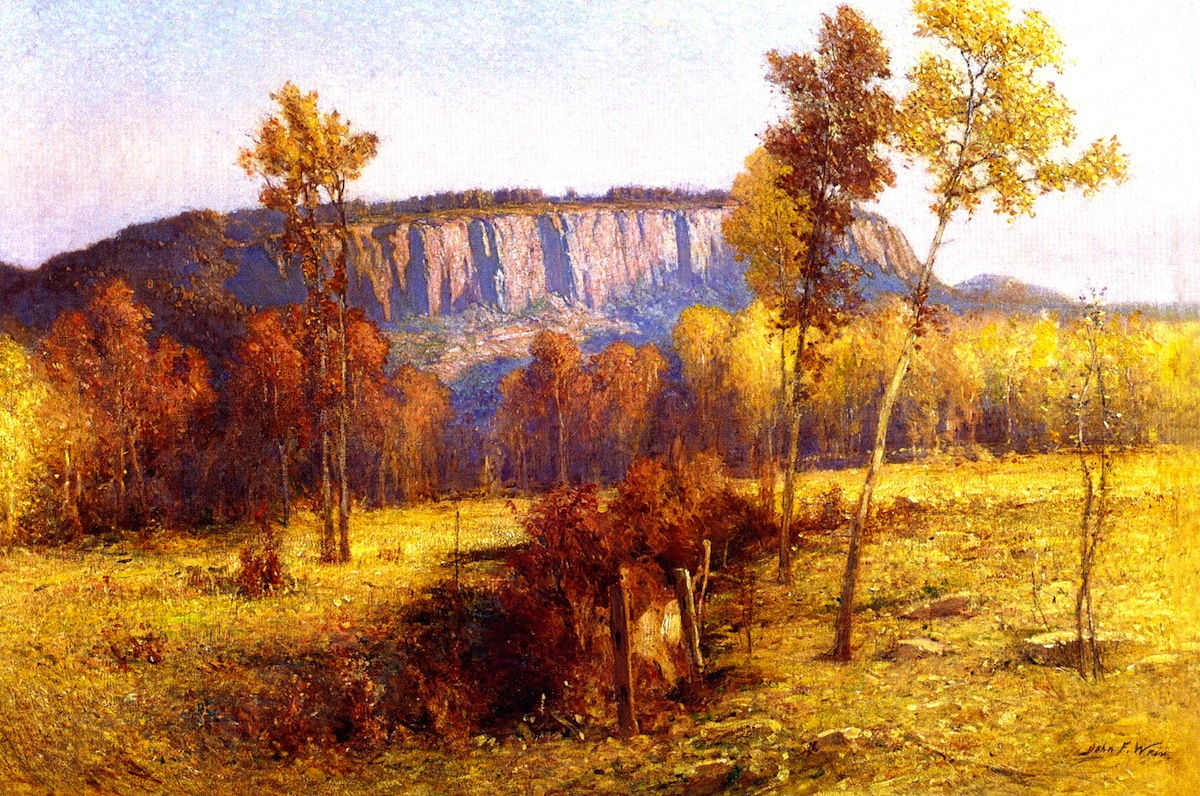
John Ferguson Weir’s vibrant painting of East Rock, New Haven from about 1901 shows the landscape not far from his home and his work as the founding Dean of the School of Fine Arts at Yale University, New Haven, Connecticut. He enlisted the help of his brother, the painter Julian Alden Weir, to model classes at Yale on the same lines as those of the École de Beaux-Arts in Paris.

