
After Odysseus and his colleagues had recovered Achilles from living in disguise as a princess in the royal court on Skyros, the warrior joined the fleet of a thousand ships that sailed against Troy.
Before arriving on the mainland of the Troad, some of the Greek fleet landed on Tenedos, the modern Turkish island of Bozcaada, where they faced a hostile reception. It may have been here that Achilles fought Cycnus and achieved the first victory of the war. This story was borrowed by Ovid for his Metamorphoses, in which the defeated Cycnus was transformed into a swan, cygnus in Latin.
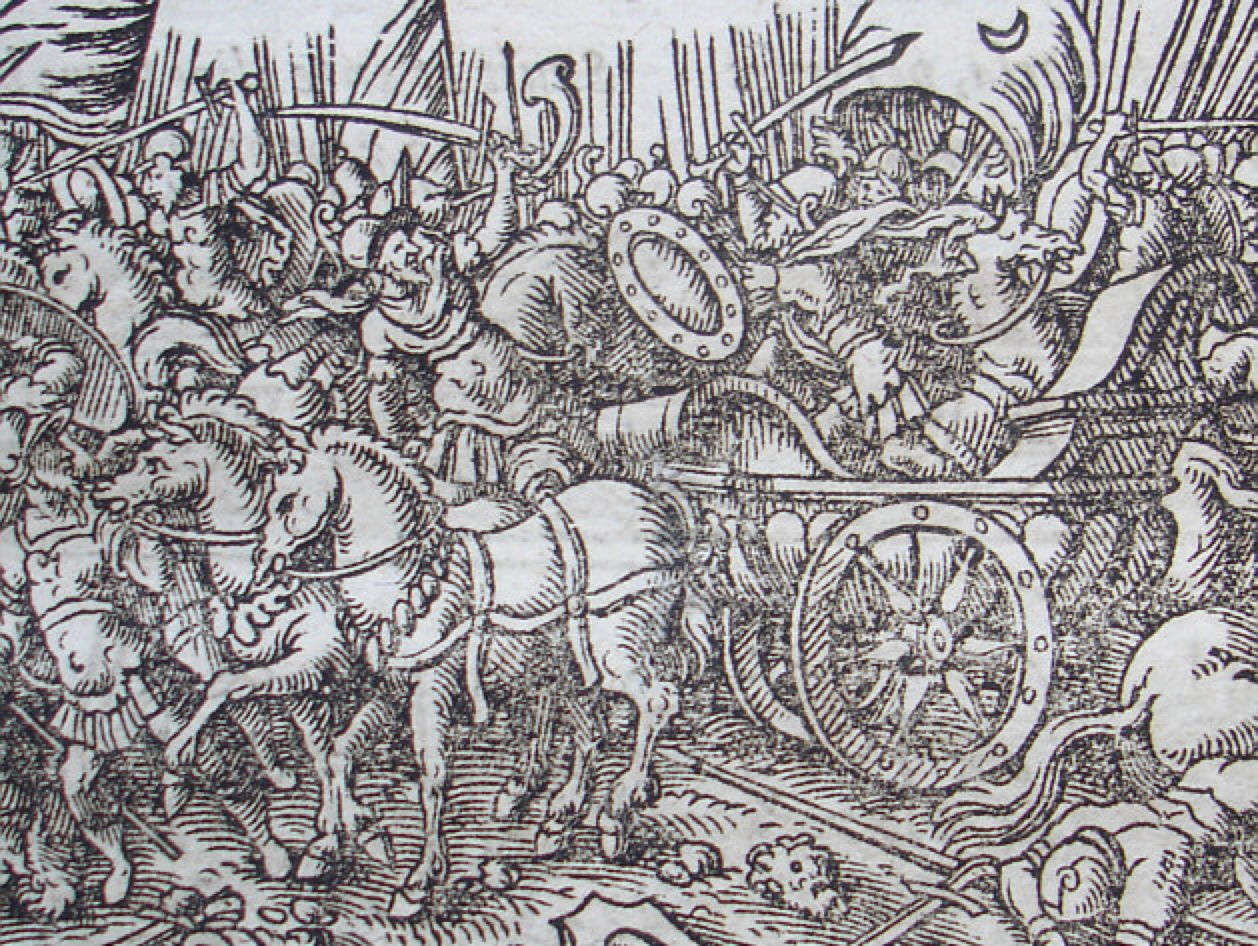
Virgil Solis’ Achilles Challenges Cycnus to a Duel from about 1560 shows Achilles and Cycnus swinging their swords at one another in the midst of this opening battle.
When the fleet reached the shore of the Troad, Hector and his army were expecting them. One of the first of the forces to disembark there, Protesilaus, became the first Greek death of the war, spurring Achilles and Agamemnon’s army to establish control over the Troad and isolate the city of Troy, where they were to spend the next decade. Thanks to Achilles and his fierce Myrmidon warriors, the Greeks soon put Trojan forces to flight. The invaders were then able to haul their ships ashore and build themselves an operating base.
Achilles was prominent during the nine years that preceded the siege, in a succession of battles that took possession of twenty-three cities. At some stage during this fighting, Helen and Achilles had a secret meeting. This was arranged by Aphrodite and Achilles’ mother Thetis, and if nothing else it ensured the Greek warrior had good motive to see the war through to its conclusion.
As the Greek forces closed on Troy, Achilles led forays into the pastures around Mount Ida, where he came into contact with Aeneas. Achilles chased him into the city of Lyrnessos, then attacked that city and Pedasos, sacking them both. In one of them Achilles killed the king, queen, their three sons and a son-in-law, leaving just the king’s daughter Briseis as survivor. As was usual at the time, Achilles took the widowed princess Briseis as his enslaved concubine.
Agamemnon, in spite of his marriage to Clytemnestra, had also won himself a concubine, Chryseis, daughter of Chryses, a priest of Apollo. Chryses was left alive, though, and tried to ransom her back from slavery. When Agamemnon refused to bargain with his concubine’s father, Apollo sent the plague to sweep through the massed Greek forces, with devastating effect. This forced Agamemnon’s hand, and he returned Chryseis to her father.
Homer’s Iliad opens with this problem, and Agamemnon’s decision that he should take Briseis from Achilles, making her his own concubine in place of Chryseis. Abhorrent by any modern standards, women captured during war and in other circumstances were treated as prize possessions at the time, and Agamemnon’s action was by no means unusual.
Although Briseis was but a slave and concubine, there is evidence of a deeper relationship developing. Achilles’ great friend Patroclus had comforted her following the loss of her home city, family, and freedom, and promised to have Achilles make Briseis his wife when the war was over. The arrival of Agamemnon’s two envoys, Eurybates and Talthybius, to take Briseis to Agamemnon was therefore a great shock to Achilles, Patroclus, and Briseis.

In 1801, JAD Ingres’s painting of Achilles Receiving the Envoys of Agamemnon made him the victor of that year’s competition for the Prix de Rome, and launched him on his career as one of the great history painters. The two envoys are at the right, explaining Agamemnon’s demand to Achilles at the left, who is clutching his lyre as he rises from his seat in anger. Patroclus stands behind him, wearing his helmet and a look of bemusement.
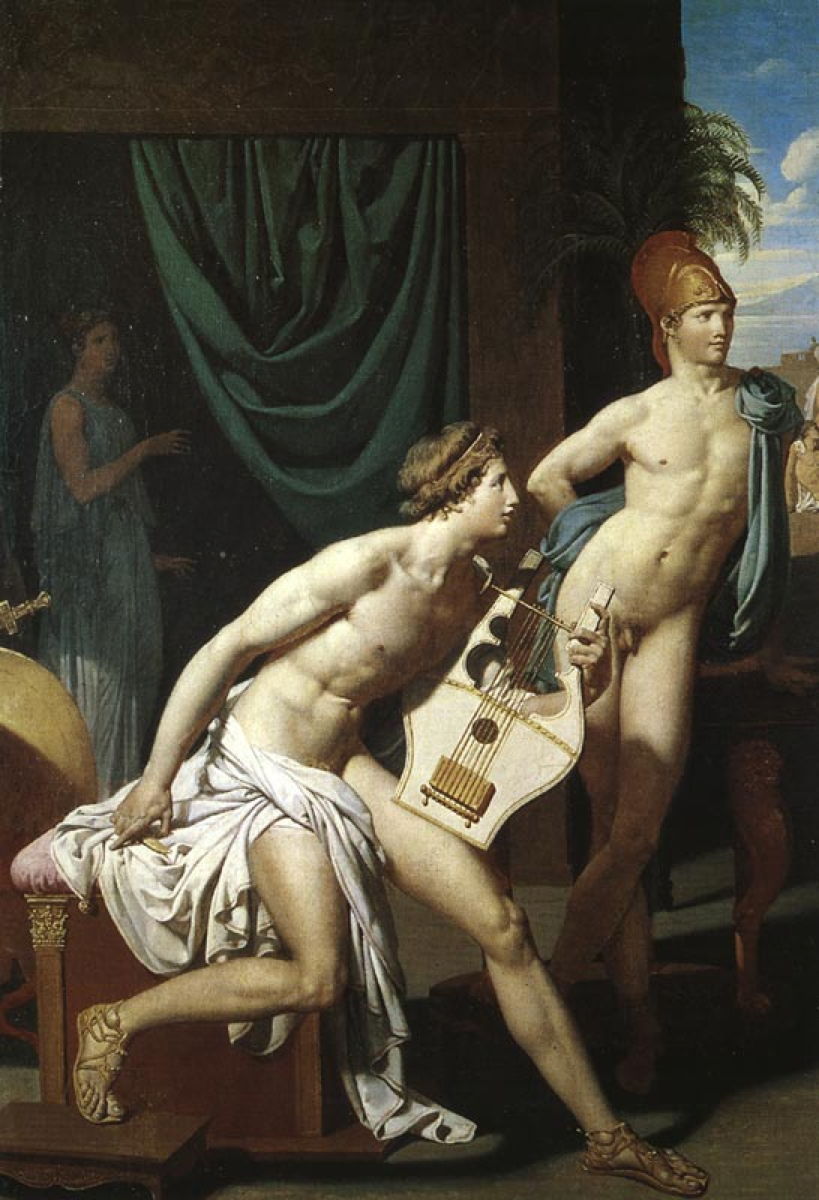
This detail shows Achilles and Patroclus in the foreground, with Briseis behind in Achilles’ tent. As a non-Greek she may have found it difficult to understand the conversation going on with the envoys, which was perhaps just as well.

Tischbein’s painting of Briseis Led from the Tent of Achilles (1773) makes the removal of Briseis from Achilles’ tent look quite amicable. By any account, it was far from that.

John Flaxman’s original drawing of Briseis Taken from Achilles, made between about 1793-1805, perhaps to illustrate Pope’s translation of the Iliad, catches the atmosphere better as Achilles sulks in anger, and Patroclus tries to comfort Briseis again.

Piroli’s final engraving of Flaxman’s illustration, Briseis Taken from Achilles (1793), shows an oddly weaker composition and lacks body language.
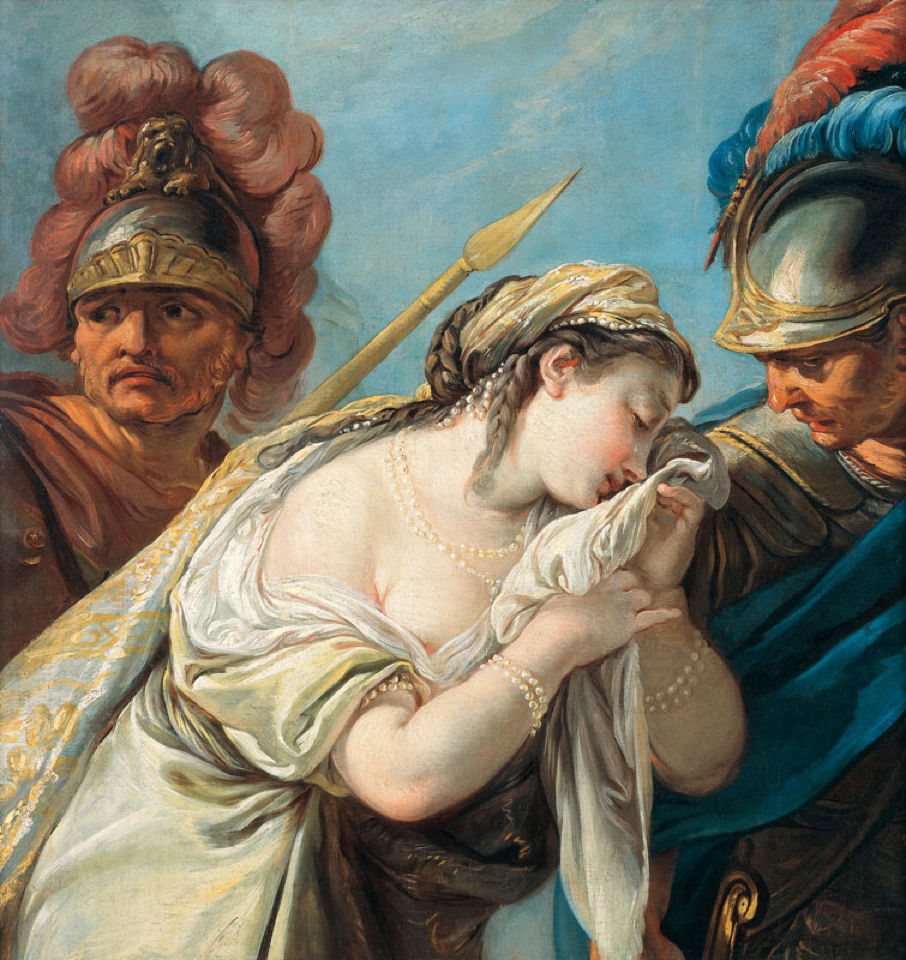
Jean-Baptiste-Henri Deshays’ Briseis Led from the Tent of Achilles (c 1761) is a close-cropped view of the grief of Briseis as she is led away by the envoys, in an interesting change of focus from Achilles.

George Frederic Watts showed an alternative version in his much later fresco of Achilles and Briseis (c 1858-60). Achilles is once again the centre of attention, and being comforted by another woman, as Patroclus, further to the left, looks resigned.

Tiepolo told the story over three sections of fresco in the Villa Valmarana, Vicenza. This is the last of the three, Eurybates and Talthybius Take Briseis, Achilles’ Concubine, to Agamemnon, from 1757.
The Iliad continues, its focus on Achilles and his anger, resulting in the warrior withdrawing completely from the action. This was devastating to the Greek campaign; as Achilles’ anger simmered steadily over the following days, the Trojans, who had changed tactics and come outside their city’s walls to confront the Greeks, started gaining the upper hand.
Agamemnon knew he had to persuade Achilles to re-engage if they were to have any chance of success. He tried offering Achilles wealth as compensation for the loss of Briseis, and a deputation of Ulysses, Ajax, and Phoenix was sent to appease Achilles’ wrath, but failed.
It was about this time that, according to Ovid’s fictional account in the third letter of his Heroides, Briseis might have written to Achilles. Whereas much of Homer’s Iliad is devoted to describing Achilles’ side of the story, Ovid takes up the cause of his former concubine, then presumably sharing Agamemnon’s bed.

Robinet Testard’s miniature Briseis Writing to Achilles (c 1510) shows this, in Octavien de Saint-Gelais’ translation of the Heroides into French. Briseis weeps as she struggles to write to her former captor in a foreign language.
Ovid’s fictional letter goes over the horrific murders of both her parents, her three brothers, and her husband. Despite that, Briseis even offered to remain Achilles’ enslaved concubine if he were to marry another woman. She pleaded with the warrior to take her back and settle with Agamemnon. She also swore that she had not slept with Agamemnon, although she doubted that Achilles had been faithful to her since their parting.
It looked increasingly as if the obdurate anger of Achilles was going to bring the defeat of the Greeks.

