
By 1912 Colin Campbell Cooper had mastered the novel art of painting New York’s rising skyscrapers, and he and his wife travelled extensively in Europe and beyond. In April of that year they were returning to New York in the liner RMS Carpathia, and happened to be among the witnesses to its rescue of survivors from the sinking of the Titanic on 15 April. He produced several paintings showing the events, although as they are views showing the ship that he was on, they must have been based on constructed scenes rather than his direct experience.
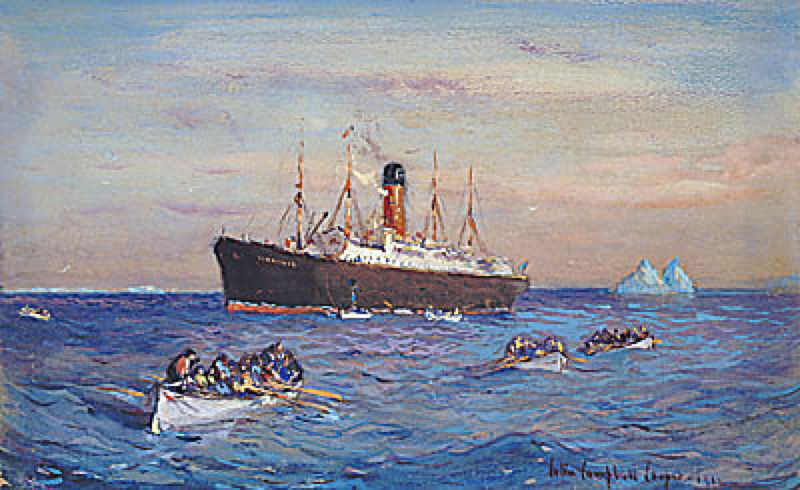
Rescue of the Survivors of the Titanic by the Carpathia, above, and View of Steamship Carpathia Passing along the Edge of the Ice Flow after Rescuing Survivors of the Titanic, below, were both painted in gouache on cardboard. I apologise for the small size of these images.

In 1913, the Coopers travelled to India, apparently commissioned by a rich woman in the US to paint for her there. They visited, and painted in, what are now India, Pakistan, Sri Lanka, and Myanmar.

Taj Mahal, Afternoon (c 1913) was probably the best-known painting resulting from that trip, and was exhibited on their return in Rochester, NY, in 1915. Cooper and his wife, Emma Lampert Cooper, showed an equal number of paintings, but hers seem to have disappeared almost without trace.
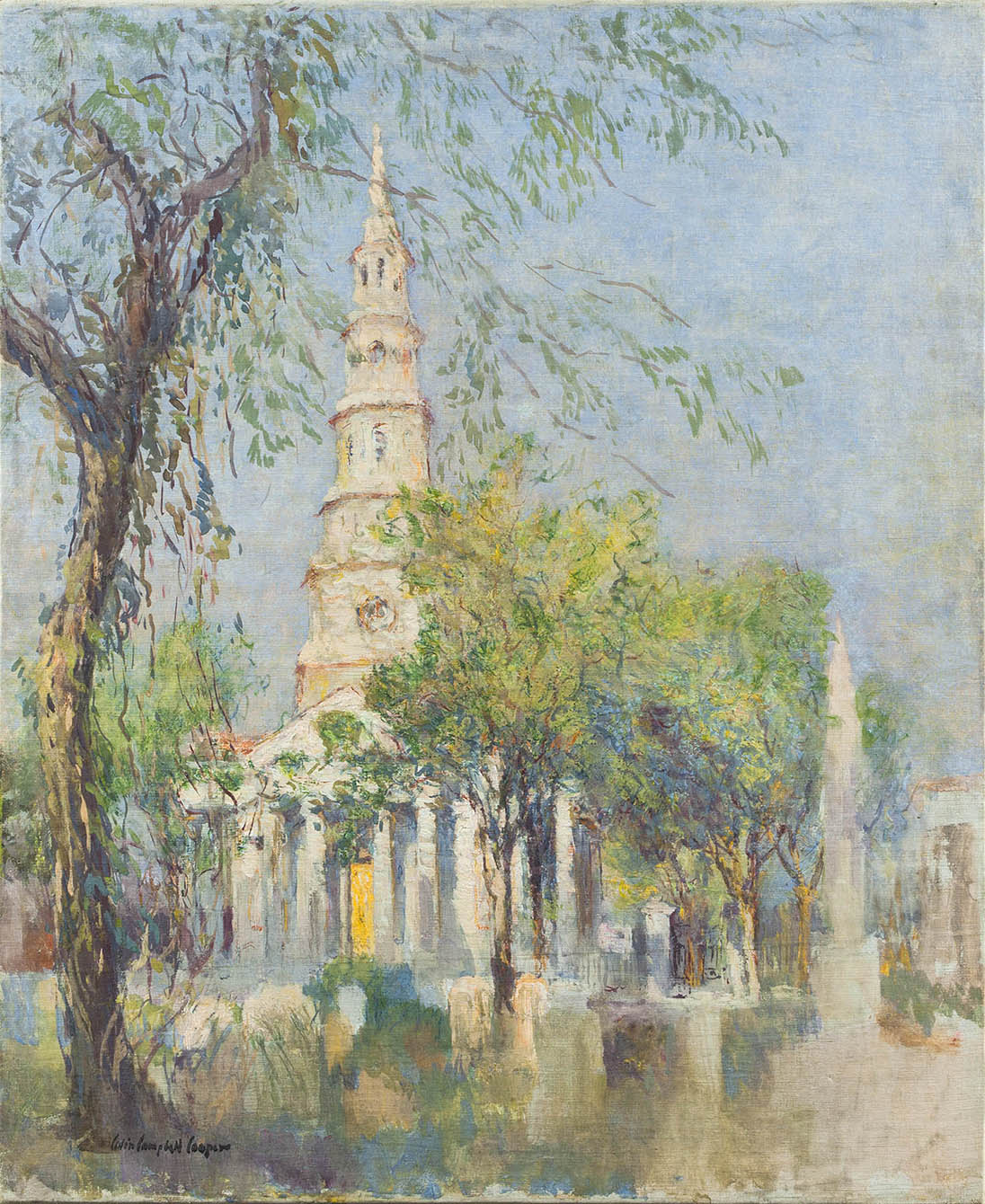
Saint Philip’s Church, Charleston (1913) shows this beautiful Episcopal church in South Carolina, amid Cooper’s highly gestural foliage of trees. The church was built in 1835-6 to replace a series of ill-fated wooden buildings. Its spire was completed in 1850, and served as a navigational lighthouse for many years.

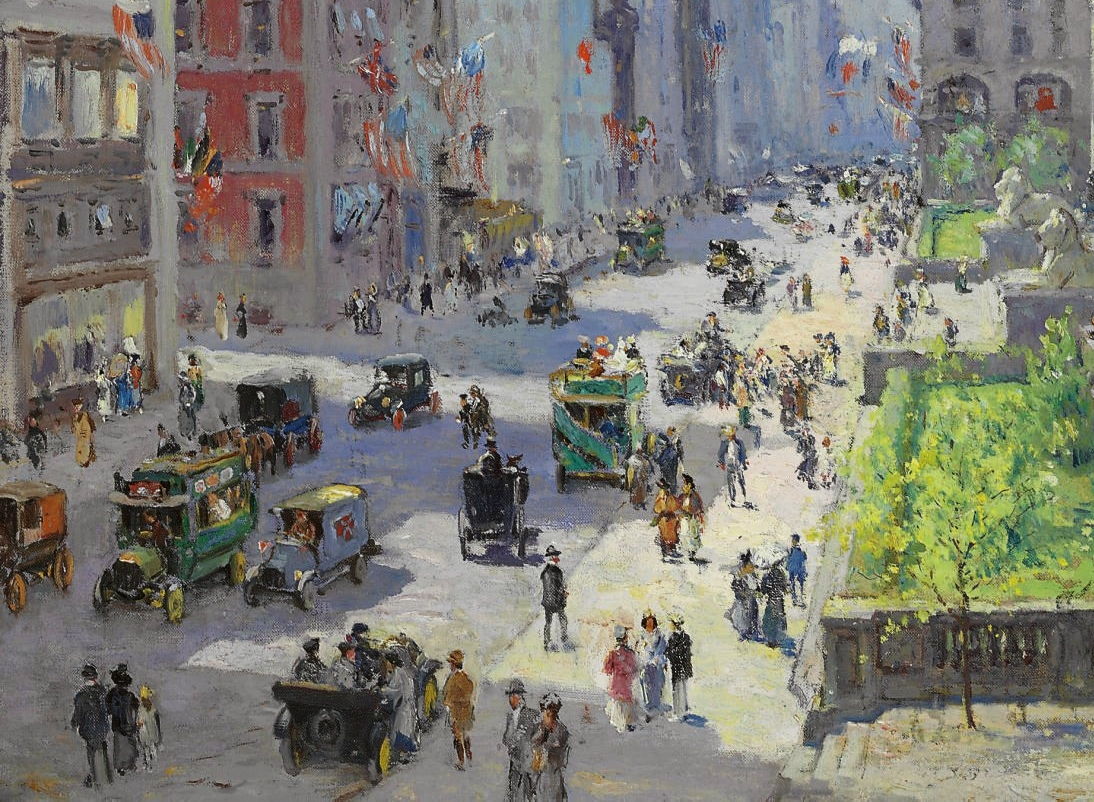
In these later paintings, Cooper moved from the solid masses of skyscrapers to greater lightness and greenery. Although one high building is still present in his New York Public Library (c 1915), the street is less densely packed, and the plants and trees brilliant green.
In 1915 he exhibited in the Panama-Pacific International Exposition in San Francisco, and fell in love with the West Coast, so completing his transition from skyscrapers. He and his wife spent the winter of 1915-16 in Los Angeles, and decided to move there permanently.

Cooper painted several views of that International Exposition, the most spectacular being that of the Palace of Fine Arts, San Francisco (c 1916) on a cloudless night, one of his few nocturnes.

Summer (1918) is inspired by Japonisme, which was of course far stronger on the West Coast, and Claude Monet’s paintings from his garden at Giverny.
Following his wife’s death in 1921, Cooper moved to Santa Barbara, CA, where he became Dean of Painting at Santa Barbara Community School of Arts. He maintained his studio in New York until 1931, though.

Fortune Teller (1921) is another brilliant study in colour, light, and East Asian influence, although it’s something of a mystery that the woman at the left, whose fortune is being told, is holding a ukulele in her right hand.

Cooper still apparently craved the occasional skyscraper, and must have painted Hudson River Waterfront, New York City when he was back in his East Coast studio, in about 1921. The highlighted and tallest skyscraper on the left is the Woolworth Building, completed in 1913, and until 1930 the tallest building in the world, at 241.4 metres. But here the clouds are also built up high, and rise to belittle those human structures.

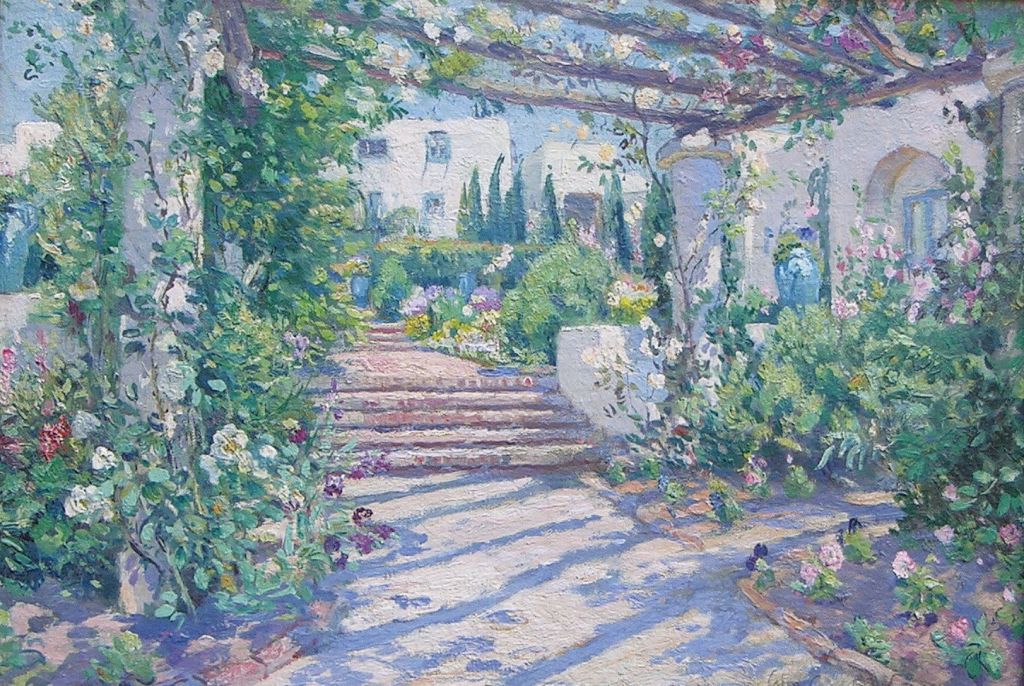
Back on the West Coast, Cooper completed some exquisite paintings of the lush vegetation in California, such as his Pergola at the Hotel Samarkand, Santa Barbara (c 1921). This hotel, more correctly named The Samarkand Persian Hotel, offered the height of luxury when it opened in 1920, in the buildings of what had been a boys’ school. Although it closed in 1940, the name lives on as one of Santa Barbara’s neighbourhoods.

Terrace at Samarkand Hotel, Santa Barbara, California (c 1923) shows Cooper’s sustained Impressionist style.
In the 1930s, Cooper’s failing eyesight limited his painting. Since his death in 1937, his works have been exhibited frequently throughout the USA, but as far as I can discover no exhibition has ever taken them to Europe, and very few of his paintings have entered major European collections.
Reference

