
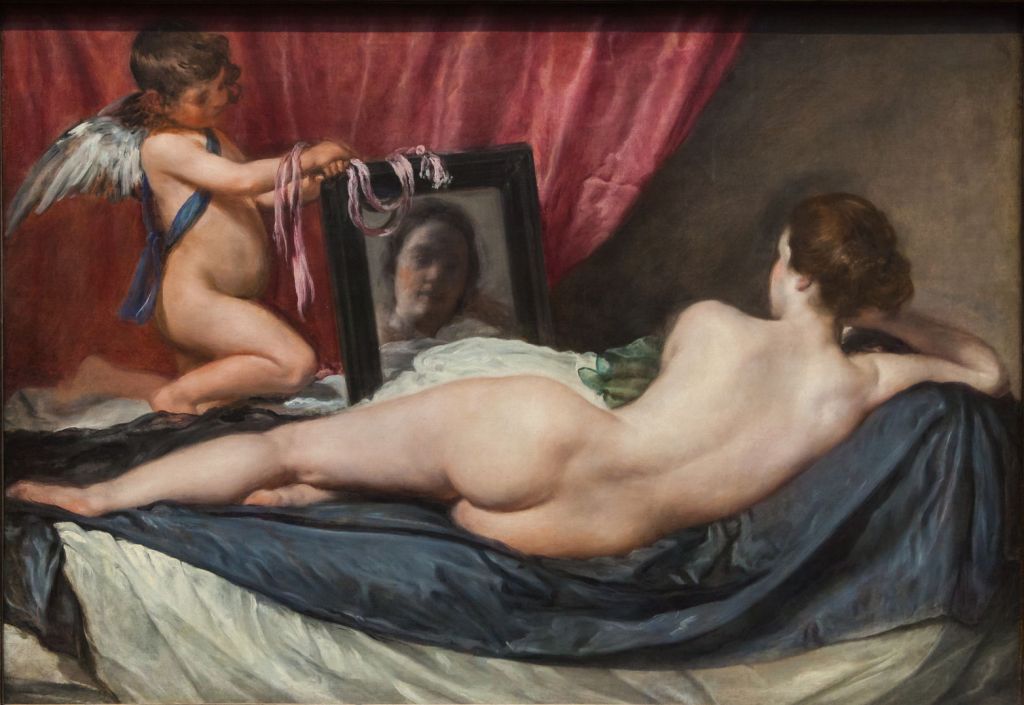
In 2003, the psychologists Marco Bertamini, Richard Latto and Alice Spooner published a paper in which they described a known phenomenon in the perception of paintings, and named it the Venus Effect. Their definition is: “The Venus effect occurs every time the observer sees both an actor (eg Venus) and a mirror, not placed along the observer’s line of sight, and concludes that Venus is seeing her reflection at the same location in the mirror that the observer is seeing.”
Although they dismissed optical “mistakes” as being of less interest, they were intrigued by “the situations in which we as observers read the scene in a certain way, but the mirror itself is used (deliberately or not) to lead us down the wrong path. More specifically, the mirror shows us something that we accept as the view available to the actor in the scene. However, the actor has a different vantage point
from us and therefore the laws of optics imply that he/she cannot be seeing what we see in the mirror.”
In this article, I explore what I believe to be the artist’s intention in this effect, of revealing the face of the subject of a painting in its reflection rather than in the original, a popular form of mirror play.

Frans Floris’s Allegory of Sight was probably painted around 1550, making it an early and quite sophisticated entry to the subject. The face of its figure is shown reflected in the only appropriate optical instrument of the day: a simple mirror, carefully angled to project most of the face. Although only a small feature, that reflection looks fiendishly difficult, given the wildly different angle between the mirror and the picture plane. In this case, what’s shown in the mirror is optically plausible, although the subject is looking at the viewer rather than the reflection.

This painting of Sight has been attributed to Abraham Janssens, and could date to any time between about 1590 and 1632. It appears to have been inspired by Floris’s Allegory of Sight, and the reflection of the woman’s face in the mirror doesn’t appear optically correct. She does appear to be looking at her reflection, although that’s optically impossible.

Hans von Aachen’s David and Bathsheba of about 1612-15 introduces a figure standing behind Bathsheba, holding a mirror in front of her face with his outstretched left arm. A glance at that reflection says that something is seriously amiss: von Aachen has painted a reflection in which Bathsheba is looking to the left, although her face is actually looking to the right. No single plane mirror could ever achieve that optical impossibility.

Although often illustrated by one of Titian’s paintings of Venus, the canonical example must be Velázquez’ Venus at Her Mirror, also known as The Toilet of Venus or the Rokeby Venus, from 1644-48. It shows the goddess Venus, whose face is blurred in a false reflection in a mirror being held by her son Cupid. The theme was common, seen in paintings by Titian and Rubens, with Venus sat upright. Giorgione and others had posed her reclining and facing the viewer, making her pose here unusual. Most other paintings of Venus set her in a landscape: here she rests on luxurious even sensuous fabrics.
No matter how convincing her face might appear in the mirror, a moment spent placing yourself in the same position confirms that the image in the mirror is wholly imaginary, and optically incorrect. Yet, according to Bertamini and others, the majority of viewers succumb to the Venus Effect and believe that Venus is looking at that image of her face.

JW Waterhouse’s Mariana in the South from about 1897 stands her in front of a full-length mirror revealing her face to the viewer, but she too is looking at her own reflection.

Laura Theresa Alma-Tadema’s A Knock at the Door, also from 1897, shows an attractive young woman checking that she is looking at her best in a mirror, before receiving a visitor. Once again it is the reflection that shows her face, and we’re struggling to be sure whether this is optically correct, although in this case the artist has at least brought closer alignment between the two optical axes.

Frederick Carl Frieseke’s Nude Seated at Her Dressing Table (1909) also uses closer alignment to appear more optically plausible, as this nude apparently studies herself in the mirror.

Walter Crane made this watercolour and ink drawing of The Mirror for Arthur Kelly’s The Rosebud and Other Tales, published in 1909. Although there are clear disparities between the alignment of face and chest with their reflection, this too appears plausible.

Lovis Corinth’s At the Mirror from 1912 complicates this further by raising the viewer well above the subject and her reflection, and revealing the artist standing behind her.
There are a few paintings where the artist has overtly declined to employ the Venus Effect.

Tintoretto’s Susannah and the Elders from about 1555 goes further with mirror play. Susannah has been caught as she is drying her leg after bathing in the small pool beside her, looking at herself in a rectangular mirror, which is propped up against a rosy trellis in a secluded part of her garden. Unlike in other paintings of nudes, neither the image seen in the mirror nor the reflection on the water show anything more of Susannah.

