
Of all the artists of the late nineteenth century, Paul Cézanne presents the greatest challenges over his depictions of reflections on water. From the earliest of his surviving paintings, he painted many landscapes featuring reflections, but few are faithful to optical principles.

Landscape on the Banks of the Oise is an Impressionist view from Cézanne’s first campaign along the River Oise in 1873, when he painted in company with Pissarro, and shows the northern bank near the hamlet of Valhermeil.
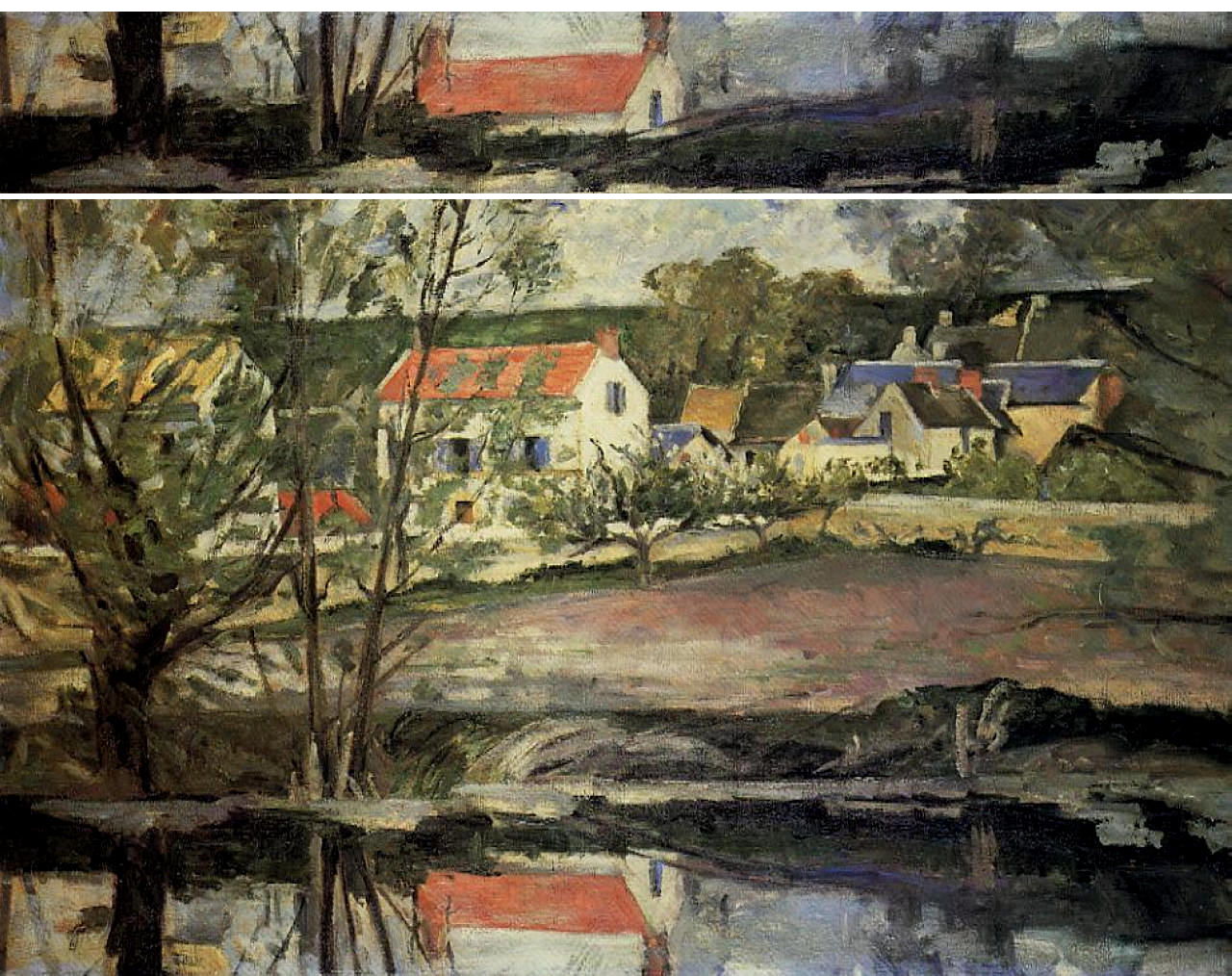
Although reflections only appear in a narrow band at the foot of the picture, those of the house with a red roof are particularly prominent, and visibly out of alignment with the original. The measured lateral displacement in the reflected image of that house ranges from 27 to 39 mm, depending on which part of the house is assessed. Those represent 2.9% to 4.2% of the total width of the canvas. All those displacements seen are of the reflection to the right of the position expected according to optical principles.
Although the view shown doesn’t make it clear, at this point even in Cézanne’s day the River Oise wasn’t just a few metres wide, but was and remains a wide, navigable waterway. While it’s not impossible that Cézanne painted this view from a boat moored close to the northern shore, there are no records to even suggest that he or Pissarro might have done so.
It’s thus most probable that Cézanne painted this from the southern bank of the Oise, at least 70 m away from the depicted reflections. Measurements made from recent satellite imagery and compared with maps of the time show that the house with the red roof was approximately 70 m and no less than 50 m from the water’s edge. Assuming the bank on which Cézanne placed his easel was about 3 m above water level, and his eye was about 1.5 m above that, basic trigonometry shows that the red roof of the house should also have been about 4.5 m above water level, which wouldn’t be compatible with the view as depicted.
Further analysis shows that the reflections cannot have been painted faithfully from nature, but must have been copied from elsewhere or constructed from Cézanne’s imagination, possibly at a later time when no longer in front of the motif. It’s hard to explain all the anomalies seen, particularly as this was at a time when Cézanne was often painting in company with Pissarro, whose long career included paintings depicting complex reflections that adhere to optical principles.

In this painting, a view Cézanne must have seen almost every day he went out from his family home of Jas de Bouffan, there are multiple discrepancies between the original and reflected areas, and evidence of pentimenti in the right side of the reflection.
Looking over the pool, the painting’s midline is marked by a tree, behind which are various buildings. At the left, closest to the viewer, branches of an evergreen tree are seen in front of the nearest large building. From that a series of smaller sheds track across the middle of the painting, culminating in a wall. Behind those are a farmhouse, and a sloping field with light brown and green stripes.
The reflections shown bear little resemblance to the rest of the painting, with disparities obvious in every object seen in the reflections, and apparently large areas of pentimenti on the right side of the reflections, as shown below.
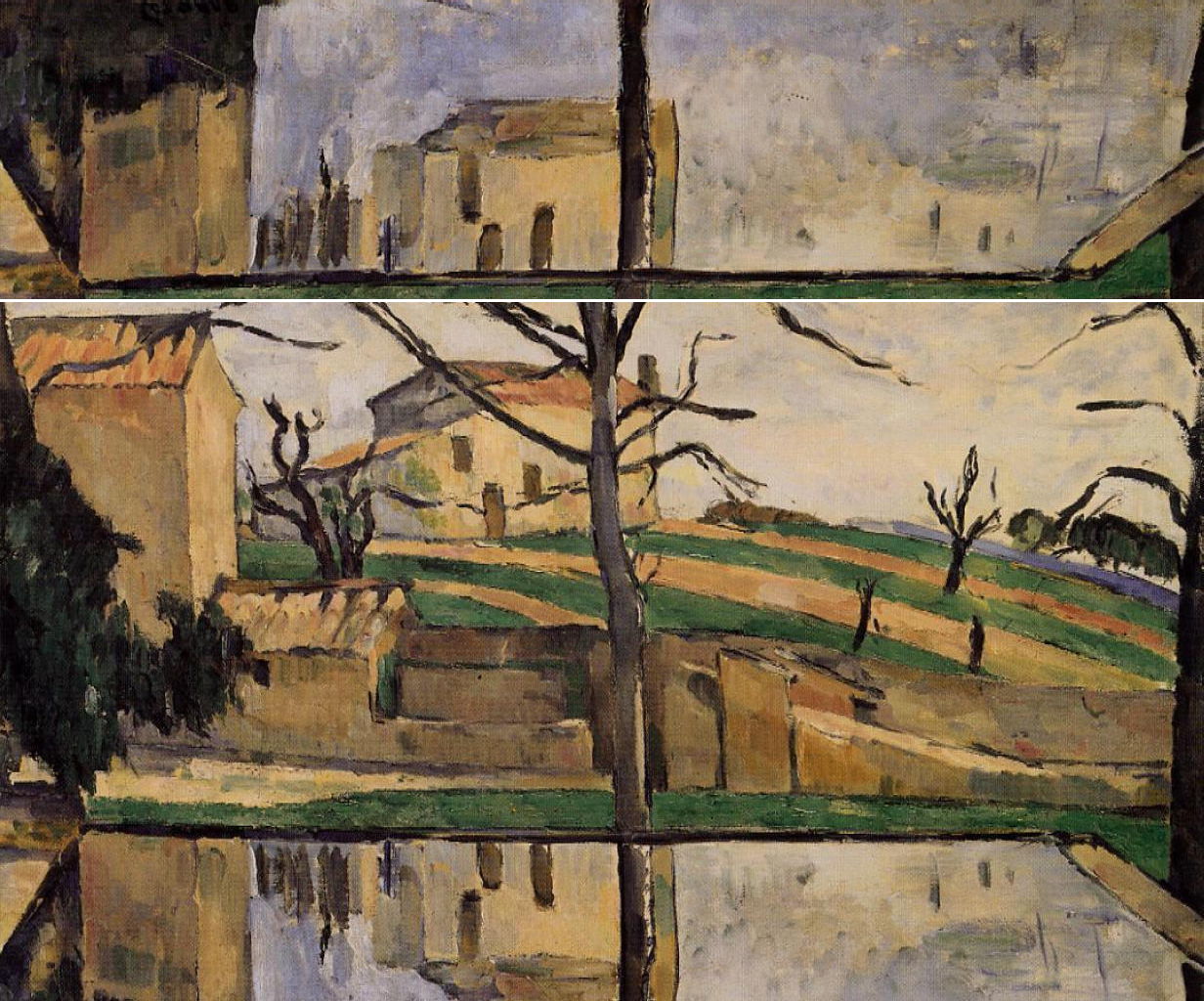
One potential explanation is that Cézanne tried using a technique sometimes recommended for painting reflections, rotating the canvas by 180˚, and inadvertently as a result painted the reflection of the farmhouse on the wrong side of the pool. On restoring the orientation of the canvas, he then tried to correct the reflection, but didn’t complete its detail. However this doesn’t explain why he painted the distant farmhouse in reflection in the first place.
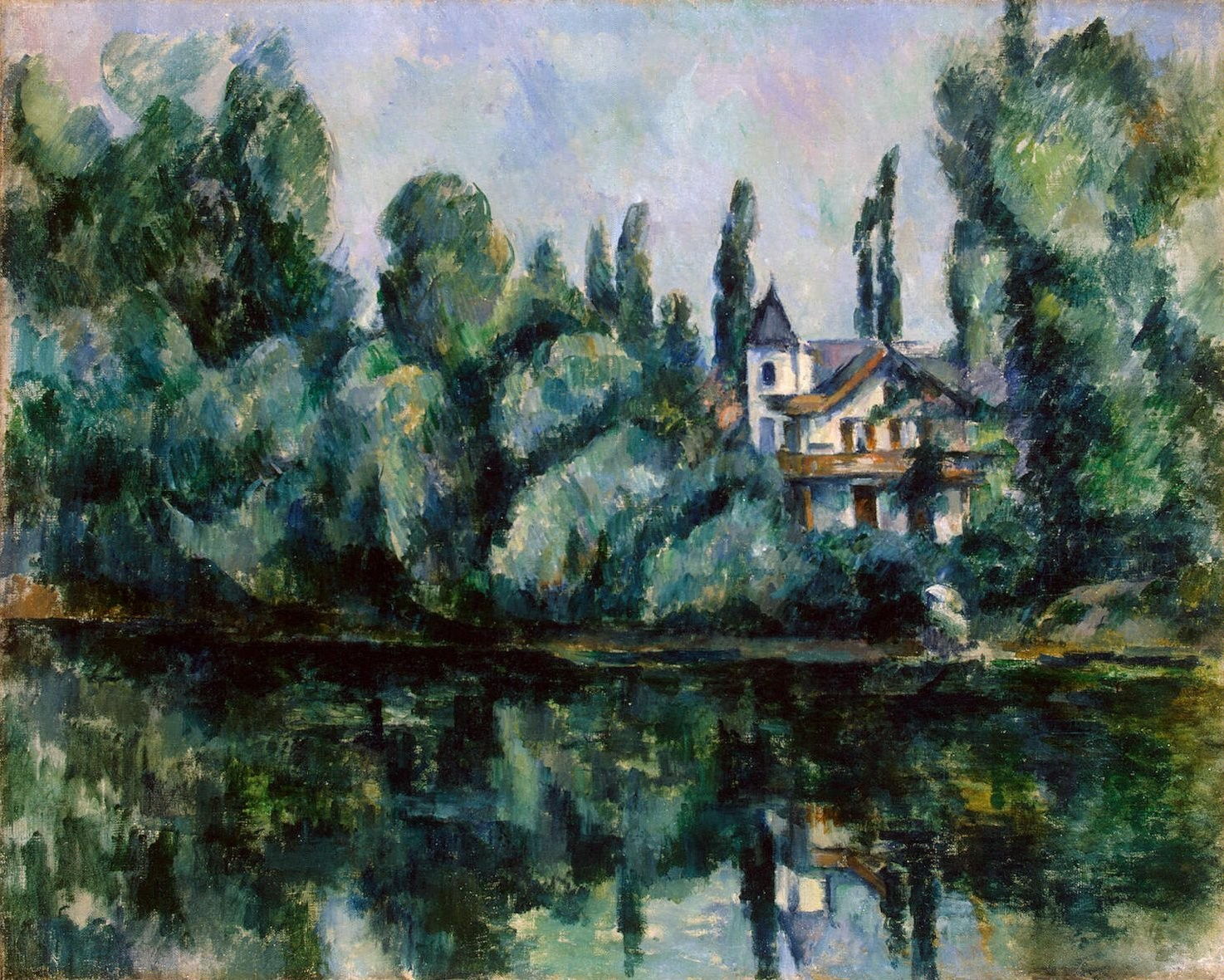
Bords de la Marne I (1888-94) is the second in a series, again showing large lateral displacements in its reflections, as seen in the composite detail below.
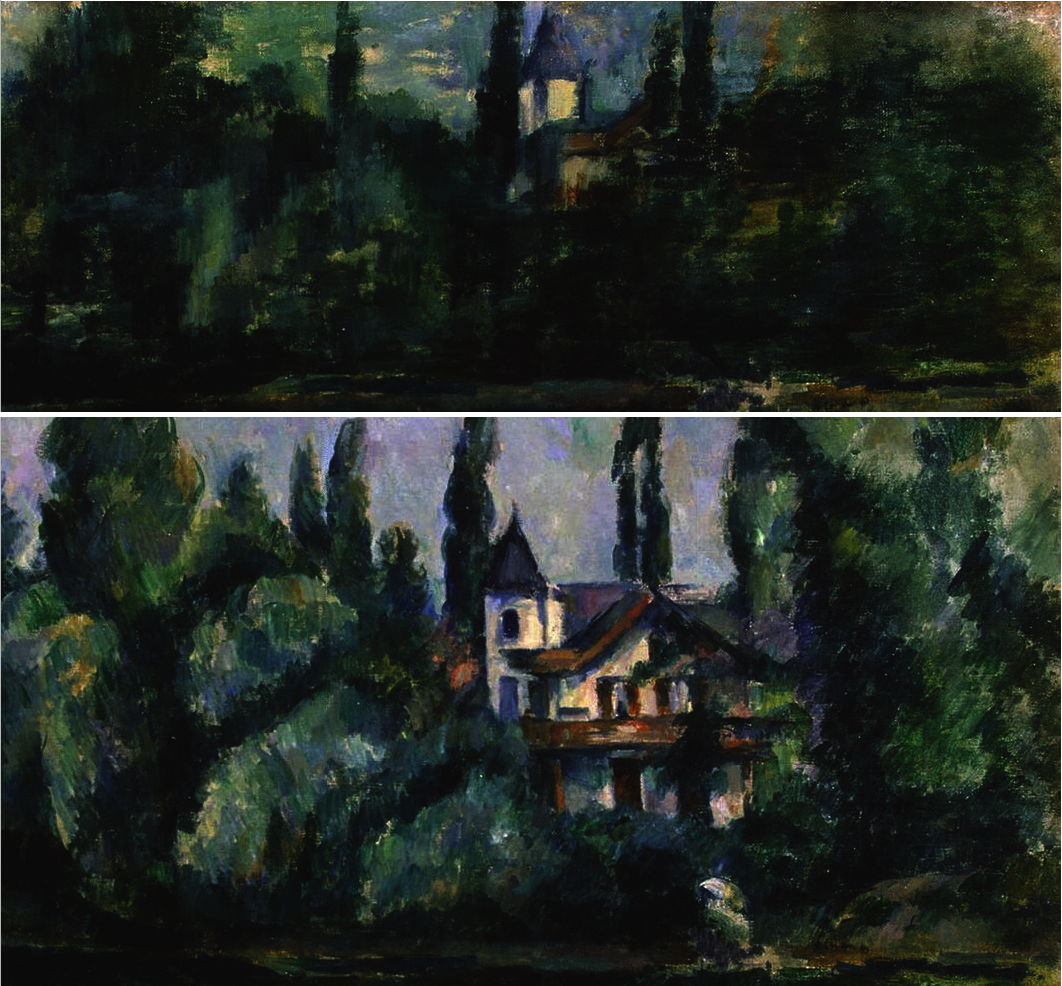
There are also differences in the depth order of the trees and house. In the original image, there is a prominent poplar behind the tower, which appears at the front left of the tower in reflection. The two prominent poplars behind the original image of the main house (in line with its gable) are also shown in the reflection as being in front of the house.
L’aqueduc et l’écluse (1894, or 1895-8) shows a view that has structural similarities to that of Cézanne’s earlier Villa au bord de l’eau (1890), but here appears totally different.
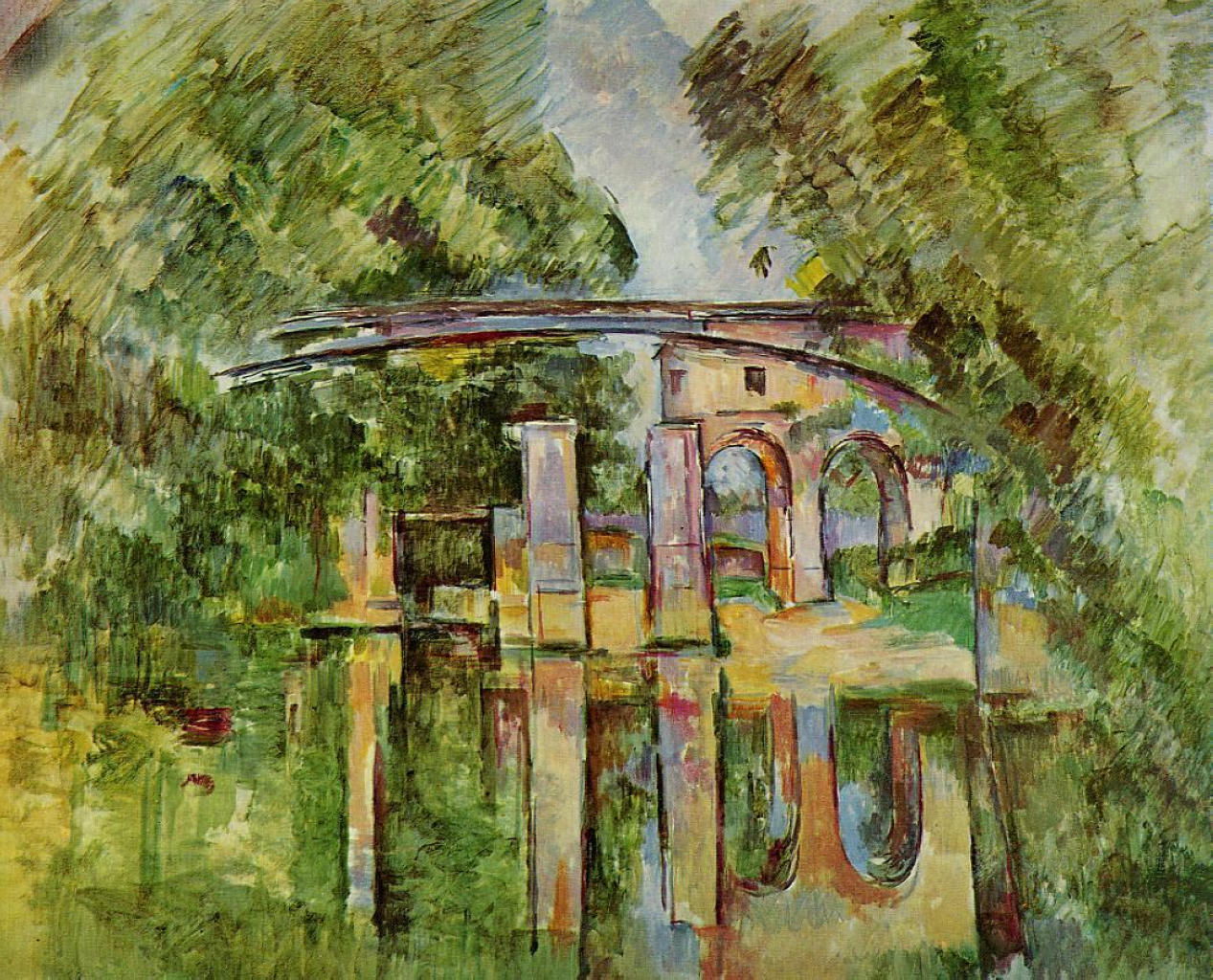
Most distant in Cézanne’s L’aqueduc et l’écluse is a building over two arches, reaching out from the right to the middle of the painting. To the left of it are two low buttresses with a horizontal piece bridging them. In front are two higher buttresses that appear unconnected with other structures. Closest to the viewer is a bridge arching over the water, its pier at the right edge of the canvas.
To each side of the view are high trees, rendered using rectangular patches of colour, each composed of a series of brushstrokes mainly laid diagonally in his ‘constructive stroke’. Discrepancies are clear in the composite view below.
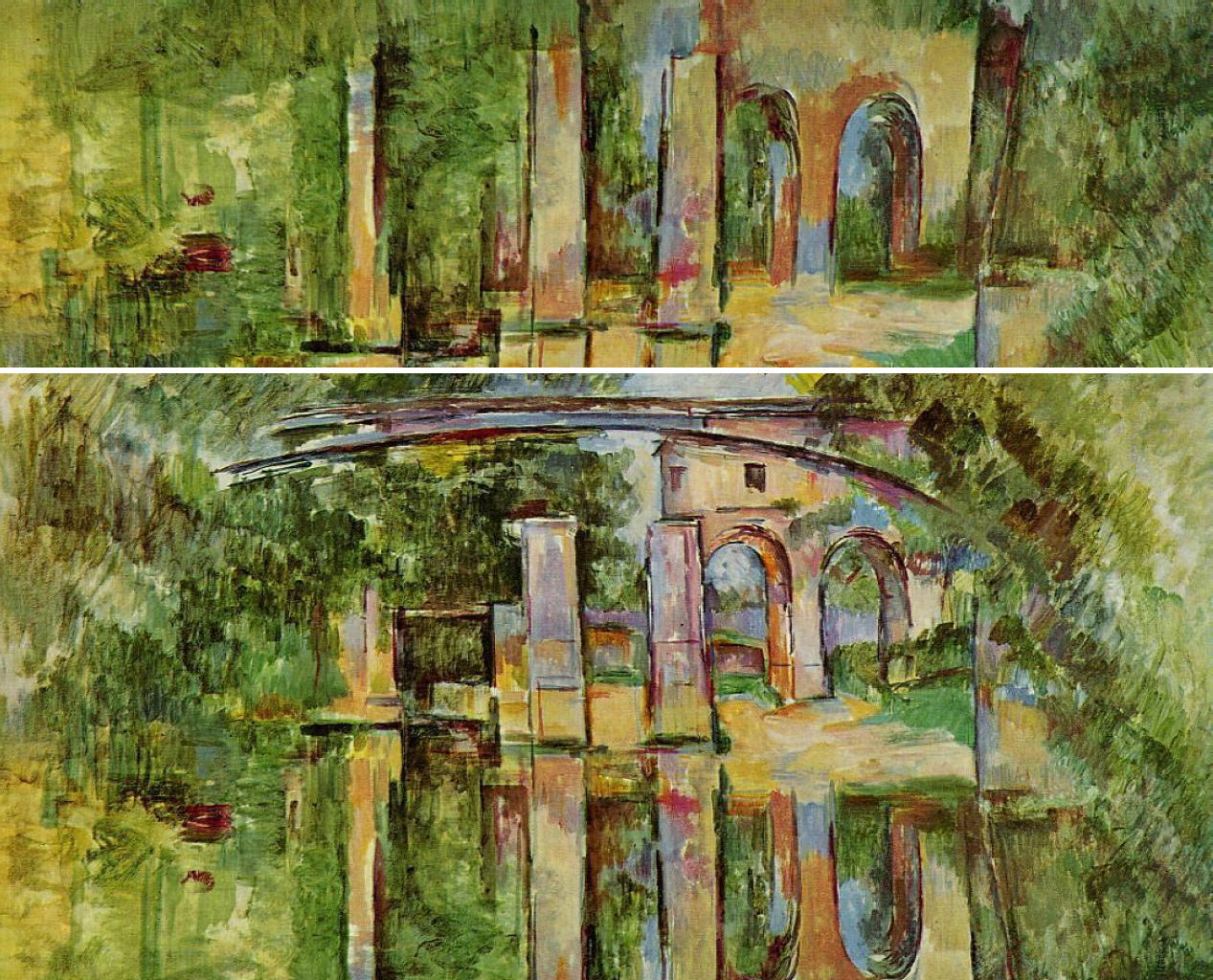
All the buttresses, piers, and arches are vertically exaggerated in their reflections, and most lean noticeably in the opposite direction to the originals. The leftmost buttress appears quite different in its reflection as compared with the original, its reflection being as high as the pair of isolated buttresses in front, despite its original image reaching to only about two-thirds of their height. In the reflection immediately to the right of that leftmost buttress can be seen evidence of an arch, perhaps part of pentimenti there, which doesn’t correspond to anything in the original, except perhaps the shallow, flat bridge.
Reflections shown for the two isolated buttresses in the middle of the painting start at their foot, although this also appears to be part of the bank rather than water. Similarly reflections of the arches of the building start on the bank and not the water, and those arches aren’t truncated in height to allow for their distance back from the water’s edge. The arches themselves aren’t shown from the low view expected in a reflection: more is seen of the underside of the top of each arch in the original than in its reflection. Not only the arch of the bridge but its right pier are either not shown in the reflection at all, or appear with distorted form and colour.
Thus the reflections shown capture the rhythmic structure of the piers and buttresses, but their forms are so idiosyncratic as to cast doubt as to whether they are reflections on water at all. Even if this painting is far from complete, its reflections make it one of Cézanne’s most enigmatic.
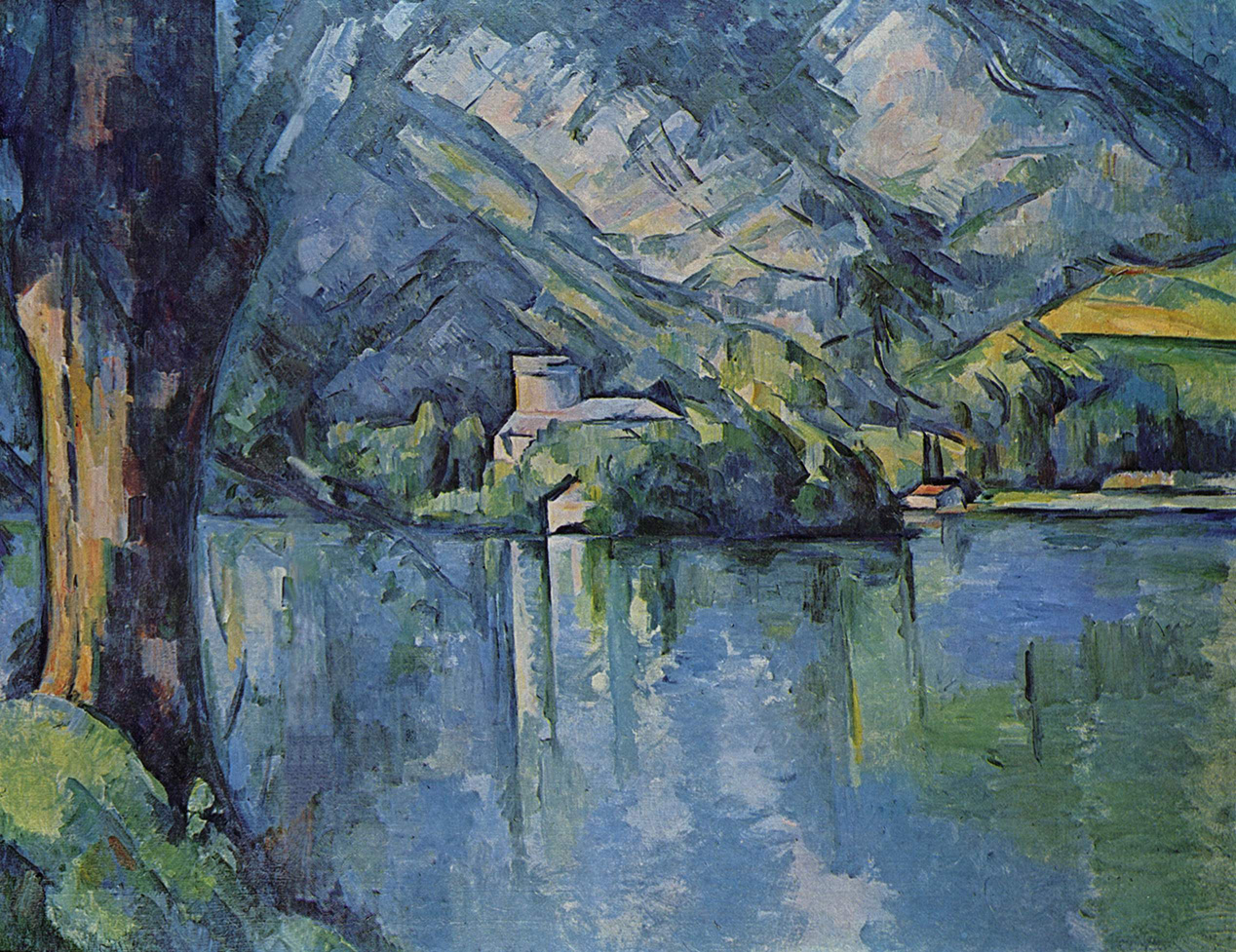
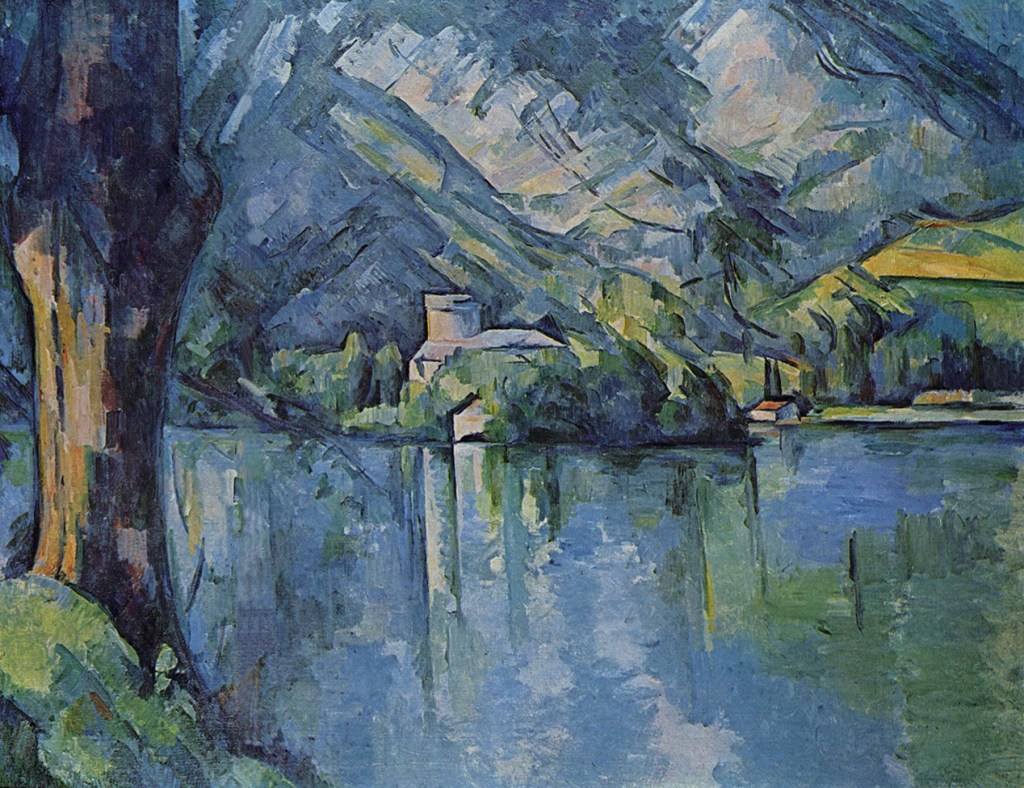
This is one of Cézanne’s best-known paintings, which has been reproduced and discussed extensively. It shows a view across Lake Annecy from Talloires, featuring the distinctive Château de Duingt and the foothills rising behind it. The water surface is shown to cover almost the entire lower half of the painting, within which the reflections of the castle are central and dominant features.
Comparison with views of the actual motif reveals that Cézanne has brought the far shore considerably closer to the viewer than it really is, by enlarging all the objects on that shore. House (2008) states that the château is about one mile away from Cézanne’s viewpoint, but measurement on modern satellite images shows the distance to be 0.76 km or just under half a mile.

As revealed in the composite image above, immediately to the right of the tree trunk shown marking most of the left in repoussoir, the water surface is depicted as being pale blue, with two light vertical marks which should represent reflections, although the area being reflected is shown much darker in the original image and lacks any object corresponding to the vertical marks.
Moving right across the reflection, there should then be a green area to match the original greenery shown on the left of the château, but the water surface there remains a mid blue. Although the original image of the castle closely resembles photographs, the reflection shown appears to be that of a quite different object, consisting of two tall, slightly slanting, pale cylinders, neither of which is aligned with the edge or tower shown.
Recognising these remarkably distorted reflections, the late Professor John House (2008) commented on them, writing “The reflections in the water are slightly distorted – like the table legs in The Card Players, they are not exactly vertical; and the water surface is implausibly still; Cézanne took no interest in the specific play of reflections that played so central a part in the art of Claude Monet, whose work he nevertheless greatly admired.”
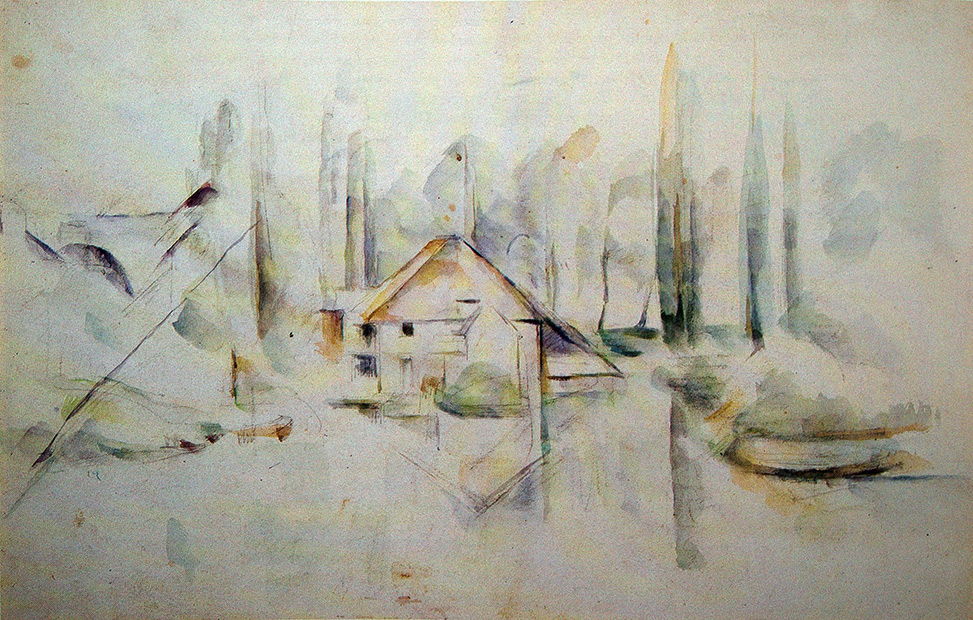
Maison au bord de l’eau (1900-4) is a late watercolour showing a house surrounded by tall poplar trees, fronting onto a body of water. There are large areas of white ‘reserved’ space and relatively few reflections, but the crisp geometric depiction of the house and its reflection enable assessment of those details shown in the composite view below.
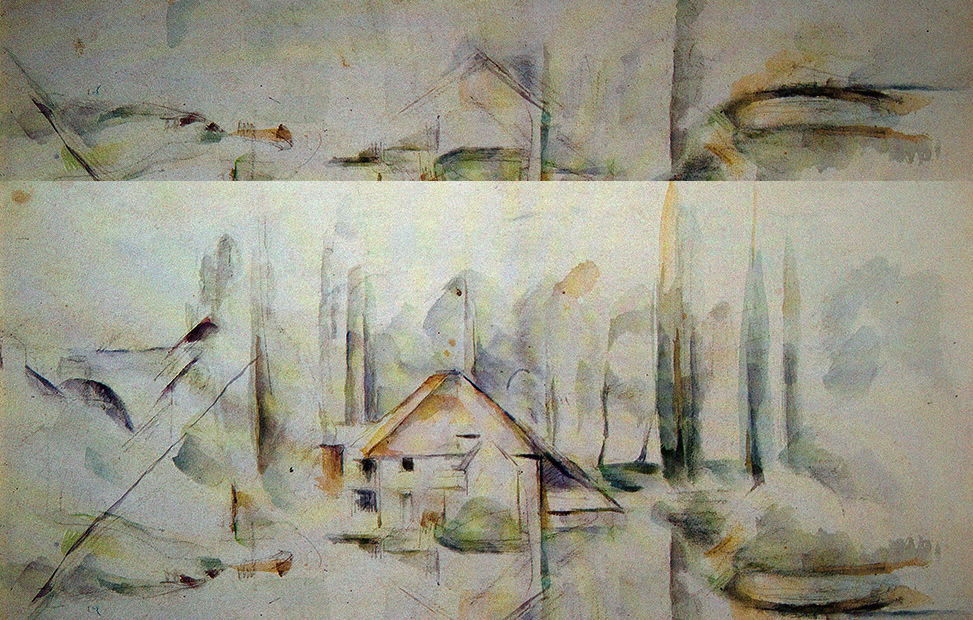
In the original image, the front of the house roof is shown to have a single broadened gable at its apex, but the reflection omits the horizontal section at that gable. As a result the left side of the reflection of the house is markedly asymmetric from the original. This is exacerbated by displacement of the apex of the reflected roof to the right, which in turn makes the reflected roof appear less high than the original.
Possibly recognising the difficulties and asymmetry that had arisen, the left side of the roof reflection is left incomplete, the pencil line indicating its position stopping level with the end of the reflection of the left side of the sloping roof, where it’s clearly too close to the bank. The single poplar tree shown in reflection is also visibly displaced to the right.
I have yet to see any account of Cézanne’s paintings of reflections that is consistent with these images.
References
Reflections in art:
3 – Cézanne’s conundrums
4 – Cézanne has more problems
5 – Explaining Cézanne’s discrepancies
Arrouye J (2011) “L’eau, miroir de la peinture”, pp 154-161 in D Coutagne Cézanne et Paris, Rmn-Grand Palais, Paris. Translated as “Water the mirror of painting”, pp 154-161 in D Coutagne Cézanne and Paris, Rmn-Grand Palais, Paris.
Coutagne D (2006) “The Jas de Bouffan”, pp 76-121 in P Conisbee and D Coutagne Cézanne in Provence, Yale University Press, New Haven, CT.
Coutagne D (2011) P. Cézanne à Paris et en Île-de-France, Éditions Crès.
House J (2008) “Le Lac d’Annecy”, pp 102-105 in S Buck et al. The Courtauld Cézannes, Paul Holberton Publishing, London
Machotka P (2008) Cézanne, the Eye and the Mind, Éditions Crès, Marseille.
 The Eclectic Light Company