
Some partnerships between artists and their models grew as the model became the artist’s muse, and exerted their influence on the art produced by the partners. This was particularly true for the Pre-Raphaelites, who socialised together, shared models and muses as well. There are several books revealing who slept with whom, and whose parties they each attended, but here I celebrate a few who made Pre-Raphaelite art through their patient posing and sometimes physical hardship.

John Everett Millais’ masterpiece Isabella (Lorenzo and Isabella) from 1848-49 is much more than a composite of different references to Keats’ poem and Boccaccio’s story. It’s a Pre-Raphaelite group portrait. For example, Lorenzo, actually William Michael Rossetti (brother of Dante Gabriel), shares a blood orange with Lisabetta, in reality Mary Hodgkinson (the artist’s step-cousin-sister-in-law). We see Dante Gabriel Rosetti drinking wine at the far end of the table, and the old man wiping his mouth is Millais’ father. There are two stories here, one from Keats and Boccaccio, the other more contemporary.

Less than fifteen years later, Millais shows how their lives had changed in his Eve of St Agnes (1863). In addition to referring to another of Keats’ poems, here about the elopement of Madeline and her lover Porphyro on Saint Agnes’ Eve, we see more Pre-Raphaelite relationships.
Millais painted this in the King’s Bedroom in the Jacobean house at Knole Park, near Sevenoaks in Kent. His model is his wife Effie, formerly Euphemia Gray, who originally married John Ruskin, the critic. That marriage resulted in annulment on the grounds that it was never consummated. Millais found Effie totally beguiling, and was obsessed with her after painting her in 1852 at Ruskin’s insistence. When Effie was finally free to marry Millais, they must have realised that her previous marriage would exclude her from many of the social functions that she loved, including any event attended by Queen Victoria.

Immediately before Millais painted his future wife, he spent many days painting Elizabeth Siddal in a bath, when she modelled for his Ophelia (1851-2). For this, one of the most famous of all Pre-Raphaelite paintings, he painted its background en plein air near Ewell, Surrey, England, then the following winter he put Siddal into a bath full of water while he painstakingly painted her figure onto the canvas.
Millais tried to warm the water in the bath using the flames of lamps and candles against its outer surface. One day he failed to notice that they had gone out, and Siddal became ill as a result of her prolonged cold immersion. Her parents threatened Millais with her medical bills, and tried to stop their daughter from further modelling.
It’s just as well they failed, as Lizzie Siddal next modelled for Dante Gabriel Rossetti, who became obsessed with her even as he pursued torrid affairs with other ‘stunners’. Rossetti and Siddal married, and for almost six months he seems to have remained faithful. But on 11 February 1862, Lizzie died of an overdose of laudanum (tincture of opium) at the age of only 32.

A couple of years later, Rossetti embarked on an unusual post-mortem portrait of her in the role of Dante’s beloved Beatrice. Although Dante never revealed her true identity, many have believed her to represent Beatrice di Folco Portinari, who died even younger almost six hundred years earlier. Beata Beatrix (c 1864–70) is one of Rossetti’s major works.
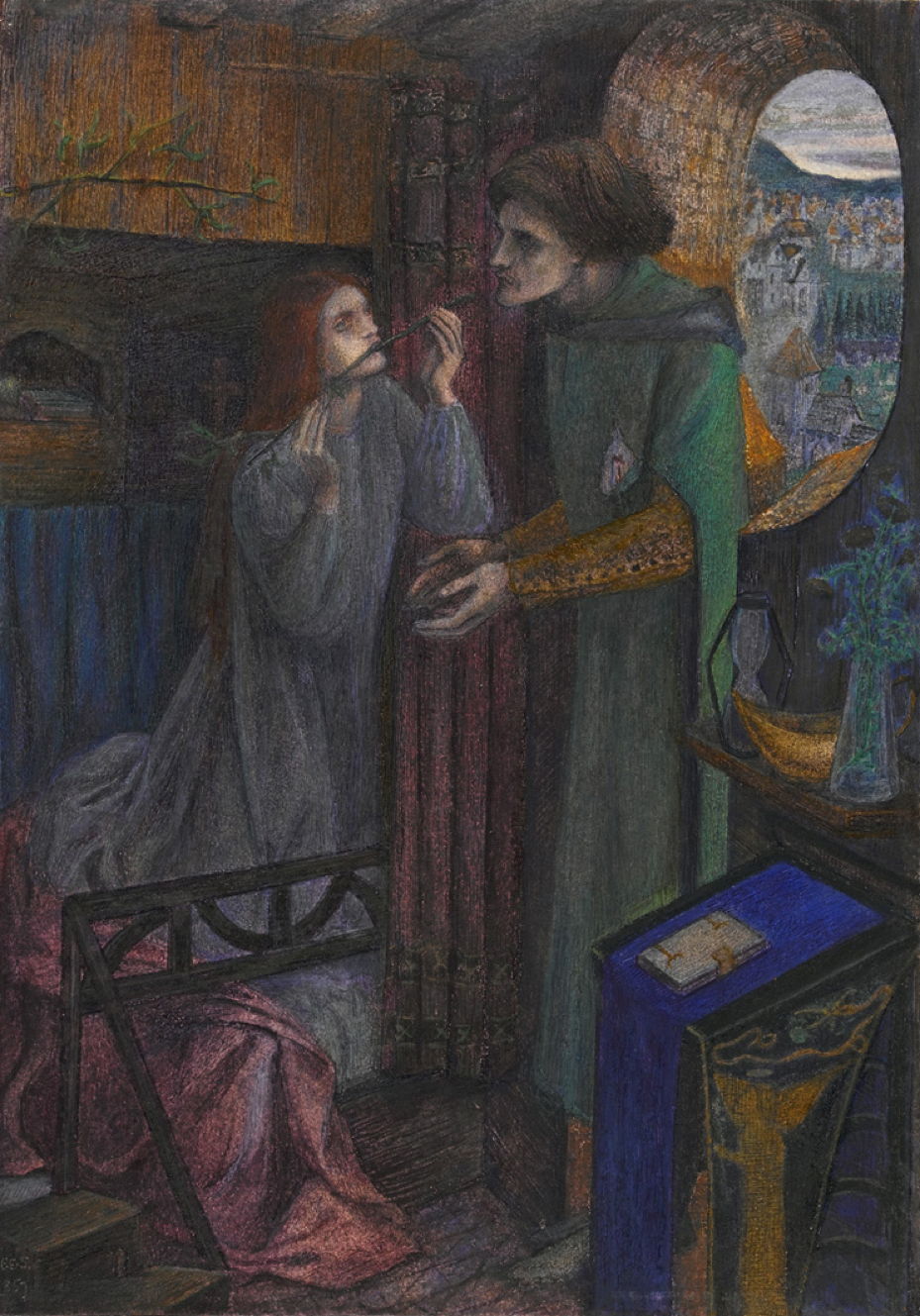
Lizzie Siddal was an artist in her own right, and was trained by Rossetti, whose influence can be seen in her Clerk Saunders from 1857. This watercolour also has a popular literary reference to the ballad of the same name in Scott’s collection Minstrelsy of the Scottish Border. It shows the heroine May Margaret kneeling on her bed and raising a wand to her lips. As she does this, the ghost of her murdered lover Clerk Saunders walks through the wall, and asks her to renew her vows.

Ford Madox Brown’s The Last of England (1852/55) brings another tale of modelling fortitude. Inspired by the emigration of the Pre-Raphaelite sculptor Thomas Woolner to Australia, Brown’s middle class couple is a family portrait. The husband is a self-portrait, his wife is Emma Brown, the artist’s wife, and tucked under her weatherproof hooded travelling cape is their infant son Oliver (Nolly), who was only born in 1855, just in time for completion of this painting.
In accordance with Pre-Raphaelite ideals, Brown painted this largely outdoors, and had his models sit outside in all weathers, even during the winter. His aim here was to recreate “the peculiar look of light all round” he considered prevailed when at sea.

Another familiar masterpiece is William Holman Hunt’s Awakening Conscience from 1851-53. A ‘problem picture’ about an extra-marital relationship with a ‘kept woman’, this small house was in the leafy London suburb of Saint John’s Wood. Hunt’s original model was Annie Miller, who had started her working life as a barmaid, before the artist spotted her as the model he needed for this work.
Hunt rashly promised to teach Miller to be a ‘lady’ along the lines of Eliza Doolittle in My Fair Lady, with the goal of them marrying, but by the time he returned from a working visit to the Middle East, Miller had succumbed to Rossetti’s desires. Hunt then scraped Miller’s face clear and replaced it with that of his wife Fanny Holman Hunt.

Dante Gabriel Rossetti depended on a succession of beautiful women, “stunners” as he called them, as both muses and models. This unashamedly sensuous portrait of one of his better-known flames, Fanny Cornforth, is something of an apogee, even for him. By modern standards, Bocca Baciata may not appear particularly sensuous or shocking. At the time, though, her loose hair, unbuttoned garments, and the abundance of flowers and jewellery were seen as marks of the temptress. These are reinforced by one obvious symbol: the apple, harking back to the Fall of Man. And staid viewers such as William Holman Hunt were shocked, writing “it impresses me as very remarkable in power of execution – but still more remarkable for the gross sensuality of a revolting kind, peculiar to foreign prints”, by which he meant imported pornographic prints.

Lizzie Siddal’s death in 1862 did nothing to reform Rossetti’s conduct. In 1868, he met the beautiful Alexa Wilding, who immediately became his next obsession. Four years later, she was his model for Veronica Veronese (1872), commissioned by Frederick Leyland, a Liverpool shipping magnate. It then joined Leyland’s collection of Rossetti’s images of women in the drawing room of his Kensington, London, residence.

Rossetti’s first painting of Pandora, completed in 1871, was one of his earlier paintings of Jane Morris, the wife of his friend William Morris, and the subject of Rossetti’s late passionate obsession. It was commissioned by John Graham for 750 guineas, who was so pleased with the result that he exhibited it, against Rossetti’s wishes, in Glasgow the following year.
Although Rossetti was notorious for his many relationships, Sir Edward Coley Burne-Jones, First Baronet of Rottingdean and of the Grange, appeared more august in photographs. Yet in 1870 he was at the centre of a major scandal and was asked to remove one of his paintings from the exhibition of the Old Water-Colour Society.

The painting in question was Phyllis and Demophoon (1870), a watercolour showing Phyllis embracing her estranged husband from within the structure of an almond tree. Burne-Jones’ exposure of Demophoon’s genitals in the exact centre of the painting was the most obvious reason for the reaction, but behind it was a more compelling problem: both figures were modelled by Maria Zambaco, who had recently been Burne-Jones’ mistress.
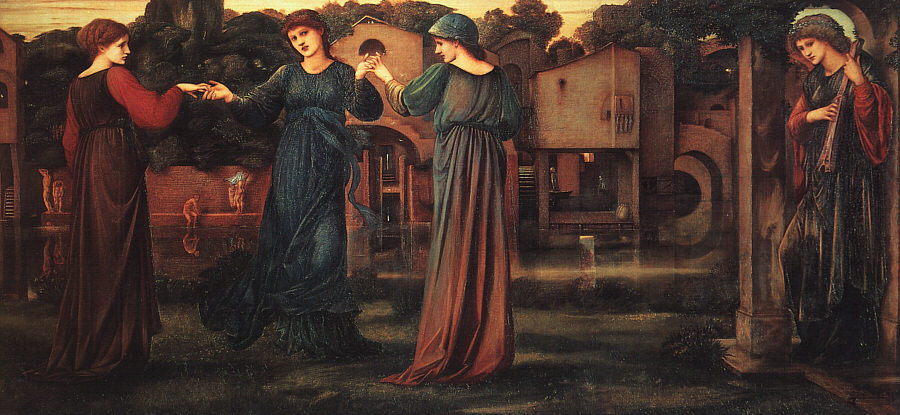
Maria Zambaco was one of three cousins from the leading expatriate (if not refugee) Greek families of London; the other two were Aglaia Coronio and Marie Spartali, an outstanding painter who later married to become Marie Spartali Stillman.

All three appear in Burne-Jones’ The Mill (1882). Shown from left to right are Maria Zambaco, Marie Spartali Stillman, and Aglaia Coronio.
Burne-Jones had married Georgiana MacDonald in 1860, and the couple had a son born the following year, and a daughter born in 1866. Maria Cassavetti was ten years younger than Burne-Jones, had married a Dr Zambaco in 1860, and went to live in France, having her own son and daughter by him. When her marriage collapsed, she moved back to London in 1866, and met Burne-Jones when he was commissioned to paint Maria by her mother.
Burne-Jones and Maria Zambaco soon became lovers, a relationship that intensified during 1868, and reached a crisis the following year. Burne-Jones tried to leave his wife and family to live with Zambaco. Maria tried to convince him to join her in a suicide pact, taking an overdose of laudanum by the canal in London’s Little Venice. The police had to be called, and what was already a public scandal become the talk of London.
Although Burne-Jones and Zambaco broke up, he continued to use her as a model in his paintings through the 1870s, and in the group often known as the Three Graces in The Mill. After the Old Water-Colour Society had ‘invited’ him to remove his Phyllis and Demophoon, Burne-Jones exhibited little for almost a decade.
Life as a Pre-Raphaelite was nothing if not complicated.
 The Eclectic Light Company