
Scissors, including shears, are hand tools use for cutting by bringing two cutting edges to bear on the sheet or object being cut. Originally they were all shears, effectively hinged at the end further from the blades, when open like a V. They have been largely replaced by scissors that rotate around a pivot between their handles and blades, when open like an X. However, in normal usage terminology is inconsistent, with heavyweight X-based scissors used in gardening and horticulture being referred to as shears. Scissors weren’t made in large numbers until the later half of the eighteenth century, since when they have become widely used.
In this article I will ignore farming and industrial uses of shears, for example to harvest wool from sheep or cut sheet metal (also known as snips), and concentrate more on domestic uses of lightweight shears and scissors. These are most strongly associated with cutting fabrics, yarn and threads, and all forms of fibre craft.
In classical myth, they appear in the weaving contest between Arachne and the goddess Minerva.
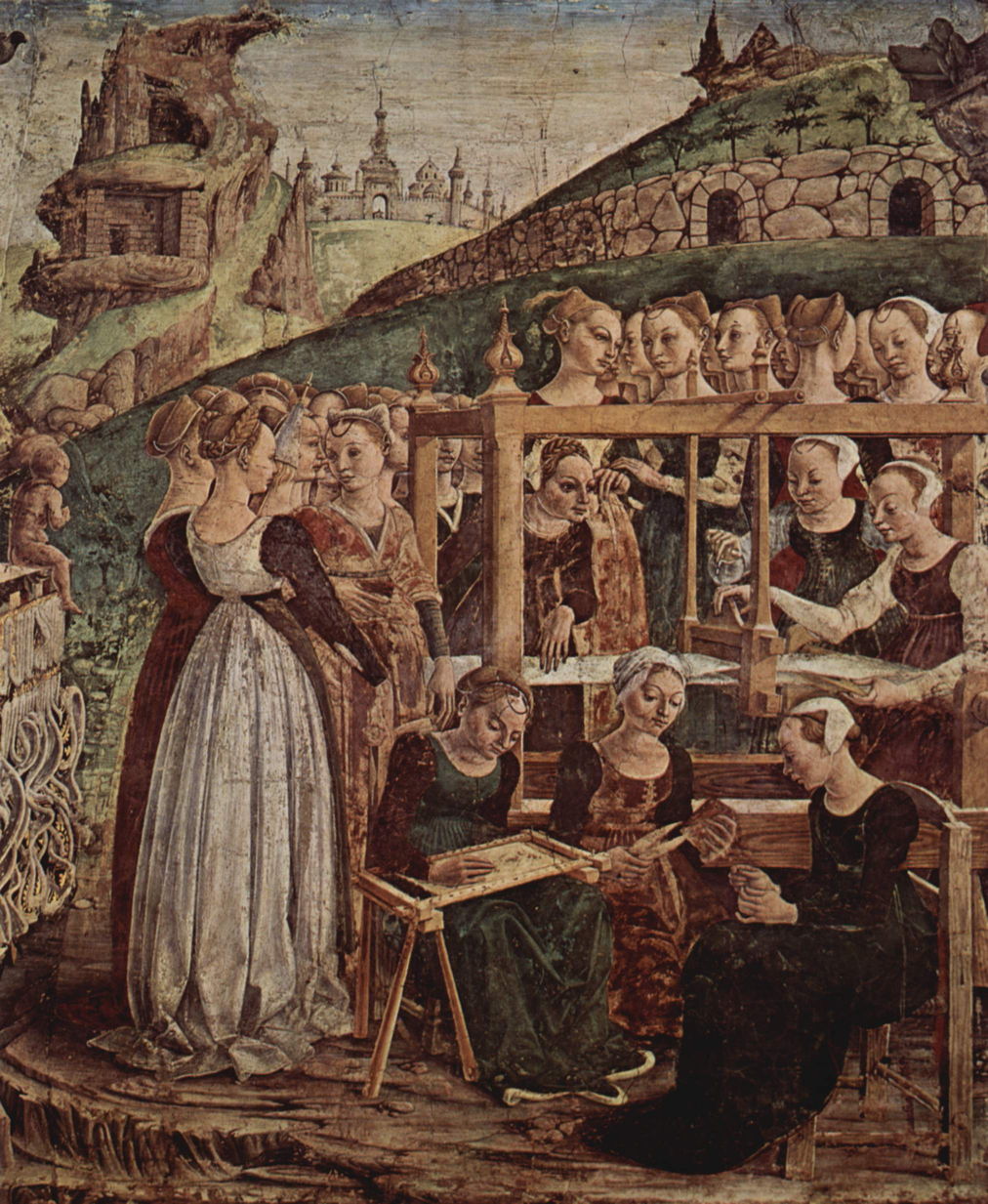
Several of the surviving paintings of this myth show Arachne and Minerva at their looms, weaving like fury. Francesco del Cossa’s The Triumph of Minerva (1467-70) was chosen for the month of March in his fresco for the Room of the Months in the Palazzo Schifanoia in Ferrara, Italy. The trio of women in the foreground are engaged in allied crafts, including embroidery and sewing, and the middle one is using a pair of shears to cut some fabric. Behind them are the two weavers working at what is shown as a single loom, the traditional boxwood shuttle just being inserted by the left hand of the woman at the right.
The three Fates are often depicted with one of them, traditionally Atropos, cutting the thread of life using shears.

Edward Burne-Jones’ painting of The Feast of Peleus from 1872-81 uses a composition based on classical representations of the Last Supper. Every head has turned towards Eris (Discord) as she brings her golden apple, apart from that of the centaur behind her right wing. Even the three Fates, seen in the left foreground with the nude Atropos wielding her shears, have for once paused momentarily in their work.

This Salon-style depiction of the Fates by Paul Thumann from about 1880 became extremely popular throughout Europe, and was often reproduced on mass-produced porcelain. It’s unusual for drawing such marked distinctions between the women: Atropos, on the left, is shown as a morose older woman armed with her shears; Clotho stands to weave, and is young, very pretty, and bare down to the waist; Lachesis is modestly dressed and holding sprigs of vegetation, at the right.

This transferred into Walter Crane’s unique allegorical narrative The Bridge of Life from 1884. Below the right end of the bridge, Atropos is seen as she is just about to cut the thread of life, so bringing death.
The Old Testament story of Samson depends on him losing his prodigious strength when his hair is cut off by the seductress Delilah.

William Blake’s Samson Subdued is one of the large series of biblical watercolours he painted for Thomas Butts in around 1800-03. It shows the naked figure of Delilah holding a pair of modern scissors in her left hand, having apparently cut Samson’s hair off with them to destroy his strength.
Although by no means universal, they are also used as a sign of the Virgin Mary’s domestic activity at the time of the Annunciation, where X-based scissors might also be a symbol of the Crucifixion to come.

Oleksandr Murashko’s breathtaking Annunciation, painted probably in 1907-08 or 1909, captures her at work on a tapestry, with a pair of scissors and thread on the carpet in the right foreground.

Jacek Malczewski’s Mary (right) is a modern young woman of 1923, whose thimble and scissors rest on a bare wooden table behind. Gabriel is in the midst of breaking the news to her, his hands held together as he speaks.
Many other paintings include scissors as a reference to their domestic use.
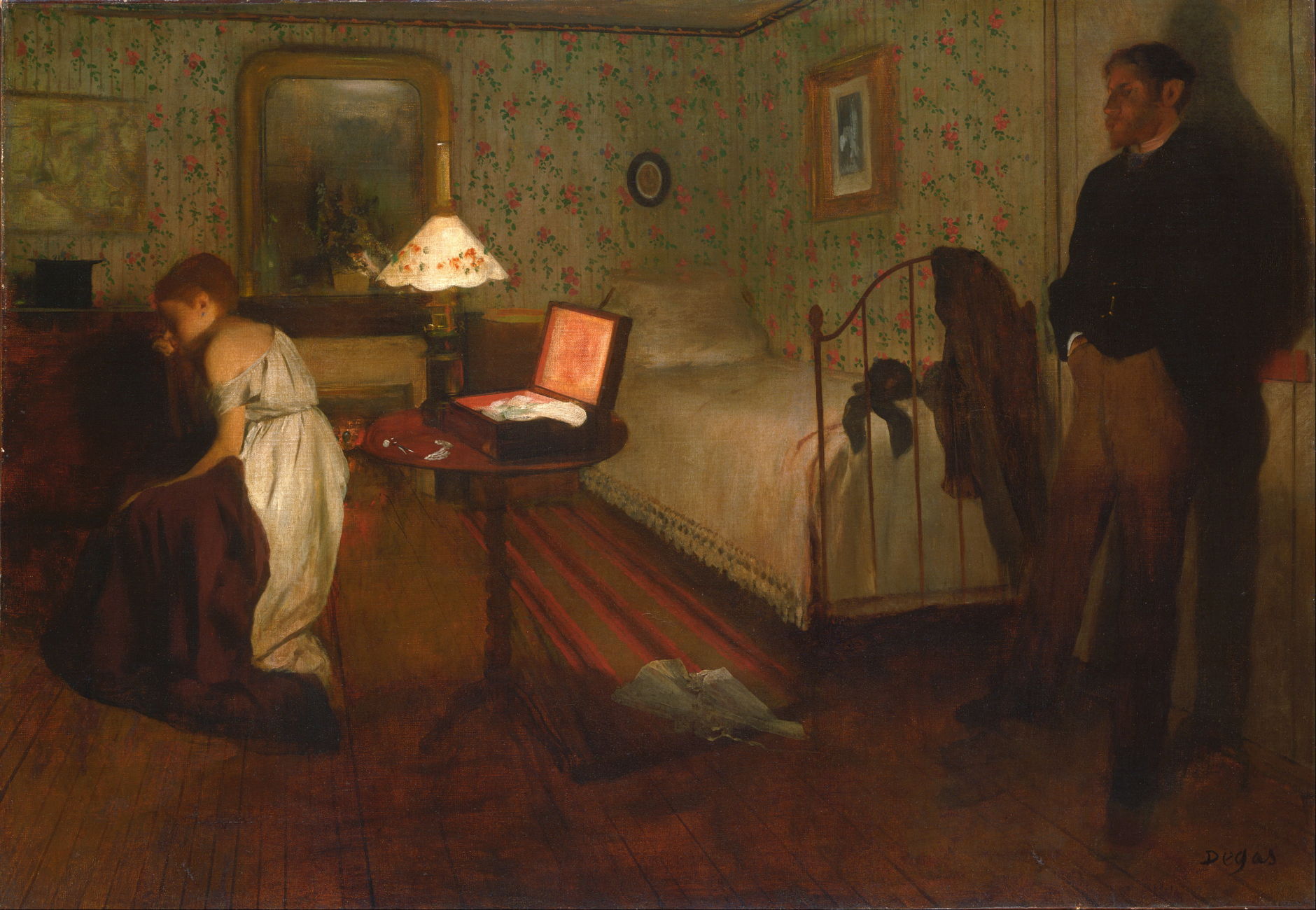
In Edgar Degas’ Interior (1868-9), also known as The Interior and even The Rape, they may be one of the clues to its reading. Between the man and woman, and just behind her, is a small occasional table, on which there’s a table-lamp and a small open suitcase. Some of the contents of the suitcase rest over its edge. In front of it, on the table top, is a pair of scissors and other items that appear to be from a clothing repair kit or ‘housewife’, indicating she has travelled away from her home to this meeting.

James Tissot painted The Farewells soon after his flight to London in the summer of 1871. This couple, separated by the iron rails of a closed gate, are in late eighteenth century dress. The man stares intently at the woman, his gloved left hand resting on the spikes along the top of the gate, and his ungloved right hand grasps her left. She plays idly with her clothing with her other hand, and looks down, towards their hands. She is plainly dressed with a pair of scissors suspended by string on her left side, implying she may be a governess.

These two young milliners in Paul Signac’s Les Modistes (Two Milliners in the Rue du Caire, Paris), from 1885-86, are busy making fashionable hats. The nearer of the two women is bent down retrieving her scissors as a symbol of her craft.

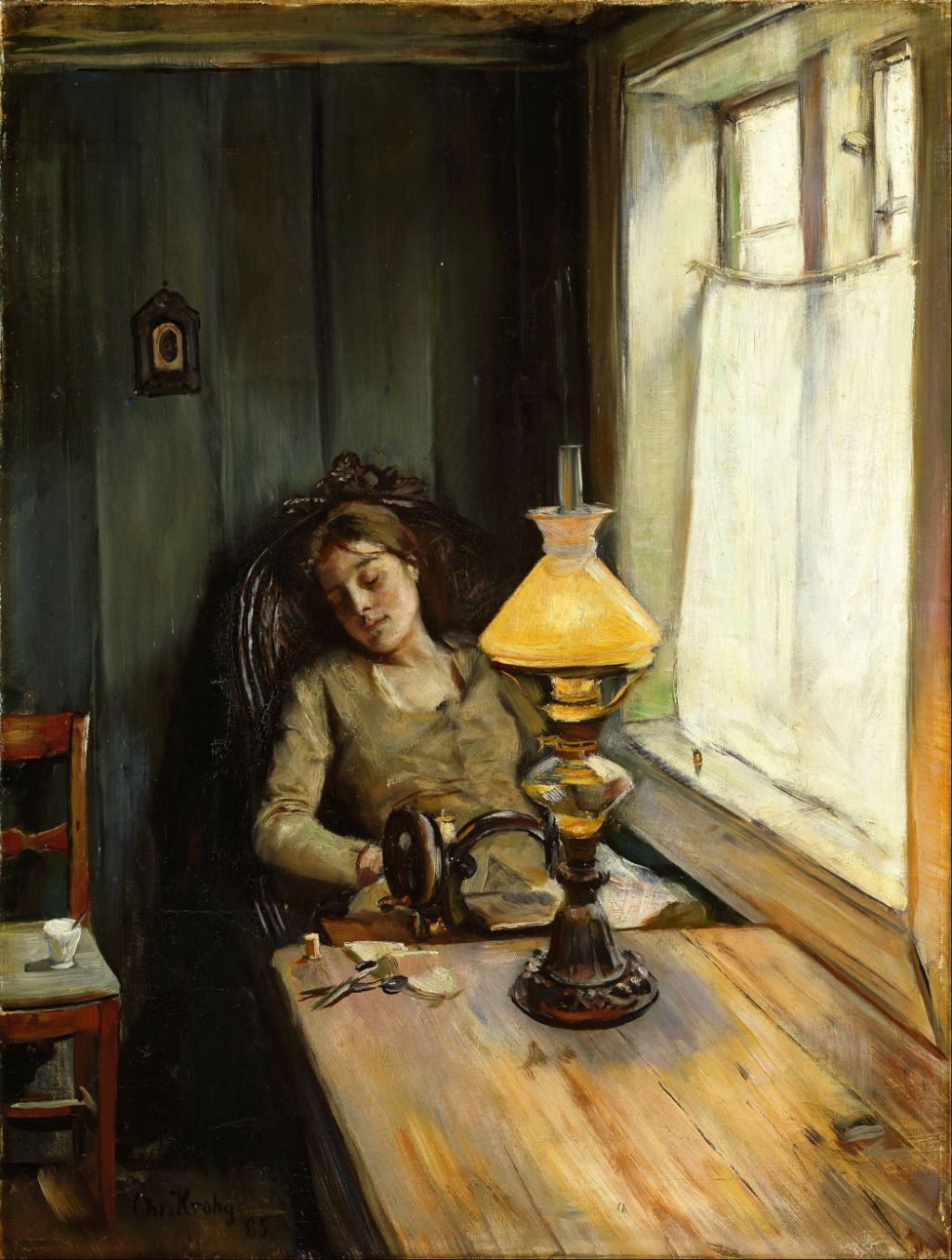
The Norwegian artist Christian Krohg’s Tired from 1885 shows an exhausted seamstress, one of the many thousands working at home at that time, toiling for long hours by lamplight for a pittance. On the table in front of her is a small pair of scissors.

Moritz Stifter’s The New Dress from 1889 shows a scene set in the dressmaker’s, with a pair of scissors resting between fabric on the table at the right.

My last pair of scissors appears as part of the sewing kit on the table of Robert Braithwaite Martineau’s painting of Kit’s Writing Lesson (1852), showing a less than memorable scene from Charles Dickens’ The Old Curiosity Shop, with its elaborately detailed interior.

