
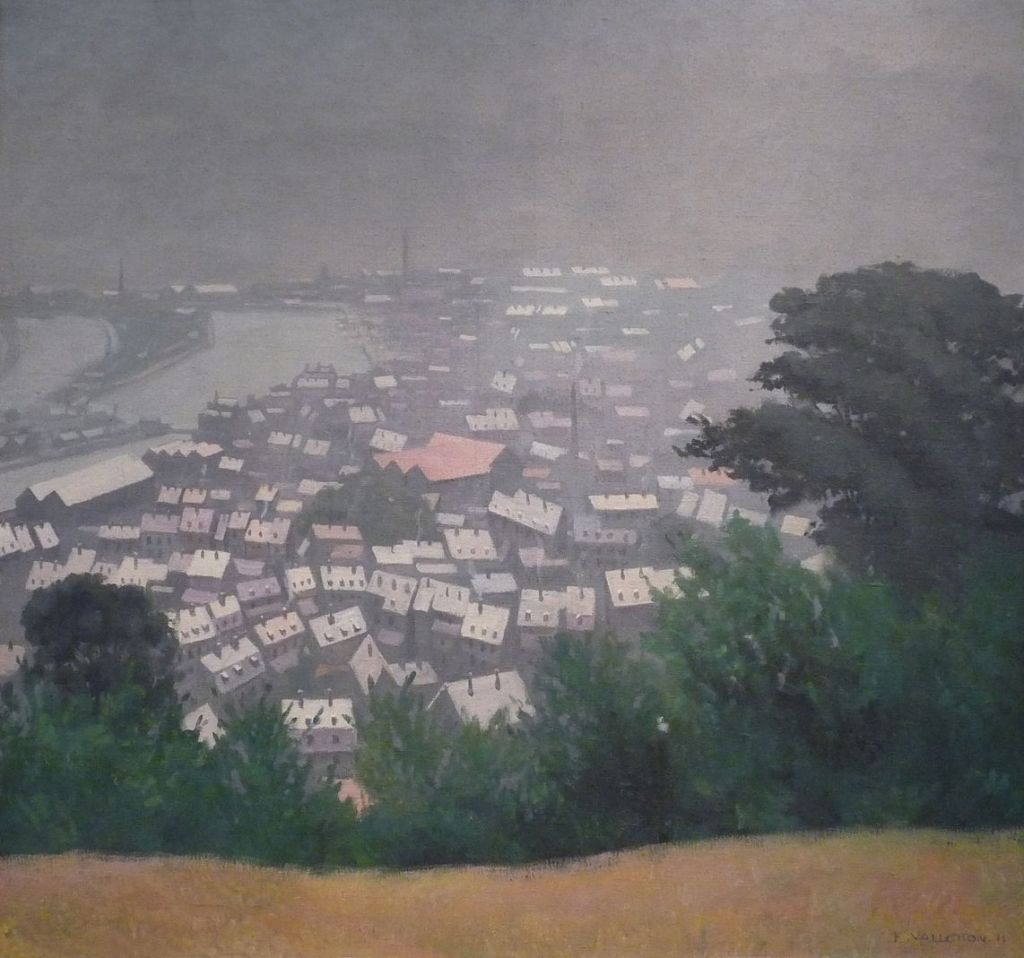
One hundred years ago today, on 29 December 1925, the Swiss-French artist Félix Vallotton died in Paris following surgery for cancer, just one day after his sixtieth birthday. Over the last month or so I have given a brief account of his career and a small collection of his 1,700 paintings. To commemorate his art, I show here a personal selection from those.
Although known primarily for his membership of the Nabis, not one of these works could be considered to be representative of Nabi style. If there’s a single label to be applied to his art, the most appropriate might be pre-Surrealist. This started with meticulous realism and scenes that aren’t quite right.

The Sick Girl from 1892 adopts the popular theme of sickness, implements it with showpiece surface optical properties, and adds subtle strangeness. The patient’s bed is reversed so she faces away from the viewer and towards a wall, and the maid who has just entered is ignoring her patient and heading straight towards the viewer.

The Cook at the Stove from the same year pulls a similar trick in a model domestic kitchen almost devoid of food. The only edible item visible is a bunch of onions suspended in mid-air, and everything is spotless.

Following the dissolution of the Nabis, Vallotton returned to these disturbing domestic interiors with Woman Searching in a Cupboard in 1901. This is influenced by his highly successful woodcut prints, in simplifying its motif with its extensive areas of black. The woman’s black silhouette appears to absorb the light falling on her, and the lamp is strange.

Two years later, his Interior with Woman in Red draws the eye deep past multiple sets of open doors to a distant bedroom. Along the way are tantalising glimpses of detail in discarded fabric and clothing.

Vallotton then modernised several classical myths drawn from Ovid’s Metamorphoses. Andromeda Standing with Perseus, from 1907, simplifies and uses a colour code for its actors, with green for the sea monster, pink for the near-victim, and blue for the hero, against a straw-coloured sea. Perseus charges to the aid of Andromeda through a cleft in the black sky.
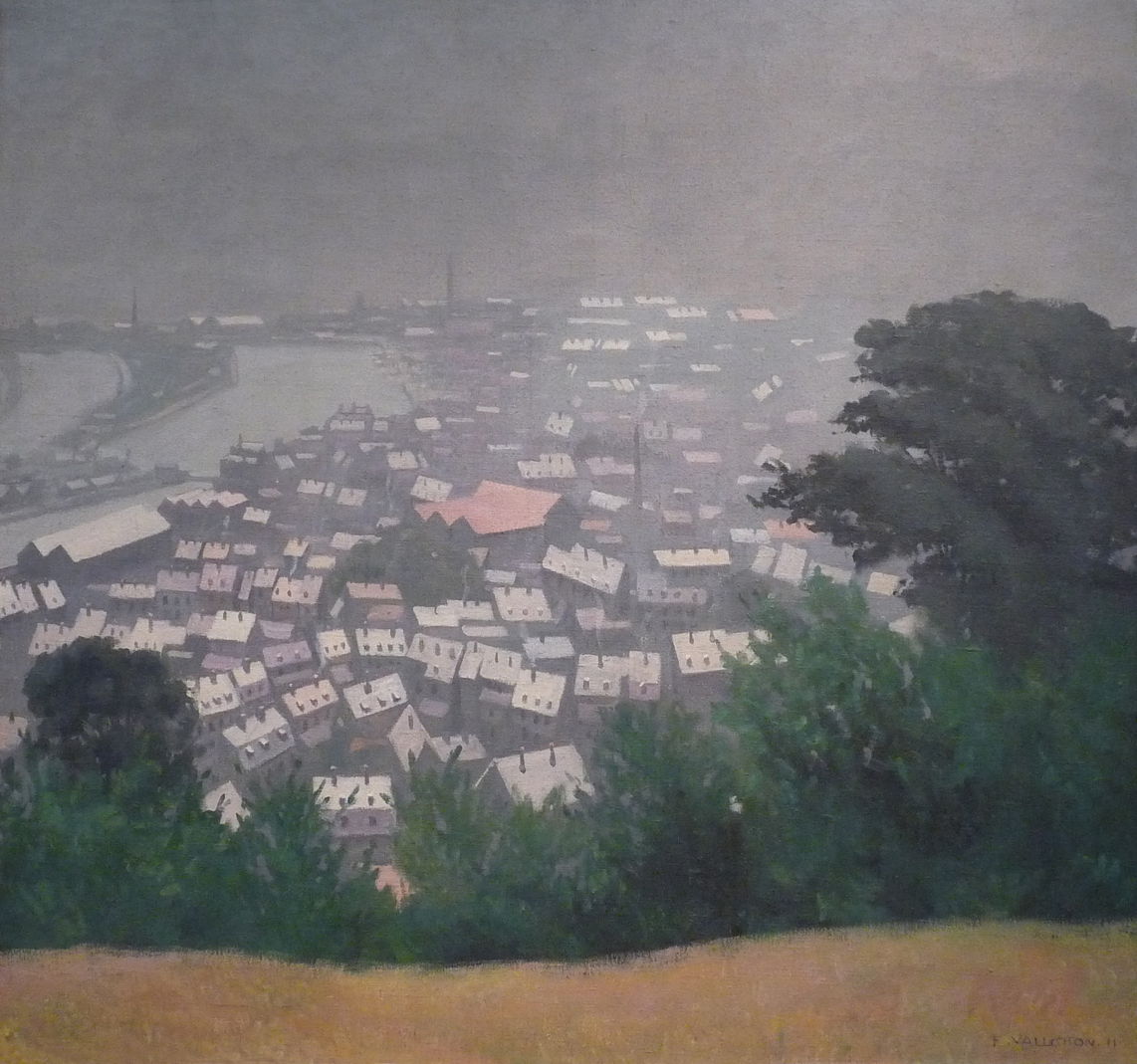
In his later years, Vallotton turned to unconventional landscapes, such as Honfleur in Fog from 1911. This looks down from Mont-Joli to the west of the town centre, where the artist had his summer house.

Shortly after the start of the First World War, Vallotton painted The Sheaves, asking where all those harvesters had gone, in one of his symbolic images of the war.

After the war he completed a series of simplified composite landscapes, including this view of Château Gaillard at Les Andelys (1924), birthplace of Nicolas Poussin and a popular location for later landscape painters.
A year after his death, a major retrospective exhibition was held in Paris, where his paintings were shown alongside those of Vincent van Gogh, Modigliani, Seurat, and other major artists. His work was in good company.
Previous articles
More than a Nabi 1: Félix Vallotton 1885-99
More than a Nabi 2: Félix Vallotton 1900-1906
More than a Nabi 3: Félix Vallotton 1907-1914
More than a Nabi 4: Félix Vallotton 1915-1925
 The Eclectic Light Company