

By now, even the mountain meadows and those in the deep valleys of Norway are bursting into colour with Spring flowers. This weekend I’m going to unashamedly wallow in paintings of the splendour of meadows. You’re most welcome to join me in some well-earned landscape therapy.
In the classics, Spring is associated with the goddess Flora, and my starting point is Botticelli’s magnificent masterwork still known reverentially by its Italian title of Primavera, Spring.

This is an intricate allegory based on Roman myth recorded by Ovid, not in his popular Metamorphoses, but his less well-known Fasti, a book of days. Starting at the right, its figures are:
- Zephyrus, the warm and moist west wind, who is borne on wings and grasps the body of
- Chloris, who looks back in fright at Zephyrus, and from whose mouth a chain of plants emerges;
- Flora, who is dressed in a robe bearing images of many different flowering plants, wears a garland of flowers in her hair, and appears to be casting flowers from within her robe;
- Venus, the mother of Cupid and (often) of the three Graces, who appears pregnant, and holds her right hand up in greeting or blessing;
- Cupid (above Venus), who is about to loose a flaming arrow from his bow, and is borne on wings;
- the Three Graces, Aglaea (splendor), Euphrosyne (mirth), and Thalia (good cheer), linked by their hands, the nearest, her back to the viewer, being the target of Cupid’s arrow, and looks at
- Mercury, the son of Maia (as in the month of May) and messenger of the gods, who holds his caduceus up to quell a small group of dark clouds, but faces away to the left, looking up at those clouds.
As you might expect, the story behind this beautiful pastoral painting is thoroughly pagan, and all about sex and violence. Chloris was a nymph, who was wandering in the Spring when she was seen by Zephyrus, who followed her. In her modesty, the nymph fled, but couldn’t escape the god, who of course flew like the wind after her. Boreas his brother had told Zephyrus that he could rape Chloris as a reward for stealing from Erechtheus’ house, which Zephyrus did once he had caught her.
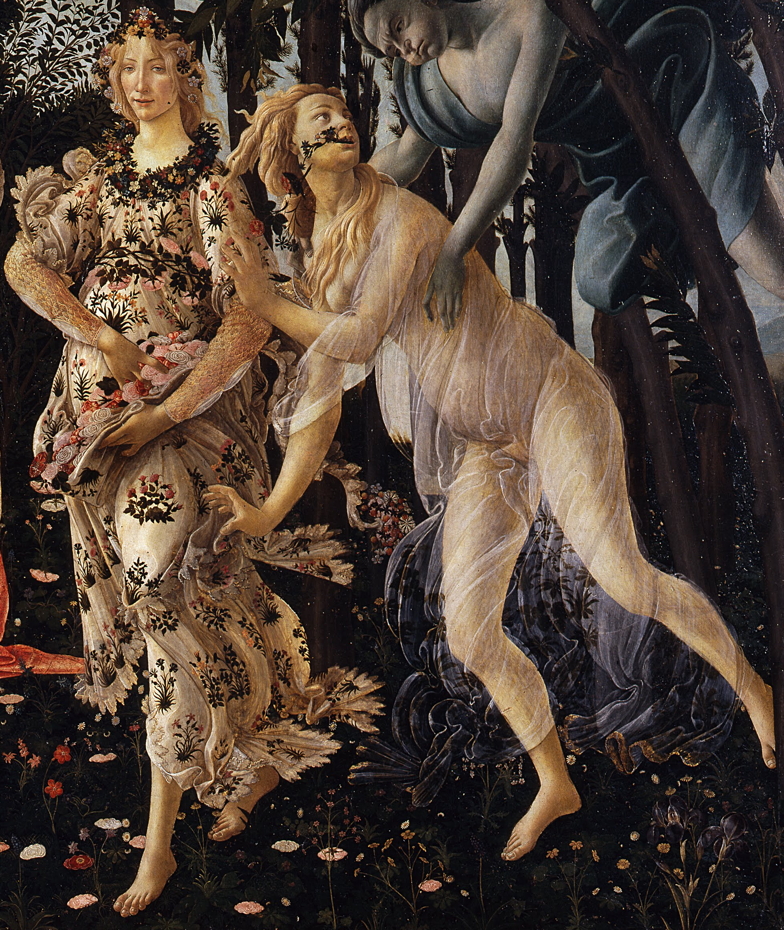
To make amends (!) for his violence to her, Zephyrus then made Chloris his bride, and she became Flora, who enjoys perpetual Spring. Her husband stocked her garden with flowers, and made her the mistress of them. When the dew has dried in the morning, the Hours gather in their colourful clothes, collecting flowers from Flora’s garden. Then the Graces join her and bind their hair with her flowers. For this, Botticelli treats us to almost two hundred different species of flower.
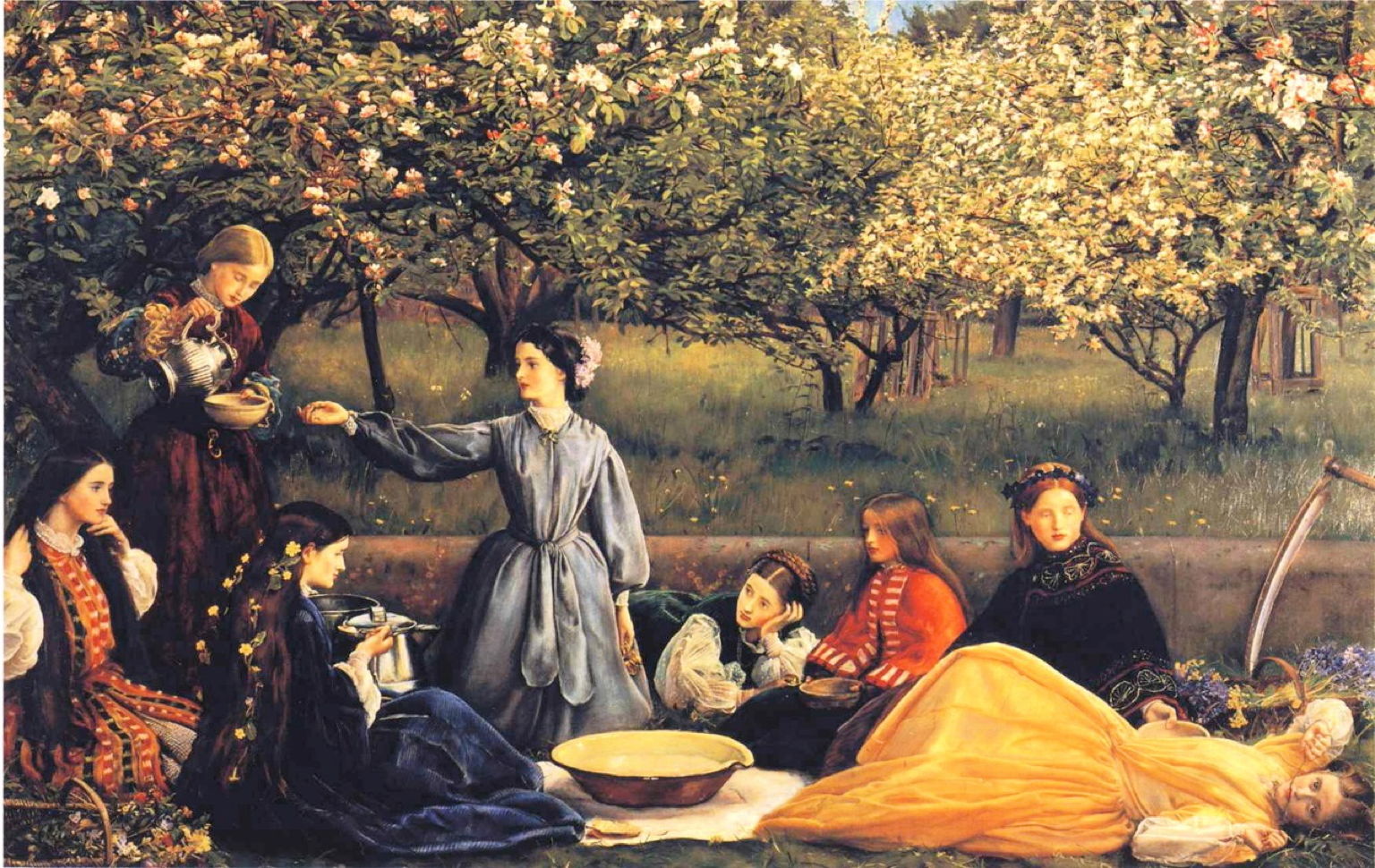
In the late nineteenth century, Flora and her Spring enjoyed a revival in paintings, particularly with artists associated with the Pre-Raphaelite movement. John Everett Millais’ Spring, also known as Apple Blossoms, from 1856-59, may contain subtle allusions to Primavera and classical myth. At the far right, beside this group of elegant young women, is the scythe of Father Time, and behind them is an orchard and meadow. Two of the group have baskets full of Spring flowers, and three have flowers in their hair.

In the closing years of Jean-François Millet’s life, he painted a commissioned series including his startling study of light, Spring (1868-73). This features a double rainbow at the upper left, with fleeting sunshine flooding the centre and dazzling on the abundant blossom. From the crops and seasonal flowers in the foreground to the inky black shower-clouds in the sky, this is a perfect summary of Spring in the countryside.
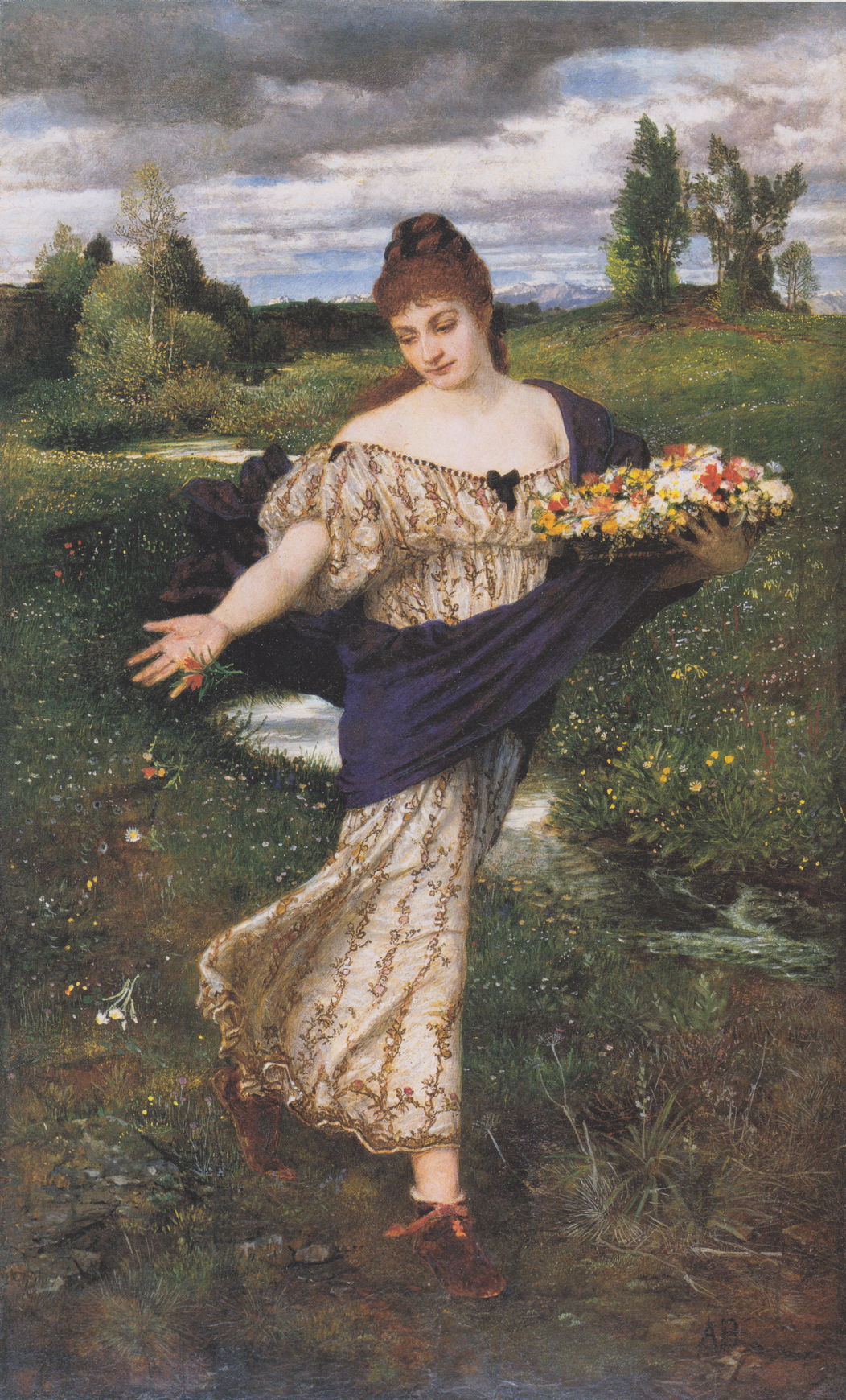
Arnold Böcklin’s Flora from 1875 is scattering Spring flowers as she walks through this meadow, with distant mountains.
Spring flowers feature in the mythical abduction and rape of Persephone.

Walter Crane’s account shows Persephone at the moment of her abduction. She had been picking Spring flowers in the meadow with the three other women shown at the left, and is seen still holding her posy, the link with the previous moments. Hades brought his chariot, complete with its pair of black horses symbolising the underworld, and is seen gripping Persephone’s right arm, ready to move her into the chariot and make off into the future, the dark cavern to the right, taking the couple down to the underworld.
Towards the end of the nineteenth century, these floral meadows started to become more painterly.
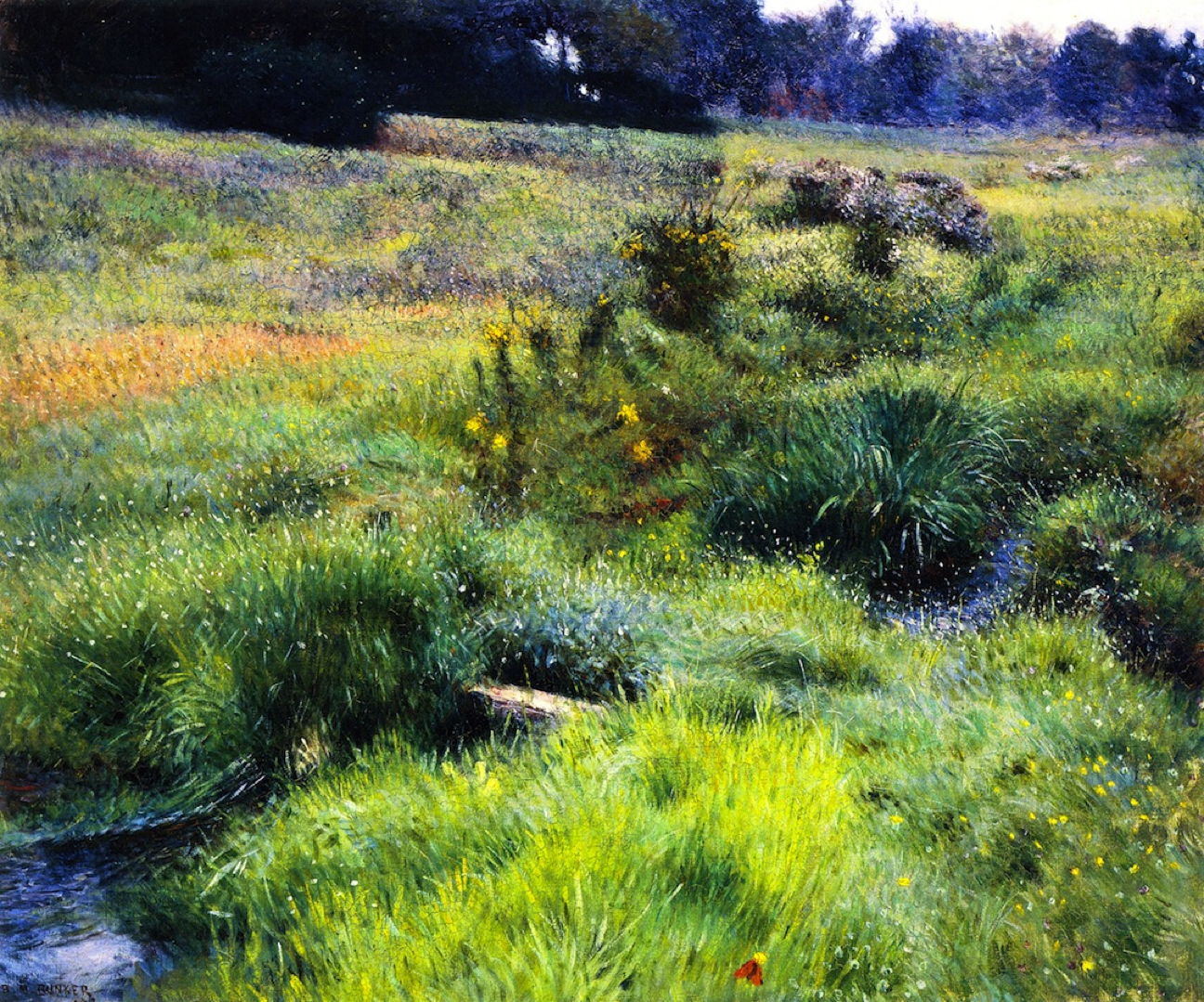
The Brook at Medfield (1889) is perhaps one of Dennis Miller Bunker’s finest and most vivid landscape paintings. Its vegetation has emerged from his earlier diffuse and vague masses, with fine formed brushstrokes building richly-varied textures. In places these become sharply defined, and contrast with the deep blues of water. A few small patches of red, such as the small butterfly at the lower edge, add carefully controlled contrasts. Tragically, Bunker was to die the following year.
Here’s another very painterly meadow, this time from one of the least-known Impressionists, Federico Zandomeneghi.
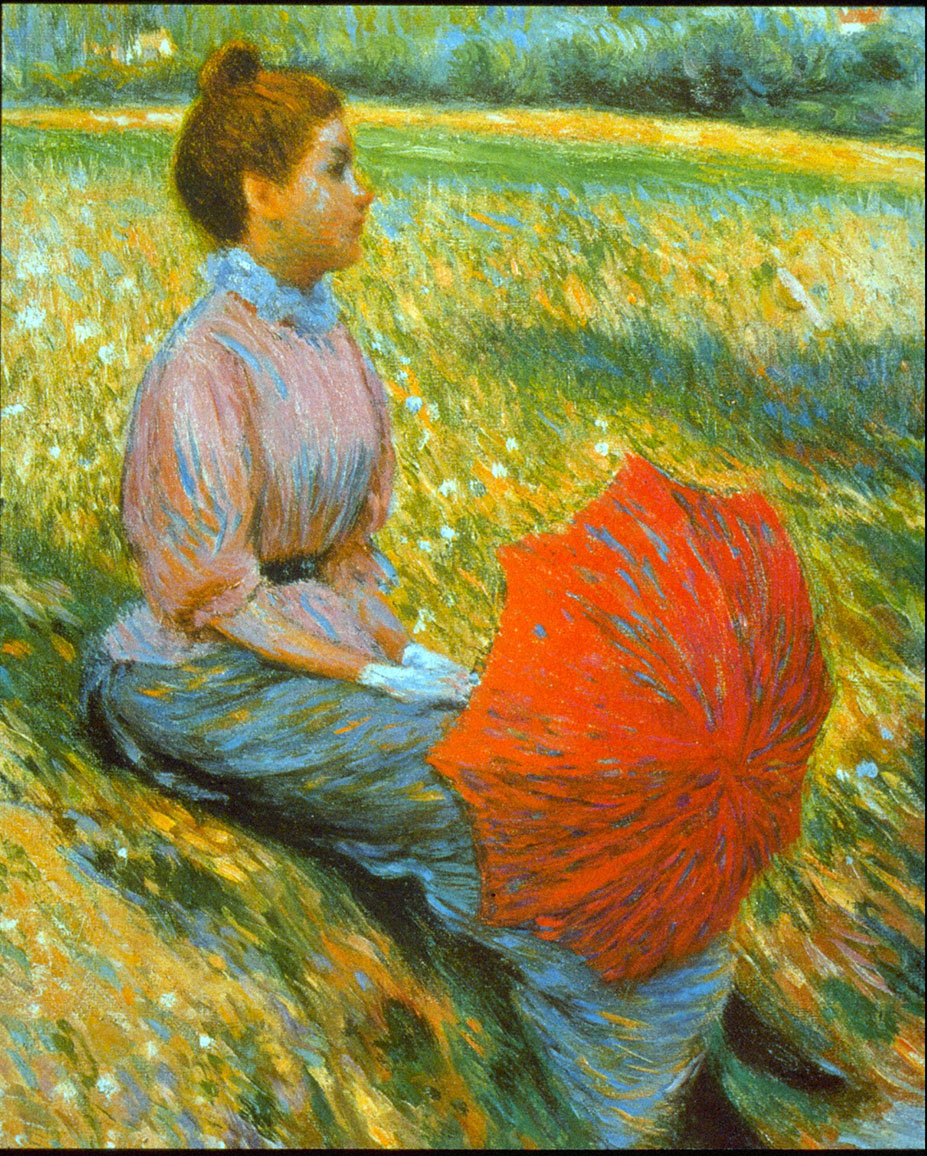
Zandomeneghi was one of the Italian artists who joined the French Impressionists. He moved to Paris in 1874 where he met French Impressionists at their first exhibition. He was particularly attracted to the work and company of Pissarro, Sisley, and Degas. Once working alongside them, his style quickly changed to parallel theirs, with high chroma, depictions of the effects of light, and the like. After four years in Paris, he moved into Montmartre, and met the dealer Durand-Ruel. He took part in the Impressionist Exhibitions of 1879 (the fourth) and 1880 (fifth), and the critic Huysmans became a keen supporter of his work. This Lady in a Meadow from 1893 looks decidedly Divisionist.
 The Eclectic Light Company