
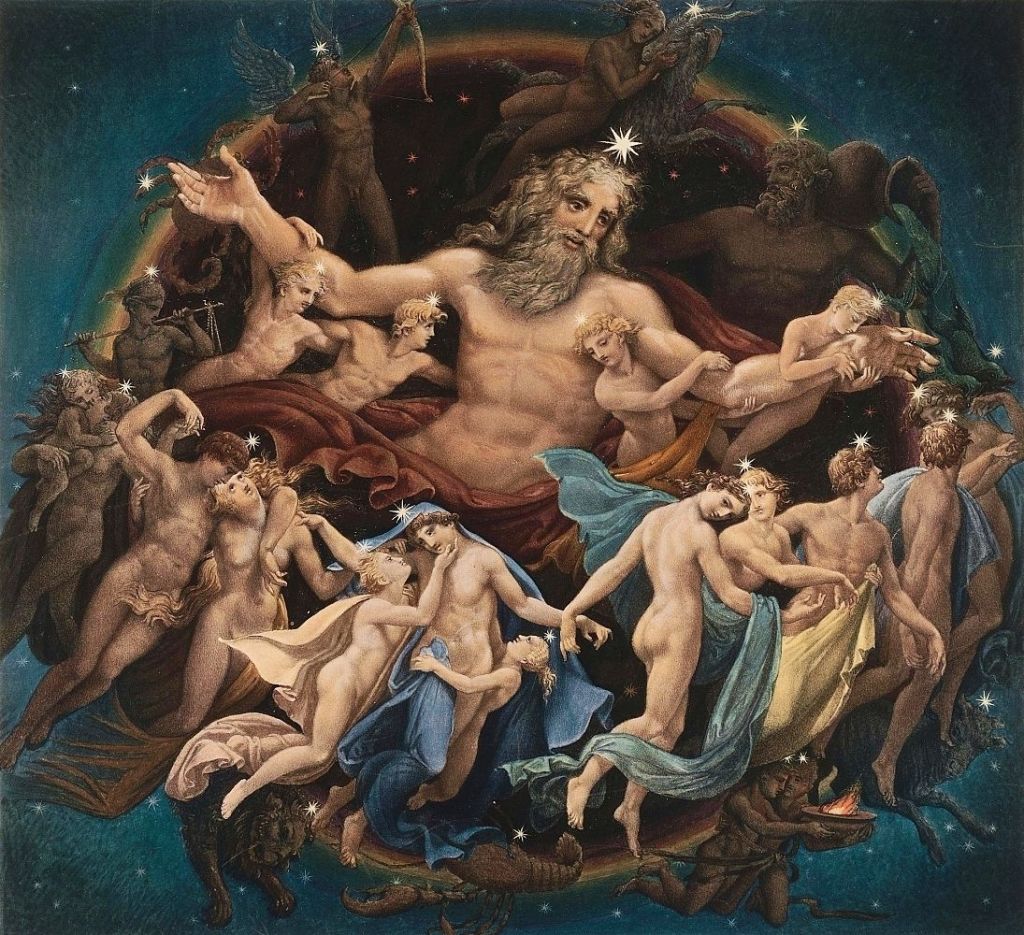
In the first of these two articles considering the reading of constellations in paintings, I showed examples of Ursa Major, the Milky Way, the Pleiades and Sagittarius. In some cases, mythical figures are associated with constellations rather than creating them.
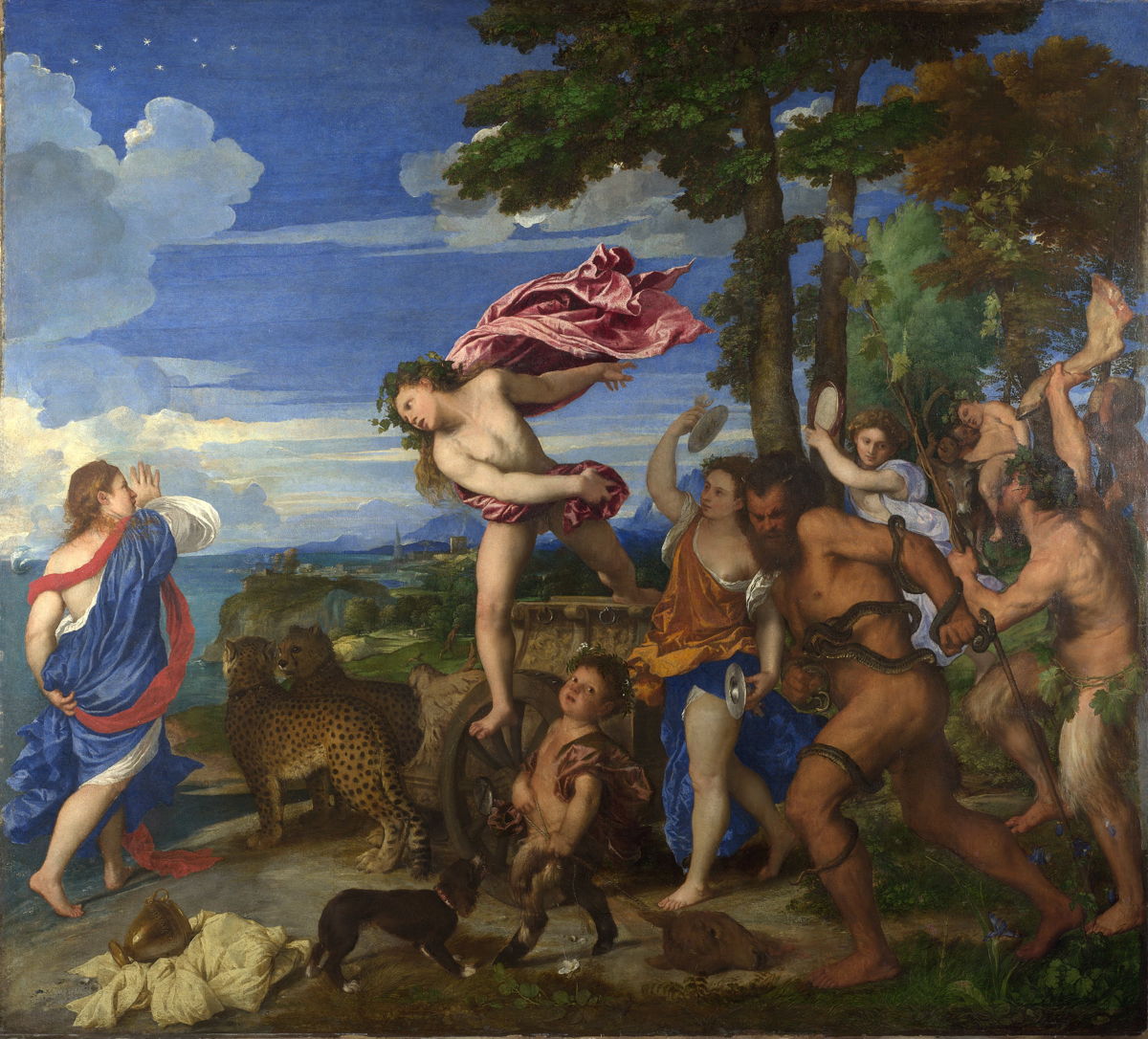
Titian’s Bacchus and Ariadne (1520-3) is probably the most famous painting of the story of Ariadne abandoned by Theseus on the island of Naxos. In the distance, at the left edge, Theseus’ ship is shown sailing away, with Ariadne apparently waving towards it, as Dionysus arrives and leaps out of his chariot. Above Ariadne in the sky is the Corona Borealis, or ‘northern crown’, a minor constellation given to Ariadne by Dionysus as a wedding gift.
The signs of the zodiac, representing its constellations with their mythical associations, are seen quite widely in paintings.

Jacopo Tintoretto’s Allegory of the Dreams of Men from about 1546 is one of his least-known paintings, and one of the hardest to read. It was apparently commissioned for the ceiling of a bedroom in the Casa Barbo, in Venice, where it must have looked really splendid. It incorporates a rich variety of symbols from astrology, arranged in a near-symmetrical fashion around its central figure. Against a background of signs of the zodiac, there’s a decorated crescent moon, gold coins pouring from the clouds, and a minor pantheon of foreshortened figures. At the foot is Father Time with his hourglass, although it’s not impossible that the signs of the zodiac refer also to Aion.
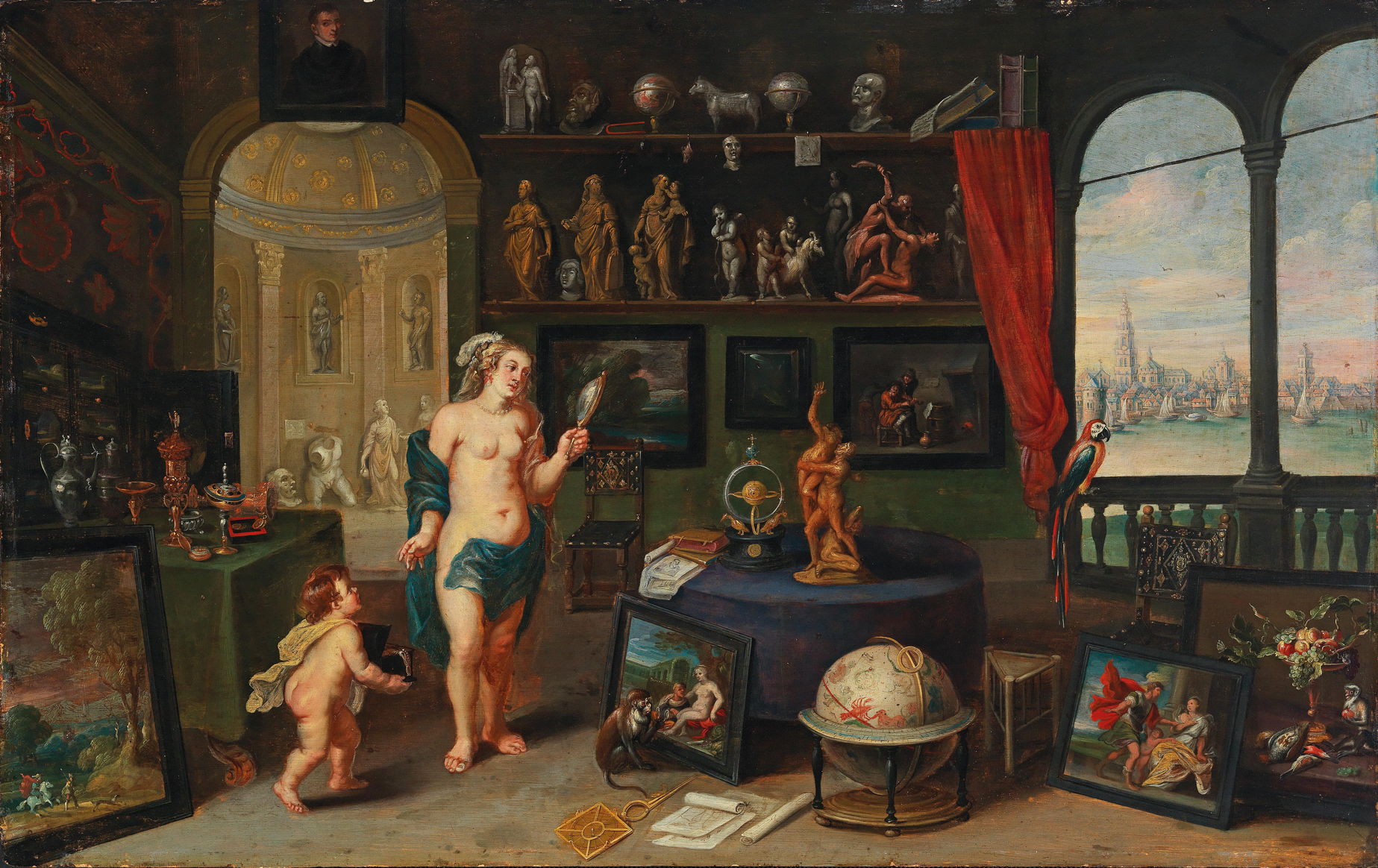
In Frans Wouters’ Allegory of Sight (1635–59), what appears to be a globe in the foreground is a celestial sphere marked with symbols of the constellations.

They also appear in Jan Vermeer’s late painting of The Astronomer, from about 1668. He is studying his celestial sphere, again marked with the symbols of the constellations.
Because of their association with the times of year, constellations and signs of the zodiac are sometimes included in allegories of the seasons.

In Antoine Watteau’s splendid tondo of Ceres as the allegory of Summer, from about 1717-18, she holds the sickle of the harvest, and is surrounded by ripe wheat. At the left is a lion, and below that a lobster, representing the summer constellations of Leo and Cancer.
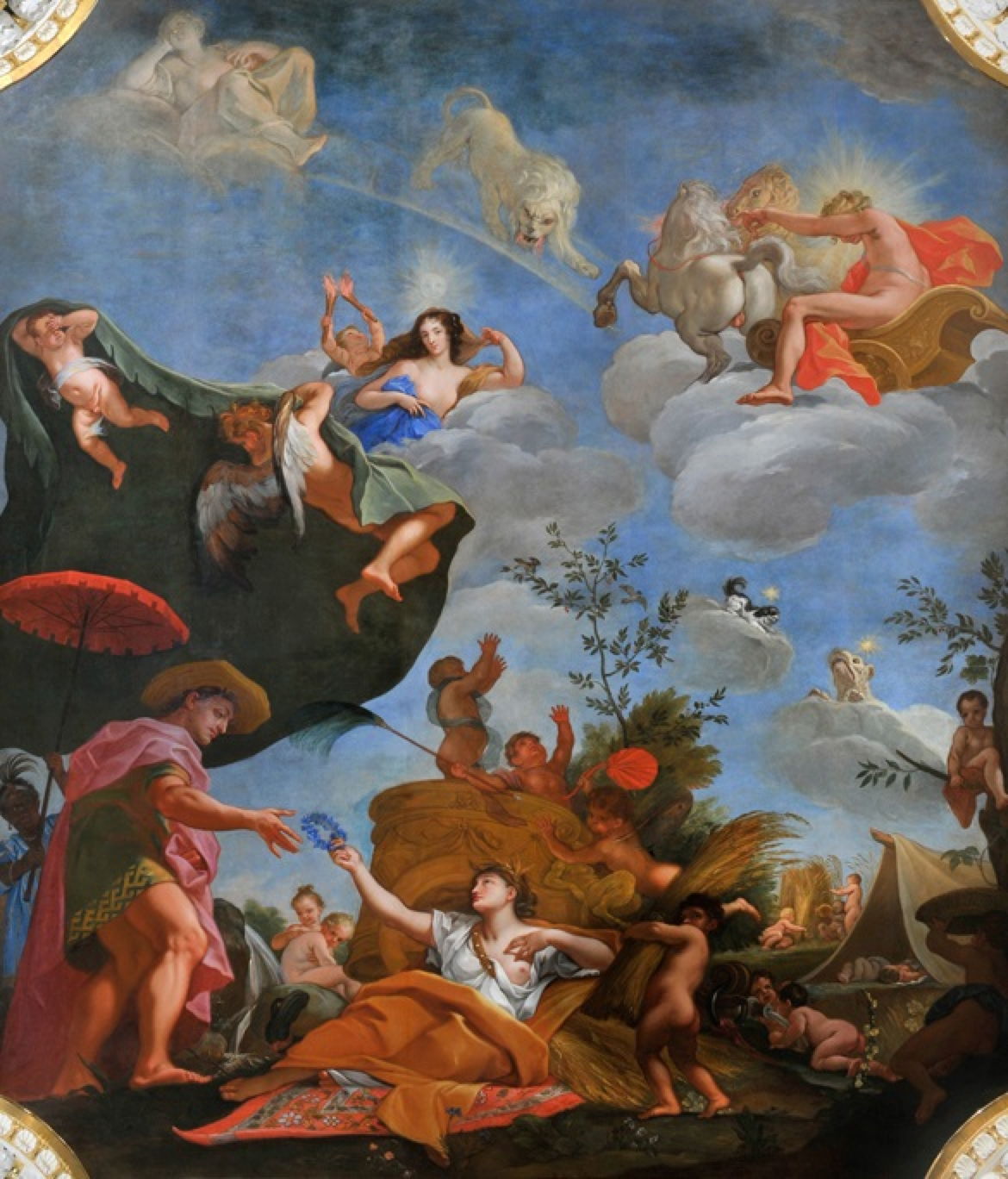
Jerzy Siemiginowski-Eleuter painted his Allegory of Summer (1684—86) on the ceiling of the bedroom of King John III Sobieski of Poland. Ceres is in the centre foreground, handing an unusual blue floral wreath to Triptolemus. Above him is an allegory of the night, with the figure of Aurora-Astraea, modelled here by Queen Marysieńka (Marie Casimire Louise de la Grange d’Arquien), the king’s wife. Low in the sky is the ‘dog star’, generally visible across Europe through the summer. Above is the chariot of the sun in the constellation of the lion, Leo. These symbols of summer are coupled with the more obvious signs of harvest, to complete the elaborate seasonal allegory.

In Karl Friedrich Schinkel’s Uranus and the Dance of the Stars from 1834, the god Uranus is the sky, and is surrounded by figures referring to the constellations.
 The Eclectic Light Company