
In the first of these two articles, I looked at the role of the bed in love, marriage and pleasure. Today, after a brief reminder that we also sleep in beds, I concentrate on beds as a place where we recover from illness, or take a turn for the worse and end our lives there. I then conclude with a few unusual depictions of beds.
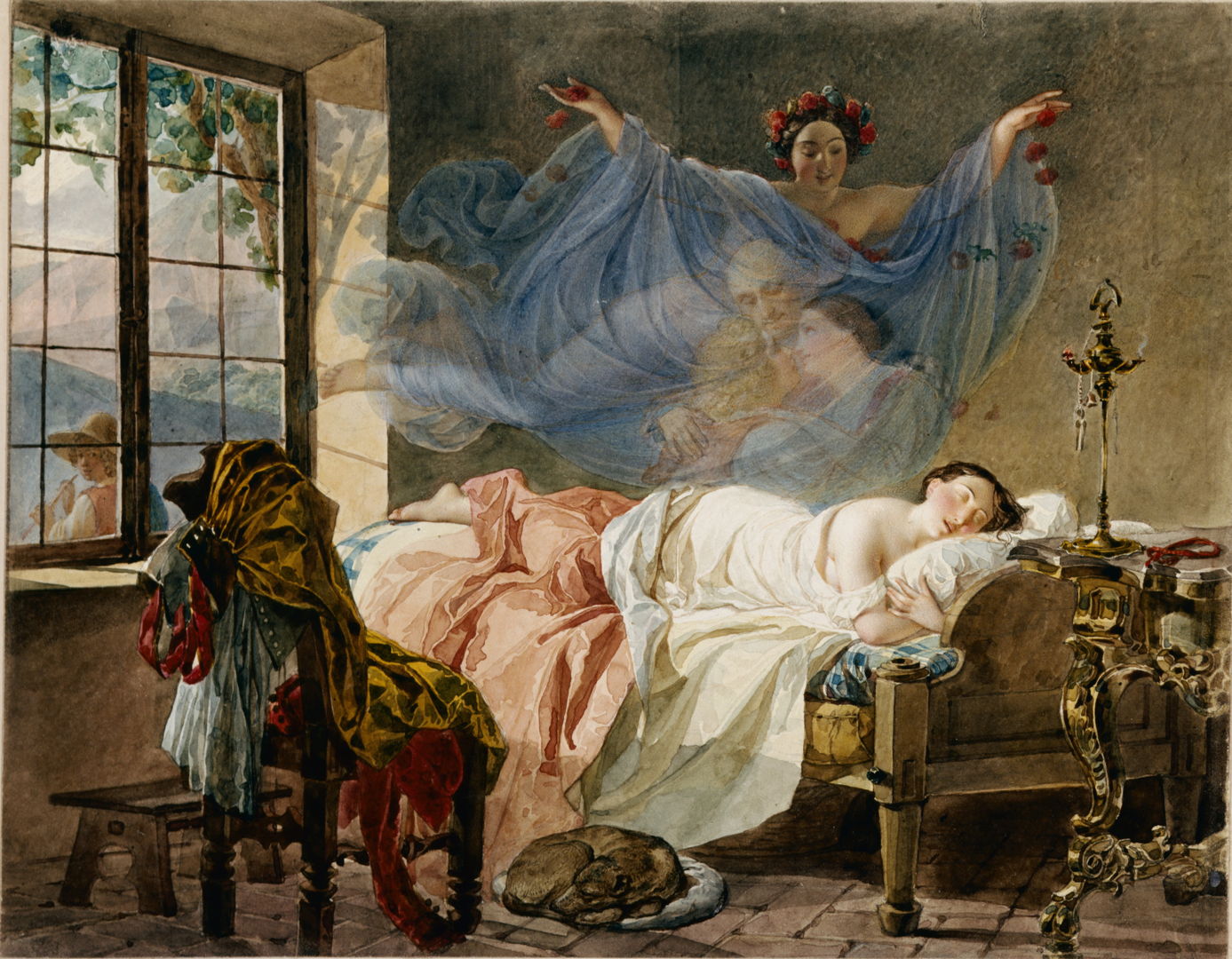
Although not well known outside his native Russia, Karl Bryullov painted a series of works showing dreams, among them this marvellous watercolour of a wishful Dream of a Girl Before a Sunrise from 1830-33.

The Sleeping Beauty of folk tales must have spent longer in her bed than anyone else. Shown here in John Collier’s depiction of the moment before the story’s climax, the princess and her two companions are asleep, with dense woodland and brambles seen through the window.

Rising from bed in the morning is a popular setting for an informal nude, as in Lovis Corinth’s Morning from 1900.
The only righteous and sound reason for remaining in bed during the day is of course illness.

Félix Vallotton’s early Naturalist painting of The Sick Girl from 1892 is detached and clinical, with another modern iron bedstead. He curiously obscures the face of his model, who was his muse and lover Hélène Chatenay.

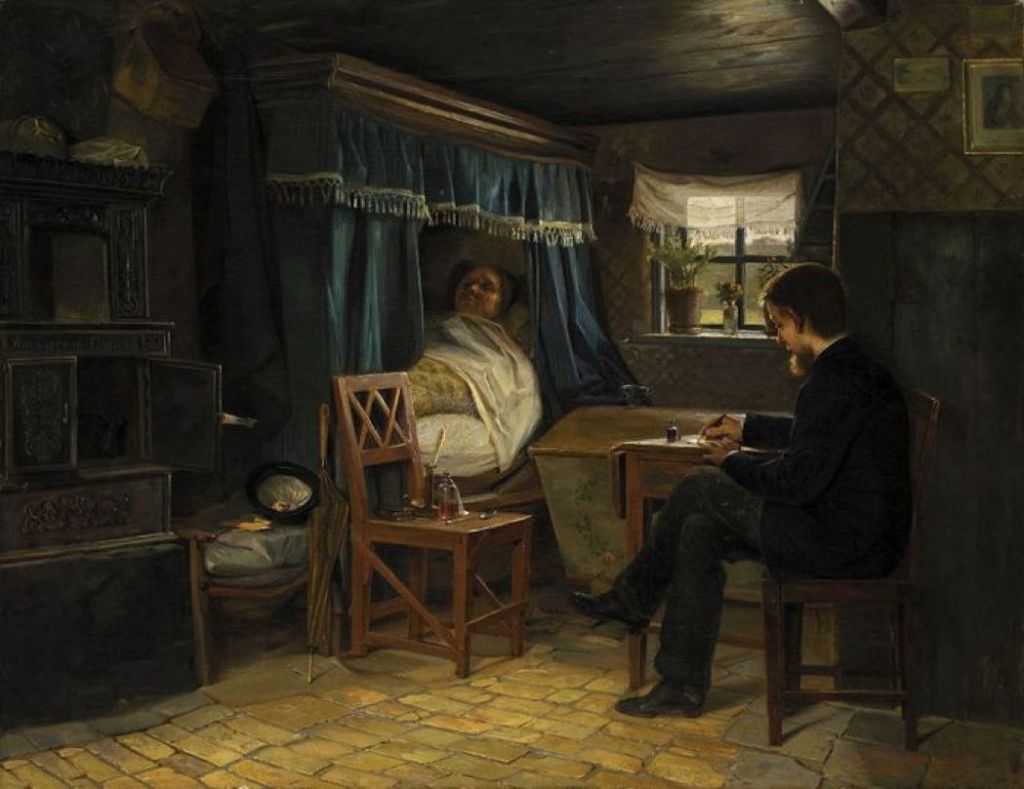
Emmery Rondahl’s The Doctor’s Orders (1882) shows a country doctor writing a prescription, perhaps, for an older patient tucked up in a magnificent fitted bed in their own home. On the chair between them, in the centre of the painting, is a candle in a holder, a bottle of medicine, and a spoon.

By the Deathbed (1895) is Edvard Munch’s painting from memory of his sister Sophie resting in her deathbed in 1877, when she was 15 and the artist was not quite 14 years old. She died of tuberculosis, an unfortunately common event at the time. Munch explained that, when painting from memory like this, he depicted only what he could remember, and was careful to avoid trying to add details which he no longer saw. This explains its relative simplicity.
Sophie is seen from her head, looking along her length to her feet, her figure compressed into almost nothing by extreme foreshortening. Her deathbed resembles the next step, in which her body will be laid out in a coffin prior to burial. More than half the painting is filled by the rest of the family, father with his hands clasped in intense prayer. At the right is the mother, who had died of tuberculosis herself nearly nine years earlier.
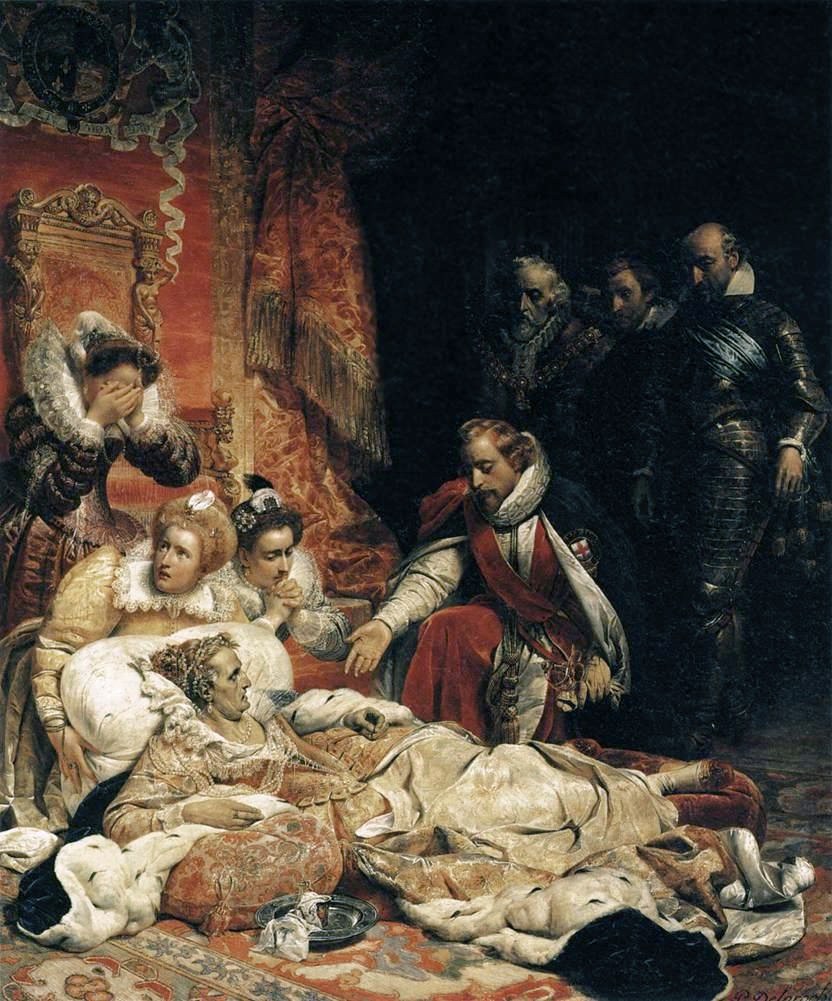
In Paul Delaroche’s Death of Elizabeth I, Queen of England (1828) the haggard queen is shown slumped on a makeshift bed on the floor, putting her low in the painting. Her maids and other female attendants are in distress behind her, supporting the pillows on which her head rests. I presume that the male kneeling by the queen and extending his right hand towards her is Robert Cecil, leader of the government at the time, and behind him are other members of the Privy Council of England, who were shortly to install Elizabeth’s successor.

Another notable painting of a bed on a floor is a stark contrast. Arturo Michelena’s Charity from 1888 shows a pair of bourgeois ladies arriving to do their bit for charity, in the hovel which is home to a young mother and her small child. Michelena uses the light skilfully to pick out sufficient detail in each of the figures to enable the viewer to read this painting.
Beds are sometimes the location for killing.
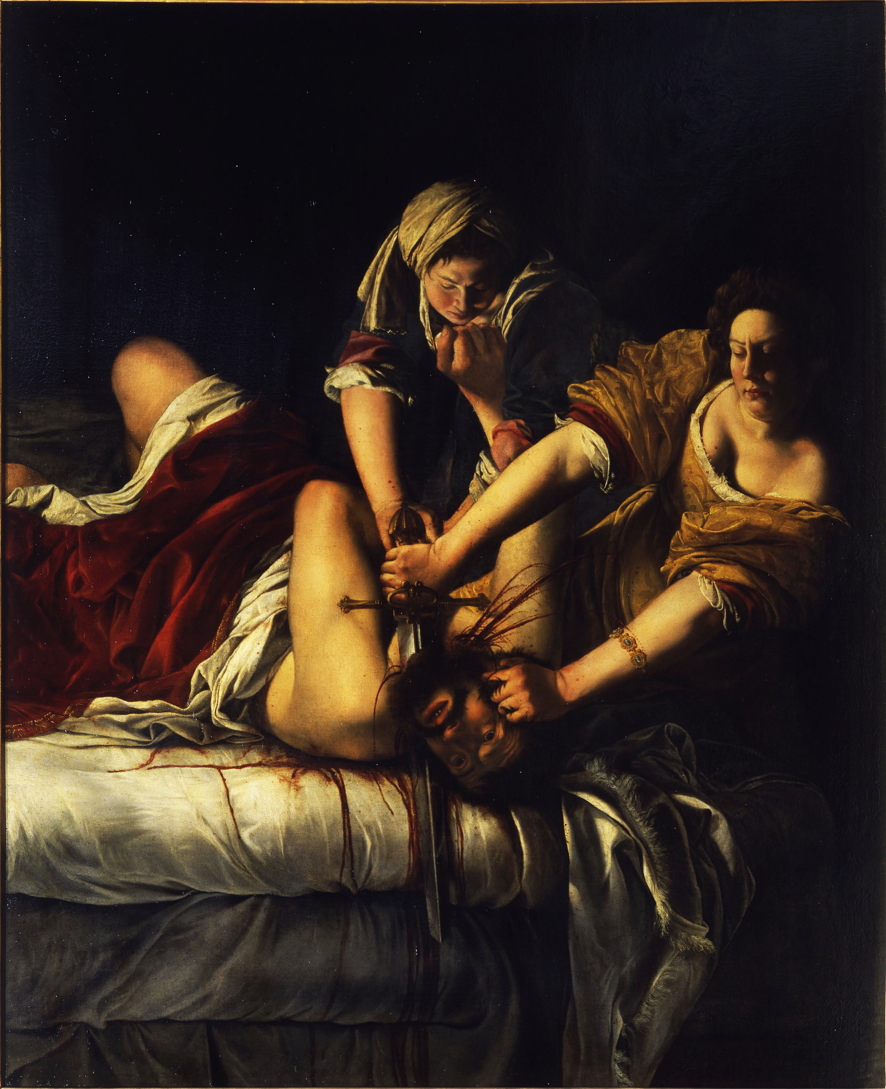
Artemisia Gentileschi’s second version of Judith Slaying Holofernes, painted in 1620-21 and now in the Uffizi in Florence, isn’t as tightly cropped on the three figures as her first, so showing Holofernes’ legs and a deep red wrap around his lower body.
Because of their earthly implications, beds are almost universally avoided in religious paintings, unless they’re explicit in the story shown. Nevertheless, in the nineteenth century there were a few risqué depictions of the Virgin Mary with her bed.
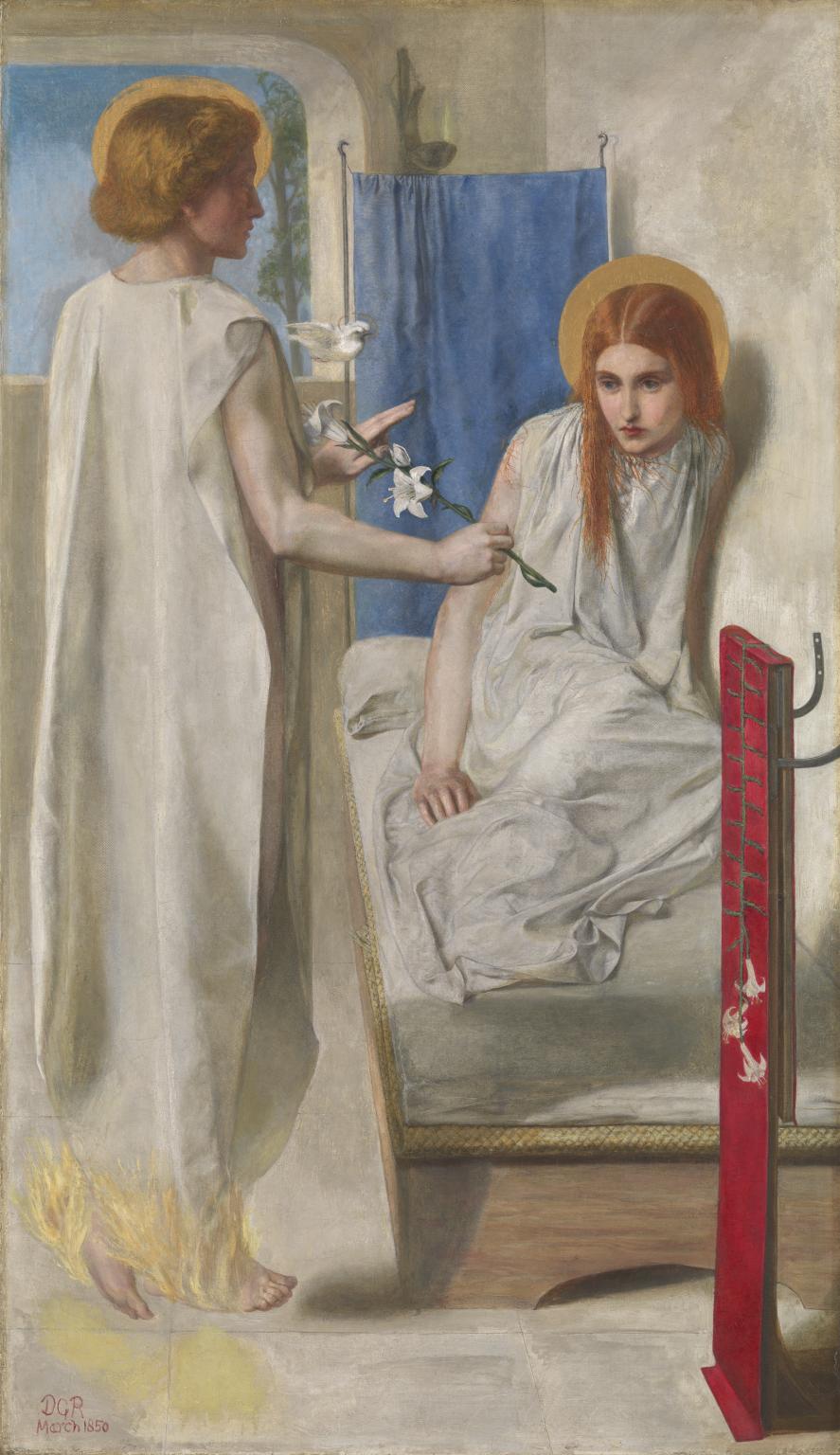
Dante Gabriel Rossetti’s Ecce Ancilla Domini! (The Annunciation) (1849–50) is as radical a reinterpretation of the traditional Annunciation painting, as his Girlhood of Mary Virgin was of the life of the Virgin. There are gilt halos, amid very natural realistic depictions of the figures and objects. Symbols include: white robes (purity), lily (purity, a traditional Annunciation symbol), a dove (the Holy Spirit), red embroidery (Christ’s crucifixion), blue curtain (heaven), and flames at the feet of the Angel Gabriel rather than traditional wings.
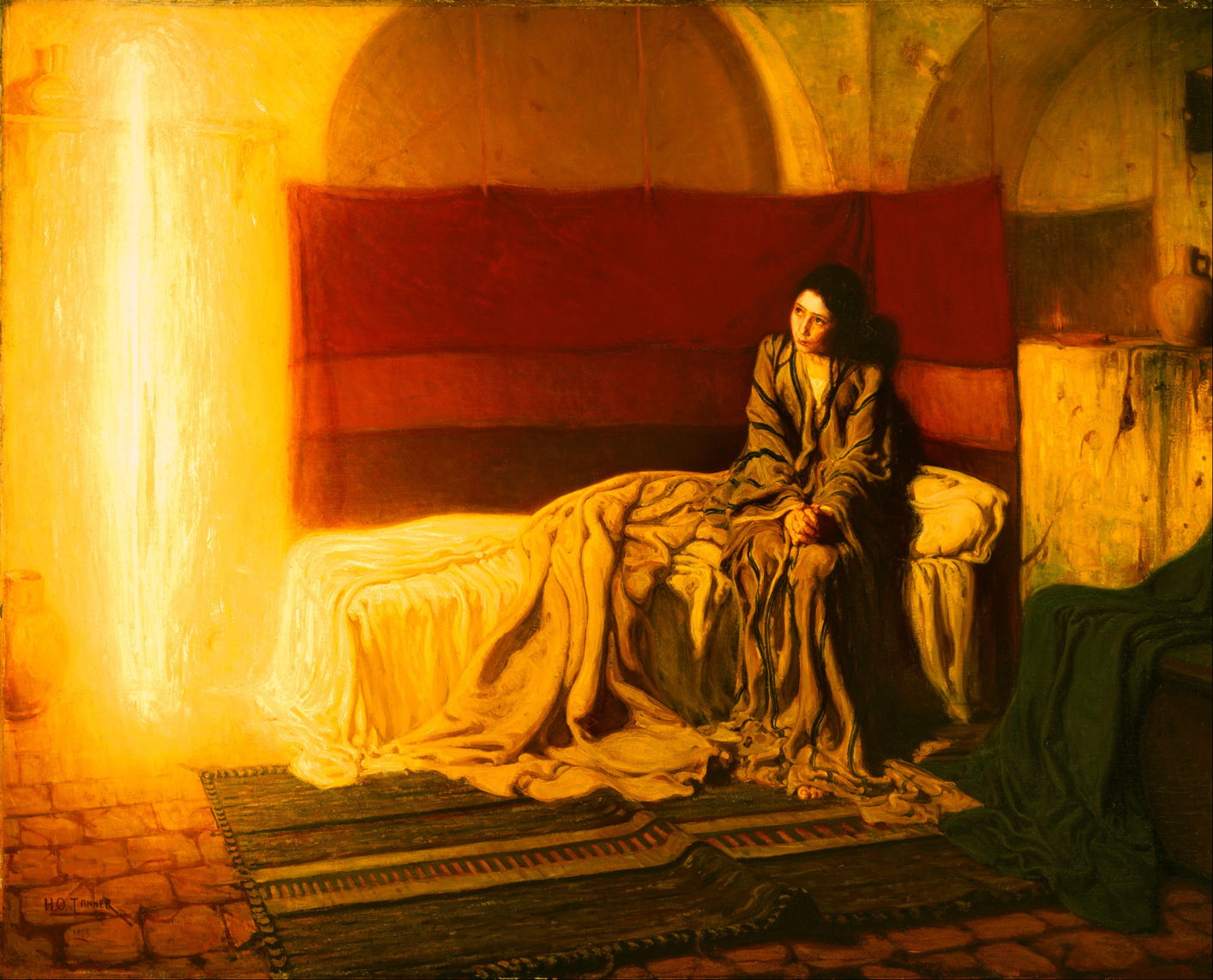
The Annunciation from 1898 is one of Henry Ossawa Tanner’s most unconventional paintings of this traditional scene, showing her sitting on her bed as she is told of her future.
My final painting of a bed is the most bizarre that I have come across, and dates back to Clovis II (637-657/8), king of Neustria and Burgundy from 639. He married Balthild, an Anglo-Saxon aristocrat who had been sold into slavery in Gaul. They had three sons: Chlothar who succeeded Clovis, Childeric, and Theuderic.
A persistent legend grew up that, in about 660 (by which time Clovis was already dead), Clovis went on a pilgrimage to the Holy Land. While he was away, he entrusted his kingdom to his oldest son, Chlothar, under Balthild’s regency. However his older two sons fell out with their mother, and conspired to seize power from her. Clovis rushed back to control this revolt, and ponder what to do with his sons.
Clovis wanted to execute them both, but Balthild proposed punishment that would deprive their limbs of all power, so they couldn’t revolt again. Although the language is ambiguous, it appears that the main tendons, including those of the hamstrings, were cut in their arms and legs. The helpless boys were placed on a raft on the river Seine, and floated downstream to Jumièges, near Rouen, where Saint Philibert took them in and gave them shelter.
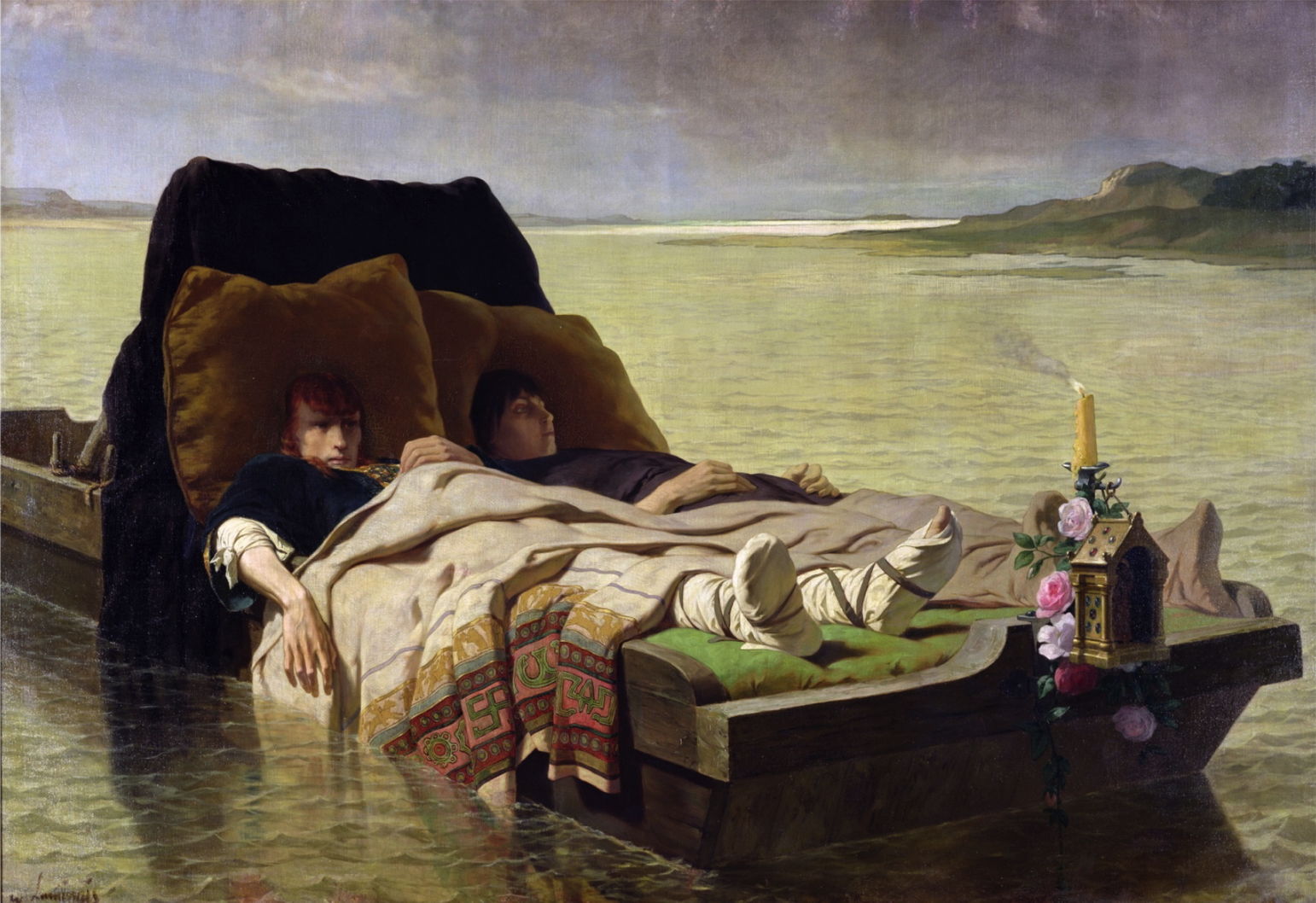
Évariste Vital Luminais painted this legendary scene of the two boys floating in their bed-like raft on the Seine, in The Sons of Clovis II (1880).
 The Eclectic Light Company