
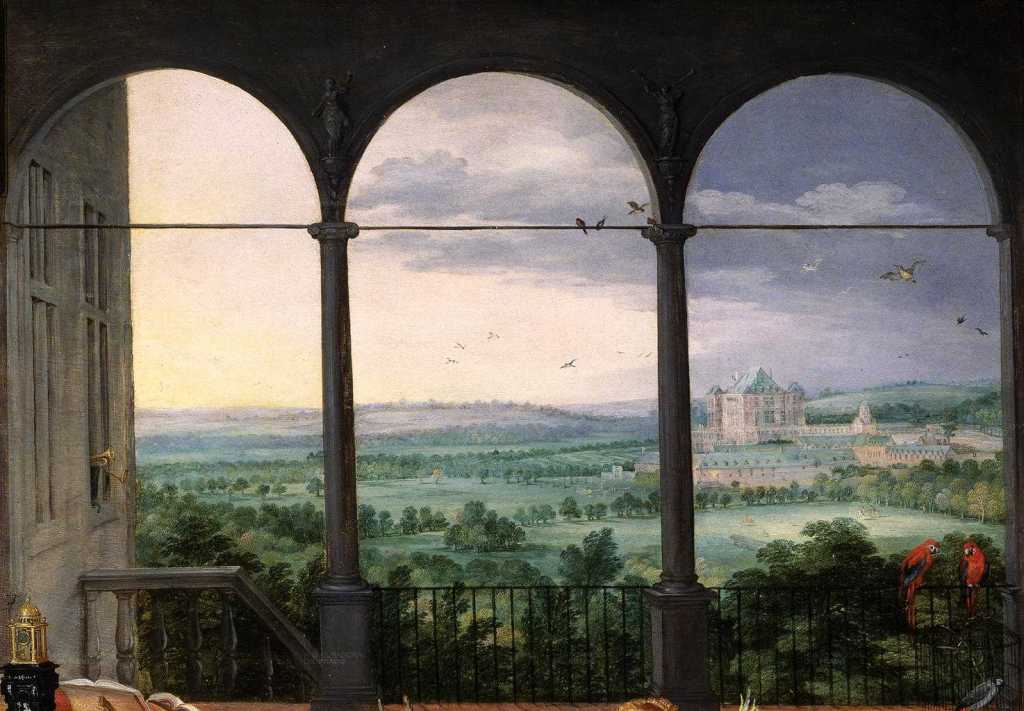
During the Renaissance, cameo landscapes had provided an acceptable way for artists to include small views of the world beyond predominantly religious motifs. As landscapes became progressively more acceptable, eventually forming a genre in their own right, those cameos grew larger and less inhibited.
Jan Brueghel the Elder (1568-1625) was an accomplished landscape painter, and one of the pioneers of the genre. When he came to paint his series depicting the five senses, in which his good friend Peter Paul Rubens was responsible for the figures, he chose to give each a landscape backdrop, with only Hearing showing the view through a window of a country palace. One explanation for these cameos is that they depict palaces belonging to Albert VII, Archduke of Austria, and his wife Isabella, who may have commissioned the series. However, with the exception of that in Hearing, the views give little information about their location, and may in fact be generic in content.

The landscape in Hearing is the best-developed of the five. Using a triptych format, created by two pillars, in a similar approach to that in van Eyck’s Rolin Madonna, it shows a large palace set in rolling countryside. There are many green fields with criss-crossing wooded roads, as might be typical of a royal estate. The sky shows either a coming or clearing storm, and there are several birds in the air; these, through their calls, may be the only reference here to the sense of Hearing.


Taste (1618) is an almost exhaustive catalogue of what was then considered to be edible. At its centre, Pan (or a satyr) pours a woman of ample figure a coupe from his large flagon. Immediately in front of her are a dozen oysters, and the remainder of the table is packed tight with an array of exotic dishes. The room then opens out to a deer park and another distant palace.
Cameo landscapes seem to have been largely abandoned once full-sized paintings became acceptable, and didn’t reappear until the nineteenth century, and then for different reasons.
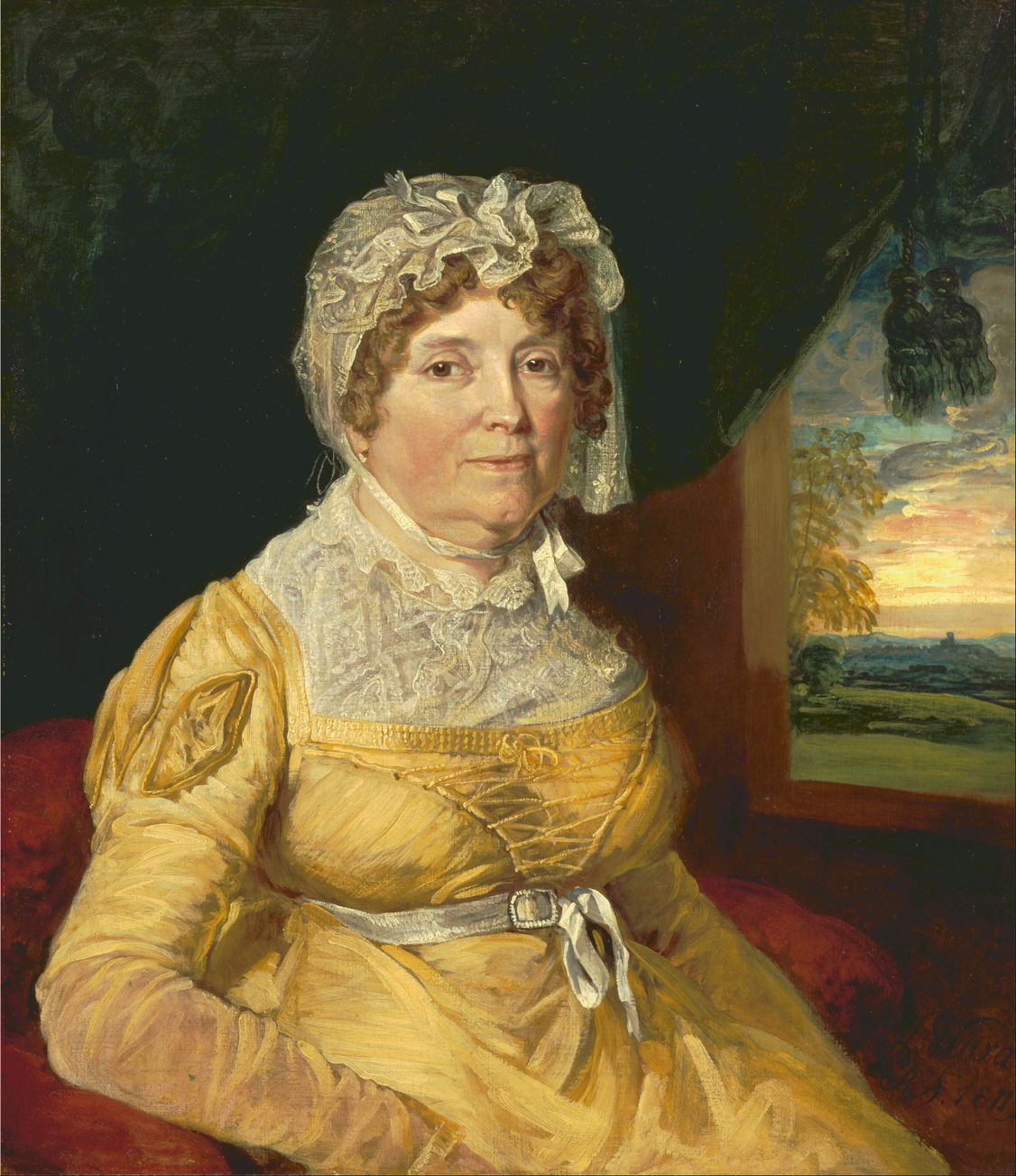
An Unknown Woman (1811) is James Ward’s honest and skilful portrait of a woman of advancing years, with a cameo landscape seen through the window on the right. That has the painterly style and light effects of Ward’s oil sketches, and may have been the first time that his public got a glimpse of that.
In Frederic, Lord Leighton’s Death of Brunelleschi from 1852 the cameo view of Florence is instantly recognisable.

Leighton follows convention in locating Brunelleschi’s death to a building in Florence, whose window opens to a view of the dome of the cathedral, his monumental work. Brunelleschi is shown half-recumbent in extremis in a chair, as if flattened onto a two dimensional plane. The complex array of buildings seen between the window and the dome appear to defy correct perspective projection, but have in fact been carefully projected, and contrast with the flatness of the dying man, who devised perspective projection.

Thoughts of the Past (1859) was the first of John Roddam Spencer Stanhope’s paintings to be exhibited at the Royal Academy (in 1859), and remains one of his best-known works. It shows a woman standing by a window that looks out onto the River Thames in London, and is a faithful depiction of the studio below that used by Dante Gabriel Rossetti at the time, at Chatham Place, London. The woman and her surroundings contain rich clues as to her status as a prostitute. The view looks towards Waterloo Bridge, with the Strand embankment to the right, an area that was at that time a popular haunt for prostitutes.
I’m only aware of a single example of a cameo landscape used as a tribute to a recently dead artist.
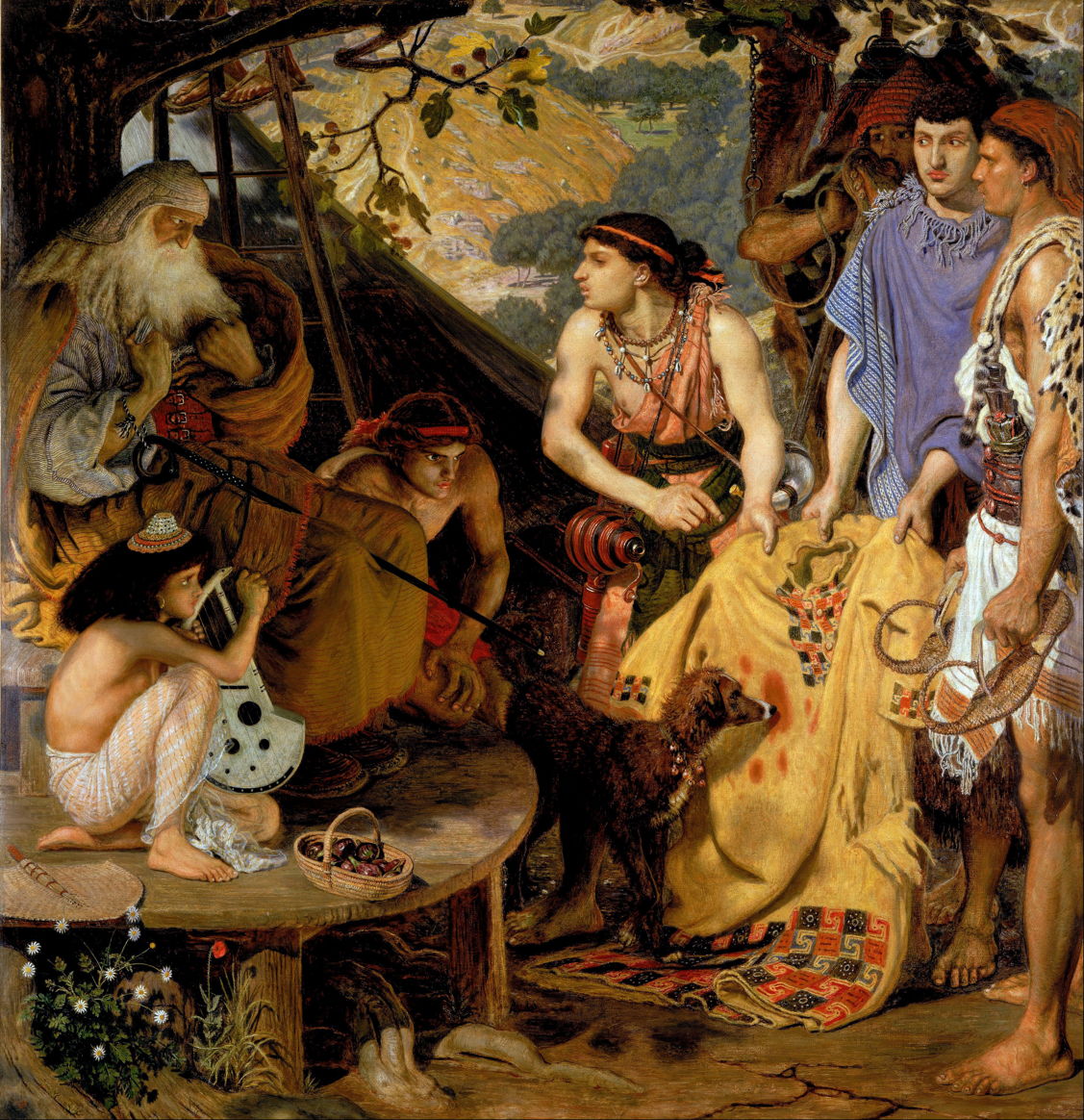
Ford Madox Brown’s Coat of Many Colours (1864-66) is a religious story, based on the Old Testament account of Joseph and his jealous brothers. The brothers sold Joseph into slavery, then brought his distinctive coat, suitably bloodstained, to their father to convince the latter that their brother had been killed by wild animals. Brown packs many figures into his image, which is set against a background based on Thomas Seddon’s landscape paintings made in front of the motif in Palestine, including his Jerusalem and the Valley of Jehoshaphat from the Hill of Evil Counsel (1854–5), shown below. This is not only an appropriate context, but a tribute to his fellow Pre-Raphaelite who tragically died in Cairo of dysentery in 1856.

The next milestone is in works of the twentieth century, particularly those of Eric Ravilious, such as his Interior at Furlongs (1939).
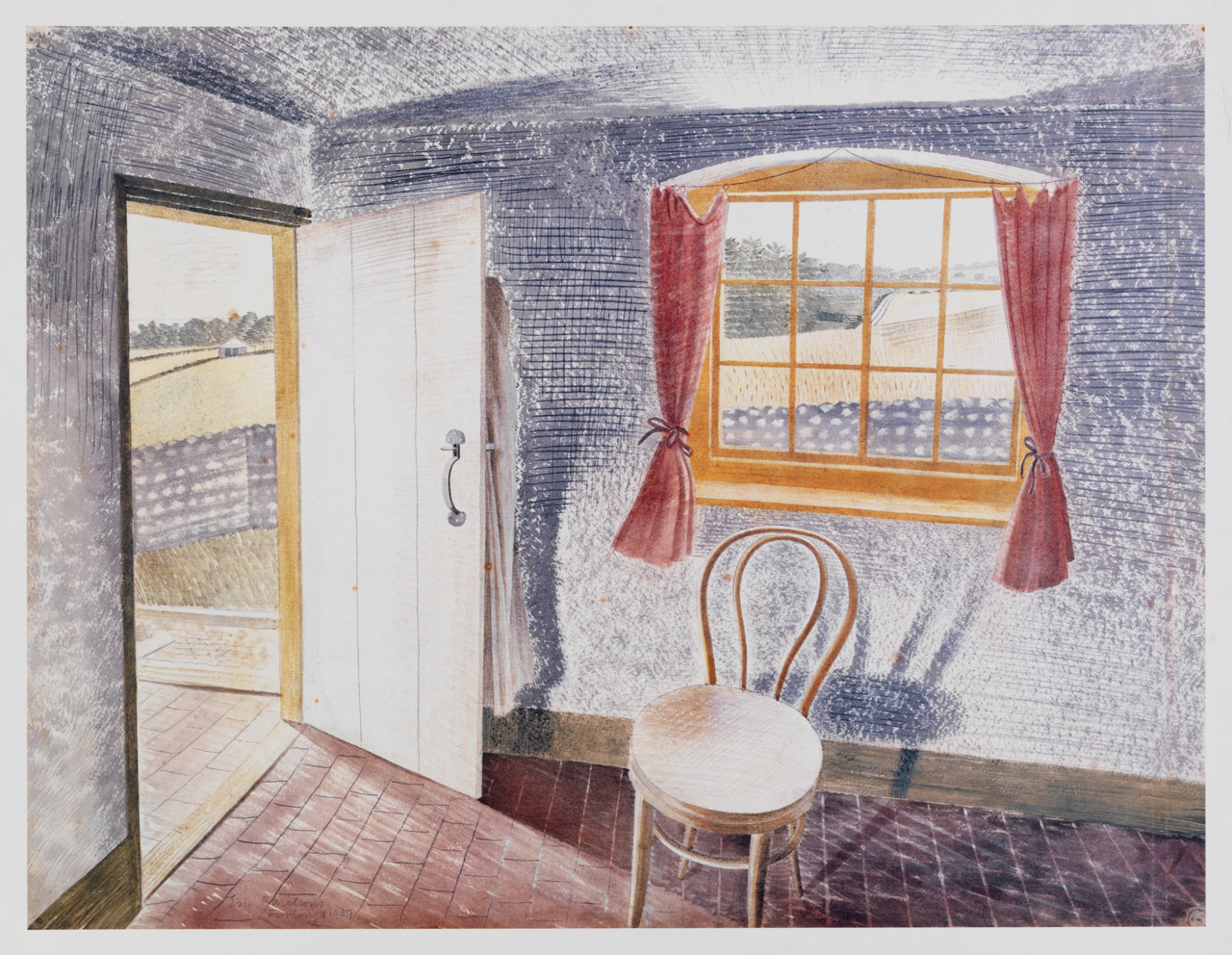
This watercolour has the appearance, and many of the traits of, a print, and combines its interior view of a largely empty room in a cottage, with one view through the open door, the other view through a closed window. The landscape shown is that of the South Downs in East Sussex, Furlongs being the cottage owned by Peggy Angus, who invited Ravilious to stay there. The fragmented view shows woods, a distant hut or cottage, and golden fields of grain crops, so would have been painted in the late summer, at the outbreak of the Second World War.

The second of Ravilious’ cameos is that of Train Landscape (1940), painted during the early part of the war. He had intended producing a book showing the many chalk figures found on the Downs in the south of England. That shown, again in the form of a triptych, harking back to van Eyck’s Rolin Madonna, is that of a huge horse, near Westbury in Wiltshire.
For Ravilious these composite paintings of train interiors and cameo landscapes were different in intent from their predecessors. The railway carriage was more than a framing device, and the landscape more than a means to add depth to the interior. This type of travelogue motif was popular at the time, as a means of promoting travel to see places, and would likely have been an important theme had Ravilious been able to complete his book. He was tragically lost when flying on a sortie from Iceland in 1942.

Around 1920, George Bellows painted more figurative and portrait works, including this Nude with Fan. This wasn’t his first nude, but is remarkable for its richly-lit cameo landscape with marked aerial perspective, that may have been intended to enhance depth.
Late in the life of Eleanor Fortescue-Brickdale, when her eyesight was starting to deteriorate, she painted one of Botticelli’s works together with a locational cameo landscape in Renaissance tradition.

The title of this painting reveals its key figures: Botticelli’s studio: The first visit of Simonetta presented by Giulio and Lorenzo de Medici (1922). Behind Botticelli, Giuliano de’ Medici, Simonetta Vespucci, Lorenzo de’ Medici, Giovanna Tornabuoni and her attendants is an embedded view of the Palazzo Vecchio in the centre of Florence. The painting shown in progress is Botticelli’s Madonna of the Magnificat, believed to have been completed in 1483.
Another pair of famous paintings that develop the idea of the cameo landscape are those of René Magritte’s La condition humaine (The Human Condition) of 1933 and 1935. As these are still protected by copyright, I can only point you at the account on Wikipedia, which lists some of his other works using this device, and a full image of the earlier version at the National Gallery of Art, where it’s on display.
Magritte himself stressed the effect on the viewer, for whom objects shown in the painting within the painting were both inside the room, and outside in the real landscape.

