
Before the nineteenth century, group portraits had been precious records of families and guilds gathered together. Just as those paintings were starting to be challenged by photography, they changed. Manet assembled images of those in his circle into a crowd in the Tuileries Gardens, and Courbet collected all sorts of figures into what he claimed was an allegory in his studio. It seems those inspired Henri Fantin-Latour to paint a series of increasingly weird imagined group portraits.
Fantin had started as a skilled copyist of old masters in the Louvre, then of floral still lifes, which proved commercially successful. When Eugène Delacroix died in 1863, he decided to try his hand at a group portrait in his memory.

Following a long series of studies, Fantin’s first group portrait Homage to Delacroix was completed in 1864. Its figures include two, Champfleury and Baudelaire, who had appeared in Courbet’s Painter’s Studio, together with those who Fantin rated as the brightest and best among modern painters, including his friends Whistler and Manet. Inevitably he included himself among such distinguished company.
But Fantin neither poses us the puzzle of Courbet’s allegory, nor the social gathering of Manet’s Music in the Tuileries. Instead we have seven men looking at the viewer, and three gazing somewhere else. It almost looks like a real group portrait, but lacking interactions between the figures, it’s clear that it’s eleven individual portraits, including that of Delacroix.
Fantin’s second group portrait, started as he was finishing Homage to Delacroix and exhibited at the Salon the following year, crashed and burned so badly that he cut it up shortly afterwards. As far as we can tell now, Fantin threw the nude figure of Truth into another agglomeration of men in drab clothing, in The Toast! Homage to Truth.

Deterred by the failure of his second attempt, Fantin didn’t try a third group portrait until 1870, when he exhibited A Studio at Les Batignolles (1870). This group has purpose, being gathered around Fantin’s friend Édouard Manet at his easel. Although still dressed for a funeral, this stars three of the Impressionists, Renoir, Bazille and Monet, together with the great Naturalist author Émile Zola, Zacharie Astruc and others. It still refers to Courbet’s Painter’s Studio.
In human terms, this is even more disconnected than the first. Directions of gaze are all over the place: Manet isn’t even looking at his brush, and none of the figures are remotely aware of the presence of any of the others, let alone relating to them in any way.

Nevertheless, Fantin’s painting prompted Frédéric Bazille to paint his Studio on the Rue La Condamine, which is in almost every respect the exact opposite of Fantin’s painting. Of the six figures included, only one, the pianist, isn’t interacting with others. The space is wide open instead of closed in, and the scene appears natural rather than posed or assembled from individual studies.

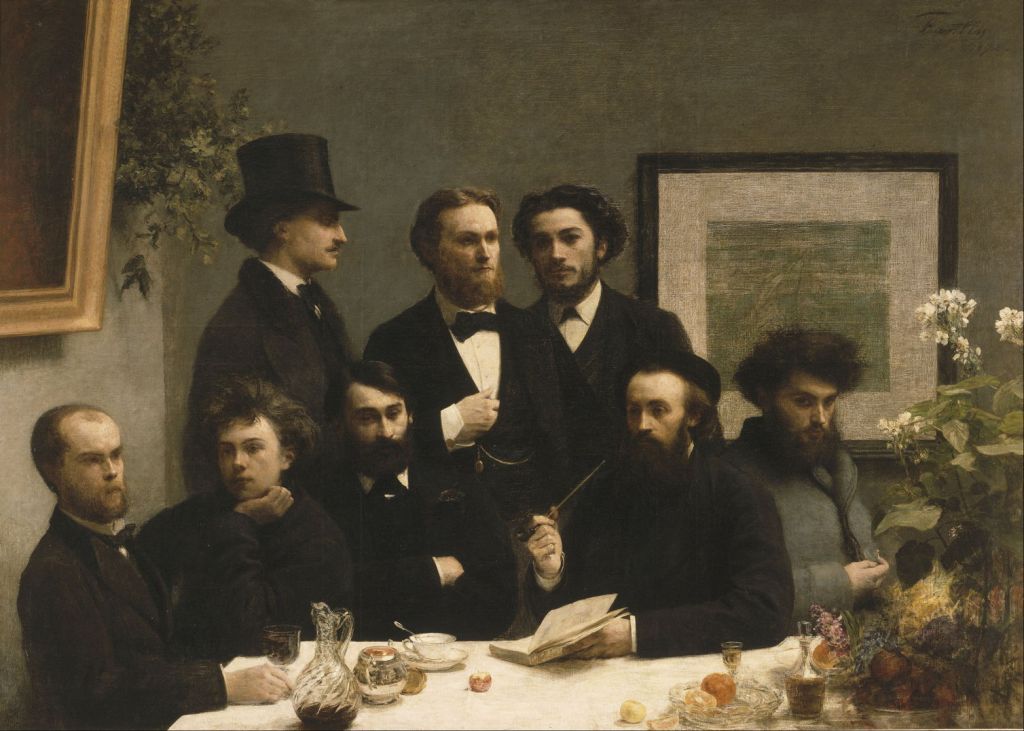
Fantin seems to have been encouraged by this success, and followed with his fourth group portrait, By the Table, just in the nick of time for the Salon in 1872. Having shown many of the painters of the avant garde, it was now the turn of writers and poets, and here he was unlucky in his timing and choice. Just a few weeks beforehand, the growing scandal surrounding Verlaine and Rimbaud had erupted into a bit of a swordfight after dinner.
Now we have eight from the literary avant garde, one absent and replaced by a floral display. Even Verlaine and Rimbaud appear unaware of one another’s presence, and gazes lead in many directions. But it seems to have been the scandal which sealed the fate of this painting.
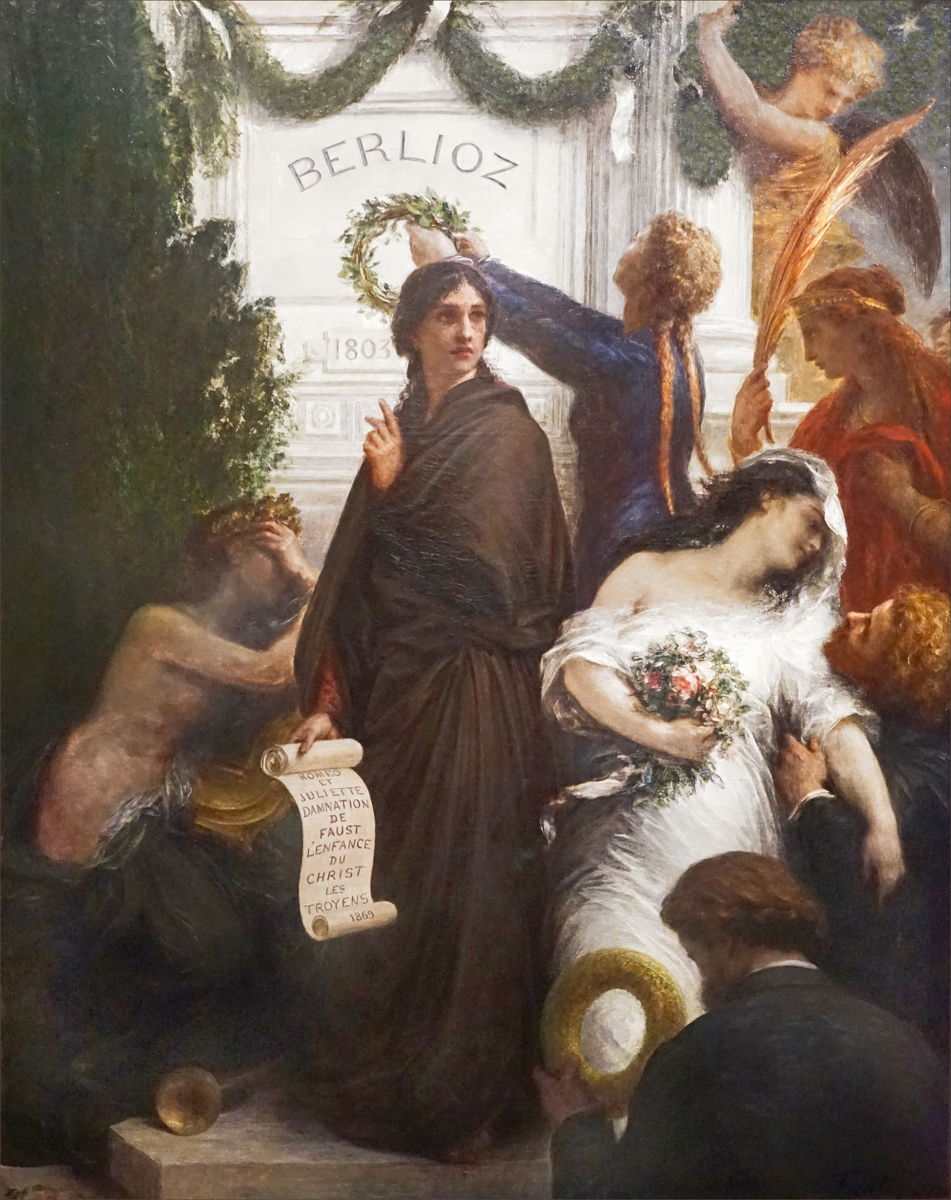
For his fifth group portrait, Fantin went for something completely different: a tribute to one of his favourite composers, who had died seven years previously. He started work on The Anniversary. Homage to Berlioz at the end of 1875, after hearing Romeo and Juliet, and invokes a cast of five characters from Berlioz’s works, together with the Allegory of Music, the Muse Clio, and a self-portrait. Even here, the only figures interacting are Romeo and Juliet.

Fantin doesn’t appear to have attempted another group portrait for nearly a decade, until he decided his sixth and final one would show members of a Wagner fan club in Paris at the time: Around the Piano (1885). Although well-known in their own musical circle, few outside would have recognised their names or faces. Yet again, they are each gazing at something different, not interacting, and although Emmanuel Chabrier is playing the piano, the other figures (bar one) appear distracted.
This marks the end of the line for Fantin’s group portraits, but others continued to try their luck with them. Two notable paintings by former Nabis complete the series.

Maurice Denis was one of the few artists to take a deep interest in the late paintings of Paul Cézanne, and in 1900 paid his respects in this Homage to Cézanne, although Cézanne didn’t die for another six years.
The artist to whom this group of Nabis are paying their respects is represented by a painting, Cézanne’s Fruit Bowl, Glass and Apples. Although not entirely cohesive as a group, there are clear interactions taking place, and gazes reflect that, with Odilon Redon at the left and Paul Sérusier (foreground, at the right edge of the painting) clearly engaged with one another.

In 1902-03, Félix Vallotton painted a smaller group of Nabis in his Five Painters. Only Édouard Vuillard and Ker-Xavier Roussel seem to be joined in discussion, and there’s a strange array of hands around the centre of the canvas.
Fantin’s group portraits are important paintings, but almost entirely because of their place in the historical record, rather than as works of art. They show ad hoc aggregates of figures from the avant garde of the day who are consistently behaving as if no one else is present. Rather than looking like groups of people, they form catalogues, against which the viewer is expected to check the list of contents.

By contrast, Michael Peter Ancher’s family portrait on Christmas Day 1900, completed in 1902, looks truly funereal. A family bible is open on the table as they gaze grimly away from the magnificent triptych of waves behind them. I believe that the woman at the far right is the painter Anna Ancher, then aged 40; she wears a distinctive necklace with an anchor, the Danish for which is anker.

