
Even the most cursory glance at the paintings of Rembrandt, one of the greatest masters of all, demonstrates how much they changed during his career. One reason often given is that, as he grew older, he suffered impaired vision. Suggested causes range from cataract, which is expected to develop in those over fifty, to macular degeneration, similar to that suffered by Degas, which could have forced him to rely on his peripheral vision. This article considers whether his paintings show any evidence to support that. I must also declare from the start that I have an unfair advantage, as I was fortunate enough to study several of his paintings closely when they were exhibited at London’s National Gallery some years ago.
Rembrandt was well educated, initially at a school in the centre of the city of Leiden, then from the age of 14 at its university. He soon opted to be apprenticed as a painter, and joined the workshop of Jacob van Swanenburg, who had trained in Italy. After three years, Rembrandt went on to work for shorter periods with Pieter Lastman, a history painter in Amsterdam, and others.

Rembrandt’s early painting of The Operation, from his late teens in 1624-25, shows a barber-surgeon and his assistant performing surgery on the side of a man’s head. His style is painterly, with brushstrokes visible in expected places such as textiles, but fine detail where it mattered.
In 1625, when he was only 19, he became a master in his own right, and opened his first studio in Leiden, shared with his former fellow-student Jan Lievens. Two years later he started taking on his own apprentices.

In 1626-27, Rembrandt painted this portrait of a Man in a Gorget and a Plumed Cap, demonstrating his early mastery of surface textures and reflected highlights. This is finished conventionally with a smooth surface to the paint layer.
His break came in 1629, when he was discovered by a distinguished poet and composer Constantijn Huygens, who was secretary to the head of state, held influence in the Hague, and was the father of Christiaan Huygens, a leading mathematician and physicist. Huygens helped arrange commissions for Rembrandt, and introduced his work to Prince Frederik Hendrik, then head of state.
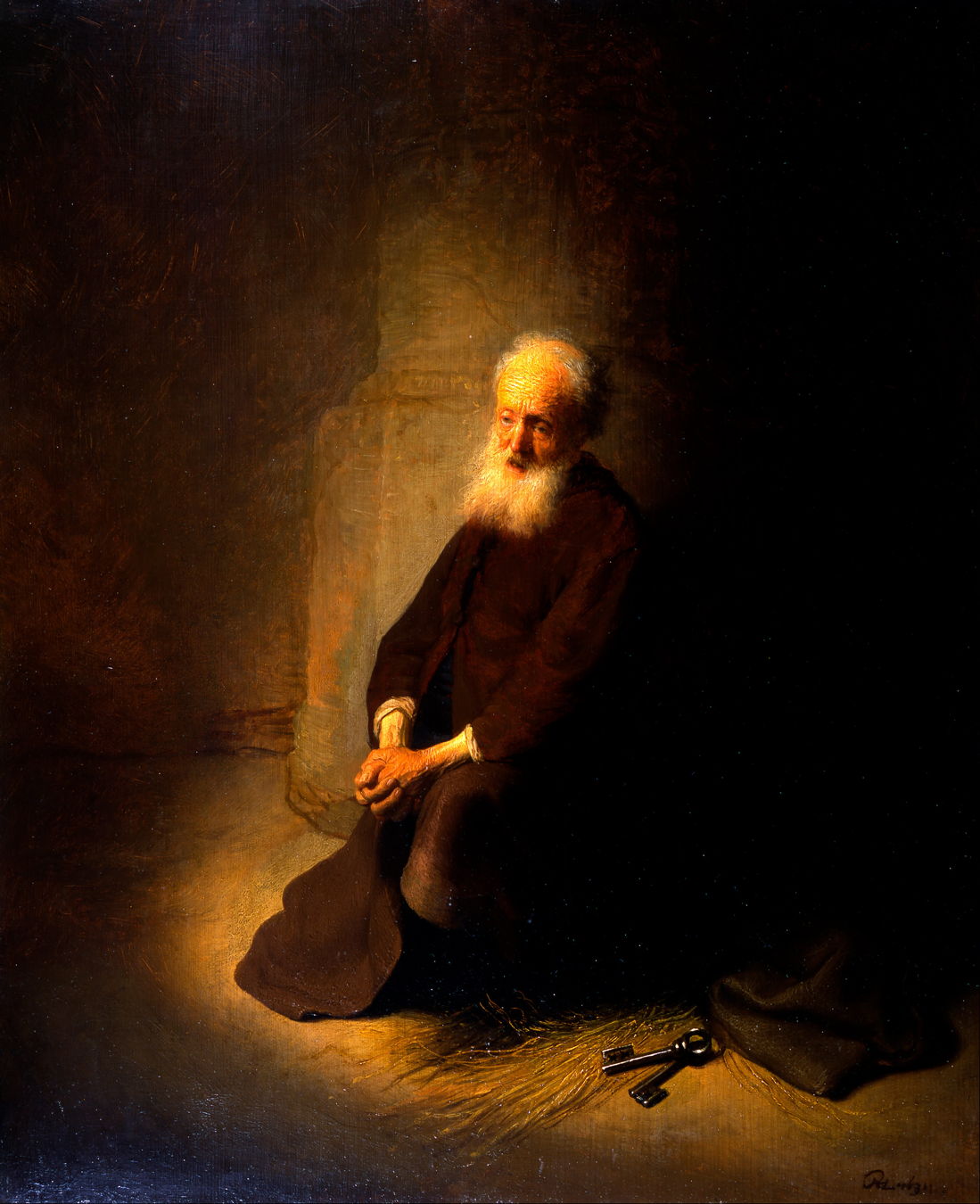
Although several of his best-known chiaroscuro paintings were made in his old age, Rembrandt had long used the technique when appropriate, here in Saint Peter in Prison (The Apostle Peter Kneeling) from 1631. Details remain crisp, with an even surface.

A couple of years later, in his painting of Daniel and Cyrus before the Idol Bel, the highlights on Cyrus’s clothing and the tablecloth to the right are becoming more gestural, although he doesn’t appear to have used significant impasto for them.

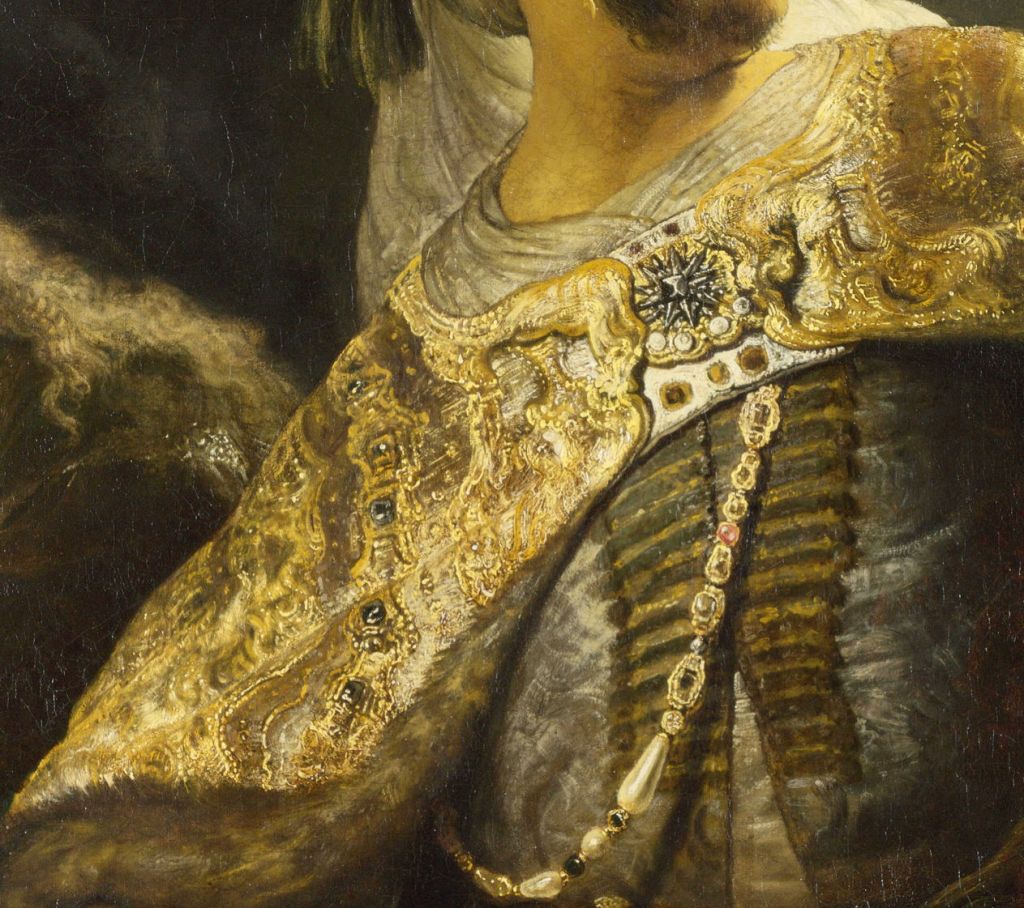
His outstanding painting of Belshazzar’s Feast was made in about 1635-38, when he was developing his distinctive techniques of depicting decorative metals, as shown in the detail below.
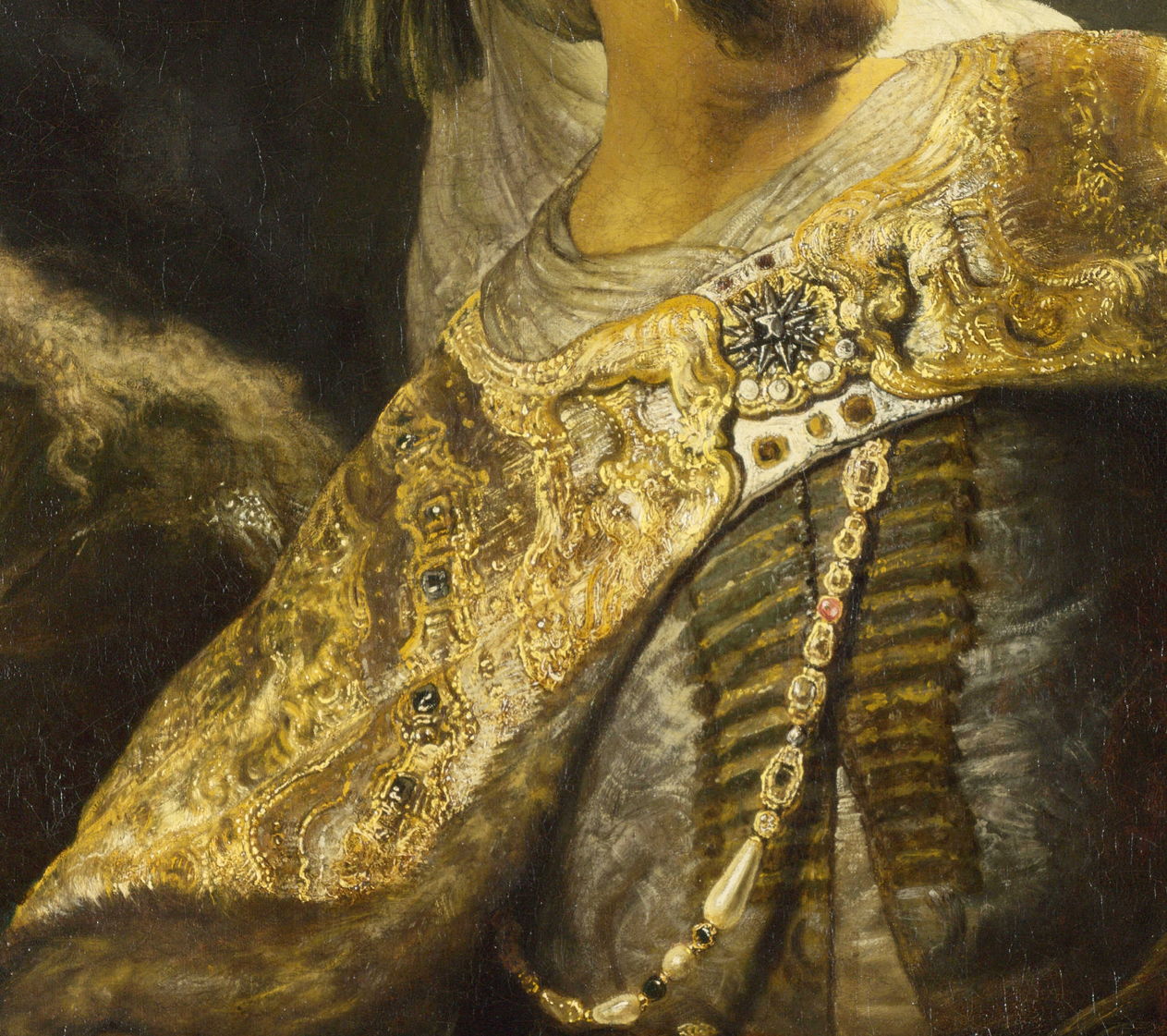
When seen at the distance Rembrandt must have worked at, above, this looks rough and sketchy. But the viewer is more likely to see it as below, where those marks magically assemble into the rich textures of real garments.
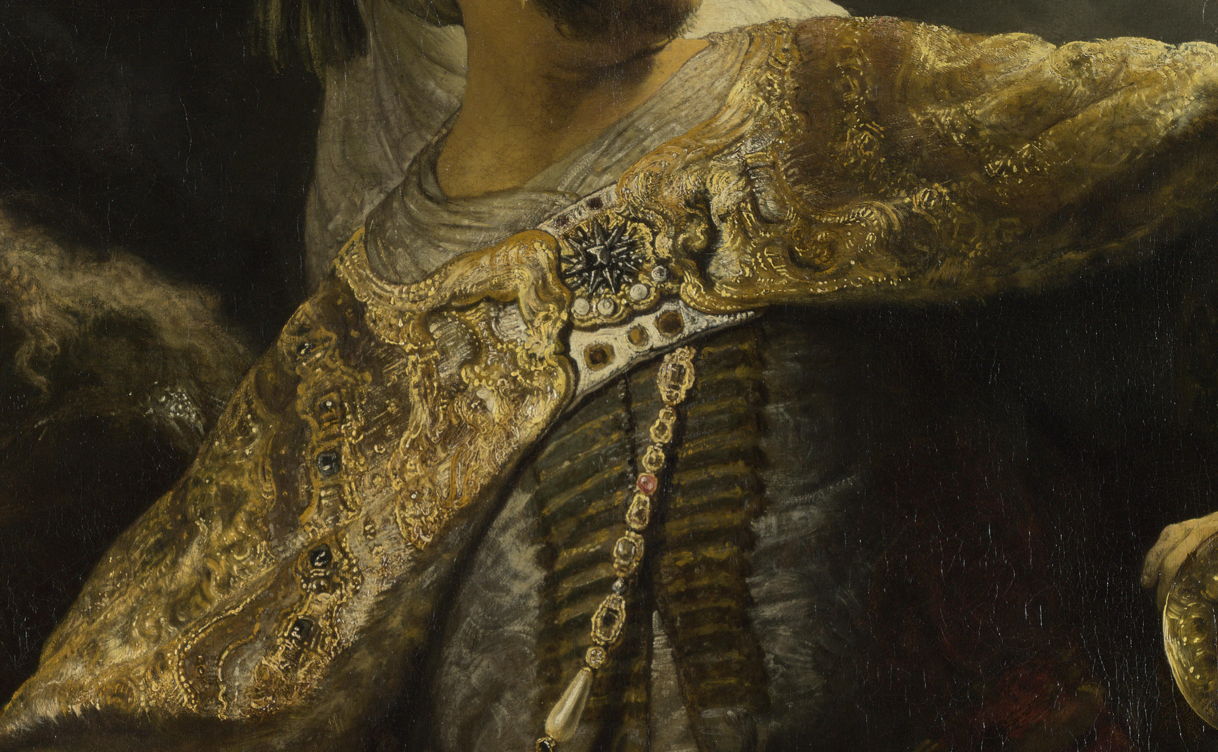
Rembrandt’s skill is in being able to lay down his paint in a way that looks right from further away than he would have seen during the act of painting.

Rembrandt’s Self-Portrait from 1658, when he was fifty-two and at the height of his art, is one of the most insightful of his unique series of self-portraits, showing the artist when he was bankrupt and growing old.

He painted the first of his two moving portraits of Lucretia in 1664, five years before his death. There are passages that, when seen close up, look rough, with more extensive use of impasto. Stand back a few metres/feet, though, and her fine contemporary clothing and jewellery look amazingly real. Sharp edges, such as that of her dagger, remain crisp and keen.

Rembrandt continued to develop his mark-making right up to his death. It’s often at its most florid when he painted fabrics, such as the clothing of the couple shown in The Jewish Bride of about 1665.
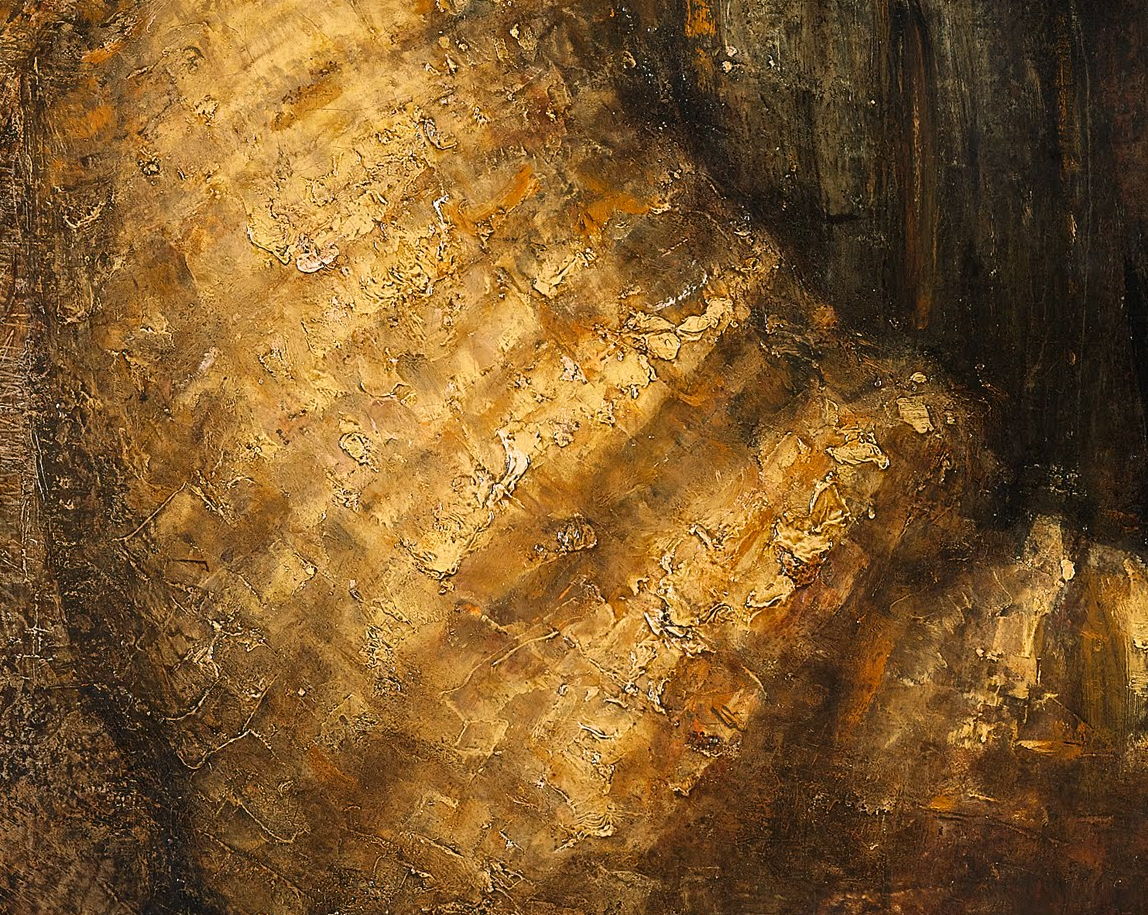
Rembrandt clearly changed the way that he applied and manipulated his paint, but there’s no evidence from his paintings that was influenced by any change in his vision.
Reference
Michael F Marmor & James G Ravin (2009) The Artist’s Eyes. Vision and the History of Art, Abrams. ISBN 978 0 8109 4849 5.

