

By 1860, several narrative artists across Europe had started painting unresolved instantaneous narratives, which became increasingly popular with a public who were enjoying mystery stories by the likes of Edgar Allan Poe. Poe’s C. Auguste Dupin tales became very popular across Europe when they were published from 1841 onwards, and in 1868 Émile Gaboriau’s serialised detective story Monsieur Lecoq shot to fame throughout France. That same year, Edgar Degas started work on his own detective story.
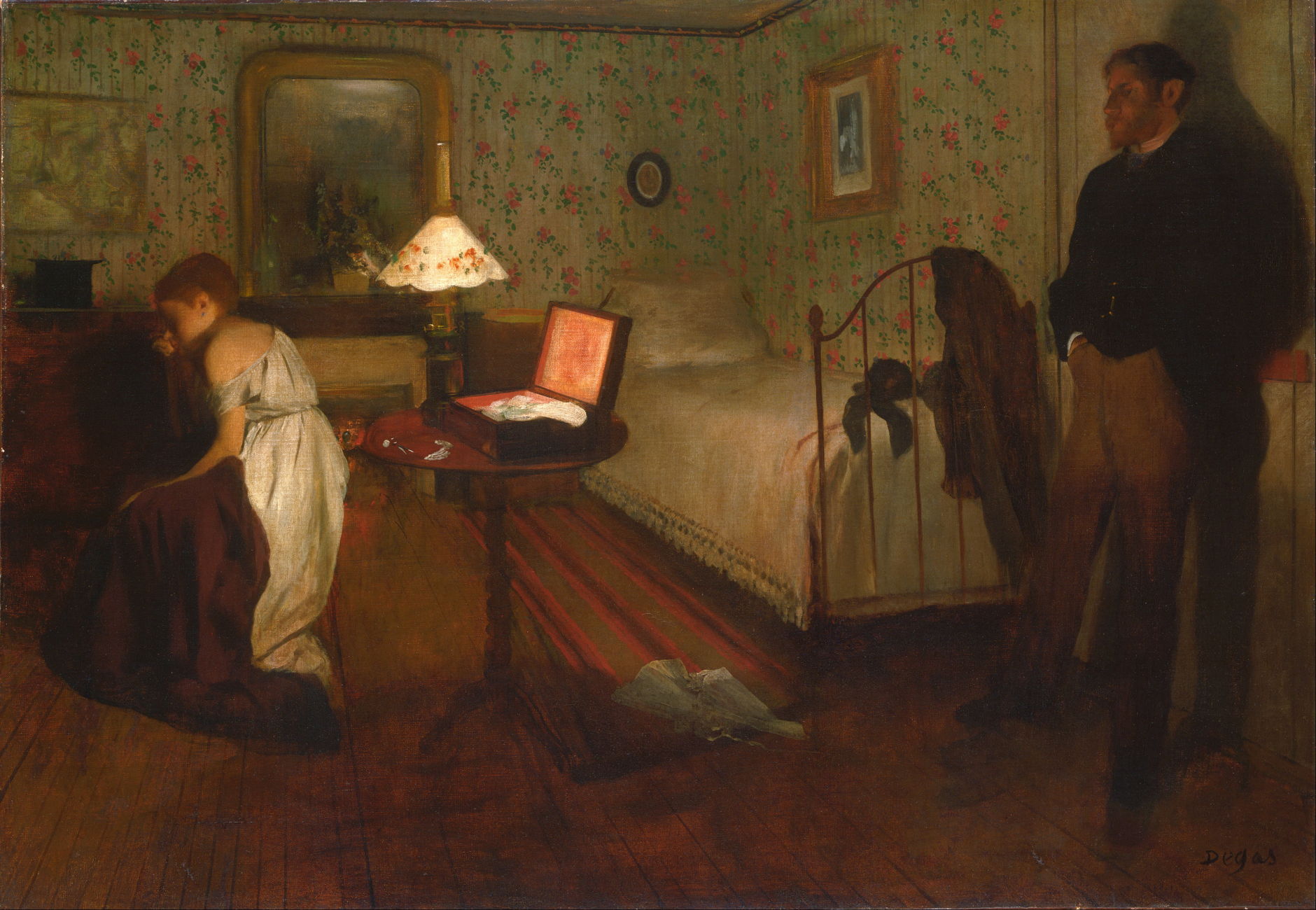
Degas’ Interior (1868-9), also known as The Interior and even The Rape, appears strongly narrative, but has so far defied all attempts to produce a reading consistent with its details.
A man and a woman are in a bedroom together. The woman is at the left, partly kneeling down, and facing away from the man. Her hair is cropped short, she wears a white shift which has dropped off her left shoulder, and her face is obscured in the dark. Her left forearm rests on a small stool or chair, over which is draped a dark brown cloak or coat. Her right hand rests against a wooden cabinet which is in front of her. She appears to be staring down towards the floor, off the left of the canvas.
The man stands at the far right, leaning against the inside of the bedroom door, and staring at the woman. He is quite well-dressed, with a black jacket, black waistcoat and mid-brown trousers. Both his hands are thrust into his trouser pockets, and his feet are apart. His top hat rests, upside down, on top of the cabinet on the other side of the room, just in front of the woman.
Between them, just behind the woman, is a small occasional table, on which there is a table-lamp and a small open suitcase. Some of the contents of the suitcase rest over its edge. In front of it, on the tabletop, is a pair of scissors and other items which appear to be from a clothes repair kit or ‘housewife’, or in French cousette or possibly etui.
The single bed is made up, and its cover isn’t ruffled, but it may bear a bloodstain at the foot. At the foot of the bed, on its large arched frame, another item apparently of the woman’s clothing (perhaps a coat) hangs loosely. On that end of the bed is a woman’s dark hat with ribbons, and her corset has been dropped on the floor by the foot of the bed.
She clearly arrived in the room before the man, removed her outer clothing, and at some stage started to undress further, halting when she was down to her shift or chemise. Alternatively, she may have undressed completely, and at this moment have dressed again as far as her chemise.
The suitcase appears to belong to the woman; when she arrived, she placed it on the table, and opened it. This indicates that she was expecting to stay in the bedroom overnight, and brought a change of clothing and travelling kit including the housewife.
The man is obstructing the door, the only visible exit to the room. Although he looks as if he may have come no further across the room, his top hat says otherwise.
The man and woman appear to be a couple, who have met in that room to engage in a clandestine sexual relationship. However, the bed is a single not a double, and shows no sign of having been used, nor has the bedding been disturbed in any way. There is a mature fire burning in the fireplace behind the woman and the lamp.
There are four paintings or similar objects hanging on the walls, of which only one appears to be decipherable. This is the large rounded rectangular one above the fireplace. Although that appears to be a mirror, the image shown in it doesn’t resemble a reflection of the room’s interior, but looks to be a painting. This might show a bright figure, resembling the woman, in front of some shrubs, behind which are classical buildings. This doesn’t resemble any of Degas’ paintings, nor any well-known work.
Degas provides a lot of small details, just as in a detective story, none of which points clearly to a resolution. You can discuss and debate its narrative endlessly, as has been done for the last 150 years.

Degas’ second painting, Sulking from about 1869, is a far simpler image, but no less enigmatic. This time his story is set in an office, where a man is sat at a desk, and a young woman stands leaning over the back of a chair, looking directly at the viewer.
The desk in front of the man is strewn with piles of papers, which he is studying intently, his arms folded with elbows resting on the desk. Within the papers is a full cup of coffee. Although his face is largely obscured, he appears sullen and sulking.
The wall behind the figures is wood-panelled, and there is a large painting of an unidentified steeplechase horse race in full view. The woman is well-dressed, as is the man, and her wrists are crossed on the back of the chair on which she is leaning. In her right hand is a light object, which may be a rolled-up paper tied with a fine ribbon. Her facial expression is neutral, with the hint of a slight smile, perhaps.
One reading could be that the man is sulking over excessive bills and expenditure; it is feasible that the woman is his wife, and that her dressmaking and millinery accounts are part of the cause of his unhappiness. Once again, though, Degas leads us into a story and leaves us looking at clues that can only resolve in our imagination.

Meanwhile in Britain, Philip Hermogenes Calderon continued his series of unresolved narratives with Letter from Daddy in 1873. Here he gives us fewer clues, and a theme which he previously considered in his “Lord, Thy Will Be Done” (1855), in my last article.
A young mother, who appears to have just been breast-feeding, leans low over her baby, both of them resting on a bed. She wears a full and long gown. Clutched in her left hand are the pages of a letter, which the title tells us has come from the baby’s father. Behind, on a shelf, is a model of a square-rigged ship, implying that the absent father is a sailor (probably an officer) on board. Although centred at a very different social level from “Lord, Thy Will Be Done”, the message appears similar.

At about the same time in New York, the American genre artist Eastman Johnson painted a narrative work which only makes any sense when you know its title of Not at Home (c 1873), apparently showing the interior of the artist’s home. Without those three words of the title, all you see is a well-lit and empty parlour, and the presumed mistress of the house starting up the stairs, in relative gloom in the foreground. At the right is a child’s push-chair, parked up and empty.
Those three words, of course, are the classic excuse offered in someone’s absence – “I’m sorry, but the Mistress is not at home” – even when they are very much at home, but simply don’t want to see the visitor. So the title could imply that the woman is ascending the stairs in order not to see visitors. Or, if we know that this is the artist’s home, could it be that it’s Johnson himself who is not at home?
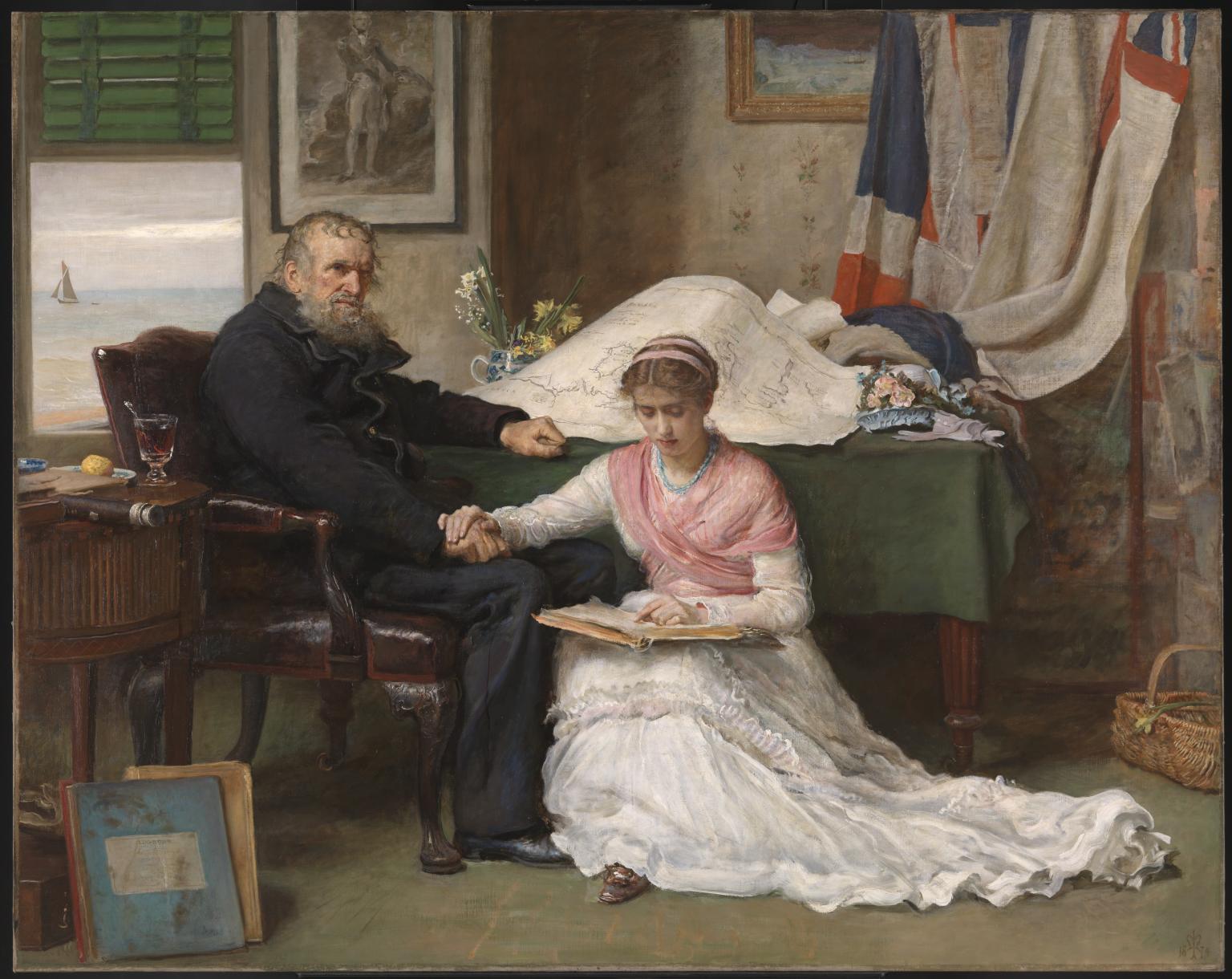
These modern narrative paintings are often built on highly contemporary themes. The title of John Everett Millais’ The North-West Passage from 1874 tells you how closely it coincided with the departure of a British expedition in futile quest of the rumoured north-west passage round the north of Canada to the Pacific. Enterprises like that had brought a succession of failures since the famous total loss of Sir John Franklin’s expedition of 1845.
Rather than adopt the symbolic richness of the Pre-Raphaelite, Millais addresses this topical issue in another image leaving the narrative unresolved and open to speculation by the viewer.
The old man is clearly an experienced mariner, who knows the risks and futility, which are expressed in his body language. The young woman, probably his daughter, is presumably the wife of one of those on the expedition. The man stares hard and cold, the woman reads anxiously. Behind them a chart shows the limited knowledge of the area of the north-west passage at the time. Flags declare an affinity with the nation, and its Navy. A painting on the wall shows a ship negotiating ice in the far north.
The view through the window shows this is set on the coast, and there is a sailing vessel in sight. A telescope rests on the table, by a glass presumably containing rum. Below the table are old ships’ logs and other papers.
That same year in what was then Prussia, Berthold Woltze moved on from his earlier letter-based narratives in one of the finest of these ‘problem pictures’.

Woltze’s Der lästige Kavalier (1874), best rendered into English as The Annoying Bloke, is thoroughly contemporary in its setting and theme.
The story takes place in a railway carriage, where there are two men and a young woman. She is dressed completely in black, and stares towards the viewer with tears in her eyes (detail below). Beside her is a carpet bag, and opposite is a small wooden box and grey drapes.
Leaning over the back of her seat, and leering at her, is a middle-aged dandy with a brash moustache and mutton-chop whiskers, brandishing a lit cigar. He appears to be trying to chat her up, quite inappropriately, and very much against her wishes. Behind him, and almost cropped off the left edge of the canvas, is an older man with a dour, drawn face.
The young woman appears to have suffered a recent bereavement, and may even be travelling back after the funeral. She looks too young to have just buried a husband, so it’s more likely that she has just lost her last parent, and is now living alone, and prey to the likes of this annoying and abusive bloke. Woltze’s painting tackles a modern theme which became very popular in ‘problem pictures’: relationships between men and women at a time when society was changing rapidly, and most particularly in the changing roles of women.

Some of these unresolved narratives were historic rather than contemporary. These run the risk that, as at least part of their story is likely to be known to the viewer, that might provide clues which cut speculation short.

One of the most famous of these historical paintings is the only work for which William Frederick Yeames is now remembered, And when did you last see your Father?, painted in 1878.
For anyone familiar with costume at the time of the English Civil War, and the Puritan dress of conical hats and plain clothes, this immediately places the event shown at that time, 1642-51. Contrasting with those are the opulent silks of the mother and her children, who are clearly Royalists, the other side. Yeames tells us what the young boy is being questioned about in the painting’s title, without which the narrative would be largely lost.
The only unresolved issue is whether the boy did reveal the whereabouts of his Cavalier father, an act clearly bringing great anguish to his sisters and mother.
At about this time, William Quiller Orchardson started to paint the first of his many problem pictures.

Orchardson’s Hard Hit from 1879 isn’t as easy to resolve. The fashionably dressed young man about to open the door on the left is walking away from a group of older villains, who have stopped at nothing, probably including cheating, to beat him repeatedly at cards, and have relieved him of his wealth. Although this may appear a carefully chosen narrative, it was apparently Orchardson’s model who provided the inspiration, when he arrived dejected at the studio one day and revealed that he had been ‘hard hit’ himself the previous night.
By 1880, these problem pictures were poised for commercial success.

