
When Emily Carr was busy painting in the forests on the west coast of Canada, a young painter was starting his career in the forests of central Canada, in Algonquin Park, Ontario. Tom Thomson’s life was cut short when he disappeared after only five years of painting, but he left many outstanding portraits of trees.
Thomson was brought up in Leith, Ontario, on the south shore of Georgian Bay, Lake Huron. When he was twenty-one, he started an apprenticeship in a local machine shop, but was soon fired for his poor timekeeping. He also volunteered for the Second Boer War, but was turned down because of his flat feet. For eight months he studied at a business college, then joined his older brother in Seattle. He returned to Canada, settling in Toronto in the summer of 1905, where he worked for a photo-engraving firm. His first formal training in painting was in evening classes in Toronto taught by William Cruikshank (1848-1922), who had been trained in the academic tradition.
In the winter of 1908-9, Thomson moved to work in a graphic design studio, whose senior artist encouraged staff to paint outdoors in their spare time. He started meeting regularly with artists who were to form the Group of Seven, including Arthur Lismer, Fred Varley, Franklin Carmichael, and Lawren Harris, who was later an important influence on Emily Carr. In the Spring of 1912, Thomson and a friend from work undertook a canoe trip in Algonquin Park, a large forested area about two hundred miles to the north-east of Toronto. He bought a plein air oil painting kit, and started his first oil sketches there.

His trees in Evening (1913) are sketched quickly and simply.
His turning point came in 1914, when the National Gallery of Canada started buying his paintings, which was unusual for such an inexperienced artist. Despite this he still needed to augment his income with short periods of employment, working in various roles in Algonquin Park. His career and art were greatly helped by the patronage of a Toronto professor of ophthalmology, James MacCallum, who covered Thomson’s expenses for a year. Thomson’s studio was a renovated shack in the grounds behind a small block of six studios in Rosedale, Toronto (The Studio Building, 25 Severn Street), completed in 1914 using funds provided by Lawren Harris and Professor MacCallum.
In 1914, Thomson spent April-May in Algonquin Park, June-July in Georgian Bay exploring the area around Professor MacCallum’s cottage, and returned to Algonquin Park for August-November.

The Brook (1914) is a sketch exploring the colours of autumn from his later campaign in Algonquin Park.
At the end of the year, Thomson moved into his studio shack in Toronto, to live and work through the winter months, and to prepare himself for the next spring campaign.

That winter he produced this full-sized work in oil on canvas, Northern River (1914-15). When exhibited in 1915, this was bought by the National Gallery of Canada for $500.

In the Northland (1915) is a more elaborate and detailed depiction of what are most probably young paper or canoe birch trees, Betula papyrifera, in a dense stand at the edge of a lake.
Thomson followed a similar schedule in the summer of 1915, capturing what he saw in the forest in quick oil sketches.
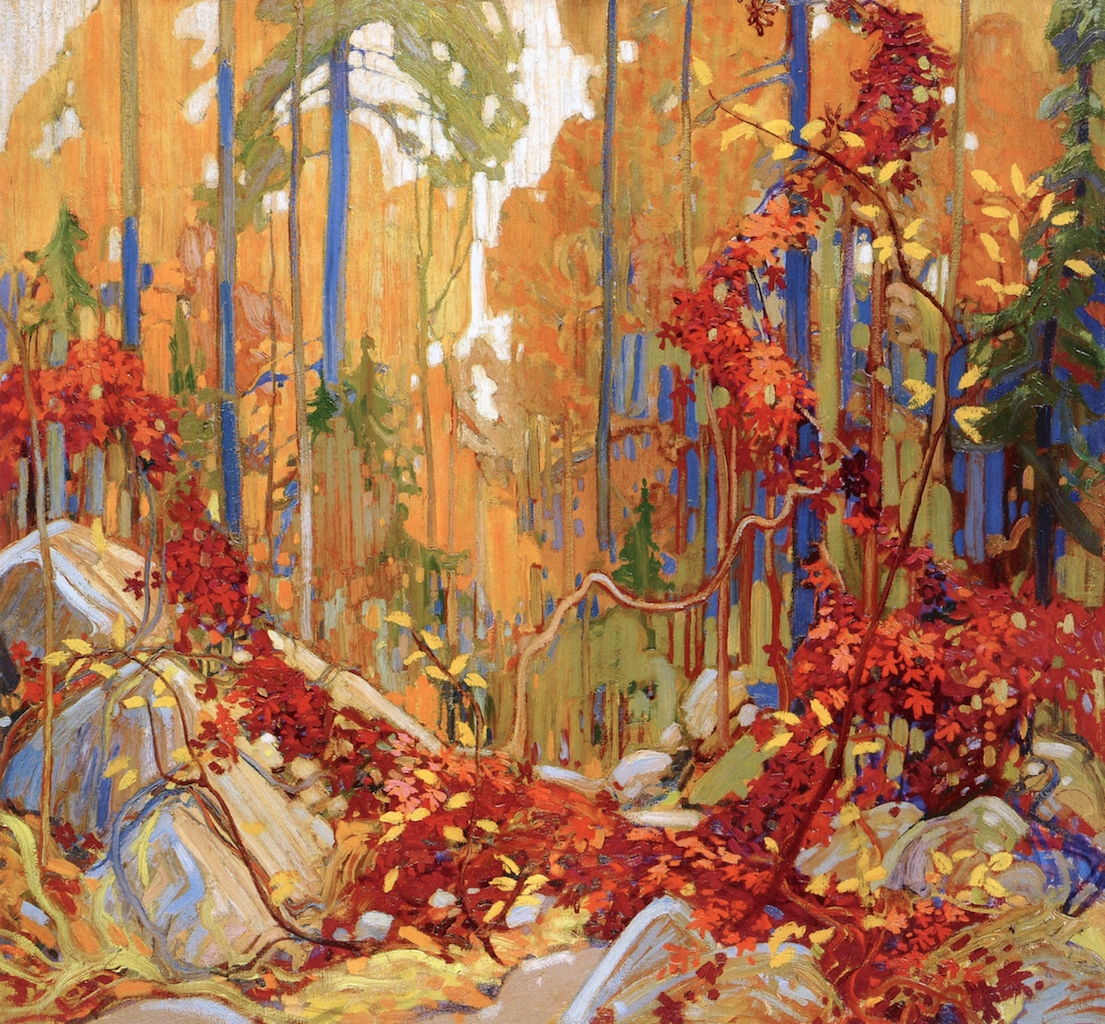
During the following winter, when he was back in his studio, Thomson developed one of those many plein air sketches into a large painting on canvas: Autumn’s Garland (1915-16).

Opulent October (1915-16) is a smaller canvas painted in the studio that winter. This canopy is built more anatomically on the branches, with irregular small daubs of colour placed on top of those to create the effect of clusters of individual leaves.

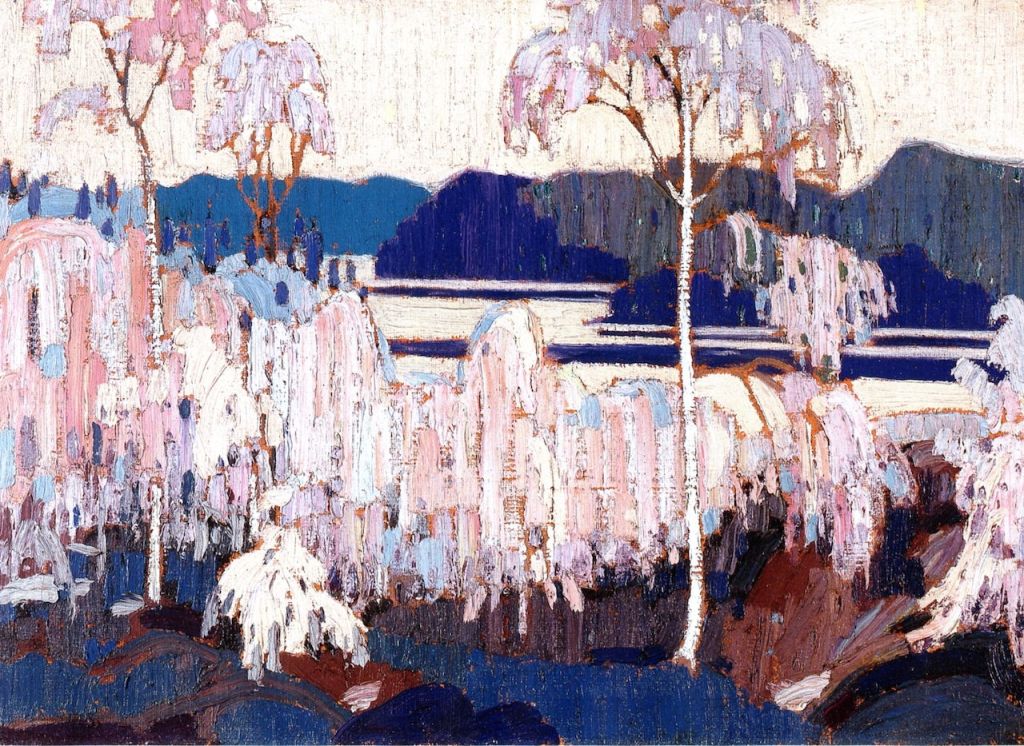
He painted After the Sleet Storm in the studio the following winter, in 1915-16, showing the beautiful effects of sleet frozen onto the canopies of birch trees, in the cold half-light of the northern winter. The pale pinks and blues are reminiscent of spring blossom, a frequent theme in the paintings of Vincent van Gogh.

The Dead Pine (1916) is one of a series of sketches made in the autumn of 1916, which culminated in two of his major studio works of the following winter. This explores a solitary dead tree against a normal daytime sky, with more muted autumnal colours.

The Jack Pine (1916-17) developed considerably from another sketch Thomson had made in Algonquin Park in his campaign of 1916. Set at dusk, against a luminous sky formed from longer strokes of colour, Thomson has lit the straggling branches of the pine tree in red. The surface of the lake mirrors the sky in colour (the water being more muted) and in its facture. Remaining patches of snow on the distant shore break up the dark forms of the hills, and more red in the foreground adds to the sunset effect. The jack pine, Pinus banksiana, covers vast areas of central Canada.

Snow in October (1916-17) is another well-known studio painting from that winter. Its fine geometric reticulations of frozen white canopies are another surprise, and an opportunity for the artist to use subtle colour and patterns in its shadows.
On 8 July 1917, in the middle of his summer painting campaign, Tom Thomson set out alone in his canoe. His body was discovered eight days later, drowned in the lake which he had paddled in and had painted so often. He was just a month short of his fortieth birthday.
References
Wikipedia.
Online catalogue raisonné by Joan Murray
David P Silcox (2015) Tom Thomson, Life & Work, Art Canada Institute. Available in PDF from here.

