
Next month we commemorate the centenary of the death of the last of the French Impressionists, Claude Monet. He was such a prolific artist that I could easily have spent the whole of this year working my way through his career and art. Instead, over the next few weeks I’m going to focus on more limited aspects, starting today with his early paintings up to the First Impressionist Exhibition of 1874.
Monet was born in Paris, but brought up in Le Havre, on the Normandy coast, where his family ran a grocery shop. However, he started selling caricatures, and took drawing lessons. In about 1856, he met Eugène Boudin, who became his mentor and introduced him to plein air painting in oils. He left school in 1857 following the death of his mother, and went to live with an aunt in Paris. There he continued to paint, and in 1862 started lessons at the academy run by Charles Gleyre, an academic painter who had become a popular teacher.
There he met Renoir, Bazille, and Sisley, and they become close friends, often painting together en plein air. They came under the influence of others, including Jongkind and Manet, and developed ideas following those of Manet. He had two paintings accepted for the Salon, but struggled to sell any of his works.

View At Rouelles, Le Havre (1858) is believed to be Monet’s earliest surviving painting in oils, and adopts thoroughly realist style. Given that he was only 18 when he painted this, and had been learning to use oils for just two years, it’s strong evidence of his technical abilities and talent. It’s also prescient in containing a row of poplars similar to those he was to paint later in some of his first major series.

He first painted at Étretat on the Channel coast in 1864, shown in this view of Étretat, with the headland nearest the village and the Manneporte. He doesn’t appear to have painted here again until the 1880s.
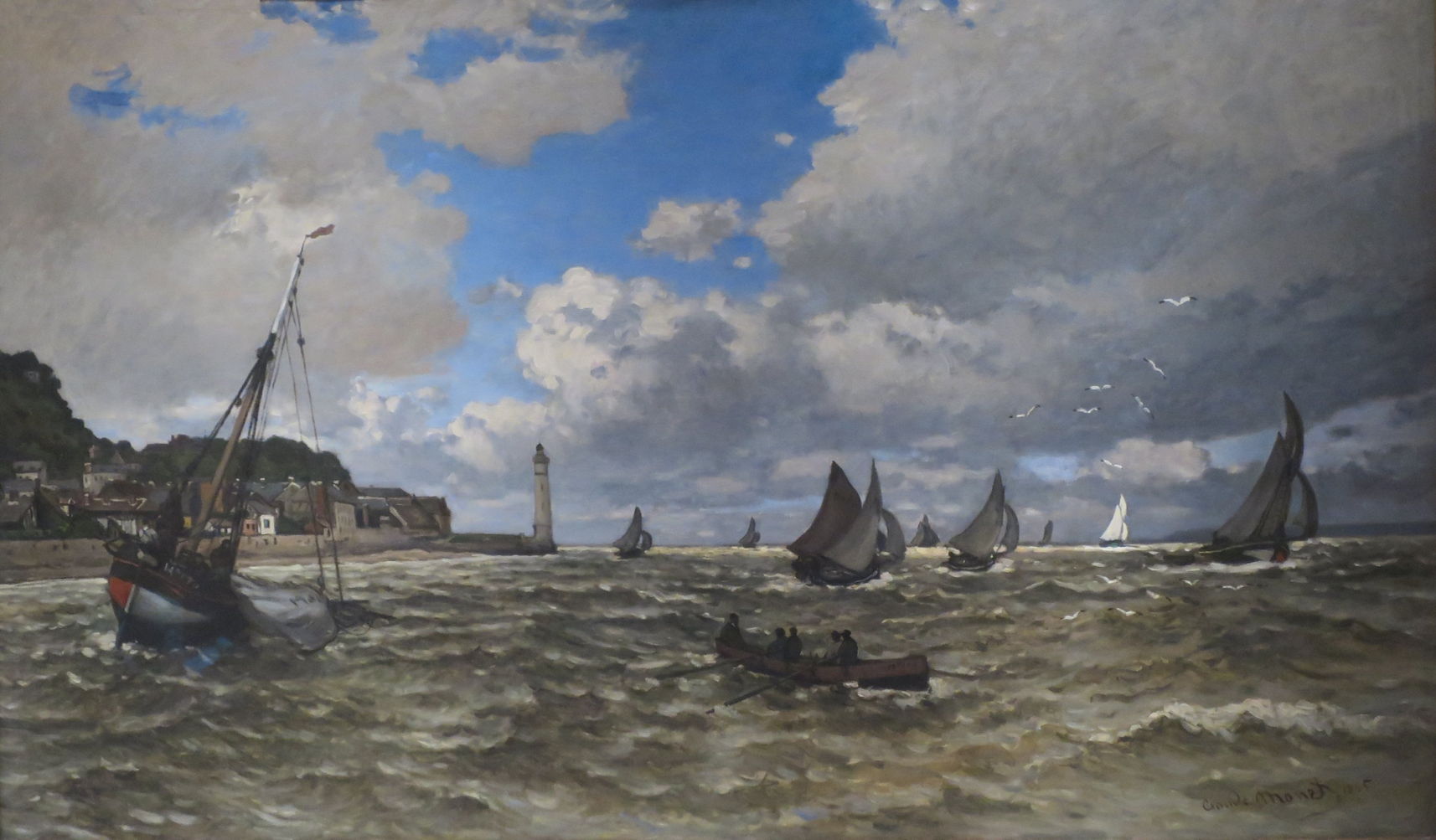
The Mouth of the Seine, Honfleur, painted the following year, is even closer to his home in Le Havre.

Just a couple of years later, Monet painted these fishing boats in fairer conditions, on the northern side of the mouth of the River Seine, in The Beach at Sainte-Adresse (1867). In flatter light and less breeze there is less scope for the effects of his earlier work, but his style is evolving steadily.

Around 1870, Monet, Renoir and Pissarro painted many snow scenes. One of Monet’s best-known is paradoxically titled The Magpie (1868-9), where the bird is probably the smallest and least conspicuous part of his motif.

Although not known for his still life painting, Monet’s Pheasant from 1869 is a classical hunting subject, sketchily executed, and follows the still life tradition.

In 1869, Monet and Renoir painted together at a popular resort on the River Seine near Paris. Monet’s Bathers at la Grenouillère (1869) is probably the first statement of his Impressionist agenda, a plein air oil sketch originally intended to be turned into a finished painting. The pair realised that Impressionism was about these sketched instants. This also reveals Monet’s preference for modern pigments, as most of the brighter mid-blues here are cobalt blue, introduced earlier in the nineteenth century.
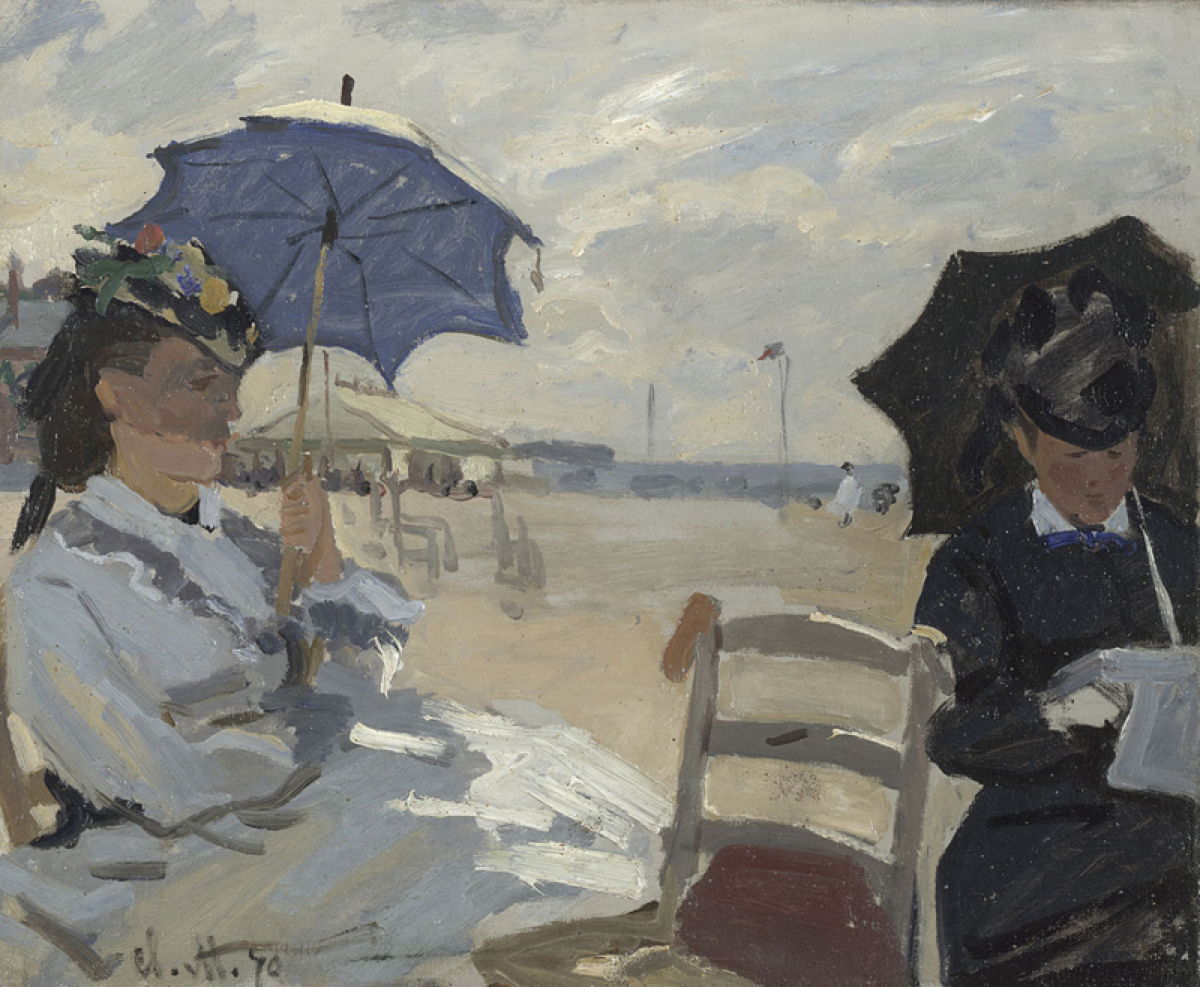
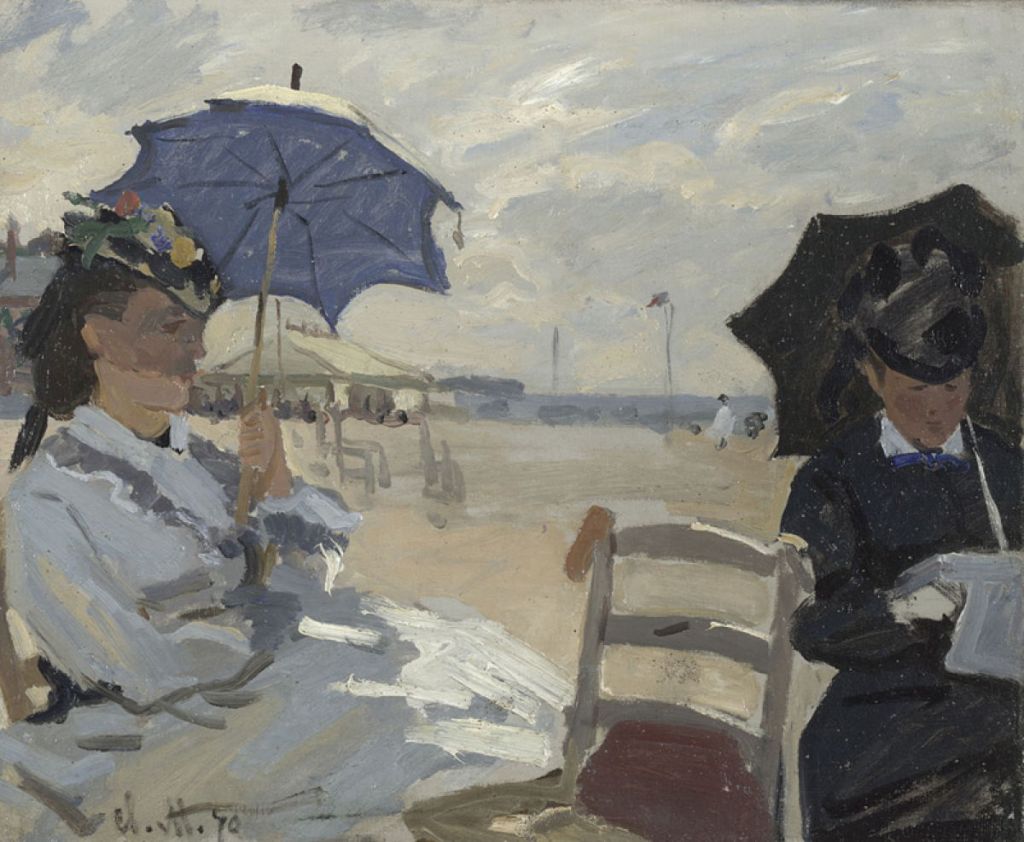
Claude Monet probably painted his wife (left) and the wife of Eugène Boudin (right) on The Beach at Trouville during his honeymoon there in 1870. Their clothes are sketched in using bold and swift brushstrokes. Even their form is rough and ready, and there’s no indication of their materials. This also marks a period of transition in fashion: Madame Boudin wears black and holds a black parasol, similar to those seen in her husband’s beach scenes. Camille Monet wears white and holds a white parasol, attributes of the younger generation.
With the outbreak of the Franco-Prussian War in 1870, he fled with his family to London, where he painted the city and the Thames. However, his paintings were refused by the Royal Academy in 1871, and he moved to the Netherlands, where he also painted. He returned to France to live in Argenteuil on the River Seine at the end of the year.

While he was in London, he saw the works of Constable and Turner, which were a significant influence over the subsequent development of his style, and what we now consider to be Impressionism. He returned to the same stretch of the river shown in The Thames below Westminster (1871) over thirty years later to paint more radical series of views in different lighting conditions.

When he moved to the Netherlands in 1871 there were still boats active in the Canal at Zaandam, to the north-west of Amsterdam.

He painted this Still Life with Melon rather more slowly in 1872, with attention to surface textures and their optical properties, a familiar feature of a great many still lifes.

In 1872, Claude Monet painted the view which gave rise to the movement’s name, Impression, Sunrise. This appears to be a brisk oil sketch of fog and the rising sun in Monet’s home port of Le Havre, on the Channel coast. It’s one of his series depicting the port at different times and in varying lights, and was exhibited in the First Impressionist Exhibition, where its name became that of the whole movement and its distinctive style.

Although he was barely making a living from his art, Monet was among the few who could afford to use cadmium yellow until its price fell late in the nineteenth century. This pigment has been found in his painting of The Artist’s House at Argenteuil from 1873.

Claude Monet’s masterwork Autumn on the Seine, Argenteuil from 1873 is an excellent example of his waterscapes of this period, with its finely broken and rippled reflections.

By the early 1870s, Monet was a regular commuter over the short distance by train from Argenteuil into the centre of Paris. He seems to have fallen in love with The Railway Bridge at Argenteuil, shown here in 1873.

This view of The Railway Bridge at Argenteuil is from the following year.
Monet showed a total of twelve paintings at the First Impressionist Exhibition in 1874, listed in the catalogue as:
- Poppies
- Le Havre: Fishing Boat Leaving the Harbour
- Boulevard des Capucines
- Impression, Sunrise (above)
- 7 pastel croquis
- Luncheon
Few of his pastels appear to have survived.

