

Some disorders of vision can strike at any age, rather than progressively worsening with advancing years. Fortunately those that can be so severe as to result in blindness are rare. When they do occur in a painter, their effect is devastating. Although their causes remain controversial, Francisco Goya suffered two episodes of major illness, the first at the height of his career in the winter of 1792-93, and again when he was older, at the end of 1819. This article shows what effects they had on his paintings.
Many of Goya’s paintings were intended as cartoons to be turned into tapestries for the Spanish royal family to decorate their palaces. In those he appears to have enjoyed setting the weavers great challenges with his detailed realism.

The problems are obvious in this highly detailed sketch of The Meadow of San Isidro on his Feast Day (1788), which only measures 42 by 90 cm. It combines figures of the upper classes in the foreground, a crowd in the middle distance, and a superb panorama of the city of Madrid in the background.

This sketch of The Hermitage of San Isidro (1788) is rather less detailed, but I’m sure would still have made the weavers’ task difficult.

As one of the king’s new Court Painters, Goya’s everyday work was painting portraits of members of that court. This is The Duke and Duchess of Osuna and their Children in 1788, a fetching family group that must have been greatly appreciated.

The following year he completed one full-length and two more famous half-length portraits of the monarch, of which King Carlos IV in Red (1789) is my favourite. The fine detail in the silver decorations on the king’s clothing is splendid.
In 1790, the new king commissioned Goya to paint what proved to be his last set of cartoons for tapestries, for the royal palace at El Escorial. The chosen theme was rural and humorous, which must have been a greater challenge. At least six sketches were completed, following which Goya made at least seven of the twelve cartoons by late 1792.

The Straw Manikin (1791-92) shows four fashionably dressed women blanket-tossing a manikin, possibly a reference to Sancho Panza’s misfortune at the inn, in Miguel de Cervantes’ popular novel Don Quixote.

The Wedding (1791-92) shows a comical marriage, with an ill-assorted group of guests, in what appears to be the dry moat of a castle.
In late 1792, Goya apparently fell ill with colic, and early the following year he was given leave to go to Andalucia to recuperate, but only made it to Cadiz, where he had to stop to recover. He was confined to bed there for two months, during which he suffered recurrent abdominal pain. He developed severe vertigo, was partly blind at times, and had severe tinnitus and deafness.
Modern speculation as to the cause includes lead poisoning from his oil paint, although some form of infectious disease is more probable, and might well have been meningitis or encephalitis. Whatever its cause, it had profound and lasting effects on him and transformed his art. As late as March the following year, he was still reported as suffering from tinnitus, although his sight was improving and he no longer suffered from vertigo. He had certainly returned to Madrid by early June, when he was out and about again in the city.
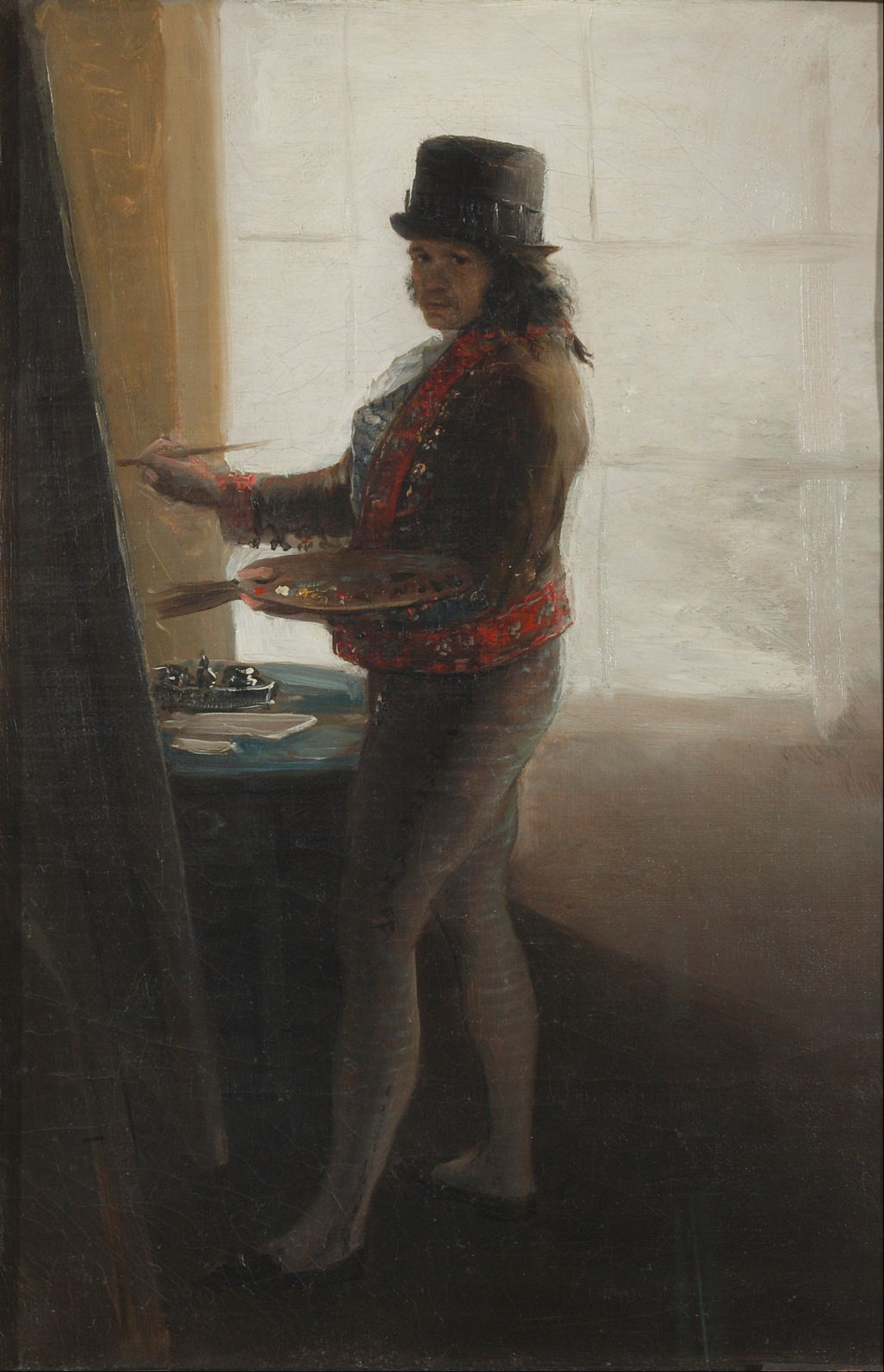
Goya’s Self-portrait in the Studio is perhaps his most famous, but its dating remains controversial. Some argue it was painted when he was working on early tapestry cartoons back in 1785, but others consider that he painted it either shortly before or just after his illness of 1792-93. Although dressed to impress or even resemble one of his favourite Majos, with a remarkable hat covered in metal clips, it turns out to be a lot less pretentious than might appear. The clips on his hat, for instance, enabled him to attach candles so he could paint in the dark. His palette is charged with no more than a dozen colours, and the diffuse backlighting is also typical of many of his works.
During his convalescence in 1793, Goya painted a series of works, some of them on tinplate, which he sent to Iriarte, a connoisseur and collector, for them to be shown to the Academicians. Eight of them show various scenes from bullfighting, but there are a further six tackling very different themes.

The Strolling Players (1793) is the lightest of these, showing a small cast of itinerant actors in the commedia dell’arte of the time. This appears to be set on the bank of the River Manzanares in Madrid, with a packed audience behind its stage. Others were darker in every sense.
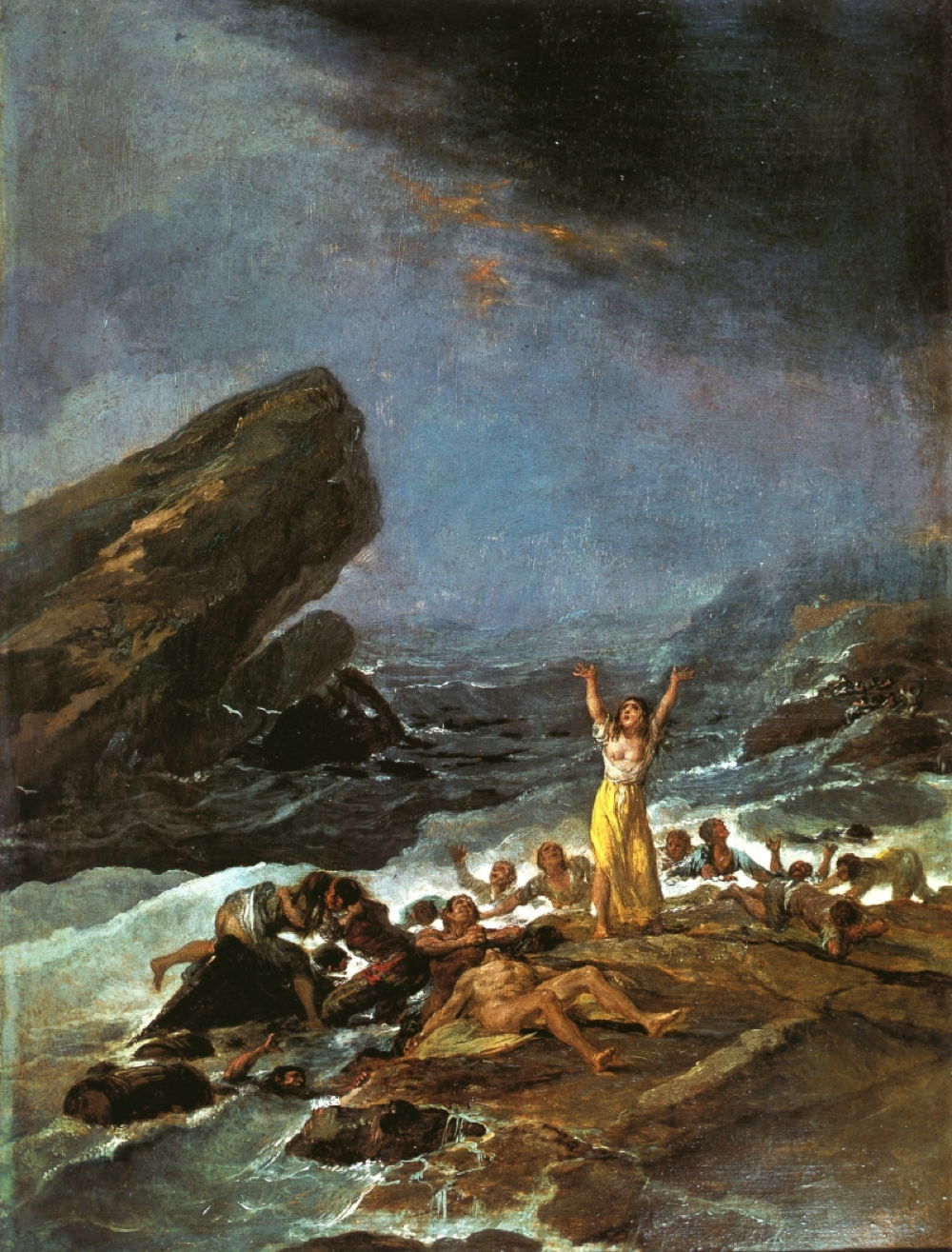
Although it has been suggested that The Shipwreck (1793-94) might show the Biblical flood, the breaking waves and rocky coastline make it more likely to show survivors coming ashore from a stricken vessel, and this is confirmed by a couple of barrels as flotsam to the left. Although Goya spent much of his life inland, he had also travelled by sea, and must have been familiar with many stories of shipwreck.

The last of these, showing the Yard of a Madhouse (1794), perhaps sets the scene for Goya’s future paintings, with its disturbing glimpse into the tormented lives of those effectively imprisoned as a result of mental illness. They wrestle and shriek down in the gloom beneath its walls, while there’s the bright light of hope in the sky above.
In addition to portraits, in the late 1790s Goya made several large series of drawings, many of which he turned into prints. Among the more famous of these is Los Caprichos, caprices from 1797-98. At the same time, he was painting six works on the theme of witchcraft, for the study of the Duchess of Osuna. There was nothing inherently sinister about these: it was a popular subject at the time, and some of the artist’s friends seem to have been fascinated by it. But taken together with the themes above these show a changed tone in his art from the lighthearted country scenes for earlier tapestries, to a gathering darkness in the soul.

Goya’s Witches’ Sabbath from 1797-98 is perhaps the clearest vision of a “witches’ sabbath” from this period. His devil is a billy goat with lyre-shaped horns and evil human-like posture, and above that are several dark shapes of flying bats.

Witches’ Flight (1798) shows three witches levitating in the air, while carrying a naked body, which they appear to be exorcising. Below them are a donkey and another two human figures, one shrouded in a white sheet to cover their eyes, the other lying on the ground covering their ears, a possible reference to Goya’s own deafness and tinnitus at the time.

This self-portrait is one of two that he painted in 1815, and makes interesting comparison with some of Rembrandt’s later self-portraits.
War with France didn’t help Goya’s gathering darkness. Then towards the end of 1819, when he was seventy-three, he suffered another period of severe illness. The only substantial evidence of that is a double portrait, painted the following year.

It was only through the care of his doctor, Eugenio García Arrieta, that he survived. Once he was well enough, Goya painted his Self-portrait with Dr Arrieta (1820), which he presented to the doctor in gratitude. But Goya’s profound darkness didn’t abate until he left Spain in his retirement.
References
Janis A Tomlinson (2020) Goya, A Portrait of the Artist, Princeton UP. ISBN 978 0 691 19204 8.
Pierre Gassier and Juliet Wilson (1981) The Life and Complete Work of Francisco Goya, 2nd English edition, Harrison House. ISBN 0 517 353903.
Michael F Marmor & James G Ravin (2009) The Artist’s Eyes. Vision and the History of Art, Abrams. ISBN 978 0 8109 4849 5.

