
Prior to the nineteenth century, the overwhelming majority of European narrative paintings told stories already familiar to the viewer. Most were drawn from the Bible and other religious sources, others from classical literature notably Ovid’s Metamorphoses, and some from more contemporary writing such as Tasso’s Jerusalem Delivered. A literary basis was even more important in instantaneous narrative, where backward and forward references were inevitably subtle reminders. This brought full narrative closure, and without that the viewer is left wondering and unsatisfied.
In the nineteenth century, storytelling in literature changed. New genres such as detective and ‘mystery’ novels started to challenge the convention of narrative closure. Readers of Edgar Allan Poe’s short stories in the first half of the century, and Arthur Conan Doyle’s Sherlock Holmes novels towards the end of the century, developed a taste for something rather different.
Narrative painters started trying to tell stories that the viewer hadn’t already read, and those lacking closure, which became the closest thing that visual art has to the literary riddle, leaving the viewer speculating rather than completing. In their heyday, between about 1895 and 1914, such unresolved narrative paintings became so popular that they frequently featured in the press, and became known as problem pictures. These didn’t arise out of the blue, but evolved from 1850 onwards, perhaps even earlier.

As far as I can discover, one of the earliest major paintings lacking narrative closure is William Holman Hunt’s The Awakening Conscience, painted in the period 1851-53 to contrast with The Light of the World (1851-53). As with most masterly narrative paintings, its story is assembled from a multitude of clues to be found dispersed throughout its image, much in the way that William Hogarth did in his series.
It shows a fashionable young man seated at a piano in a small if not cramped house in the leafy suburbs of London, in reality Saint John’s Wood. Half-risen from the man’s lap is a young woman who stares absently into the distance. They’re clearly a couple in an intimate relationship, but conspicuous by its absence is any wedding ring on the fourth finger of the woman’s left hand, which is at the focal point of the painting. This is, therefore, extra-marital.
Around them are signs that she is a kept mistress with time on her hands. Her companion, a cat, is under the table, where it has caught a bird with a broken wing, a symbol of her plight. At the right edge is a tapestry with which to while away the hours, and her wools below form a tangled web in which she is entwined. On top of the gaudy upright piano is a clock. By the hem of her dress is her lover’s discarded glove, symbolising her ultimate fate when he discards her into prostitution. The room itself is decorated as gaudily as the piano, in poor taste.
The couple have been singing together from Thomas Moore’s Oft in the Stilly Night when she appears to have undergone some revelatory experience, causing her to rise. For Hunt this is associated with a verse from the Old Testament book of Proverbs: “As he that taketh away a garment in cold weather, so is he that singeth songs to an heavy heart.” Ironically, his model was his girlfriend at the time, Annie Miller, an uneducated barmaid who was only sixteen herself.
Hunt leads us to imagine that this kept mistress has had a religious moment, seeing the route to her redemption as her conscience is awakened. The image brings hope without any resolution.
As Hunt moved away from the Pre-Raphaelite Brotherhood, he wasn’t the only painter who was asking viewers to puzzle over his images.

Philip Hermogenes Calderon followed in 1855 with his “Lord, Thy Will Be Done”. This quotation is derived from the Gospel account of what was turned into the Lord’s Prayer, and has subsequently been used on many Christian religious occasions.
A young mother cradles her baby on her lap, looking up to the left. She’s living in difficult circumstances, but isn’t destitute, and unlike Hunt’s young woman wears a wedding ring on her left hand. The carpet is badly worn, and the coal scuttle empty, but there is a loaf of bread on the table: she has her ‘daily bread’, another reference to the Lord’s Prayer.
A portrait of a fine young man hangs above the mantlepiece, indicating her husband and the baby’s father is currently absent on military service. Several issues of The Times newspaper are scattered on the floor at the right, as if the woman has been following news of an overseas military campaign. Under the table is a letter, most probably from her husband.
The clues all point to the woman putting her trust in the Lord, but despite that hope there is no resolution.

The following year, Calderon exhibited Broken Vows (1856) at the Royal Academy, where the painting proved a great success, and remains his best-known work. It’s also the earliest true ‘problem picture’ I have come across.
A beautiful young woman, displaying her wedding ring, stands with her eyes closed, clutching a symbolic ‘heart’ area on her chest to indicate that her love life is in trouble. On the ground near the hem of her dress is a discarded necklace or ‘charm’ bracelet. The ivy-covered wall behind her would normally indicate lasting love, which is her aspiration.
A set of initials are carved on the fence, and on the other side a young man holds a small red flower in front of his forehead, which a young woman is trying to grasp with her right hand. The wooden fence appears tatty, has holes in it indicating its more transient nature, and affords glimpses of the couple behind.
Whereas clues in the earlier two paintings lead to consistent if unresolved narrative, Calderon has here deliberately introduced considerable ambiguity. The eyes of the shorter person behind the fence are carefully occluded, leaving their gender open to speculation. Most viewers are likely to conclude that the taller figure behind the fence is the unfaithful husband of the woman in front, but that requires making assumptions which aren’t supported by visual clues. Whose vows are being broken? Calderon leaves us to speculate.
Paintings of this type were by no means confined to Britain. Here are two slightly later examples from Germany, then still Prussia.

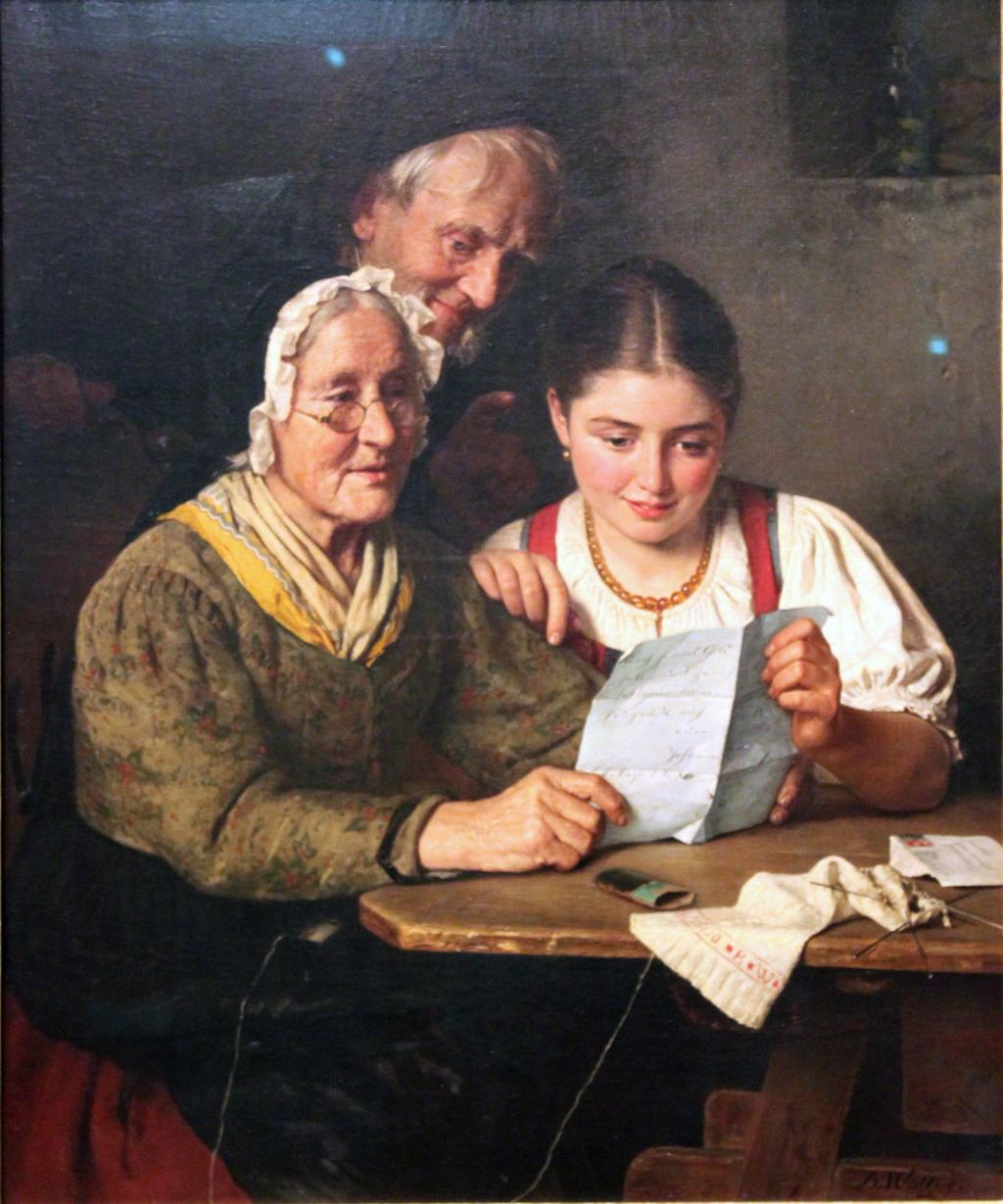
Throughout Europe, people were migrating to North America in the hope of making a better and more prosperous future there. This inspired Berthold Woltze to paint A Letter from America in about 1860, in which an elderly mother and father are eagerly reading a letter, presumably from their migrant son, and brother to the young woman, who looks as if she’s also considering migration.

Woltze is one of several artists who developed the scenario of the received letter, as seen in this undated painting of The Letter, providing fewer clues to a more substantial story. A young mother has just received, opened, and read a letter. She leans against the massive stone hearth, looking badly crestfallen, as her young daughter holds her arm and looks up at her mother’s face. The mother has been peeling potatoes, which are now scattered on the floor, and in her apron. Her shoes are badly worn, and she’s clearly not well off.
The letter’s envelope lies on the floor, at the lower left corner, but gives no further clues. This is clearly bad news, and is presumably about her husband. Is he wounded, missing, dead, or has he left her?
While Hunt and Calderon’s paintings were exhibited to the public, Woltze’s were soon being engraved and published in Die Gartenlaube (the Garden Arbour), a weekly illustrated newspaper that reached millions of readers across the German-speaking world.

