
Almost a century ago, the Austrian artist Albin Egger-Lienz died. This is the first of a pair of articles commemorating his career and art, marking that centenary. Few outside his native Austria have heard of him, despite him being regarded as important at the time as Gustav Klimt, whose paintings have enjoyed a revival over the last few decades.
Egger-Lienz was born close to the mediaeval town of Lienz in the Austrian Tyrol, in the south-west of the country. Initially named Ingenuin Albuin Troja, he was the illegitimate son of a local church painter and photographer, and a farmer’s daughter. He first learned to draw and paint with his father, before going on to more formal tuition from other artists.
In 1884, he started studying at the Academy of Fine Arts in Munich, Germany, and was based in that city until he married in 1899 and moved to Vienna. Egger-Lienz arrived in Vienna shortly after the Secession, but decided to ally himself with the conservative Künstlerhaus. While there, he spent long periods in Ötztal, in the Austrian Tyrol.

Many of Egger-Lienz’s surviving early paintings have religious motifs. Saint Sebastian was painted in 1887 when he was still a student in Munich, and is a dark and relatively objective treatment of a widely shown martyrdom.

During his time in Munich, Egger-Lienz returned to the Austrian Tyrol, painting there most summers. The Gate from about 1890 shows the entrance to a grainstore in the Tammerburg, one of several old castles in the middle of Lienz. Although I can find no reference to him painting en plein air, this appears at least to have been started in front of the motif, and was painted on cardboard.

Egger-Lienz’s The Church Choir of Lienz Parish Church of St Andrä from 1890 may have been inspired by Henry Lerolle’s huge The Organ Rehearsal, which had been exhibited at the Salon in Paris in 1885. Its dominant perspective and detailed realism are suggestive of Naturalism, which had become popular throughout Europe at the time.

Farm in Grafendorf, also from 1890, shows the deeply rustic conditions on a farm in Styria, Austria, as a young woman sits churning butter on a stone platform in a dilapidated barn.

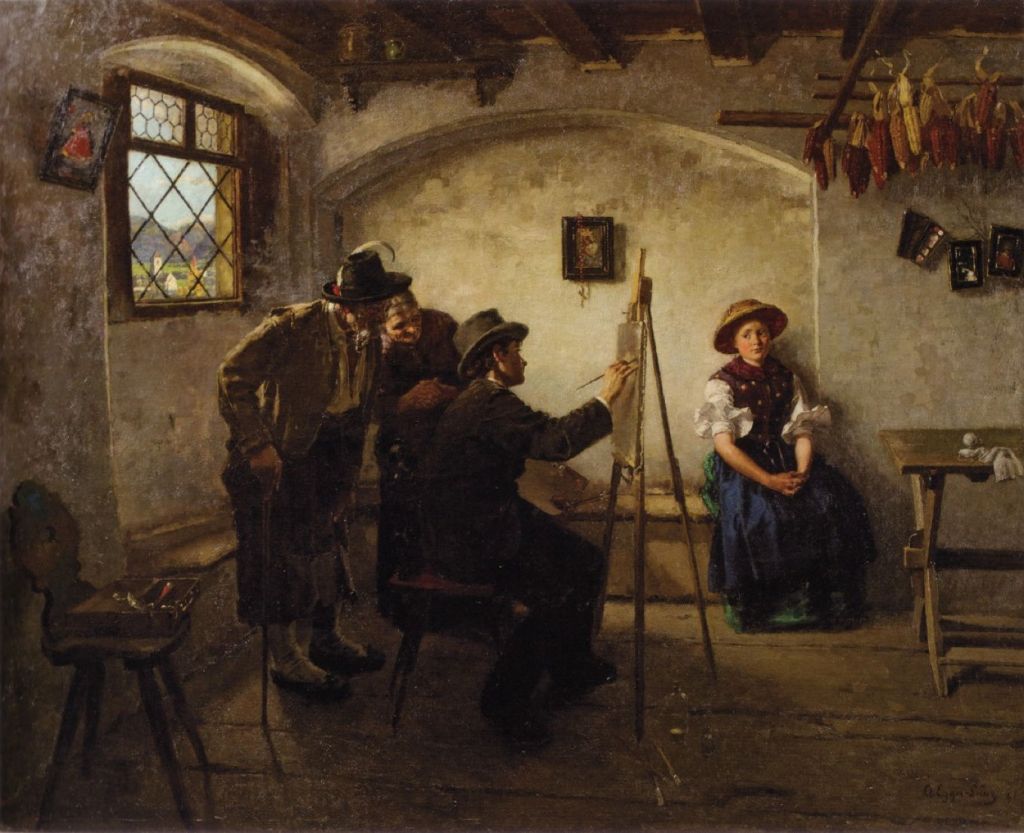
Although not described as such, I suspect that The Portrait Painter in the Countryside (1891) may have been a self-portrait of Egger-Lienz at work, painting the young woman who is seated rather tensely to the right. The cameo view through the window suggests that this was also painted in the Austrian Tyrol, or perhaps in Bavaria.

Egger-Lienz’s A Farewell in the Tyrol in 1809, painted between 1894-97, is set in a graveyard, where an elderly man is beside a grave, presumably that of his wife. His hands are clenched together in prayer as he leans, half-kneeling, on the muzzle of a crude local-made shotgun.
The year 1809 was a troubled time in the Tyrol, when Napoleon re-occupied Vienna and Austria was defeated at the Battle of Wagram. Much of the Tyrol was taken to form Napoleon’s Illyrian Provinces, and Austria became in effect a French possession. This triggered a series of popular revolts.

The Cross (1898-1901) was one of Egger-Lienz’s most successful paintings of his early career, for which he was awarded the Grand State Medal in Gold when it was exhibited at the Künstlerhaus in Vienna in 1901. This too refers to the period of discord during Napoleon’s occupation in 1809, where a Tyrolean Capuchin priest, Pater Joachim Haspinger, is leading a peasants’ revolt against the occupation.
Haspinger appears to be the man in a broad-brimmed hat in the centre of the painting, holding aloft the large crucifix to the left of him. He is surrounded by a dense throng of country men armed with scythes and the occasional old sabre. Egger-Lienz shows what is clearly a very angry mob. Perhaps inevitably Haspinger’s revolt failed, and he was forced to flee to Switzerland. He eventually returned to Austria, and died there in 1858.

In complete contrast, Egger-Lienz’s The Venison Dealer from 1902 is a portrait of a young woman with a radiant smile, surrounded by a rich still life of game, but no sign of any venison.

Christmas Eve (1903) is an effective re-interpretation of the traditional adoration of the shepherds, apparently set in a Tyrolean cowshed, with skilful use of light. This and the next two paintings mark Egger-Lienz’s transition to a looser style, which also appears to have been influenced by the social realist paintings of Jean-François Millet.

The Tyrolean Waitress (c 1903) shows a young woman pouring a drink for a customer, who is seen smoking a tobacco pipe in the well-lit room behind. Slung from a thin leather belt around her waist is her black leather purse.

Millet’s influence is most manifest in one of Egger-Lienz’s first versions of The Sower, from 1903, a motif which was to recur in the artist’s later works. The earth colours, increasing looseness and simplicity were to set the style for much of the rest of his career.
Egger-Lienz hated being accused of being a follower of Hodler, seeing him more as a competitor than an ally, but his first exposure to the paintings of Hodler in 1900 marked a turning point in his art.

