
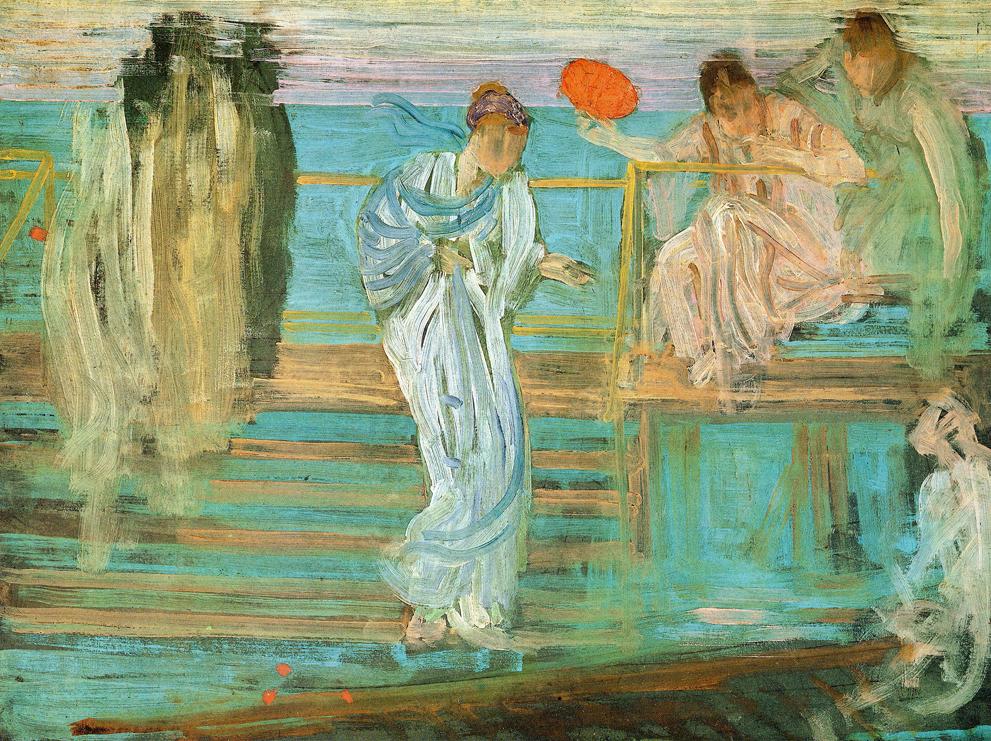
After yesterday’s account of the career of the American expatriate artist Benjamin West, today it’s the turn of James Abbott McNeill Whistler, who designed and painted the Peacock Room, described in an official account of the visit of First Lady Melania Trump and Madame Peng Liyuan as “a remarkable meeting point of American art and Asian artistic traditions”.
Born in Lowell, MA, in 1834 as James Abbott Whistler, he moved with his family to Saint Petersburg in Russia in 1843, where his father was involved in engineering the railway to Moscow. Oddly, when he was later giving evidence in his libel trial in London, he claimed that he was born in Saint Petersburg as he did “not choose to be born in Lowell”. Having taken classes at the Imperial Academy of Fine Arts there since the age of 11, after his father died of cholera, he was sent to West Point, the military academy on the Hudson River, NY, from 1851-54. Following that he learned to etch while working in the US Geodetic and Coast Survey.
He left the US in 1855 for Paris, where he became a pupil at the Gleyre Academy, seven years before Claude Monet started there. He arrived in time to visit Courbet’s pavilion outside the Universal Exposition, and immediately became influenced by him. In 1858 he produced a set of etchings from a walking tour of Alsace-Lorraine and the Rhineland that were well received. Surprisingly several of his paintings surviving from this period show loose brushwork that wouldn’t have impressed Gleyre his teacher. He also established a reputation for himself as a dandy who enjoyed the high life.

Whistler’s Head of Old Man Smoking (c 1858) above, and Old Mother Gerard (1858-9) below are painterly for the day.

He then moved to London in 1859, where he kept his studio until 1892.

The Thames in Ice shows the bitter conditions in London during the winter of 1860.

In 1862 Whistler travelled to Brittany to paint, then spent the winter in Paris. He met and started to live with Joanna Hiffernan, his model for Symphony in White No. 1: The White Girl (1862), above. That painting was rejected by the Royal Academy in 1862, and widely criticised for showing a woman in white against a white background. Whistler showed it the following year at the Salon de Refusés in Paris, where it appeared with Manet’s Déjeuner sur l’Herbe, and shared the scandalous reaction.

His friendship with the Greaves brothers encouraged him to paint views of the River Thames in London, including his Grey and Silver: Old Battersea Reach (1863) above.
In 1864 Whistler’s widowed mother arrived to live with him in London, curbing some of his social excesses until she moved out in 1875. He befriended some of the Pre-Raphaelites, and became influenced by orientalism, to which he had been introduced by Henri Fantin-Latour (1836-1904) and Félix Bracquemond (1833-1914) when he was a student in Paris in 1858. Fantin and Bracquemond were to remain close friends.

Whistler’s The Princess from the Land of Porcelain (1863-65) was later to become the focal point of his Peacock Room designed and executed for the lavish dining room of the London house of Frederick Richards Leyland, a Liverpool shipping magnate. The model was Christine Spartali, sister of Marie Spartali Stillman, and of Greek origin, but she’s wearing a fine silk kimono in a Western manner and holding a fan. Behind her is a painted screen from Japan, and under her feet is a lush white and blue carpet. This was exhibited at the Salon in Paris in 1865, and was sold to a collector, but returned to the artist in 1867.

Whistler was an early enthusiast for Japonisme. His Variations in Flesh Colour and Green — The Balcony, painted in oils between 1864-79, is Japanese in its lower half, but the dull grey buildings in the background are warehouses and factories on the bank of the River Thames in London.

In the autumn of 1865 he painted at Trouville, France, with Gustave Courbet, where he made Crepuscule in Opal: Trouville.

In 1866 he was invited to go to Chile, where there was a war involving Spain. Although he avoided involvement in any conflict, he kept a detailed journal and painted, including his Crepuscule in Flesh Colour and Green: Valparaiso. This was the closest he came to returning to America after he emigrated in 1855.

He painted Symphony in White and Red in about 1868 following his return from Chile.

He started painting a series of nocturnes, along the River Thames, in 1871, including Variations in Pink and Grey: Chelsea in 1871-72. He painted his most famous portrait, Arrangement in Grey and Black No. 1, generally known as Whistler’s Mother, in 1871. It was initially rejected by the Royal Academy, but then hung in an unfavourable location. It was eventually purchased for the French state in 1891, and is now in the Musée d’Orsay in Paris.
In 1874, he was invited to exhibit in the First Impressionist Exhibition in Paris, but declined, possibly following the advice of Fantin-Latour. Whistler’s mother then moved to Hastings for health reasons in 1875, allowing him to start entertaining lavishly.
The following year he was commissioned to decorate Leyland’s London mansion, which unfortunately ended in acrimony after a couple of years, and loss of his patron. Leyland originally engaged a British architect to remodel the interior, and entrusted the work in the dining room to another British architect with experience of what became known as Anglo-Japanese style. Whistler was working on decorations for the entrance hall when he suggested what should have been minor changes to the dining room. In the absence of Leyland, Whistler’s changes grew until they overwhelmed the whole Peacock Room.
When Leyland returned, he and Whistler fell out, and quarrelled so violently that their relationship terminated. The contents of the room were purchased from Leyland’s heirs in 1904, moved to the USA, and exhibited to the public in the Freer Gallery in Washington, DC, from 1923.

In 1877, eight paintings of Whistler’s, including Nocturne in Black and Gold: The Falling Rocket, were shown at the opening exhibition of the Grosvenor Gallery, London. These caused a furore among critics, particularly John Ruskin, who published a scathing account in protest. Whistler then sued Ruskin for libel. Although Whistler won the case, he was awarded a farthing (0.6 pence) in damages, the least possible, and his legal costs bankrupted him in 1879. He fled to Venice for a year, where he was commissioned to make a series of etchings.

On his return he resumed painting portraits, including Harmony in Pink and Grey: Portrait of Lady Meux from 1881-2, but he was soon competing with John Singer Sargent, who moved his portrait studio from Paris to London in 1886.

His etchings from Venice were exhibited at the Fine Art Society in 1883. He then visited St Ives, Cornwall, in 1884 in company with his assistant Mortimer Menpes and Walter Sickert. There he painted mainly small seascapes, and back in London he painted several works showing shop fronts. With reviews of his work steadily improving, he was elected President of the Society of British Artists in 1886.
He at last enjoyed critical success with a one-man retrospective exhibition at the Goupil Gallery, London, in 1892, but then moved to Paris for two years. He started to concentrate more on creating lithographs. He visited Paris from 1898 to teach at an art academy opened there by one of his former models, Carmen Rossi, until it closed in 1901. That academy’s sole success seems to have been Gwen John (1876-1939).
Whistler died in London in 1903, and was buried there.
During Whistler’s career, the American landscape painter Winslow Homer (1836-1910) visited the fishing village of Cullercoats in the north-east of England, between 1881-82. This was a formative period in his watercolour painting, and he attained greatness as a result, following his return to the USA.
Homer’s stay in Cullercoats took place during the early phase of John Singer Sargent’s career. Sargent had been born in Florence in 1856, to an expatriate American family with roots in Philadelphia, and travelled and worked across Europe during most of his career. Although he spent most of those years in London, and was commissioned as a British war artist in 1918, he spent increasing time in the USA during the twentieth century, before he died in Chelsea, London, in 1925.
Like so many great artists, Whistler and Sargent defy the crude jingoism of nationality.

