
The quest of Orpheus into the underworld in search of his bride Eurydice had proved successful. After he had convinced Persephone and Hades with his lyre, they agreed to make an exception, and allow Eurydice to escape. Persephone summoned Eurydice, and let Orpheus take her back on the strict understanding that at no time until he reached the earth above could he look back, or she would be returned to the underworld for ever.

Peter Paul Rubens’ atmospheric painting of the flight of Orpheus and Eurydice (1636-38) was made during his later years of retirement, a few years before his own death. Orpheus, clutching his lyre, is leading Eurydice away from Hades and Persephone, as they start their journey back to life. He includes an unusually realistic depiction of Cerberus at the bottom right.

Camille Corot’s Orpheus Leading Eurydice from the Underworld (1861) shows the couple as they near the light at the exit of the underworld. He is instantly recognisable by his lyre held high in front of him, and both are moving towards the right edge of the painting, the edge of a dark wood. Behind that are spirits of the dead, some still grieving their death.

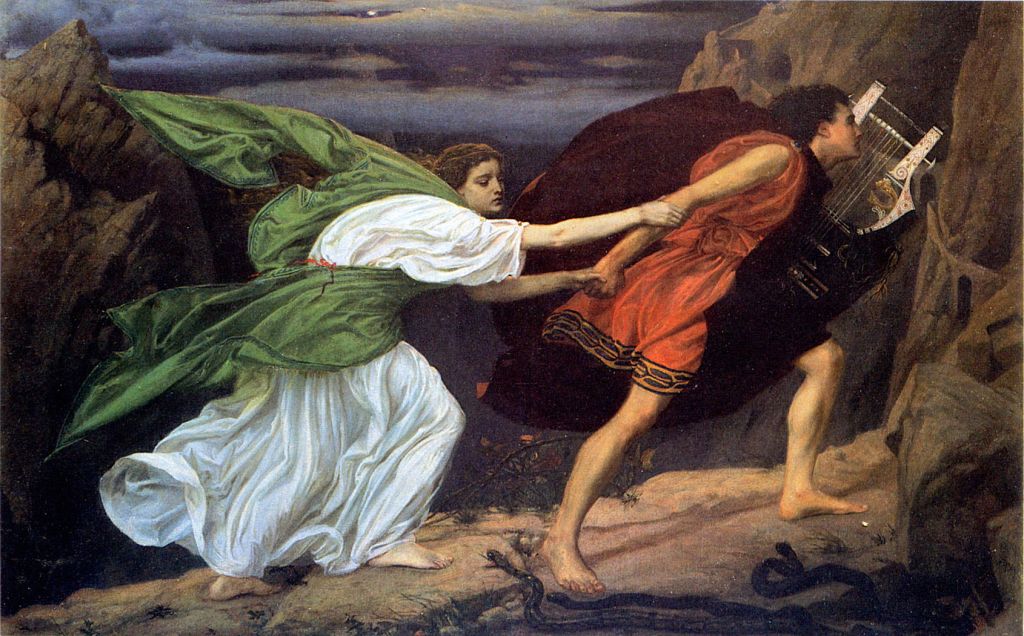
Edward Poynter’s Orpheus and Eurydice (1862) takes the couple on a physically arduous journey, striding past snakes and along a dizzying path on the mountainside. While he looks straight ahead, she seems to be struggling to keep up.
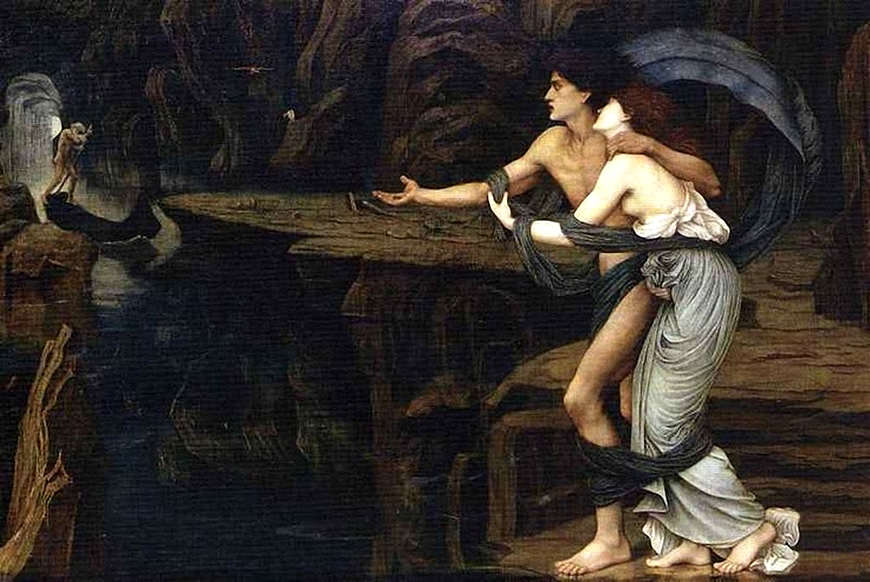
John Roddam Spencer Stanhope’s Orpheus and Eurydice on the Banks of the Styx (1878) takes the couple further still, onto the bank of the River Styx, where Orpheus is summoning Charon the boatman to take them back across the water. He clutches her closely and still looks straight ahead, the couple bound together by the black sash of the underworld.
The couple trekked up through the gloom, and were just reaching the brighter edge of the underworld when Orpheus could resist no longer, and looked back to make sure his wife was still coping with their journey. The moment he turned she melted away back into Hades’ realm. As he tried to grasp her, his hands clutched at empty air. She was gone.

It’s hard to know whether George Frederick Watts’ undated painting of Orpheus and Eurydice shows Orpheus embracing the dead body of Eurydice immediately after she has been bitten by the snake, or (more probably) Orpheus clutching in vain at her spirit as it melts away back into the underworld, after he has looked back.
Orpheus tried to persuade the ferryman to take him back across the River Styx into the underworld, but was refused. For a week he sat there in his grief. He then spent three years shunning the company of women, despite their attraction to him, and brought shade to an exposed meadow with his singing.

Gustave Moreau’s Orpheus at the Tomb of Eurydice (c 1891) shows the bard, his ghostly lyre slung from the dead tree-stump behind him, lamenting the loss of Eurydice. Moreau painted this dark and funereal work to mark his own inconsolable grief at the death of his partner Alexandrine Dureux in 1890, when she was only fifty-one.
Although there are differing accounts of how Orpheus came to meet his death, one claims that he worshipped only Apollo, and one morning went to salute the god on Mount Pangaion at dawn. He was there attacked by a mob of frenzied Thracian women, Maenads or Bacchantes, accusing Orpheus of scorning women, as he had.
The first of the Bacchantes threw her thyrsus at him, but only bruised his face. She then fell to the ground, enchanted by his voice and lyre. Soon his music was overwhelmed by the mob with their drums and deafening screams. The women first killed the birds that Orpheus had been charming, then the snakes around him, and next they turned on him. A nearby group of farmworkers ran away, abandoning their tools in the field. The Bacchantes seized those as weapons to bludgeon the bard’s body. He made one last plea for his life before they tore him limb from limb.

Émile Lévy’s Death of Orpheus (1866) shows the moment before the first wound is inflicted: a youthful Orpheus has just been knocked to the ground, and looks stunned. Two Bacchantes kneel by his side, one clasping his neck, the other about to bring the vicious blade of her ceremonial sickle down to cleave his neck open. Another wields her thyrsus like a club while pulling at the man’s left hand. Their priestess, her head thrown back to emphasise her extraordinary mane of hair, is entwined with serpents, and officiates at the sacrifice. In the shadows at the top left, the figure of Bacchus (Dionysus) stands, looking away from the scene below as a naked celebrant cavorts behind him.

Louis Bouquet’s more recent The Death of Orpheus (1925-39) transports the scene to a beach, where the naked Bacchantes are almost unarmed and just starting to tear the body of Orpheus with their bare hands and teeth.
The mortal remains of Orpheus were then dispersed into rivers: his head and lyre ended up in the Hebrus, where they still made sad sounds, as they made their way downstream and over the sea to the shores of Lesbos. Orpheus’ soul descended to the underworld, where he was at last reunited with his beloved Eurydice. But the god Bacchus couldn’t let this crime pass, and transformed those Bacchantes into an oak wood.

In Gustave Moreau’s Orpheus (1865), a sombrely dressed Thracian woman holds Orpheus’ lyre, on which rests his head, blanched in death, as if affixed to the lyre like the head of a hunting trophy. Her eyes are closed in reverie. The river Hebrus is shown in the background landscape to the right. The gentle and natural beauty of the Thracian woman, her ornate clothes, flowers, and the strange beauty of Orpheus’ head on the lyre contrast with the harsh and barren landscape.

Moreau here avoids elaborate symbols and decoration, apart from two passages at the painting’s corners: three figures, apparently shepherds, on the rocks at the upper left, and a pair of tortoises at the lower right. The figures refer to music, in keeping with Orpheus and his lyre, but the significance of the tortoises is harder to explain, and might be a personal reference to Moreau’s love for his partner.

John William Waterhouse uses his depiction of this scene, in Nymphs Finding the Head of Orpheus (1900), to celebrate honesty in art, a theme dear to the artist throughout his career. This shows two young women discovering the severed head and lyre of Orpheus. Waterhouse may well have seen Moreau’s painting, which had become popular with Symbolists of mainland Europe.

