
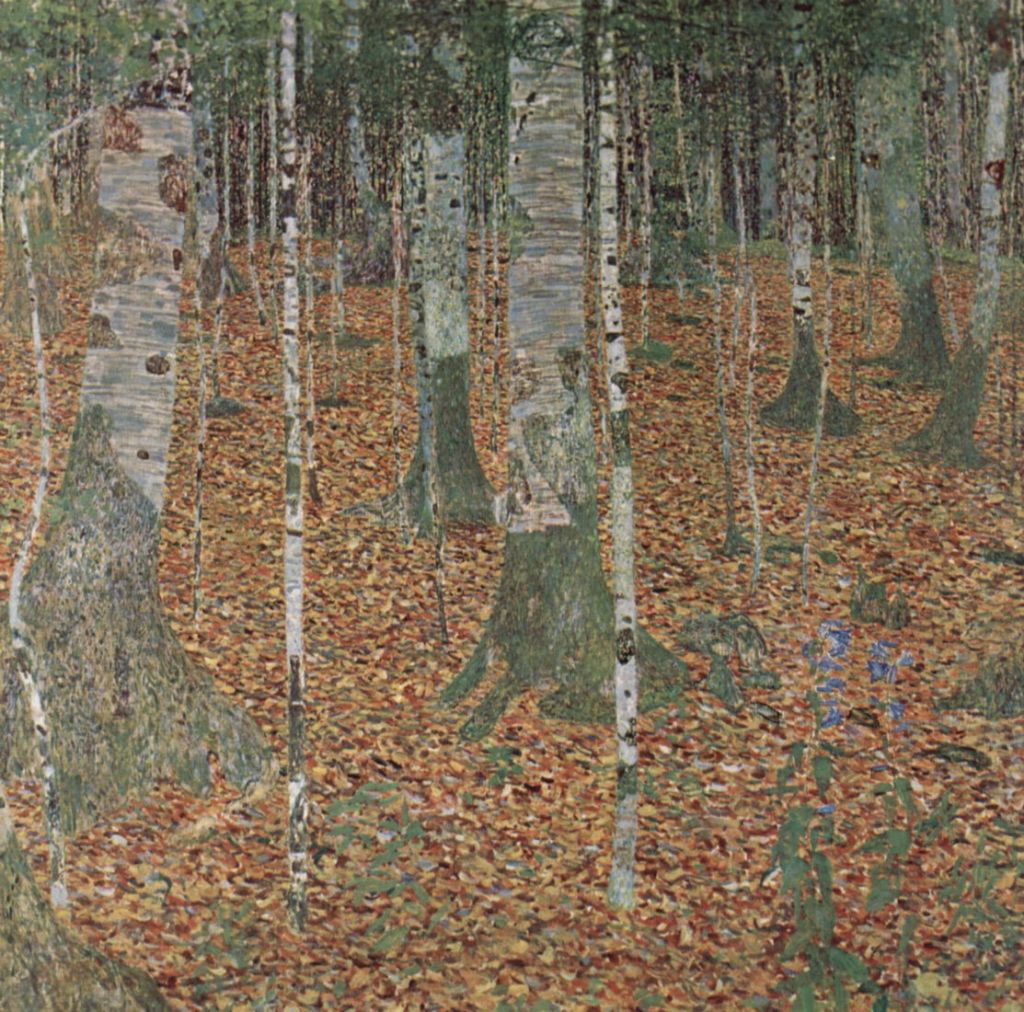
Gustav Klimt isn’t remembered as a landscape painter, or for his portraits of trees. Yet each summer he holidayed with his partner Emilie Flöge and her family, and put aside his figurative and portrait work to go out and paint in the countryside. Those landscape paintings have recently been re-evaluated and are now achieving the recognition they deserve, as distinctive and innovative as his better-known paintings of women.

Klimt had probably painted his first small landscapes between 1881-87, and returned to the genre more seriously in about 1896. This work, variously known as After the Rain, Garden with Chickens in St. Agatha, or similar, is thought to have been painted when Klimt stayed in the Goiserer Valley with the Flöge family in the summer of 1898. Bad Goisern is a small spa town in the picturesque countryside of the Goiserer Valley, near Hallstatt in central Austria, which had become a popular resort for the Viennese to spend their summer holidays. This is one of his few works showing transient conditions, and features rich textures in these trunks.

Farmhouse with Birch Trees (1900) is one of the half-dozen paintings Klimt completed during his holiday in 1900. At this stage, his vegetation is textured, and the contrasting young birch trees are slightly soft-focus.

He painted one of his finest landscapes, Beech Forest I, during the summer of 1902. His more Divisionist approach to the forest floor appears painstaking and gives it a contrasting texture from the patterned trunks. Patches of light, brilliant green foliage, and the distant sky give this painting a look distinctive to Klimt.

The following year, he again spent the summer holiday at Attersee with the Flöge family, where he painted this view of an Approaching Thunderstorm (The Large Poplar II). Despite the darkness of the sky, the foliage of the poplar trees stands out because of its fine texture.
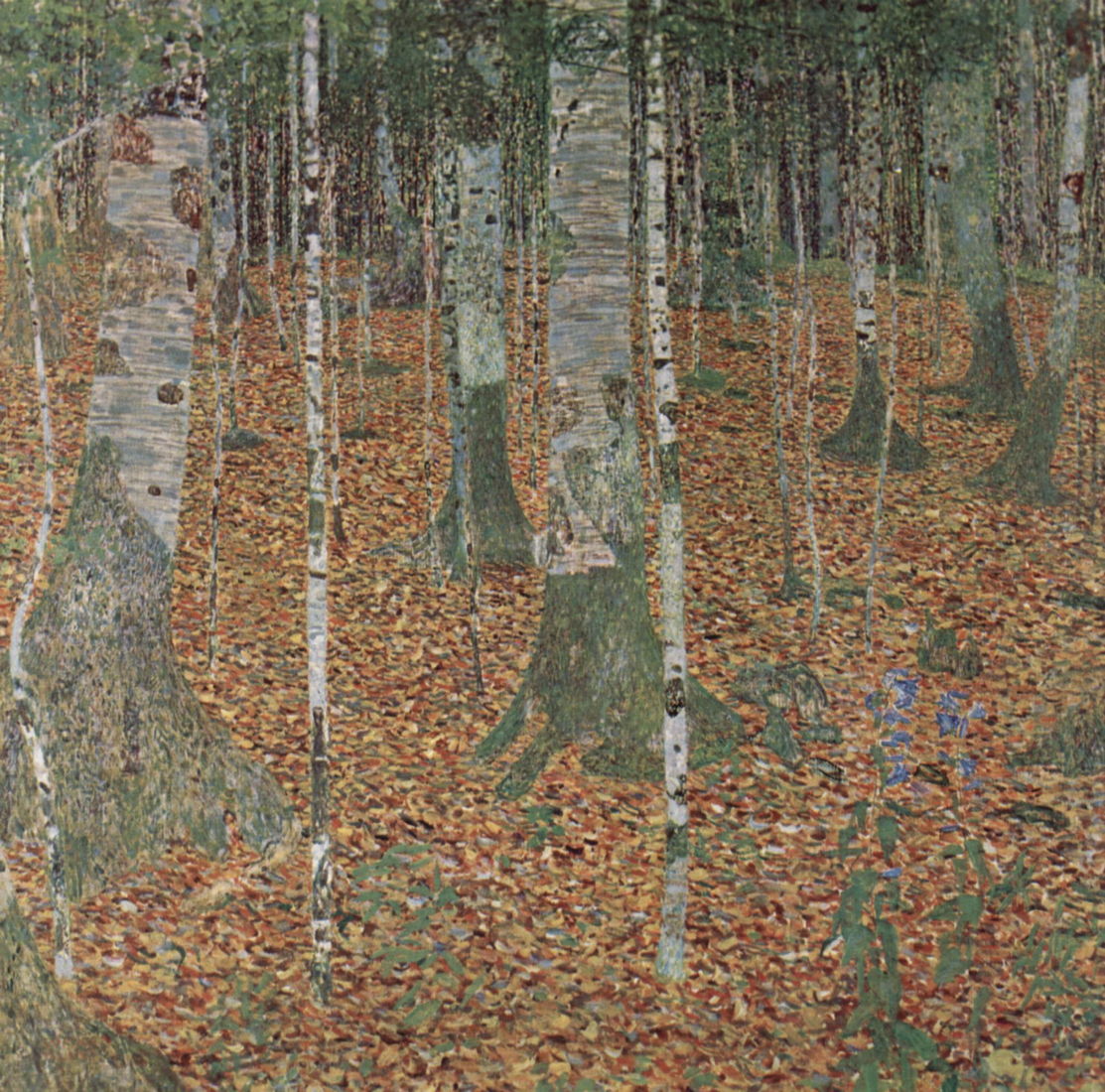
Birch Forest (1903) was another of his landscape paintings from that summer, in which the depth and glimpses of the sky in Beech Forest I above have been removed. By this time Klimt had started painting some of his landscape views through a telescope, resulting in loss of perspective depth.
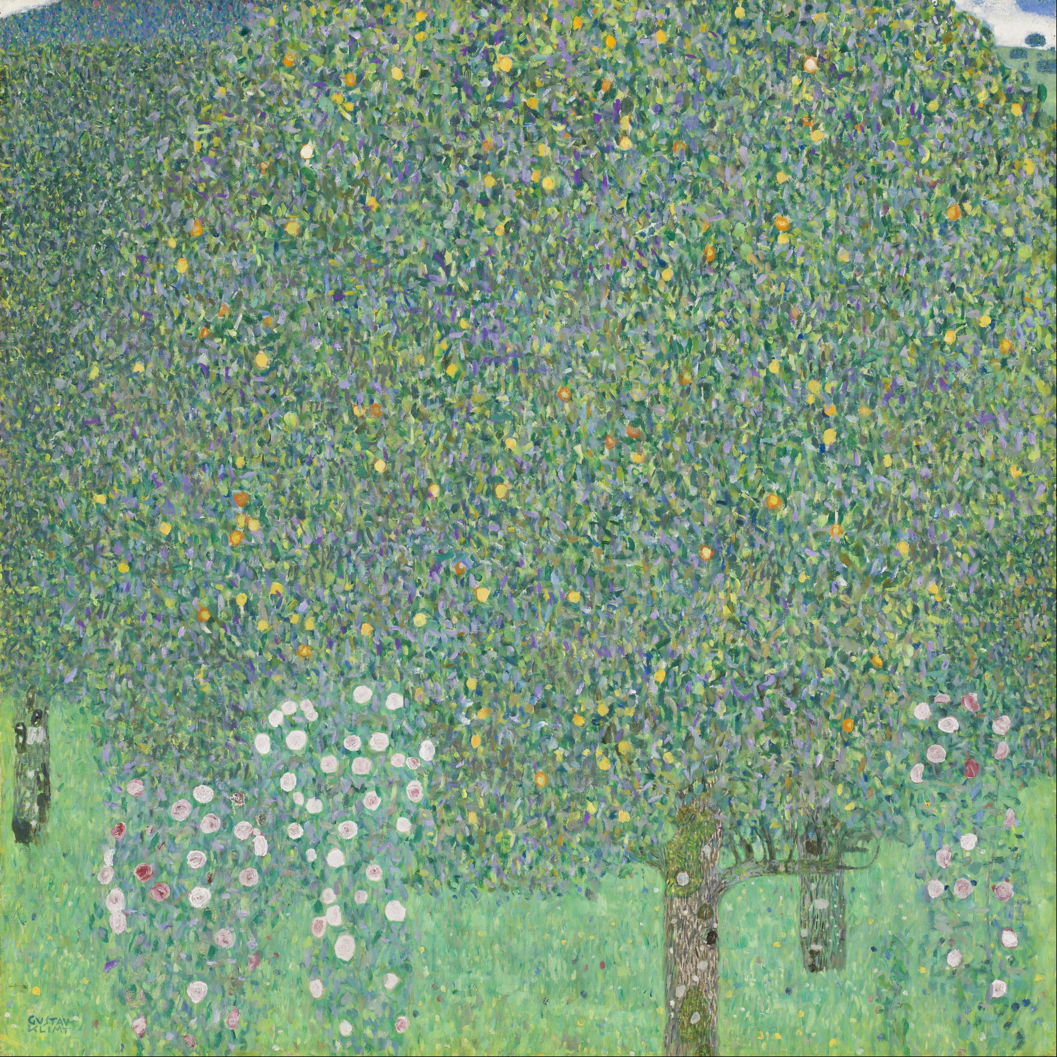
By the summer of about 1905, floral motifs such as Rosebushes under the Trees (c 1905) were starting to predominate, at first with these tiny, almost Divisionist, blobs of colour.
In the summer of 1913, Klimt stayed first at Bad Gastein, then in July went to stay with the Flöge family on Lake Garda, finishing his break in September at Attersee.
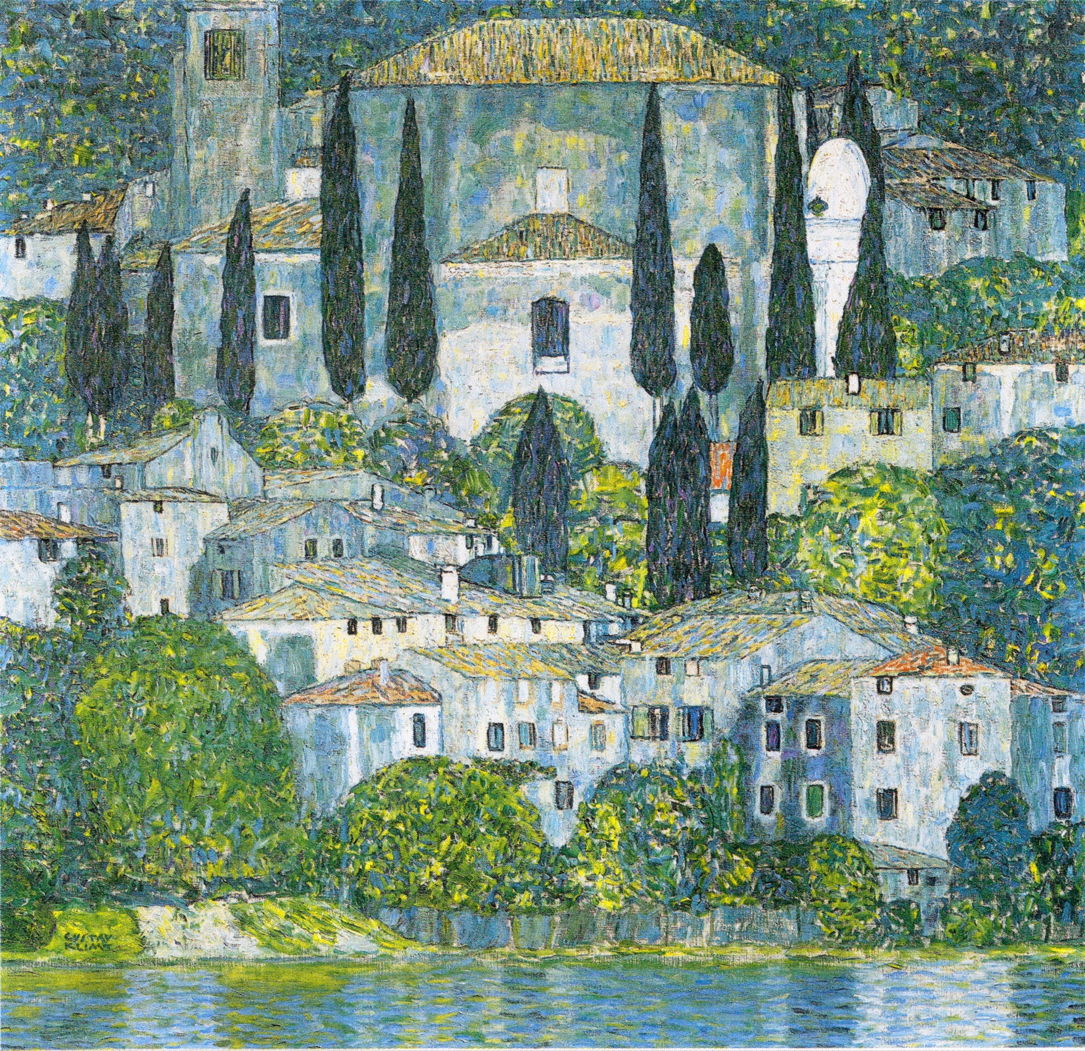
Klimt appears to have taken his telescope to Lake Garda, where he painted this view of the Church in Cassone (1913). Its flattened perspective is characteristic of the use of a lens with long focal length, as in a telescope. Another good indicator is the small difference in scale between the houses at the water’s edge and those behind the church, even though in reality the latter must have been a significant distance from the shore.
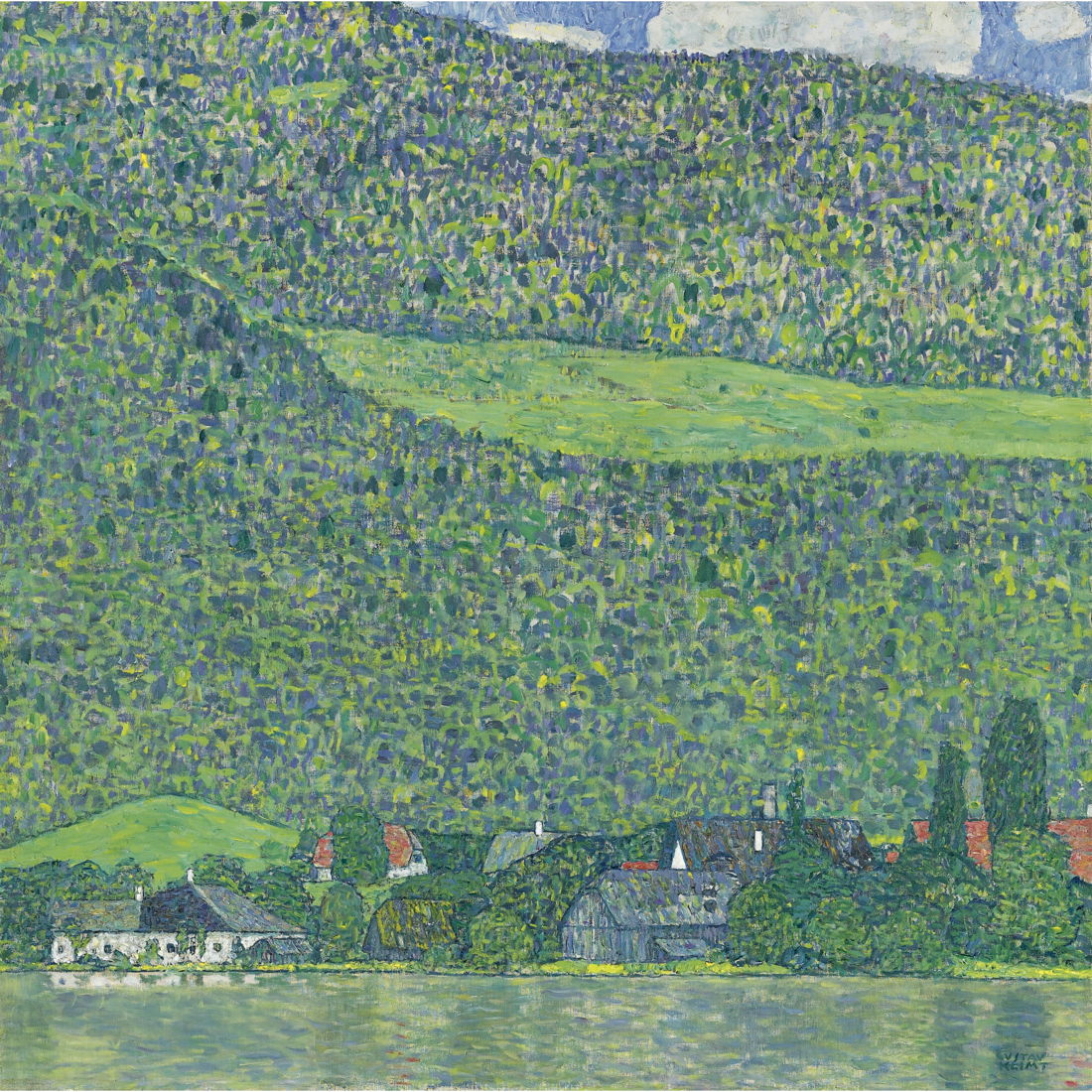
In the summers of 1914-16, Klimt took his holiday on the Attersee, where he painted this marvellously flattened view of the hamlet of Litzlberg on Attersee (1914-15). To remove any sense of depth, he has painted the trees in the two swathes of woodland without any visible change in scale from recession. This gives the effect of two vertical planes: the nearer containing the houses and farms, and the more distant the forest and fields. This is similar to painted scenery used in the theatre.
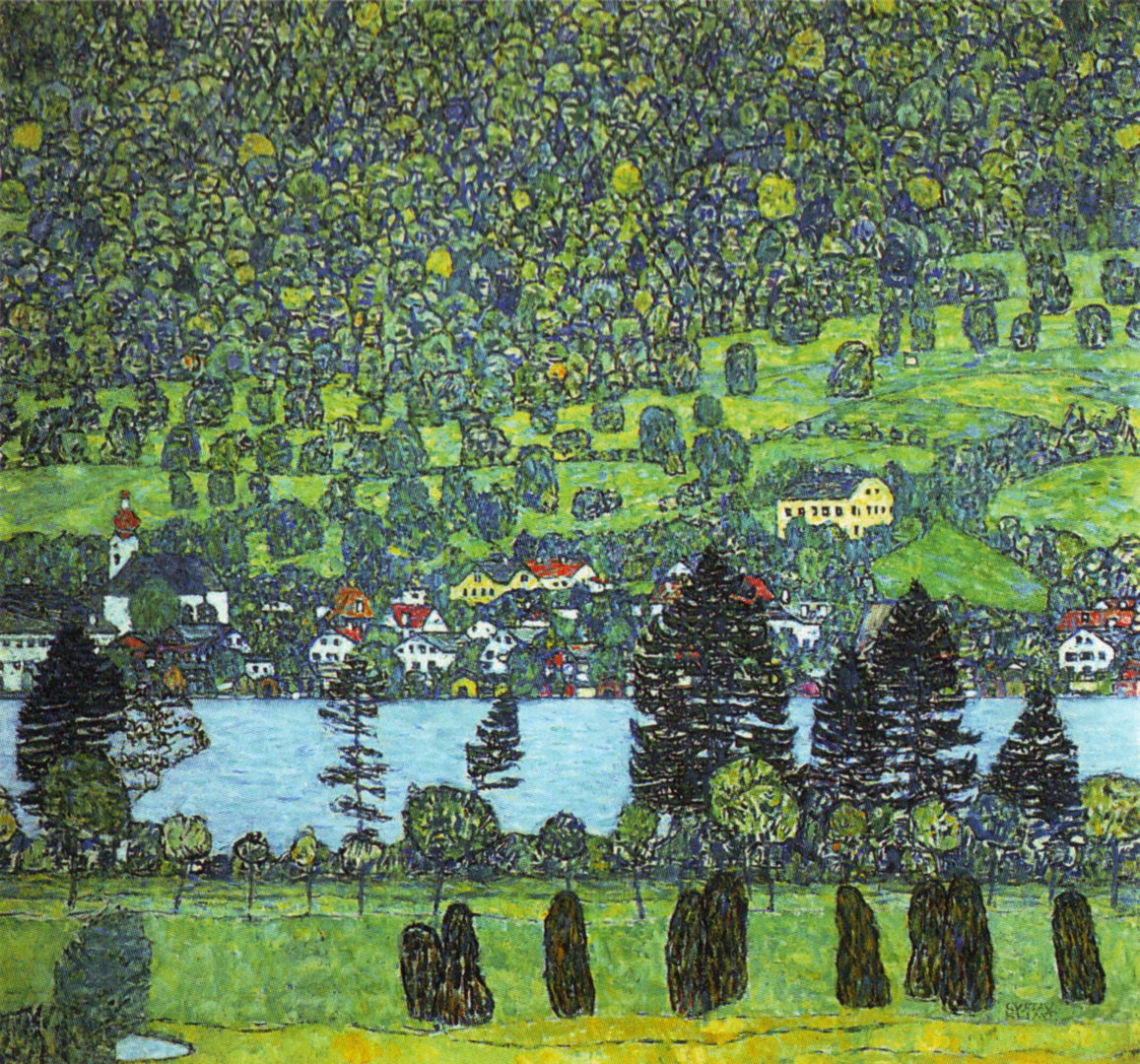
In the summer of 1916, when at Attersee, he worked again through the telescope, painting this Forest Slope at Unterach on Attersee. The loss of depth makes the lake seem small, and the village, fields and trees on the far bank appear in a vertical plane. In fact, the village and meadows are on a gentle slope, with the forest behind rising more steeply, but Klimt deliberately removes that.
References
Stephan Koja (2006) Gustav Klimt, Landscapes, Prestel. ISBN 978 3 7913 3717 3.
Rainer Metzger (2005) Gustav Klimt, Drawings & Watercolours, Thames & Hudson. ISBN 978 0 500 23826 4.

