

A multiplex narrative painting contains representations of two or more moments in time from a story, merged together in a single image. In its heyday during the Renaissance it was relatively common, and has its origins in classical civilisations, both in Europe and Asia. This article shows some of the best examples from the European canon up to 1600.
Worked example

Masaccio’s fresco of The Tribute Money, believed to have been painted in 1425-28, contains three images of Saint Peter, and two of the tax gatherer, carefully set and coherently projected into the same single view. Although each is spaced apart from the next, no pictorial device is used to separate them into frames, although spatial composition is essential for the story to be read.
His literary reference is to the Gospel of Matthew, in a story in which Christ directs Peter to find a coin in the mouth of a fish so that he can pay the temple tax. In the centre, the tax collector asks Christ for the tax. At the far left, as indicated by Christ and Peter’s arms, Peter (for the second time) takes the coin out of the mouth of a fish. At the right, Peter (a third time) pays the tax collector (shown a second time) his due.

Masaccio makes the entry point the dominant group in the middle foreground, with the figure of Christ at its centre. As Christ and Peter 1 show with their arms, the second scene in the story is the figure at the left edge of the image. Using body language to direct the reader to the next moment in the story is excellent narrative technique.

Peter 2 is seen here in the same clothing, a common means of telling the viewer that he’s the same figure as Peter 1. Here there’s the subtle twist that, when taking the coin from the mouth of the fish, he has removed his golden cloak and laid it on the bank beside him.

Having looked at the centre and left, the viewer’s eye now looks at the opposite edge, where they see Peter 3 and Tax Collector 2, following their respective dress code, as the saint pays the tax using a coin he has just retrieved from the fish.
This use of space to depict time comes into conflict with the Renaissance objective of realism, though. To ensure this story looks consistent, Masaccio has therefore set each of those three scenes in the same coherent landscape and perspective projection. What we read as three separate scenes now forms a whole image. That’s an unusual combination of painting and narrative genius.
Gallery
The oldest surviving paintings remaining in good condition tend to be the miniatures incorporated into religious manuscripts. Among the first is The Vienna Genesis from the first half of the sixth century, created on vellum dyed purple. It probably originated in Syria, and has illustrations to accompany its texts from the Old Testament book of Genesis.
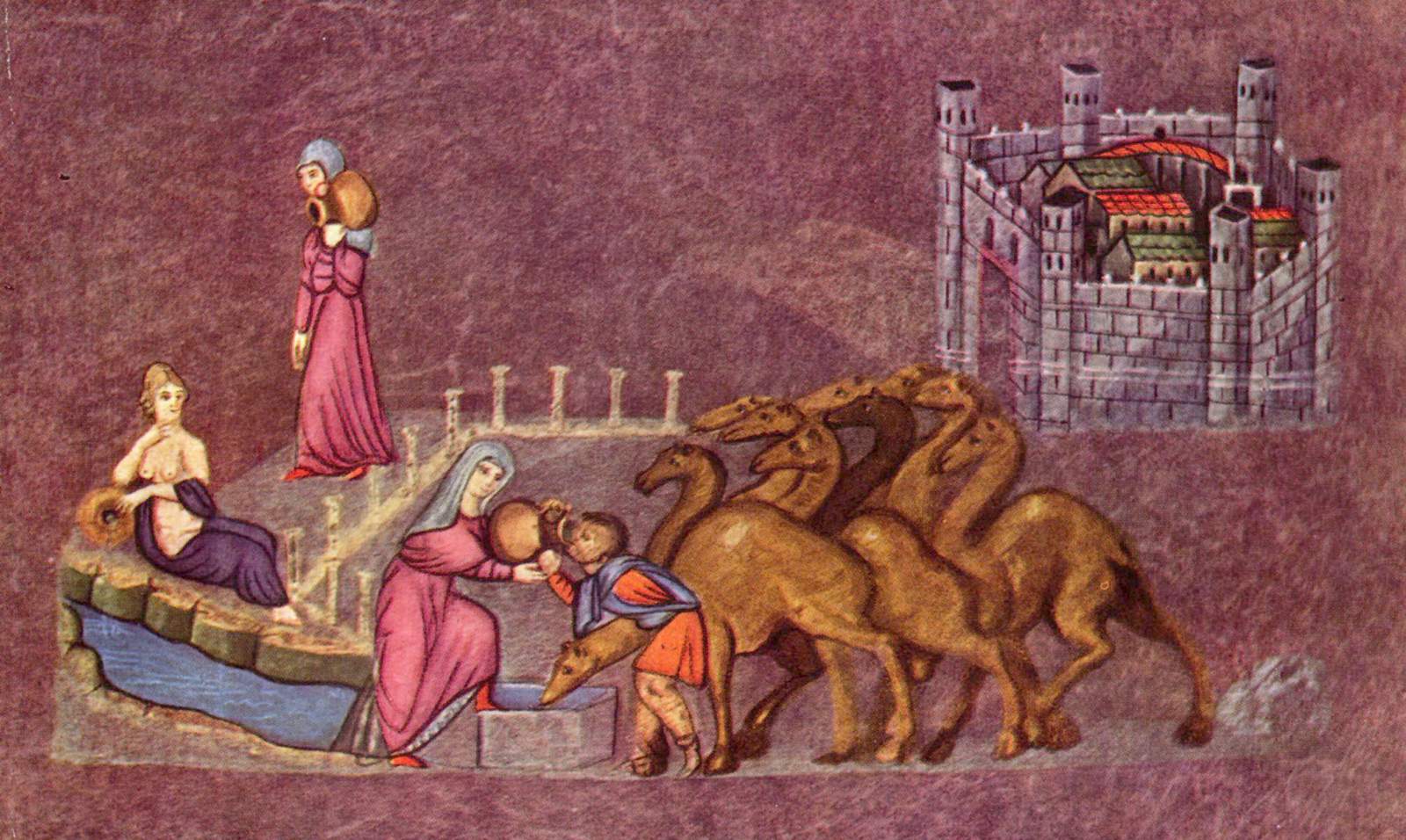
The story of Rebecca and Eliezer, shown here, comes from Genesis chapter 24. Abraham wanted to find a wife for his son Isaac, so sent his servant Eliezer back to the homeland of Mesopotamia to look for one. Eliezer reached the city of Nahor, where he stopped to water his camels and rest from his long journey. He pulled up at a well outside the city, where a young woman, Rebecca, had just drawn water. She offered him her water, and he recognised her as the chosen bride for Isaac, so presented her with the betrothal gifts which he had brought with him.
In the background is a symbolic representation of Nahor. Rebecca is shown at the left, having walked out of the city with her pitcher on her shoulder, along a colonnade. In front of her is a pagan water nymph, presumably the spirit of that well. Rebeccah is shown a second time, giving Eliezer her pitcher to slake his thirst. His train of camels is also taking water.

Duccio’s The Healing of the Man born Blind, from his Maestà Predella Panels of about 1310, is an example of a narrative painting as art emerged from the Middle Ages. Much of the panel is taken up by the first scene, in which Christ is healing a man we know from the Gospel story is blind. Back to back with him being healed as a blind man, he is shown healed and sighted to the right.

Masaccio’s The Tribute Money is one of a large series of paintings in the Brancacci Chapel, together telling the story of the Christian ministry of Saint Peter, with particular emphasis on healing and redemption for the poor. Although this was the chapel for a rich and powerful family, the church of Santa Maria del Carmine was situated in what was, at that time, a poor area of Florence. The episodes in Saint Peter’s life included appear to offer hope for those poor, that a good Christian life would be met with rewards for the spirit, if not in material existence.
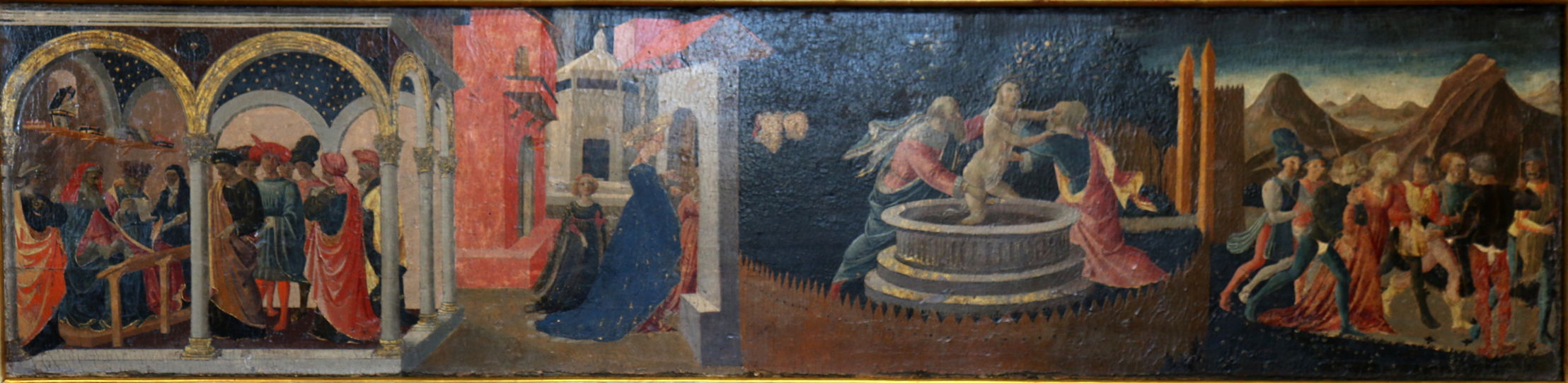
Zanobi Strozzi’s account of the story of Susanna and the Elders from about 1450 consists of four scenes which are gently integrated into the whole. In the central two scenes, Susanna enters her garden, and gets into the bath there, with the two elders physically grappling with her in their attempted rape. To the left of them are the two heads of the elders when they were earlier spying on Susanna.
The scenes at the left and right tell parts of the later story, but it’s not entirely clear which. That on the left appears to be a trial, possibly the second trial of the two elders in which Daniel has intervened. That at the right may show the two elders taken out of town to be executed.
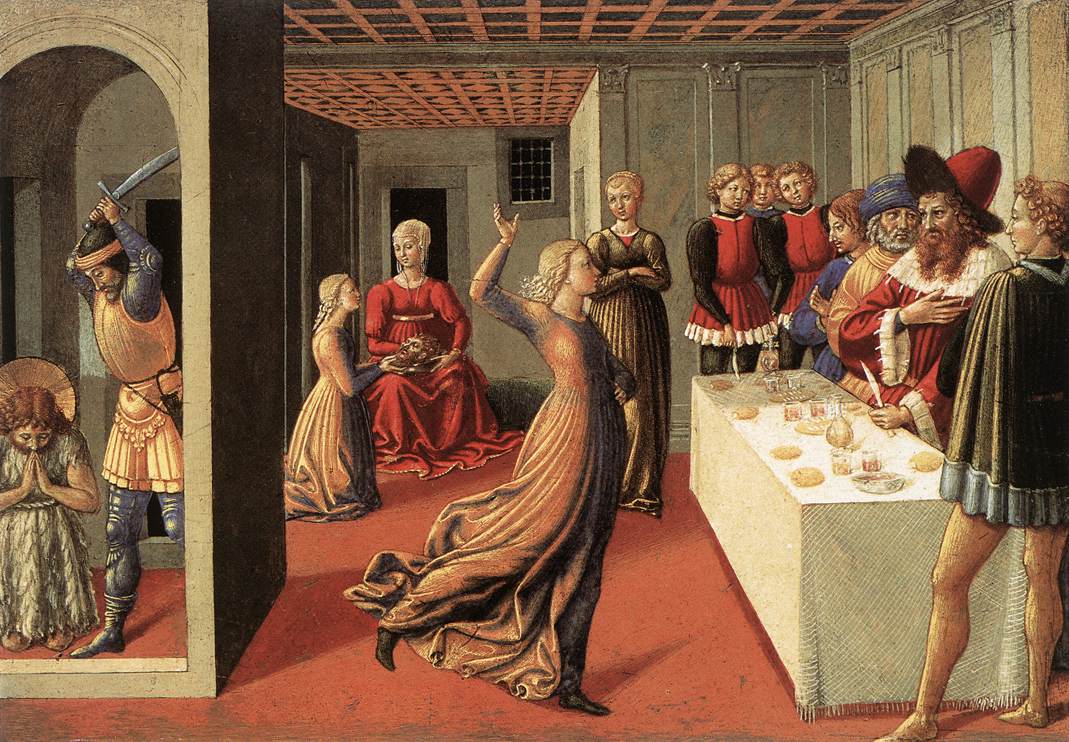
Benozzo Gozzoli’s The Dance of Salome (1461-62) tells the story of Salome’s dance before King Herod, and the presentation to her of the head of John the Baptist. Salome is shown twice in the single frame: once dancing in front of Herod, and again giving Herodias the head of John at the back of the room. The middle event in the chain, the beheading of John, is shown in a side-room at the left.
Here, it’s possible to deduce the story without already knowing it. There must be at least two scenes included, as one actor appears twice. This allows the viewer to establish the three scenes, but not the order in which to read them. Knowing the man at the left is about to be beheaded, and that his head appears on a plate at the back of the view, places those two in order, and it’s then not hard to guess that the scene of Salome dancing must have preceded those.
The story of Salome is already starting to stray from earlier religious painting. Although drawn from the Gospels, much of the detail relied on later sources embellished by legend. By the late fifteenth century, with the rise in classical scholarship, viewers were ready to read completely secular stories in paintings.

This superb panel by Jacopo da Sellaio tells much of the classical tragedy of Orpheus and Euridyce, played across an integrated fantasy landscape. Orpheus, Eurydice and Aristaeus dates from 1475-80, and is one panel of a series, now sadly dispersed across continents.
The start of the story is at the left, where Orpheus is tending a flock of sheep. To the right of that, his bride Euridyce is bitten by a snake very shortly after their wedding. At the far right, Orpheus, with the assistance of Aristaeus, puts the dead body of Eurydice in a rock tomb.

Sandro Botticelli’s textbook demonstration of both perspective projection and multiplex narrative is in one of his lesser-known works, The Story of Lucretia, painted in 1500-01. This tells its story in three scenes integrated into its single architectural whole. At the left, Lucretia is raped at knifepoint by Sextus Tarquinius. She then commits suicide in shame, and anger erupts through Rome. Her body is carried from her house (right) and placed in the Forum. There, her husband and his friends swear to overthrow the king (centre), and this brings about the new constitution for the city of Rome.
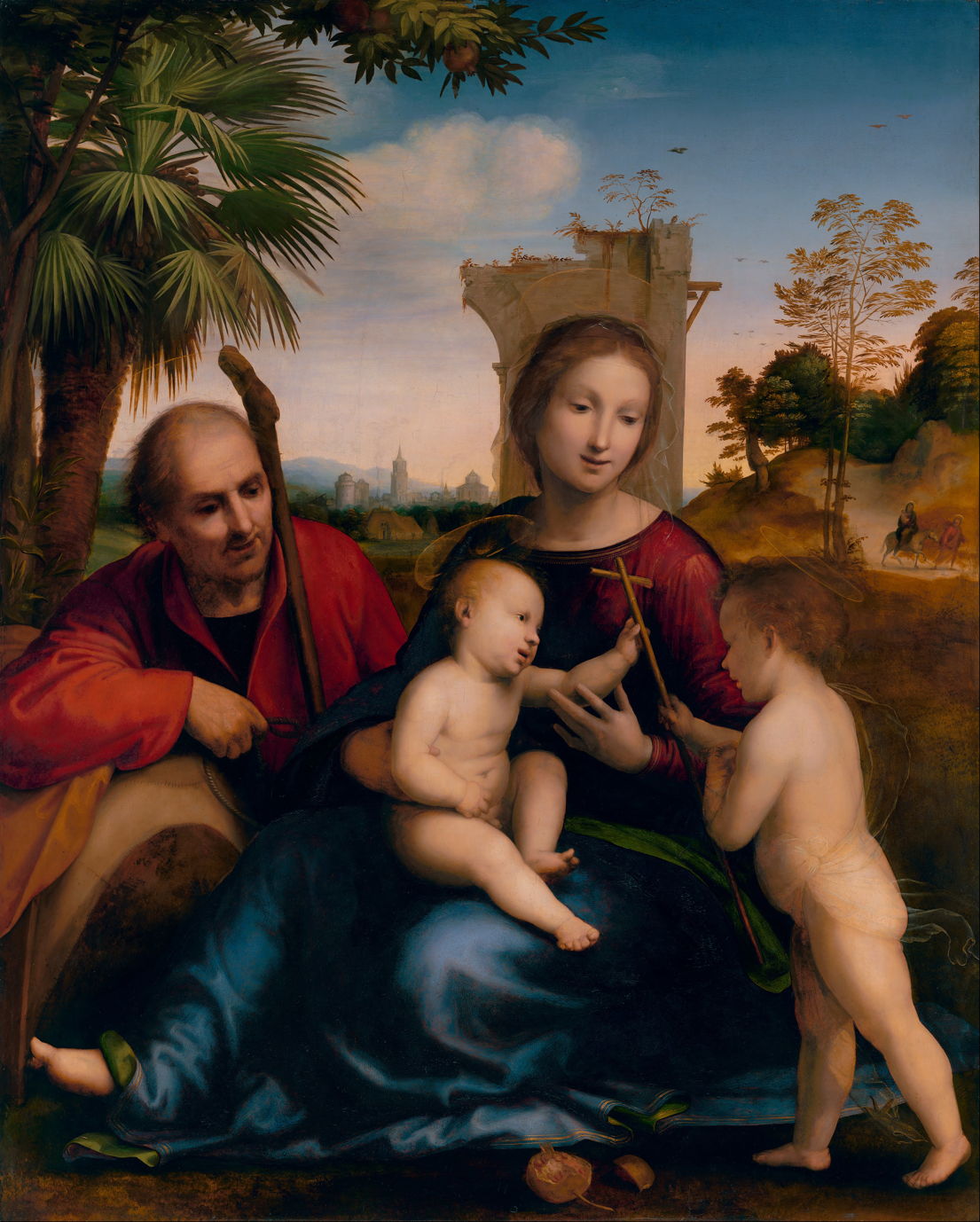
Fra Bartolomeo was one of the first artists to use a more subtle asymmetric variant of multiplex narrative, which may have been seen at the time as being progressive. In his Rest on the Flight into Egypt with St. John the Baptist, from about 1509, Joseph and Mary are shown in the dominant scene with the two infants. In the distance at the right is a couple, dressed identically, undertaking the same journey. They too are Mary and Joseph, and remind the viewer of the familiar underlying story.

Piero di Cosimo wasn’t in the least shy of being thoroughly multiplex in his Andromeda Freed by Perseus (c 1510-15). Centred on the great bulk of Cetus, Perseus stands on its back and is about to hack at its neck with his curved sword. At the upper right, Perseus is shown a few moments earlier, as he was flying past in his winged sandals. To the left of Cetus, Andromeda is still secured to the rock by red fabric bindings, and is bare to her waist.
He also shows scenes which are more peripheral to the story. In the foreground in front of Cetus are Andromeda’s parents stricken in grief. Near them is a group of courtiers with ornate head-dress, while in the right foreground the concluding marriage of Andromeda and Perseus is already in full swing, complete with musicians and dancers.

Agnolo Bronzino turned to classical mythology in The Flaying of Marsyas in 1531-32, giving a detailed summary of this complex tragedy. At the right, the musical contest between Marsyas and Apollo is taking place, with a very human Marsyas playing a wind instrument resembling a clarinet. In the left distance, Apollo subdues the defeated Marsyas and binds him. In the centre, Apollo is flaying the satyr, with Olympus in the left foreground expressing his grief.

When the Carraccis painted their frescoes of the story of Jason and Medea in the Palazzo Ghisilardi Fava in Bologna, in about 1583-84, several of their eighteen separate images used elaborate multiplex technique. In this example, two of the fire-breathing bulls are still yoked, in front of King Aeëtes, at the left, from the first of his tasks for the king. The army sprung up from the dragon’s teeth appear behind the wall, armed still with spears but no longer fighting, referring to the second of Jason’s tasks.
In the foreground, in the final task to acquire the Golden Fleece, Jason has put the dragon to sleep using Medea’s magic concoction, and is unhitching the Fleece while he can. At the right, two of the Argonauts offer to help Jason (shown a second time) carry the fleece away.

