
Although Camille Pissarro had been forced to return to mainstream Impressionist style by 1890, to support his family financially, the remaining Neo-Impressionists were a close and thoroughly anarchist group.

A Kitchen is one of Maximilien Luce’s early Neo-Impressionist paintings, dating from 1888-89. It’s an unusual motif, showing domestic servants at work in the kitchen of a large bourgeois house. Like many of his paintings, it’s also an insightful social record consistent with his anarchism.

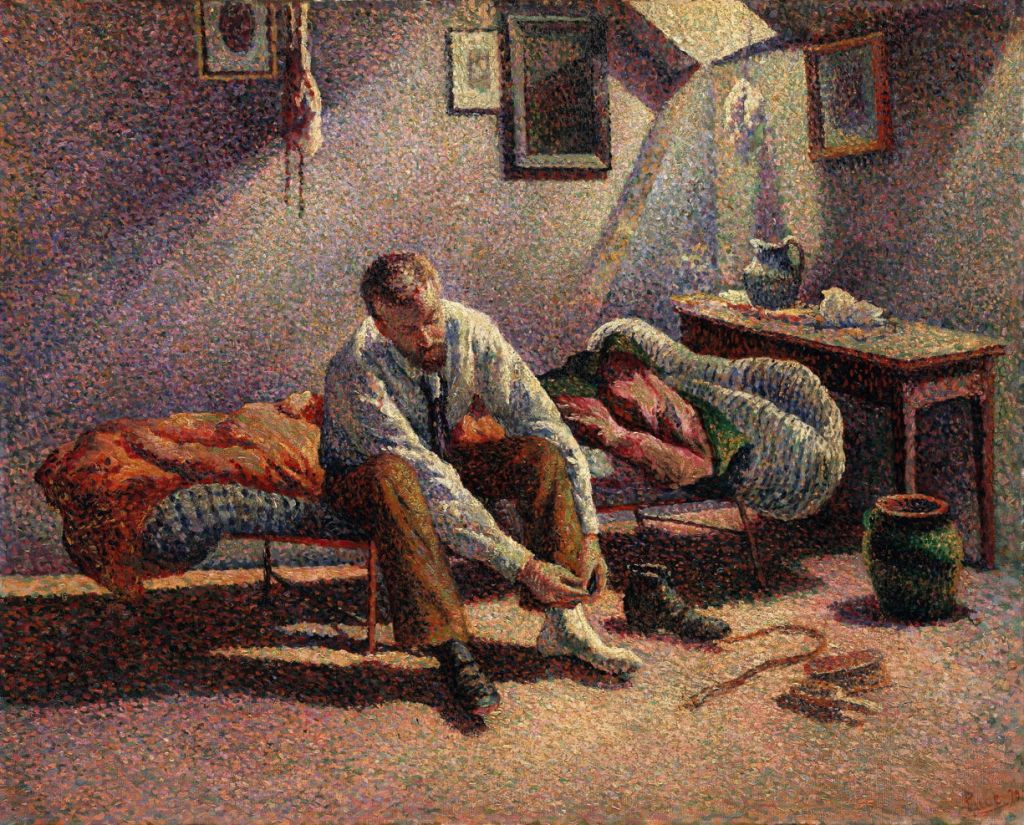
Morning, Interior (1890) is one of his best-known Neo-Impressionist paintings from this period. Although it adheres to the technique of applying small marks of contrasting colours to build the image, Luce’s marks are less mechanical than those seen in Seurat’s paintings. In places they become more gestural and varied, particularly in highlights.
Georges Seurat’s sudden and untimely death in 1891 was a shock to the group, and deprived them of his interpretation of colour theory that had been the initial driving force of Neo-Impressionism.
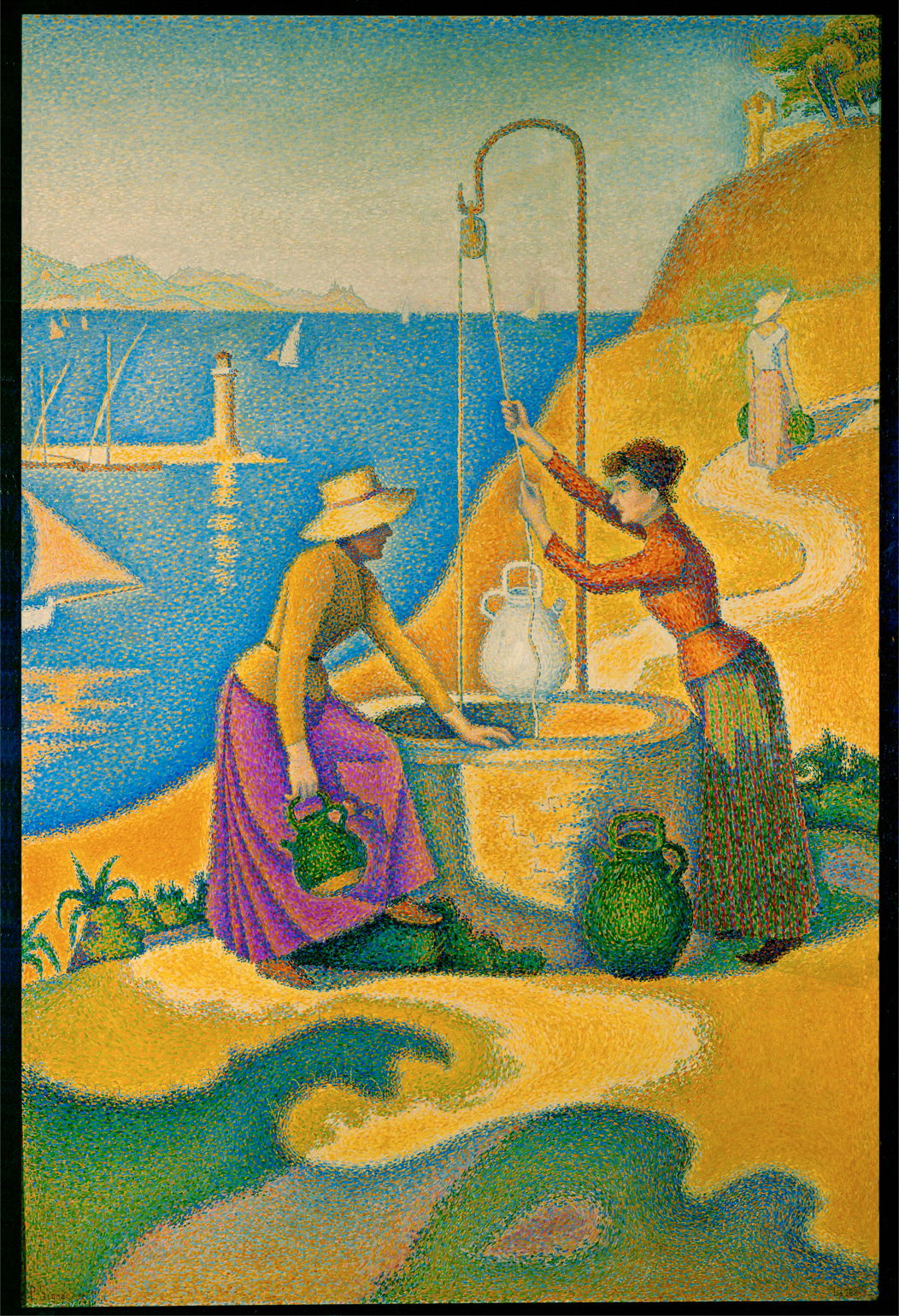
Women by the Well (1892) is an unusual work, perhaps the product of Paul Signac’s new role as the leader of Neo-Impressionism. A combination of landscape with figures, it was influenced by Puvis de Chavannes, and set in a synthetic location near Saint-Tropez. Parallels have been drawn with Seurat’s unfinished The Circus, although these aren’t easy to see. A few critics wrote in its praise, but most of his peers considered it an unfortunate mistake.

Like Signac, Henri-Edmond Cross tried some more symbolic figurative works, including The Evening Air from about 1893, but these too met with the same frosty critical reception as Signac’s.
During the last decade of the nineteenth century, Cross and Signac remained staunch anarchists, and frequently met artists of the younger generation, including Henri Matisse, André Derain and Albert Marquet.
Théo van Rysselberghe, another anarchist, had submitted his first painting to the Neo-Impressionist Salon des Indépendants in 1890. In 1892 he sailed with Signac to the Mediterranean via the Canal du Midi.
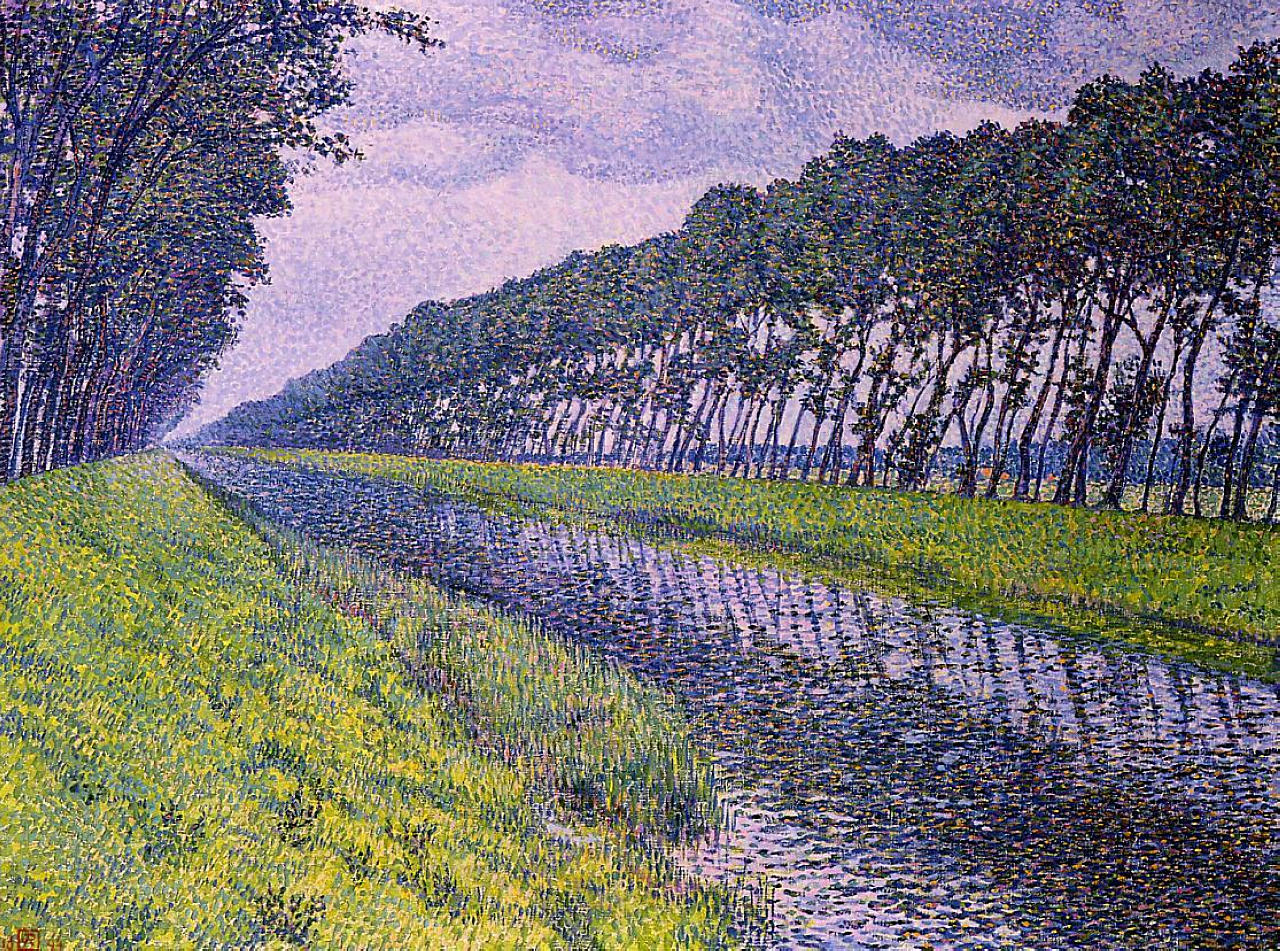
His Canal in Flanders from 1894 is an amazing combination of radical perspective projection, finely observed and composed trees, and meticulous reflections, all constructed using tiny marks of contrasting colours.
In 1895 van Rysselberghe visited the Pissarros at Eragny, then worked in Signac’s studio in Paris. His interest in print-making developed as a result of a contract to produce posters for rail sleeper services, which took him on a series of trips through Europe. He also travelled with Signac in 1896, ending up in Saint-Tropez for two months.
Paul Signac devoted much of 1894 to work on his large painting In Time of Harmony, which he completed by the end of the year, but made alterations to it in 1895. Although I’ve been unable to locate a suitable image of his full-sized original, I show here a miniature copy he made slightly later on wood.

Au temps d’harmonie (‘In Time of Harmony’) or l’âge d’or n’est pas dans le passé, il est dans l’avenir (‘the Golden Age hasn’t passed, it has still to come’) (1894-95) is another large and ambitious work.
A man has dropped his spade to pick figs from the tree at the left. Another man reads, and two play boules on the right, while a woman gives her child some fruit. In the middle ground behind them, a couple embraces, while women pick flowers or hang laundry. Other figures sow seed, paint at an easel near the sea, and dance around an umbrella pine in the distance.
The composition is based on Puvis de Chavanne’s Pleasant Land (1882), and developed from where his Women at the Well left off. It’s also an overtly anarchist painting, from a time in France when anarchists were planting bombs, in June 1894 succeeding in killing the French President Sadi Carnot. Signac intended this to be the first in a series of paintings to be shown in a suitably public location. Although it attracted qualified praise, negotiations with the Maison du Peuple in Brussels broke down, and this monumental work didn’t leave the artist’s studio until after his death.
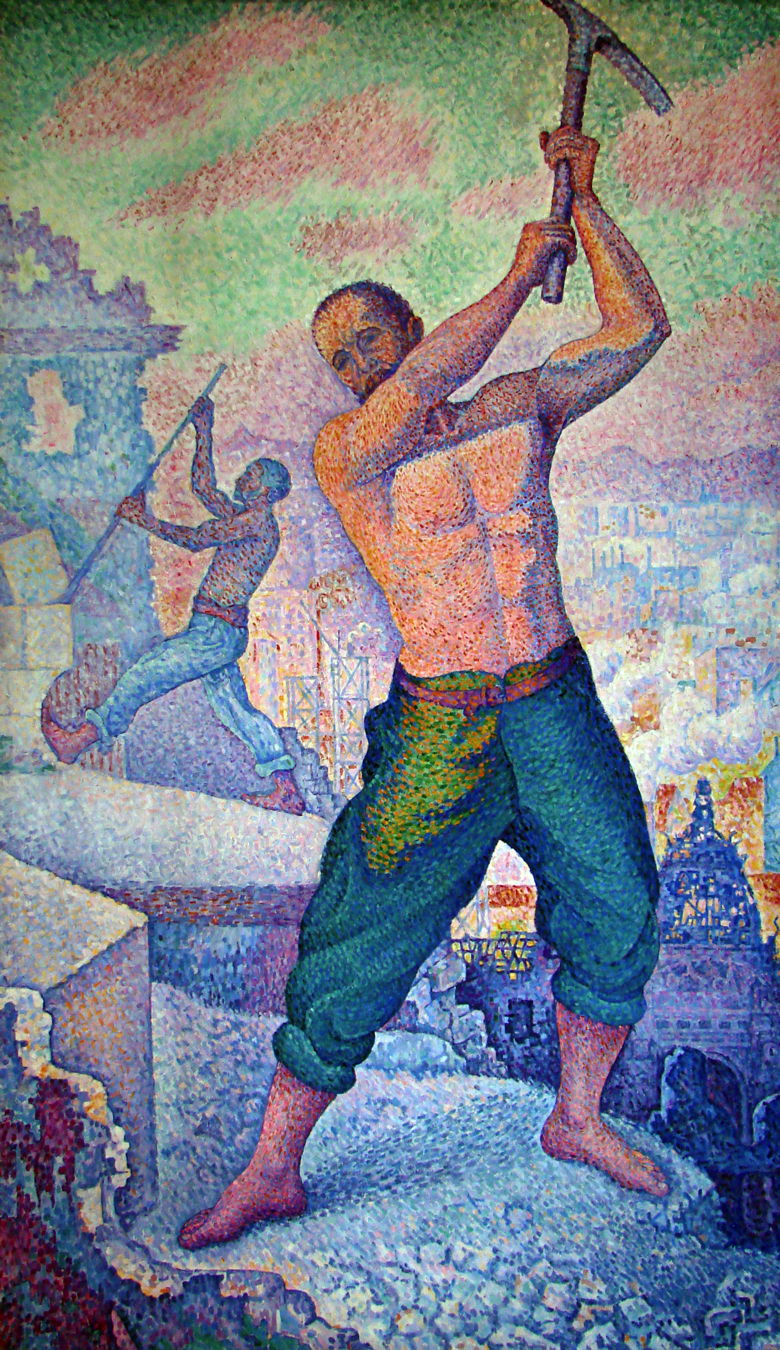
Signac’s next major work was The Demolisher or The Wrecker, first conceived in 1896, when he made a lithograph of his initial composition. It is again rooted in his anarchism, and generally read as the worker demolishing the capitalist state. He began work on this painting by the start of 1897, with the intention of making a series with the overall theme of labour, to include boat haulers and builders. By the time that he had completed it two years later, his enthusiasm had waned, and he never started work on any of its projected companions. This painting wasn’t exhibited until 1901, and it too remained in his studio until after Signac’s death more than thirty years later.

Maximilien Luce’s Pile Drivers from 1902-3 is another of his explorations of the working life of the common man in Paris. Note the factories on the opposite bank, infiltrating the surrounding residential and commercial districts.
Other painters of this period had strong political affiliations.
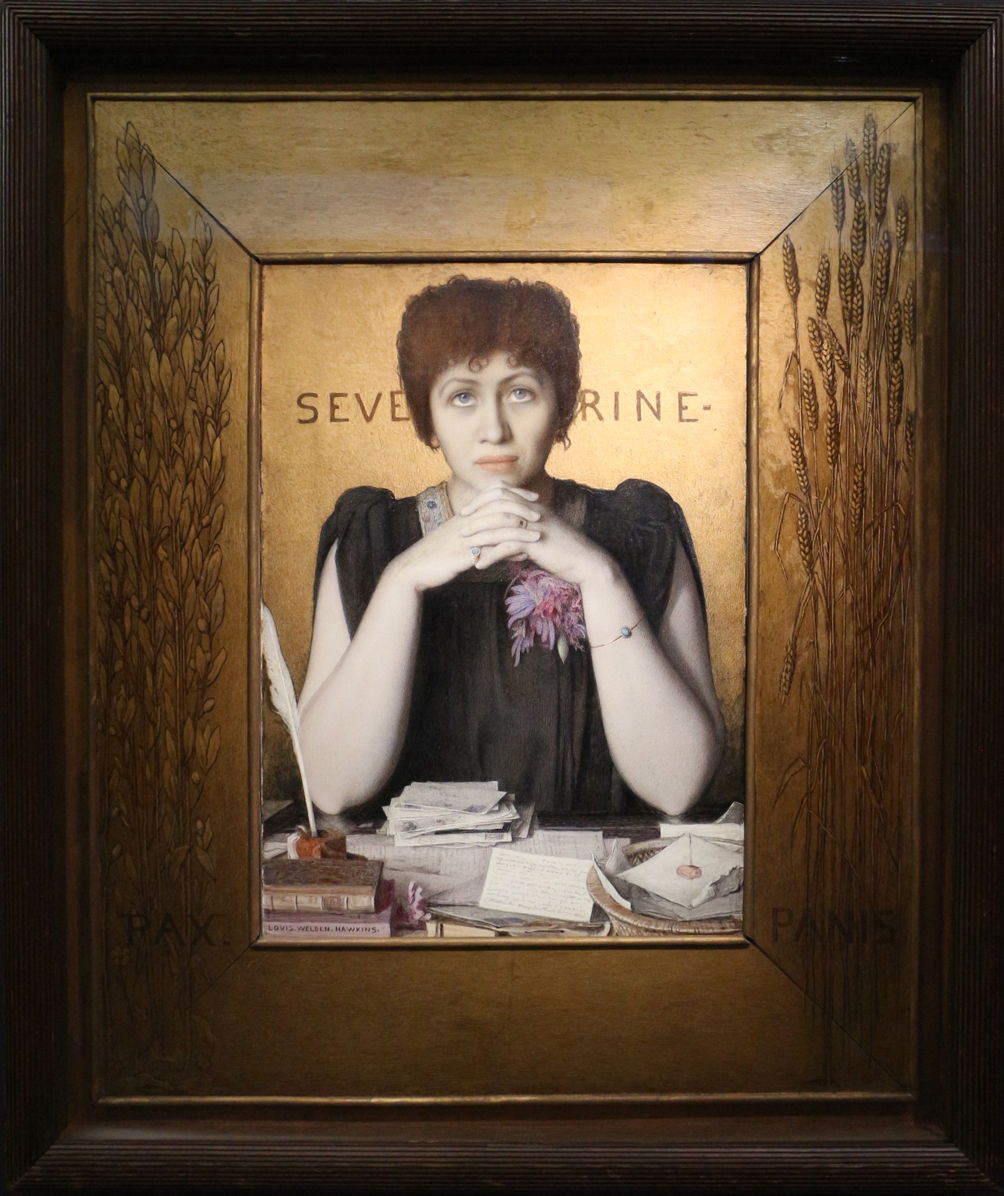
In 1888, Louis Welden Hawkins had lived for a while with Camille Pelletan, a radical socialist politician, and he continued to move in radical circles. His Portrait of Séverine (1895) shows a popular journalist, who was then at the height of her fame. Séverine’s original name was Caroline Rémy (1855-1929), and she was a famous defender of humanitarian causes. During the First World War, she sided with anarchists and protested against the fighting. Hawkins made this frame himself. On its left are olive branches and the inscription PAX (peace), and on the right are ears of wheat and the inscription PANIS (bread). This work was shown at the Salon Nationale in 1895, where it was greatly admired.
Anarchism and Neo-Impressionism appears to have been a strange combination, given the painstakingly fine brushwork required to construct each painting over a period of many weeks or months. Looked at purely in terms of work and constraints, Pointillist technique is surely anything but anarchic.

