
Each of the painters now referred to variously as Neo-Impressionists, Pointillists or Divisionists adopted and developed their own distinctive brushstroke techniques and styles. In Georges Seurat’s brief career he kept to fine dots painstakingly applied according to the theory of simultaneous contrast. Paul Signac started with slightly larger marks that grew into tiles or tesserae of colour. Today’s less-known Pointillist, Henri-Edmond Cross (1856–1910), became even more experimental than Signac.
Cross had initially been taught by Carolus-Duran, who was later to teach John Singer Sargent. After training at the École des Beaux-Arts in Paris he continued studying until 1881, when he first exhibited at the Salon. Over the following decade Cross seems to have painted through a transition from sombre realism to plein air Impressionism, but few of those works seem to have survived. In 1884, he was one of the founders of the Société des Artistes Indépendants, alongside Seurat and Signac, and his friendship with Signac remained particularly close, right up to Cross’s untimely death.
Cross had first visited the Mediterranean coast in 1883, and started spending much of each winter there, until he moved to Cabasson, near Le Lavandou, in 1891, to help his rheumatism. By the following year, when Signac moved to nearby Saint-Tropez, Cross had settled in the small seaside village of Saint-Clair, where he remained for the rest of his life.
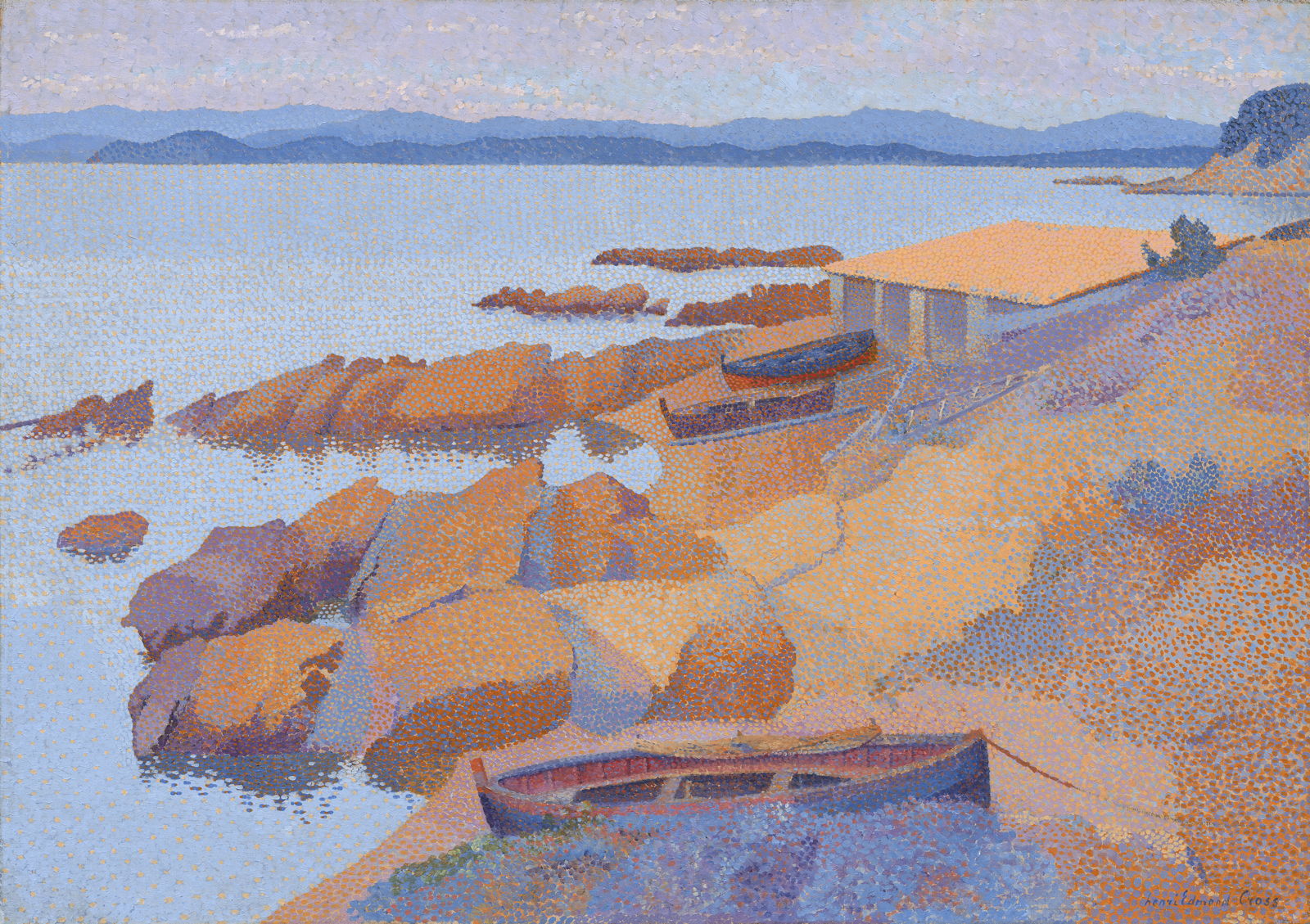
The earliest accessible paintings by Cross appear from his first years in the Midi, 1891-92, when he painted this view of the Coast near Antibes. These were the months after Seurat’s sudden and unexpected death. Many of Cross’s early Pointillist paintings are as gentle and delicate as this, with subtle colour and a fine stippled effect.
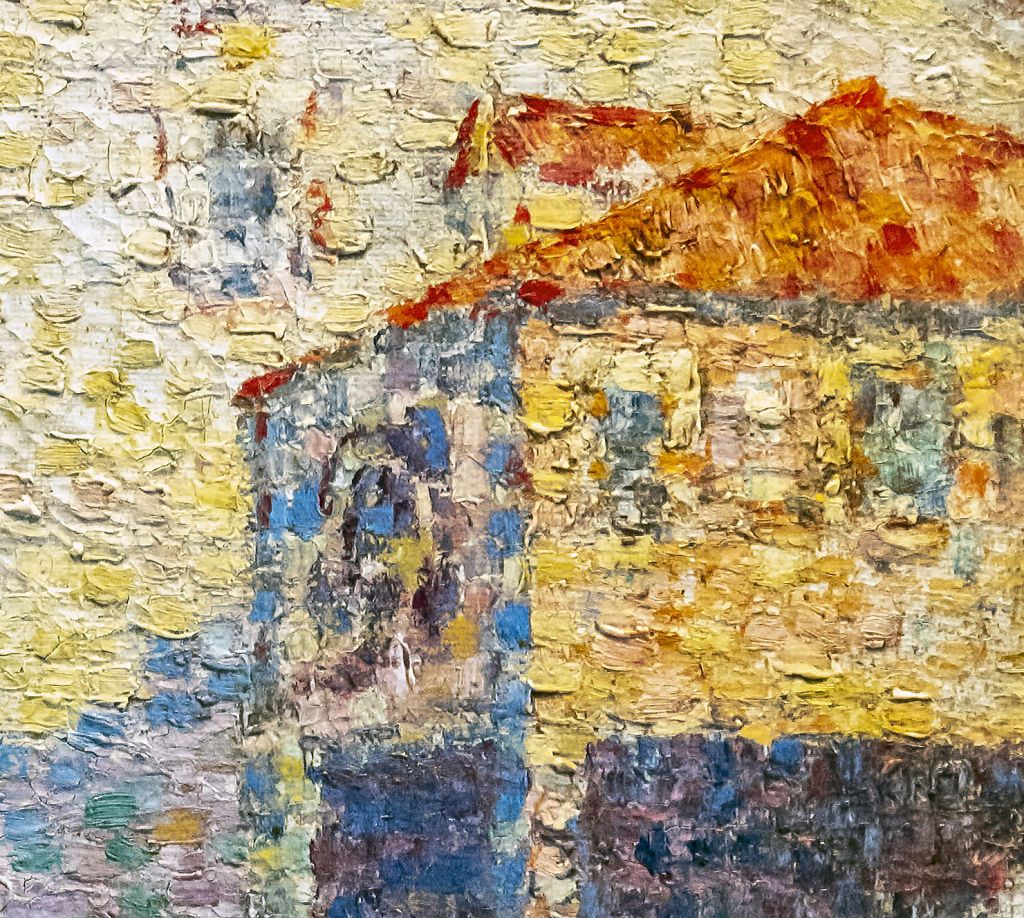
The detail below shows his use of contrasting colour in tiny dots of paint, where he superimposes orange over a dark blue, and pale blue over yellow ochre, for instance. In addition to their simultaneous contrasts, these unify one passage with another, giving harmony of appearance. He also tends to place his paint dots in rows, giving rise to linear stippling in the water.


Beach at Cabasson (Baigne-Cul) from the same years has less use of contrasting colours in its fine dots, and the figures painted at finer dot resolution, making them appear almost conventional.

A few of these early paintings seem to be heading towards abstraction, as seen in this distant view of Les Îles d’Or, more properly known as les Îles de Hyeres, again painted in 1891-92. His dots of paint are organised into distinct rows in the middle distance.

Like Signac, Cross tried some more symbolic figurative works, including The Evening Air from about 1893, but these appear to have met with a similarly frosty critical reception as Signac’s. Their brushwork and styles have converged briefly here.
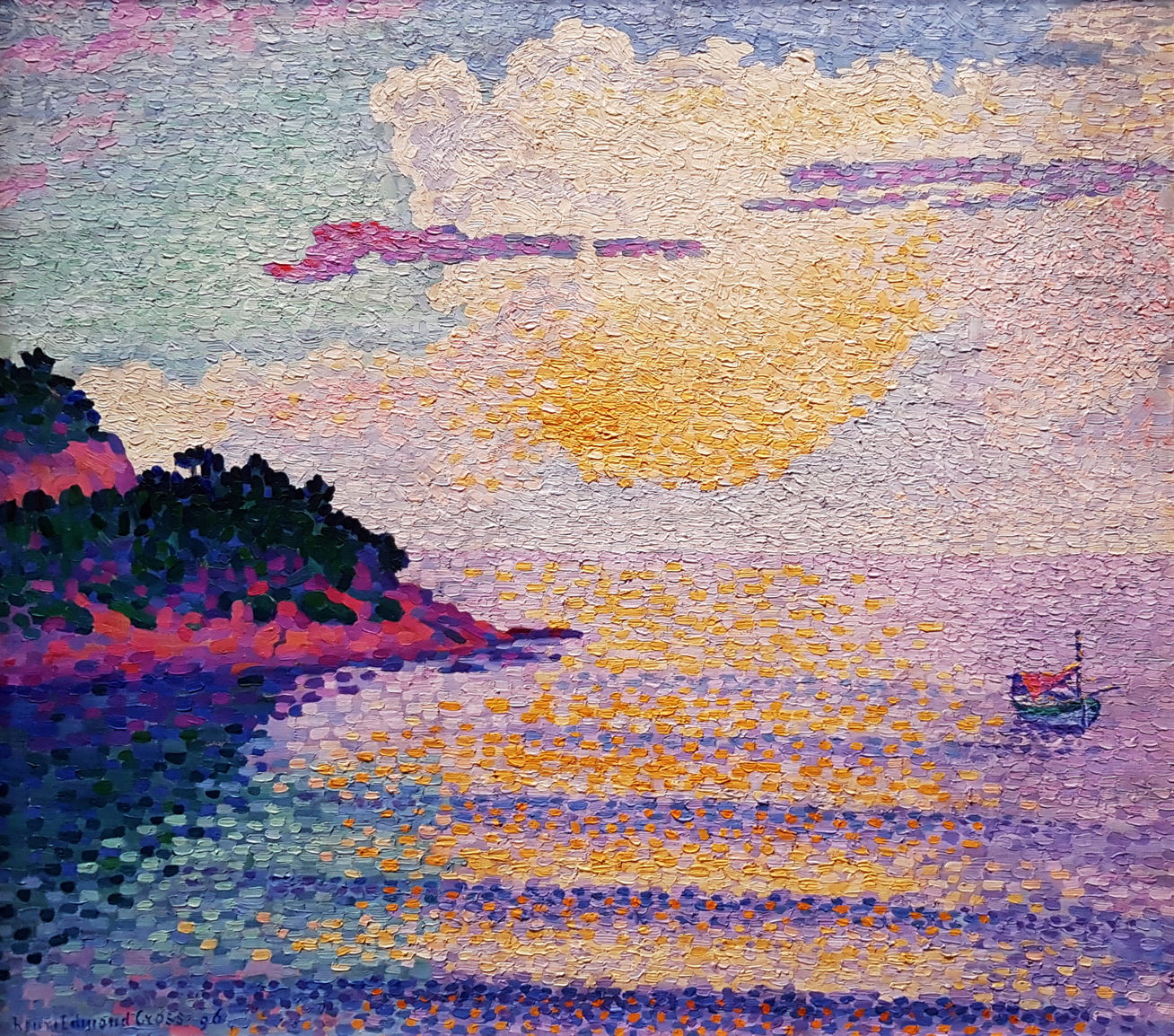
Three years later, in 1896, Cross had turned the chroma up further in this Sunset over the Sea (1896). His marks have now changed from dots to coarser tiles of colour, which fuse in impasto in the sky.

Two Women by the Shore, Mediterranean from the same year is a little more restrained, and employs more rounded marks again, rather than rectangular tiles of colour.
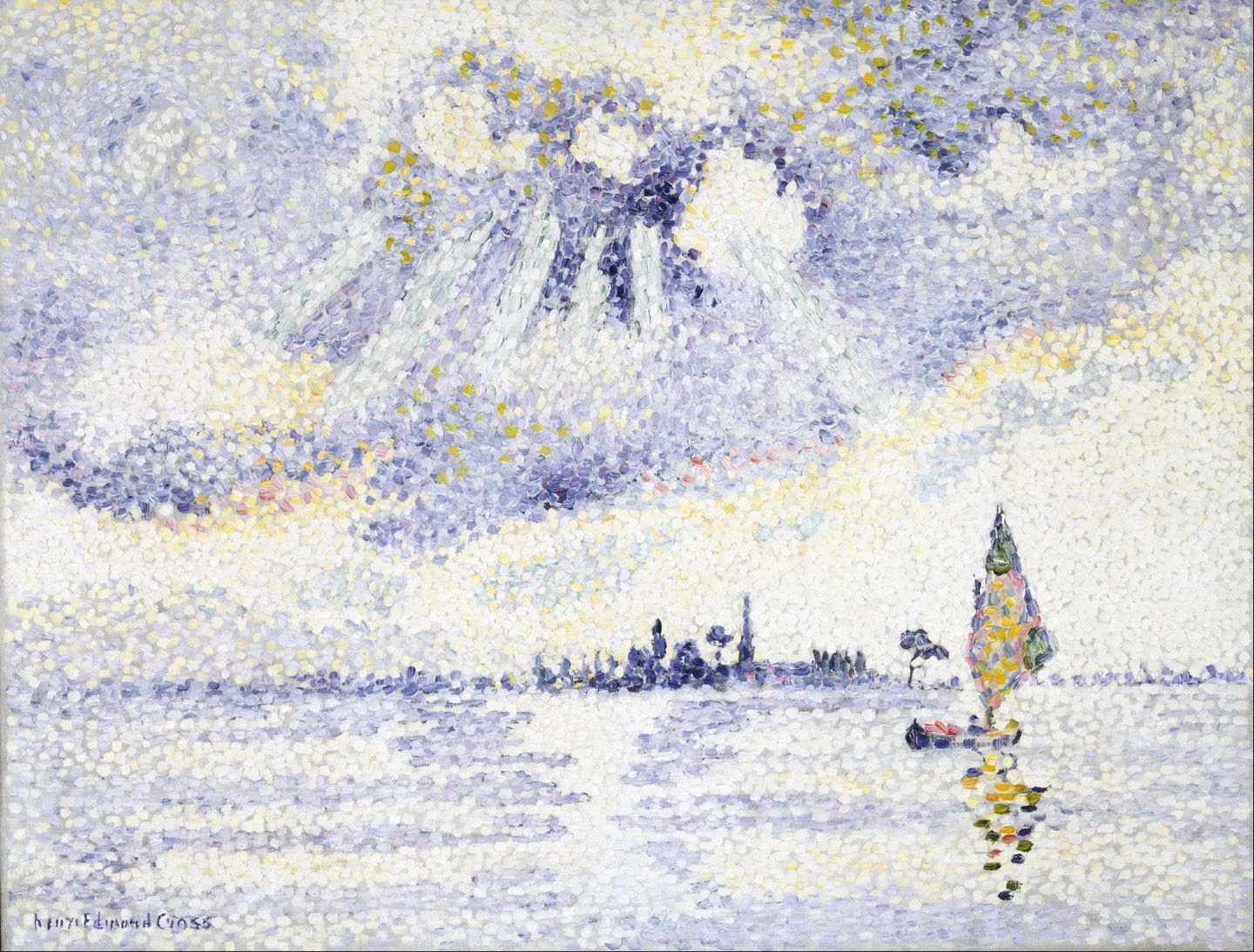
Sunset on the Lagoon, Venice is more puzzling with respect to dates. Although claimed to have been painted in 1898/1908, Cross doesn’t appear to have visited the city of Venice until 1903, and made his second and final trip there five years later in 1908. His palette has now swung the other way, to become almost monochrome.

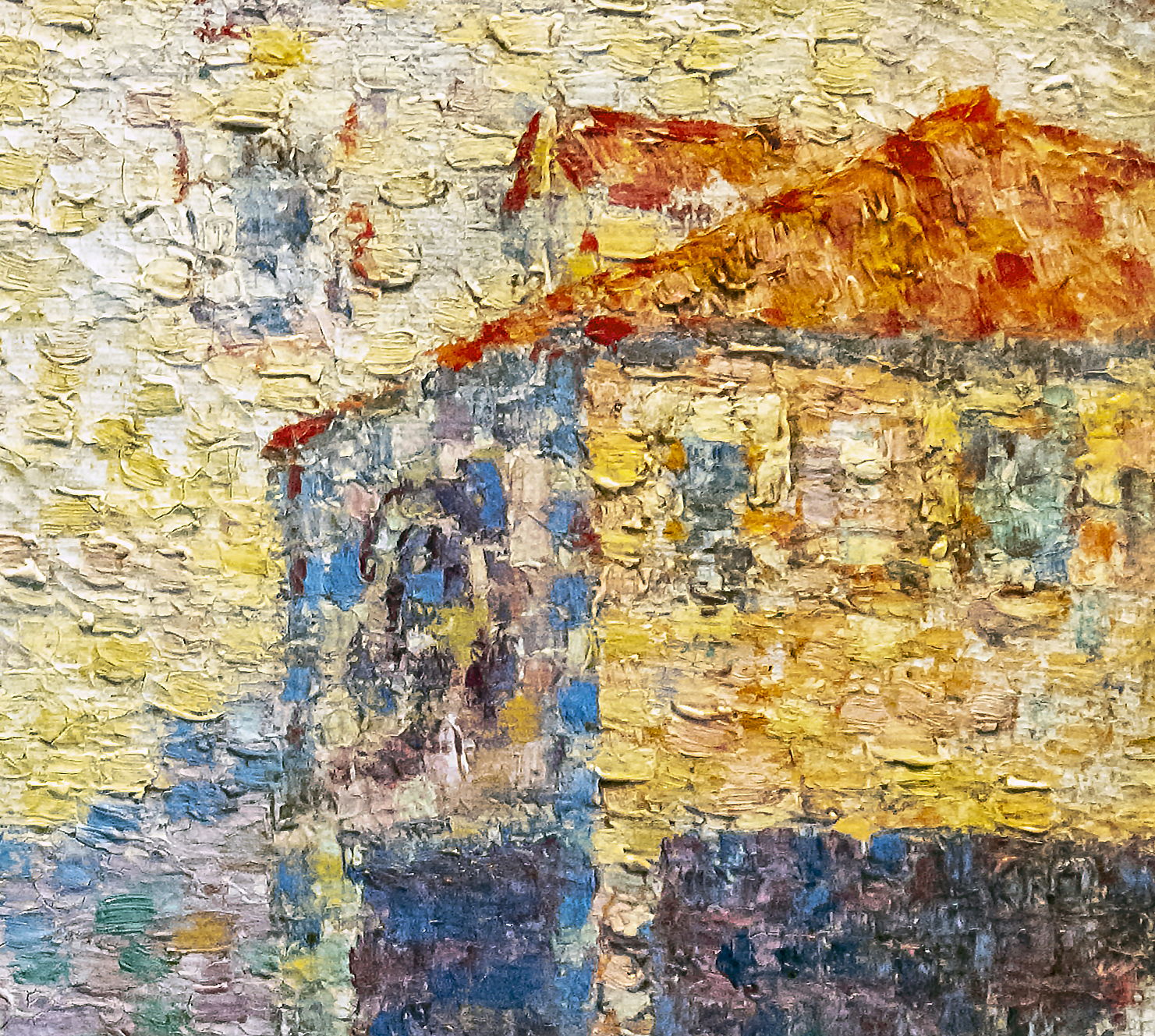
A Canal in Venice is also claimed to date from 1899, and is a Pointillist oil sketch of gondolas in one of the smaller canals in Venice. As the detail below shows, Cross has applied his paint thickly in some of his marks, and has now discontinued superimposing contrasting colours.

Cross also made preparatory sketches in oils on paper, such as this Clearing in Provence from about 1906.
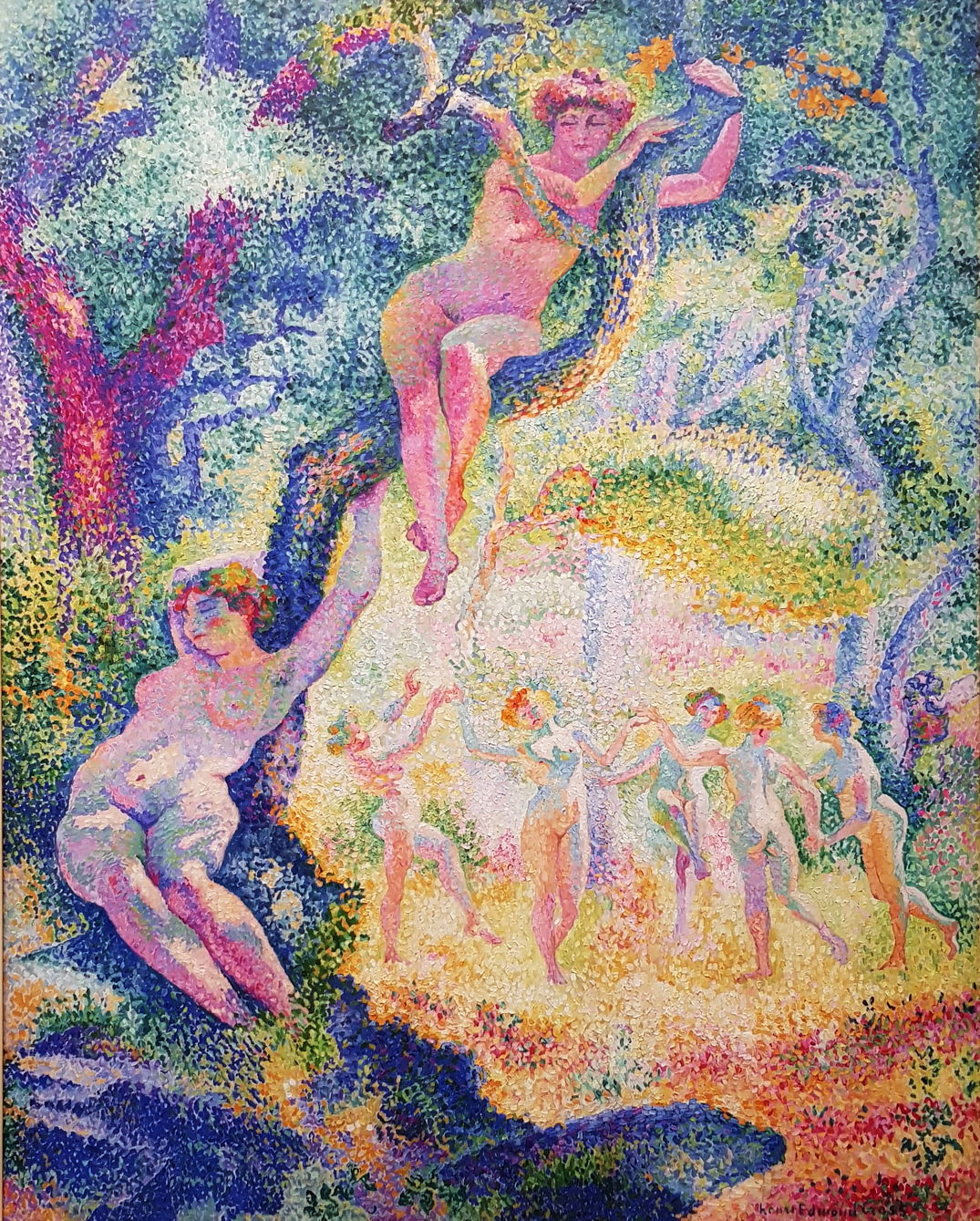
That sketch formed the basis of the woodland setting Cross used in The Glade, painted in oils in 1906. Colour changes are prominent, the chroma has been considerably enhanced, and he has returned to finer dots.

Cross then resumed using tesserae, and returned to the coast of the Midi, where he painted La Chaîne des Maures in 1906-07. Literally the ‘chain of the Moors’, this is part of the Massif des Maures, and meets the sea near Hyères, forming a landmark at Le Levandou. In its foreground is a man ploughing with a single white horse.
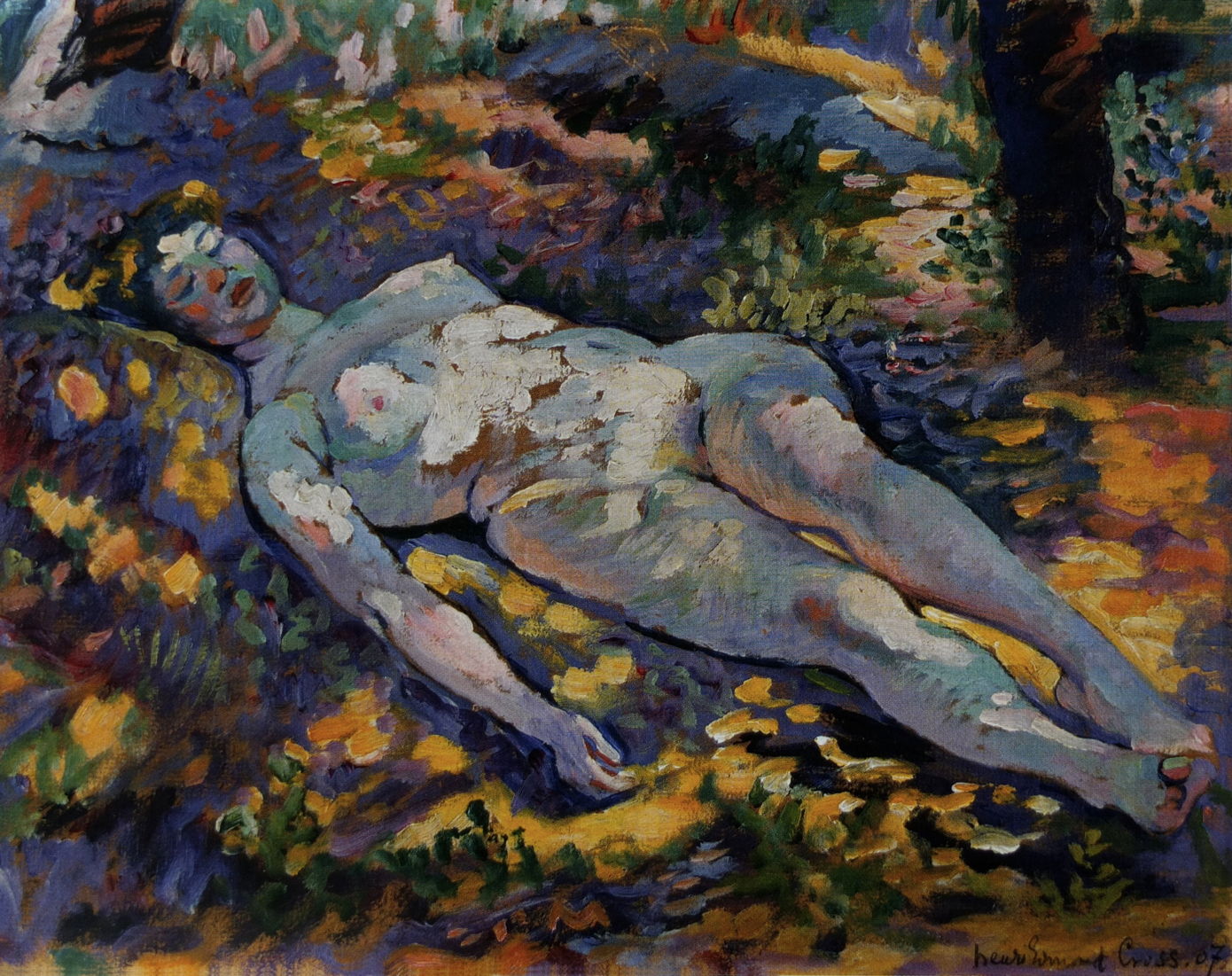
In 1907, Cross painted this enigmatic figure of a Sleeping Nude in a Clearing. This is an oil sketch, made on paper, and doesn’t seem to be associated with a finished oil painting.
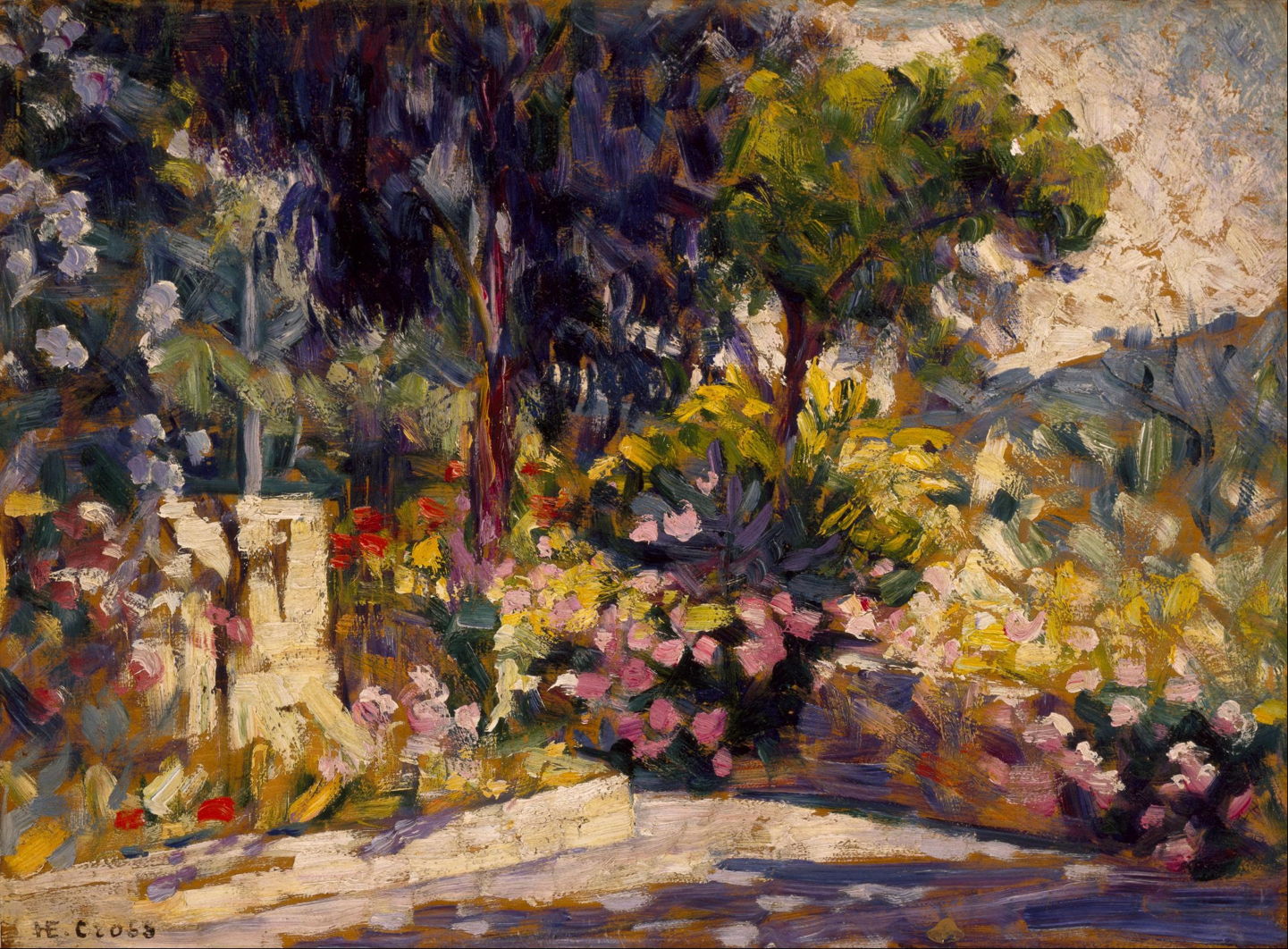
The Flowered Terrace is an oil sketch from the period 1900/1910, with coarse brushstrokes of paint applied briskly. They appear to have been laid onto a light ochre ground.
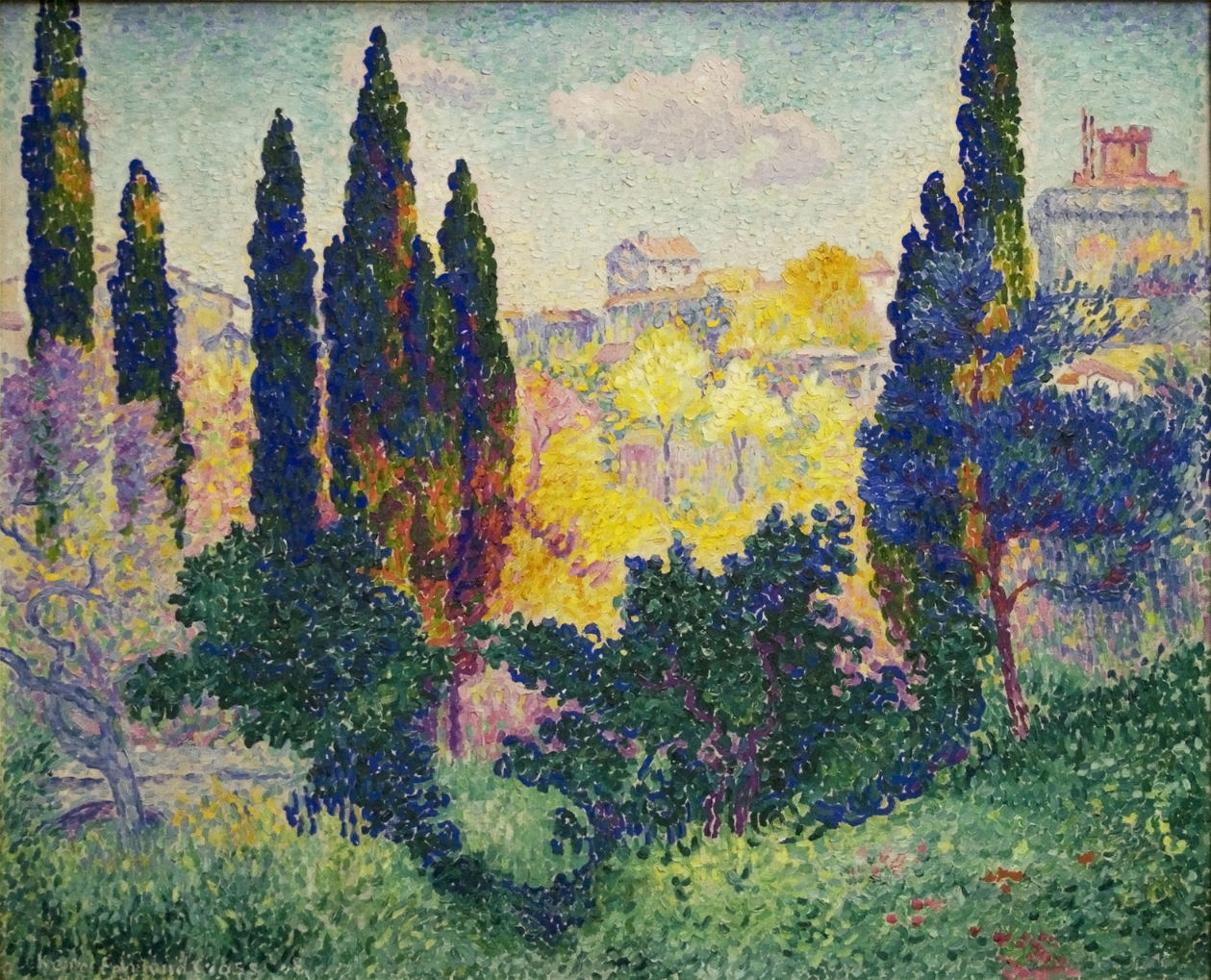
The small town of Cagnes-sur-Mer, to which Pierre-Auguste Renoir had recently moved, is a couple of hours travel north-east along the coast from the artist’s home in Saint-Clair towards Nice. Cross’s view of Cypresses at Cagnes (1908) shows the dazzling vegetation there using fine daubs of paint that treat colour more conventionally, and now have little in common with the theory and works of Georges Seurat.
Reference

