
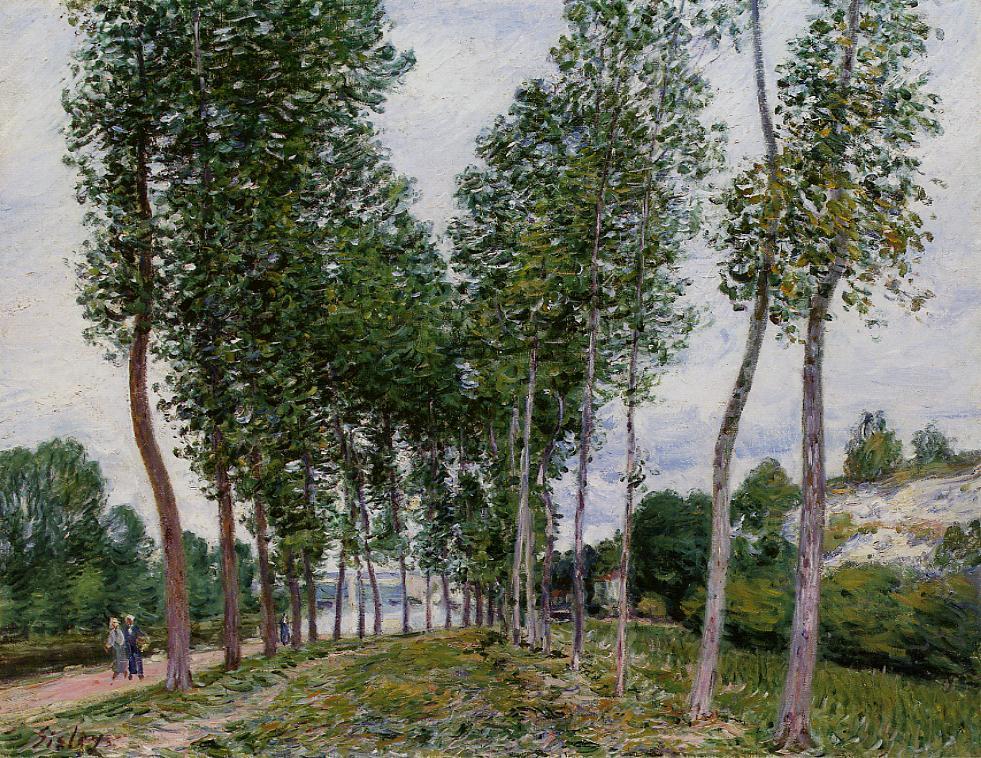
Alfred Sisley was born and brought up in a prosperous Anglo-French family of merchants in Paris. Although intended to take over the family business, when he was sent to London to study in 1857, he was apparently so moved by the paintings of JMW Turner and John Constable that he resolved to be an artist. When he returned to Paris in 1860-1, he started classes in Gleyre’s studio, where he became friends with Claude Monet, Auguste Renoir and Frédéric Bazille, who were later to form the core of French Impressionism.
Sisley painted en plein air alongside those Impressionists, and like them showed early influence by the work of Corot and the Barbizon school. Two of his paintings were accepted by the Salon in 1866, but he had no further official recognition.
He started living with Eugénie Lesouezec in 1866, and together they raised their family in financial comfort until the outbreak of the Franco-Prussian War in 1870. Like Pissarro, their home was soon overrun and many of his paintings destroyed. Worse still, his family business collapsed, and for the rest of his life Sisley and his family lived in abject poverty. His paintings sold little, and he was reliant on patrons including Gustave Caillebotte, the famous operatic baritone Jean-Baptiste Faure, and a successful pastry chef.
Monet was a staunch friend, and Sisley showed paintings in four of the Impressionist exhibitions between the first in 1874 and the seventh in 1882. Faure took him to London in 1874, where he painted, and on his return to France he and his family moved to Marly-le-Roi, where some of his best-known works were made. They moved to Sèvres in 1877, before settling permanently in Moret-sur-Loing in 1880, to the south-east of Paris and near the Forest of Fontainebleau with its endless stock of wonderful trees.
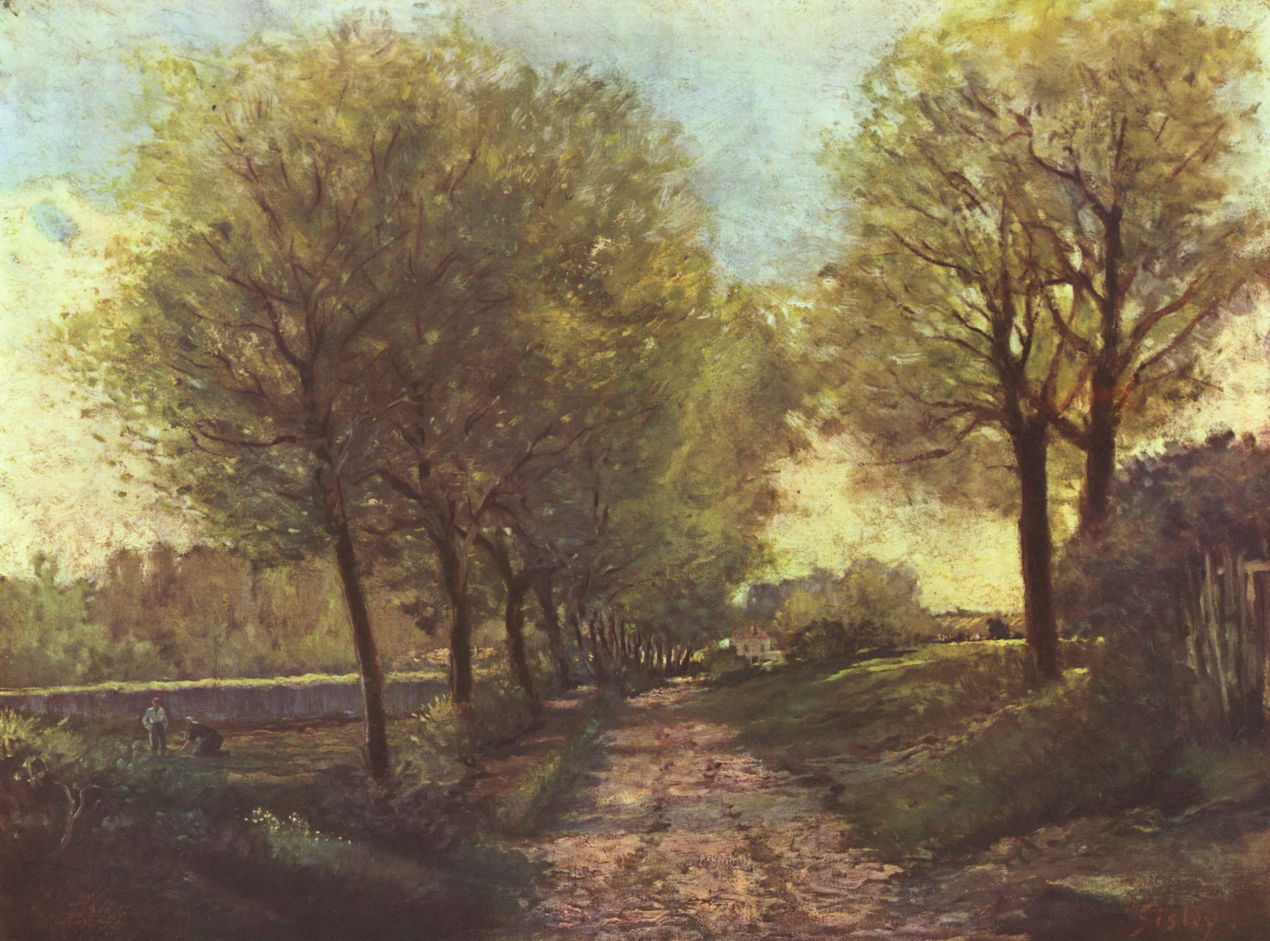
A Lane near a Small Town (c 1864) is probably the earliest surviving painting from the start of Sisley’s career. Although significantly lighter than other works influenced by the Barbizon school, its trees are constructed anatomically and have canopies painted in a manner similar to the contemporary works of Corot, a major influence on Sisley’s early style.

Sisley’s paintings of trees in the 1870s show the start of a style of his own, here in The Road from Versailles to Saint-Germain (1875). There is still some anatomical structure, but the canopies are now exuberant and more substantial. The range of greens used for foliage is limited, although they still cover a wide range of tones.

Rest along the Stream, Edge of the Wood (1878) features multiple stands of trees, each of a different species, and each depicted with great attention to detail. The line of birch trees in the foreground is detailed anatomically, with most branches shown reaching out into the canopy. Trunks are delicately coloured, textured, and shown with dappled shadows. Their foliage consists of carefully graded brushstrokes to detail individual leaves, gradually merging in the distance.
On the opposite bank five pollards are flush with fresh growth, and behind them the sunlight brings out the high canopies of more distant trees. To the right and in front of the cottage are lower trees with profuse white blossom. Behind them all stands a high wood, its great branches and leaves lit by the sun. The lines of trees, the stream, and the gash of sky all lead the eye to the distant bridge, and the figure of a woman, her back against the foot of one of the birches in the foreground.

Walnut Tree in a Thomery Field (1880) is another fine painting based on careful anatomical construction. Unlike Rest along the Stream above, Sisley has applied finer strokes of contrasting colours and tones, giving a shimmering effect, particularly in the river. This gives a rougher texture to the bark of the trunk, a granularity throughout the canopy of the walnut tree, and makes the figures pop out. Thomery is a village near Moret-sur-Loing.

Painted in the early spring of 1881 near the village of By, Small Meadows in Spring – By shows younger trees, their branches just starting to show the first leaves as they emerge from bud.

In Orchard in Spring – By from the same year the emergence of leaves has advanced further.

Moret – The Banks of the River Loing has slightly coarser marks and strong colour contrasts in this autumnal view from 1885. These bring the foreground closer, and push the background deep.
Towards the end of his career, Sisley painted formal series in the area around Moret-sur-Loing. Among those are several similar views he painted of the poplar avenue at Moret-sur-Loing. Recent books on Sisley make only passing mention of this series, placing their emphasis on the loose series of the bridge and town of Moret, and of its church.

Sisley seems to have started this series in 1888, with the first two, shown above and below. They show views from and of almost identical locations, painted in a similar style, with differences resulting from the transient effects of light. However, there are more subtle differences in the trees, particularly in their bark.


Two years later, he painted another view of the same avenue from a different point, as shown by the bridge and the trees on the left. Several of the poplars also appear much younger here.
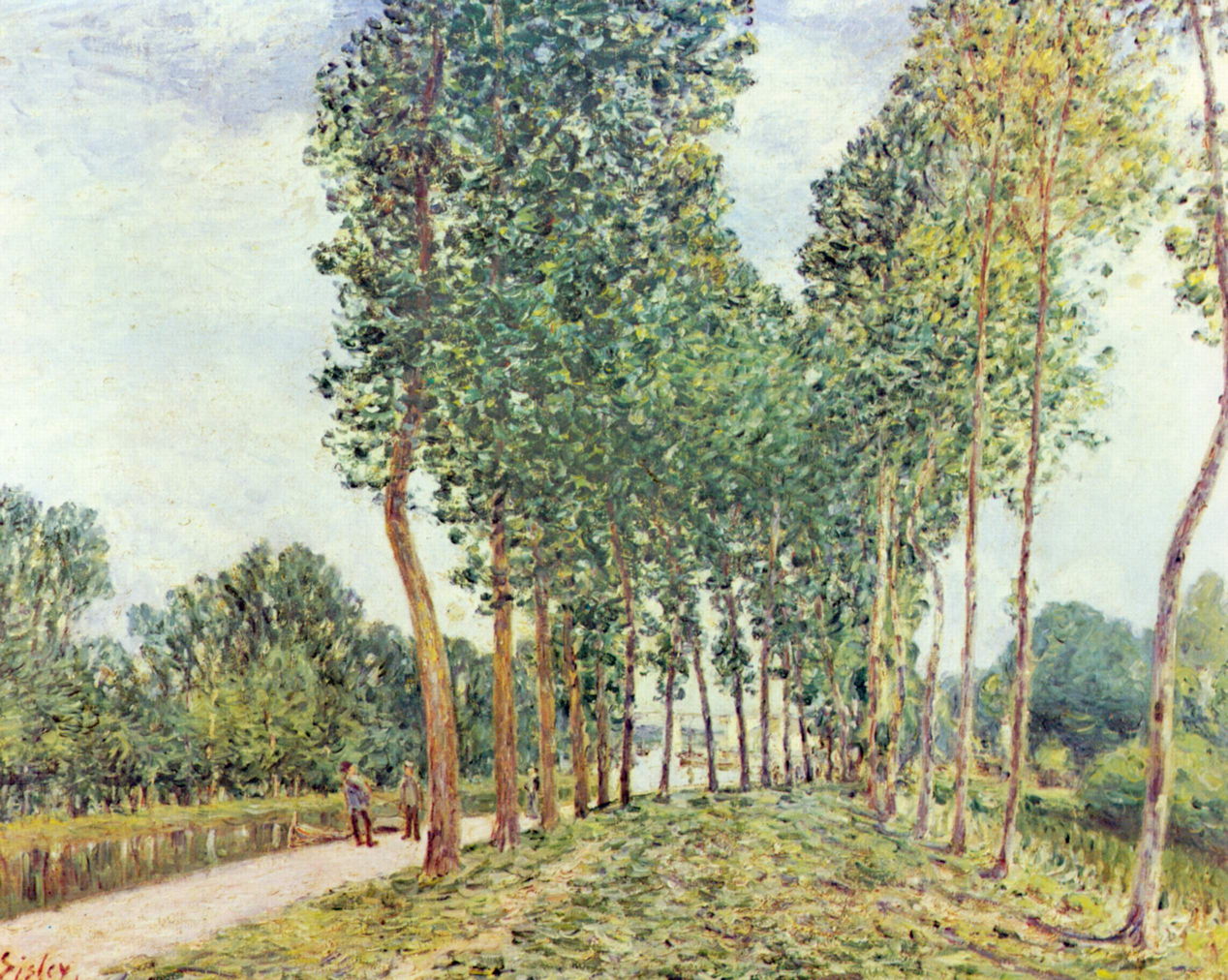
After another gap of two years, he painted a near-identical pair of views from a third location, shown above and below. These show a higher bridge further in the distance, and a bend in the avenue leading to some buildings. His marks on the trunks and in the foliage have become more gestural.


In the same year he painted this barren winter landscape of The Canal du Loing at Moret, with its spread of pale poplars in full structural detail.
References
Shone R (1992, revisions 2008) Sisley, Phaidon. ISBN 978 0 7148 3892 2.
Stevens MA (1992) Alfred Sisley, Yale UP. ISBN 0 300 05244 8.

