
In 1816 James Ward started work on his second huge painting, The Triumph of the Duke of Wellington, as soon as his preliminary study had been accepted by the British Institution. From the outset, he didn’t intend it to be an ordinary history painting, but wanted to tackle the moral issues, including the benefits of peace.
The work involved considerable commitment. As it occupied so much of his time, and he was unable to undertake many other commissions, his income fell. At the same time, he incurred significant costs: he had a special roller-easel built to accommodate the custom canvas, and had to purchase paint in much larger quantities. But the British Institution was not generous in its payment of advances, so he had to cut his household expenditure to cope.
In the autumn of 1817, he was starting to have doubts about the painting. Then later that year, Emma, his favourite daughter, died, and his wife fell ill, eventually dying in the autumn of 1819.

He did manage some commissioned work during this period, including this delightful Portrait of Dash, a Favourite Spaniel, the Property of Lady Frances Vane-Tempest (1819). The unusually vague background to this painting bears some similarity to his Gordale Scar. The dog’s owner was the nineteen year-old Marchioness of Londonderry, and great-grandmother of Sir Winston Churchill.
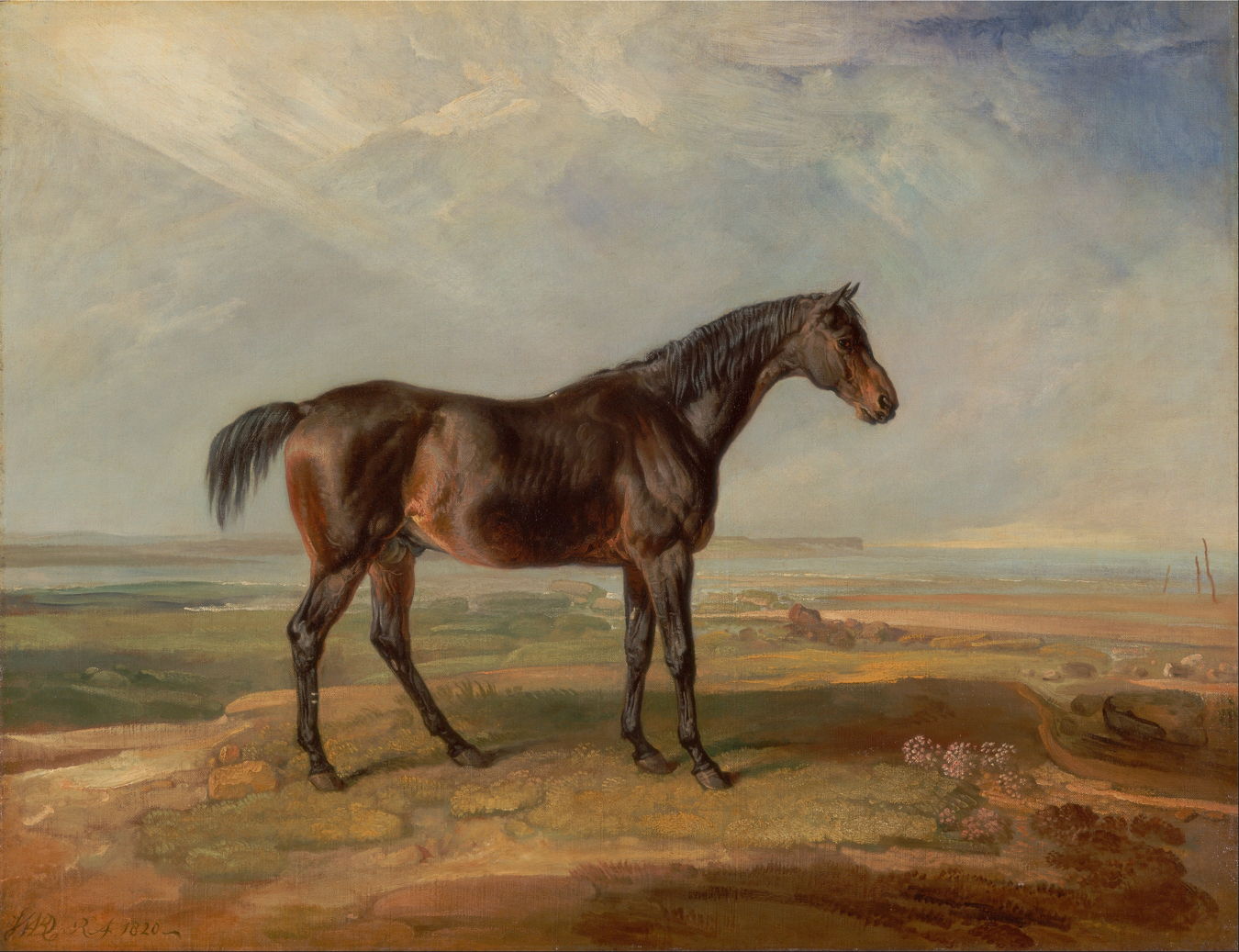
By 1820, he had to undertake other work to maintain his income. He was fortunate with two prominent paintings, The Deer Stealer, commissioned by the previously reliable Theophilus Levett, and this portrait of Dr. Syntax, a Bay Racehorse, Standing in a Coastal Landscape, an Estuary Beyond (1820). Once again, the landscape is as good as the subject of the painting, and may contain a visual pun, as it shows a bay too.
Doctor Syntax (1811-38) was owned by Ralph Riddell, and raced only in northern England, where he was one of the most successful racehorses of all time. His portrait was painted twice by John Frederick Herring, Senior, and Ward’s turn came in 1820, when the horse won all four of his recorded races.
Ward’s money and luck had run out. He looked for a studio in which to make final alterations to The Triumph of the Duke of Wellington, but couldn’t afford much. Theophilus Levett lent him £500, but died later in 1820. The painting itself was greatly delayed, awaiting Wellington himself to sit and model for it, allowing completion in 1821. Initial praise from the British Institution was quickly replaced by critical condemnation. The painting was given to the Chelsea Hospital, which eventually returned it to his family, who had it cut up. Ward’s last payment came in 1822, leaving him £700 out of pocket for the whole project.

Battered and bruised, Ward continued to paint a steady stream of equestrian portraits, farm animals, and countryside views. He also holds the unusual distinction of having painted the horses of both Wellington (Copenhagen) and Napoleon (Marengo). The Day’s Sport (1826) is one of his finest paintings of field sports, although to most of us today the grisly corpses at the right are a shock.
Its composition has some interesting nuances, such as the scaled echo of the central hunter by the smaller figure to the left, and the dog just by him. The effect of the snow frosted onto the bare trees brings delicate detail, and the glimpse of the rich sky at the left adds serenity. Its puzzle is how the two girls at the right could possibly be wearing short-sleeved dresses without coats.

Ward’s oil sketches continued to be exciting explorations of the effects of light, such as his Cattle at a Pool at Sunrise from 1827, the year that he married his second wife, Charlotte Fritche.

From early in his career, Ward painted occasional scenes from classical mythology. Venus Rising from her Couch (1828) is thought to have been his first nude, is slightly marred by the oddly globular form of her left buttock, and is a narrative oddity.
This painting has been claimed to show Leda and the swan, the popular story in which Zeus metamorphoses into a swan in order to impregnate Leda with Pollux, who with his mortal twin Castor formed the Dioskouri. Although there’s no bar to there being additional swans present at the time, paintings of this myth generally show Leda and a single swan in almost erotic combination.
The alternative title given here refers instead to Venus, to whom swans (and doves, seen at the left) were certainly sacred. Ward was no classical scholar, but it seems more likely this is intended to be Venus rather than Leda.
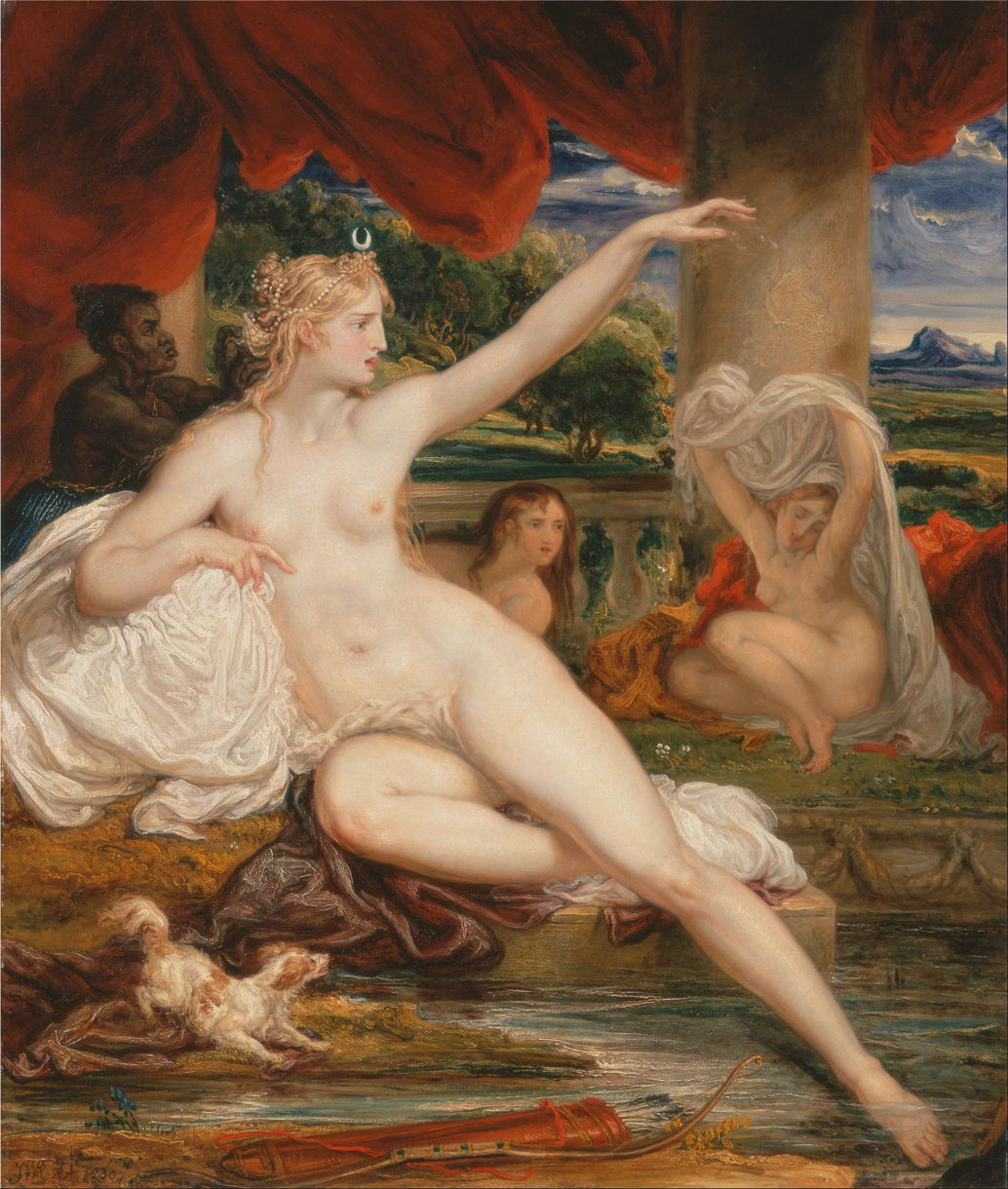
Diana at the Bath (1830) is an even more daring nude, a flimsier narrative, but considerably more accomplished and free of anatomical glitches. Diana’s bow and arrows, her unusual hair decoration, and a rather unsuitable dog, are confirmation.
Ward then went into semi-retirement in a cottage in Cheshunt, Hertfordshire, where he spent his remaining years.
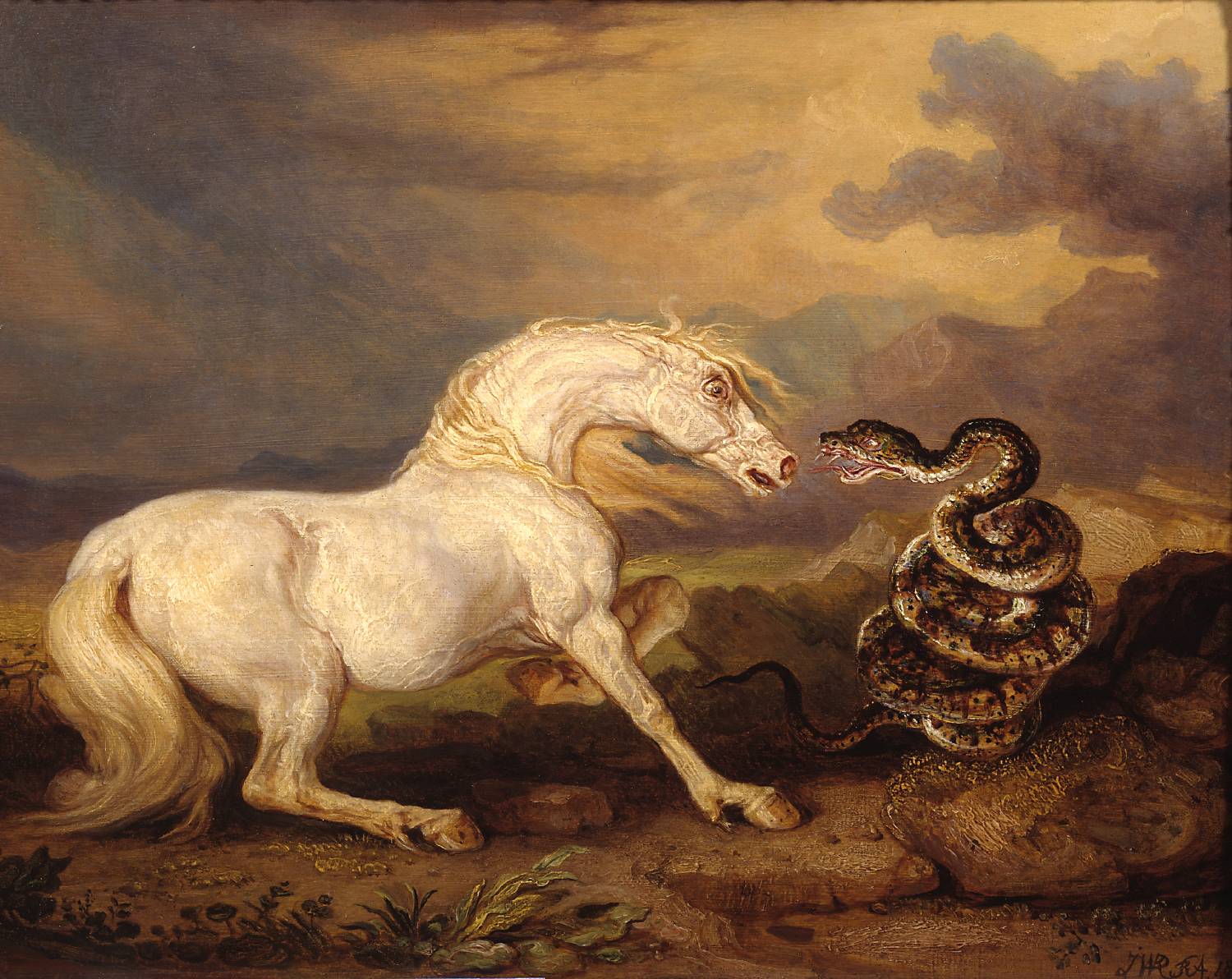
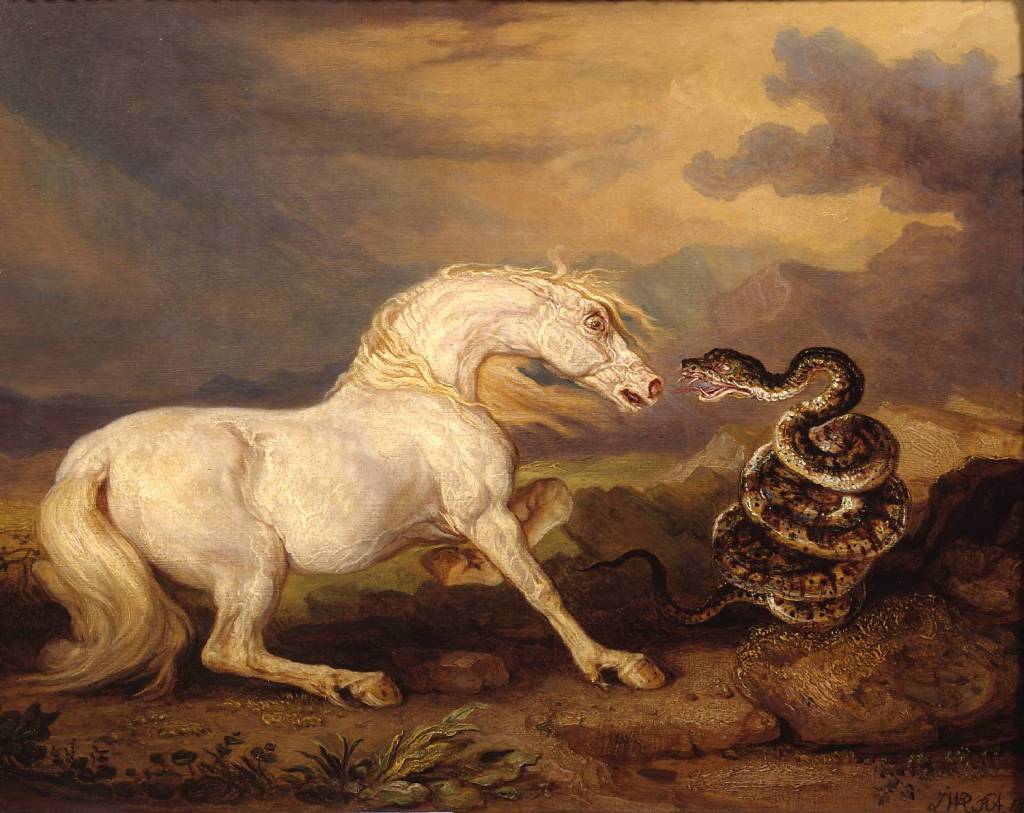
Ward’s earlier finished painting of a boa constrictor may have been lost, but later paintings of a white horse confronting a huge and menacing boa constrictor (or ‘Liboya Serpent’) have survived. The Moment (1831) is probably the best of these, something more expected of Delacroix. Its sketchy background is unusual in Ward’s animal paintings.
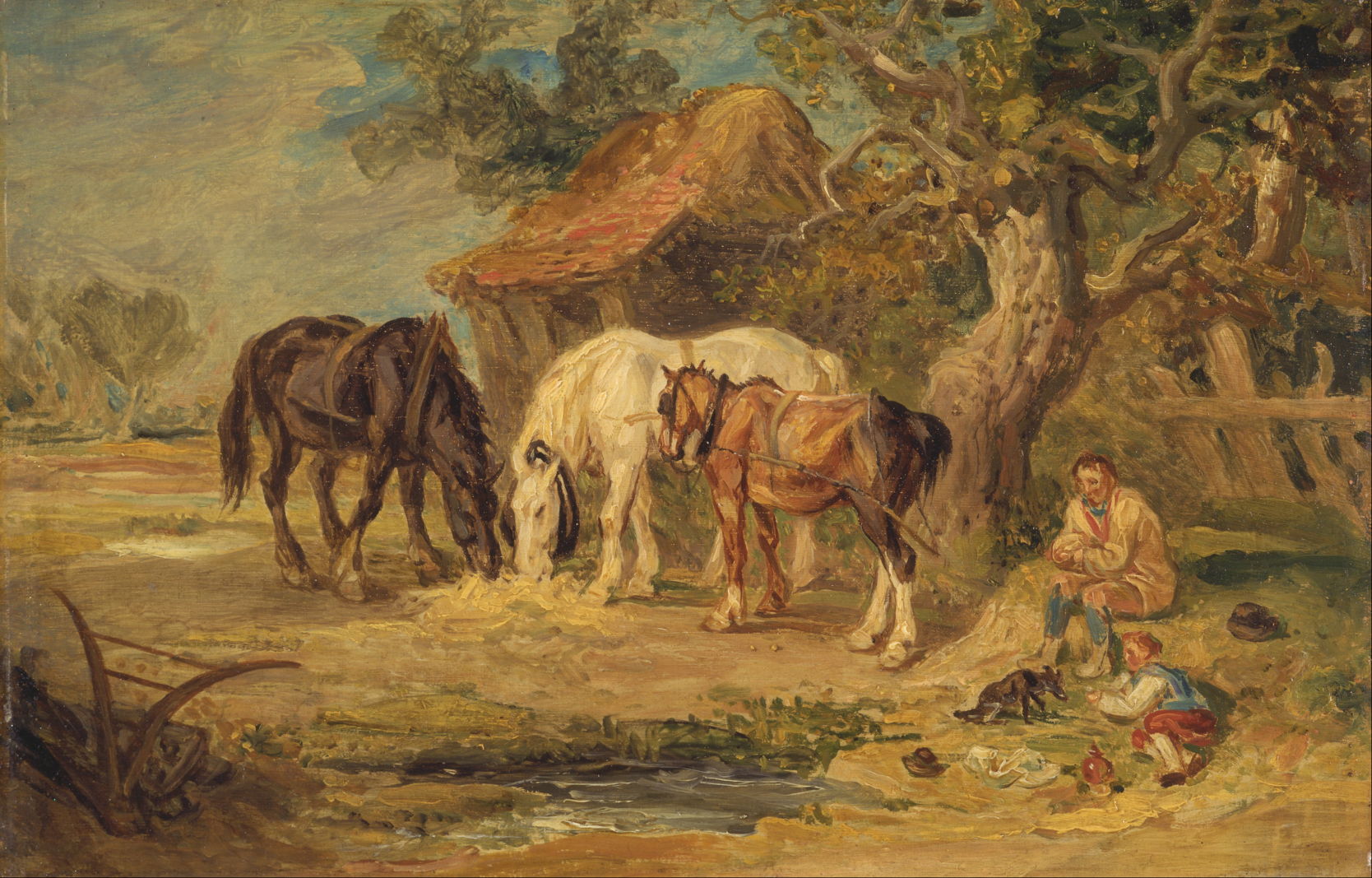
The Midday Meal (c 1835) is another superbly loose and colourful oil sketch, with references to some of George Morland’s paintings.

Ward’s landscape of Kenilworth Castle, Warwickshire (1840) follows the traditional approach shown by Constable in his Wivenhoe Park of 1816, and by this time was looking old and hackneyed, although still a beautiful painting.
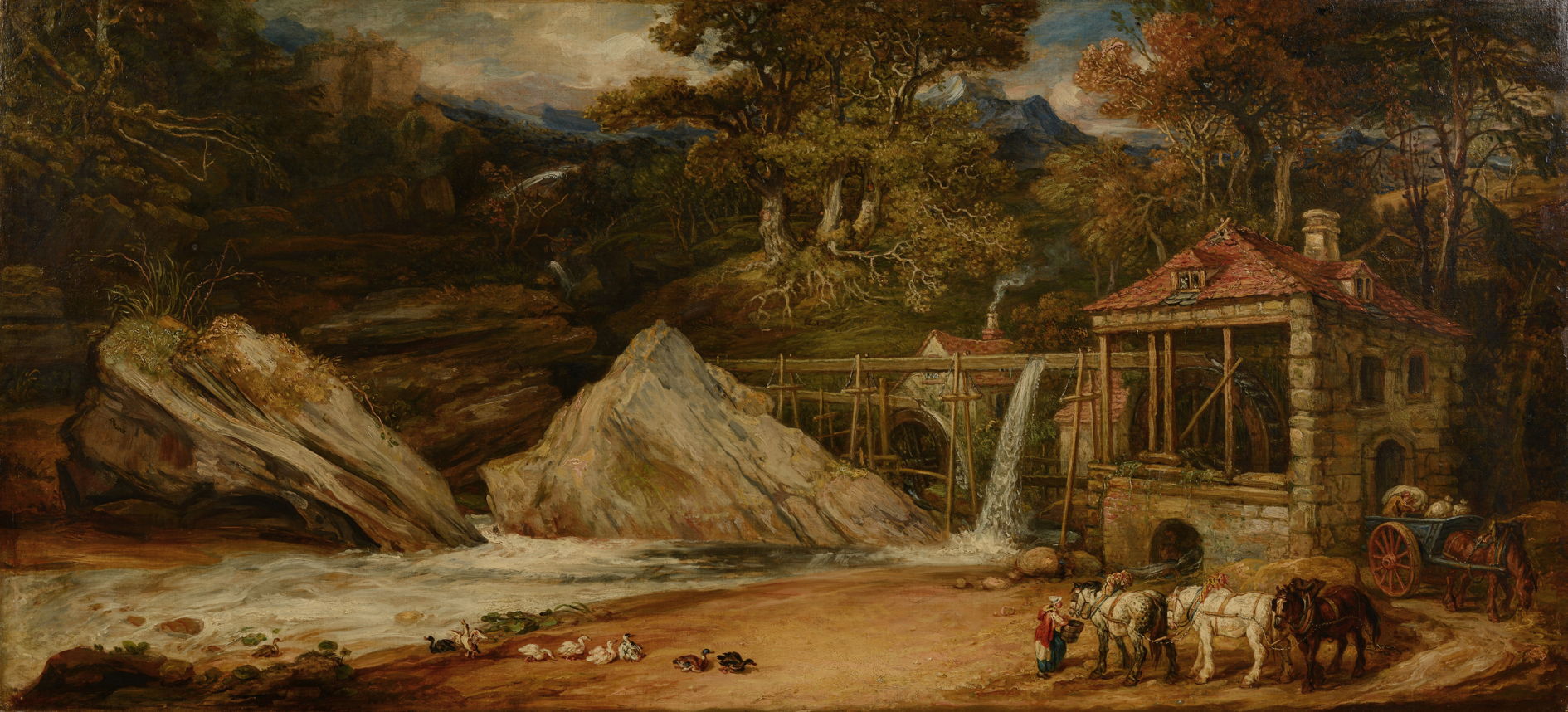
An Overshot Mill in Wales (Aberdulais) (1847) is an impressive painting for someone in their late seventies, and earned its place in the Royal Academy’s exhibition of 1847. However, by this time Ward was no match for JMW Turner.
In 1855, James Ward suffered what was almost certainly a stroke, which paralysed one side, and stopped him from painting. He died in late 1859, having recently celebrated his ninetieth birthday. Despite his late start at painting, he had been exhibiting at the Royal Academy over a period of 63 years, in which he had shown a total of nearly 300 paintings there.
I hope these three articles have shown Ward’s work as a bridge between the more traditional style of John Constable, and the more radical work of JMW Turner. His most innovative years were during Turner’s early career, when several of his paintings anticipated developments much later that century. His oil sketches in particular are wonderfully radical, and several could easily be considered to be Impressions from fifty years later. And his horses were more than a match for those of Stubbs. His most important paintings, including Gordale Scar, are major and influential works meriting inclusion in any good history of European painting between 1800 and 1900, yet they are almost invariably omitted.
References
Wikipedia.
Beckett O (1995) The Life and Work of James Ward, the Forgotten Genius, Book Guild. ISBN 978 0 8633 2948 7.

