
Jean-Baptiste-Camille Corot painted trees in the landscape throughout the fifty years of his career, from hot and arid views around Rome, and in the Forest of Fontainebleau, to his later souvenirs with their characteristic style.
He was born and brought up in a bourgeois family living in Paris. Showing no signs of any particular talent at school, he was apprenticed to a draper, and worked in the trade until he was 26. He started painting landscapes, and in 1822, when he was receiving a comfortable annual allowance from his parents, he set up his studio on the Quai Voltaire in Paris. He studied under Achille Michallon, who continued the tradition of plein air oil sketching and grand finished landscapes of Pierre-Henri de Valenciennes, but that was cut short by Michallon’s untimely death the same year, so he then studied under Michallon’s teacher, Bertin.
He spent the years from 1825-8 painting voraciously in the Roman Campagna, where his technique developed rapidly.
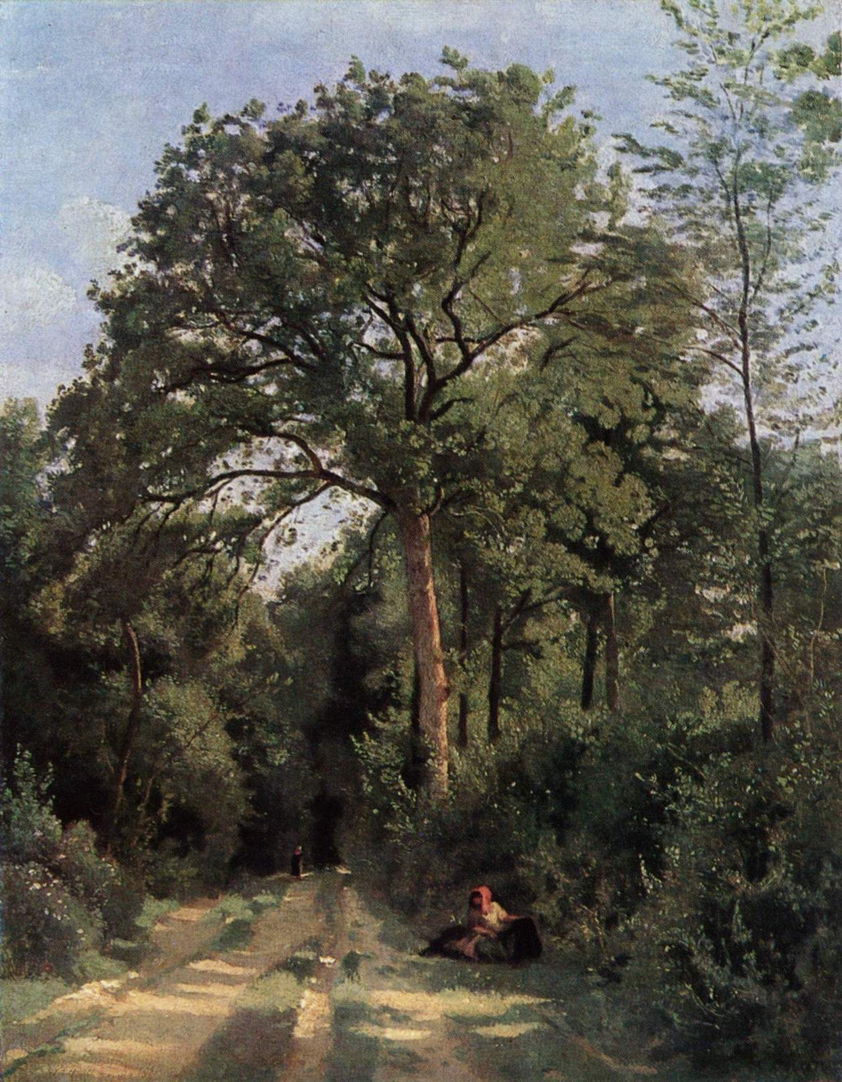
Corot’s early Ville-d’Avray: Entrance to the Wood (c 1825) must have been painted just before he departed for Italy, and shows the classical influences gained during his training. Over what was probably a series of plein air sessions, the foliage in its foreground is finely detailed, and the dominant tree in the middle of the painting has been worked anatomically, its foliage laid carefully onto its framework of branches. This isn’t dissimilar to the approach used by Constable, or the tradition stretching back from Michallon.

Once he started painting around Rome, his composition became less orthodox. In Castel Gandolfo (c 1826), the trees form an exaggerated repoussoir for the distant castle, and figures in the foreground suggest the embedded narratives typical of Poussin. Probably painted in a single plein air session, the trees remain anatomical in structure, but their foliage is painted more en masse. This is typical of his oil sketches during his first sojourn in Italy.
His subsequent studio work concentrated on preparing finished landscapes for the Salon, but from 1829 he started to paint en plein air around the town of Barbizon and the Forest of Fontainebleau, to the south-east of Paris. There he met Théodore Rousseau, Constant Troyon, Millet, Daubigny, and Paul Huet, forming the Barbizon School, a precursor to early Impressionism.

Trees resumed greater importance in his paintings. In Fontainebleau Forest (The Oak) (c 1830), the twisted limbs of the oak have taken more time and care, sufficient to give more texture and shadows to the trunk and branches. Where the canopy is more broken, Corot has painted leaves in more detail.
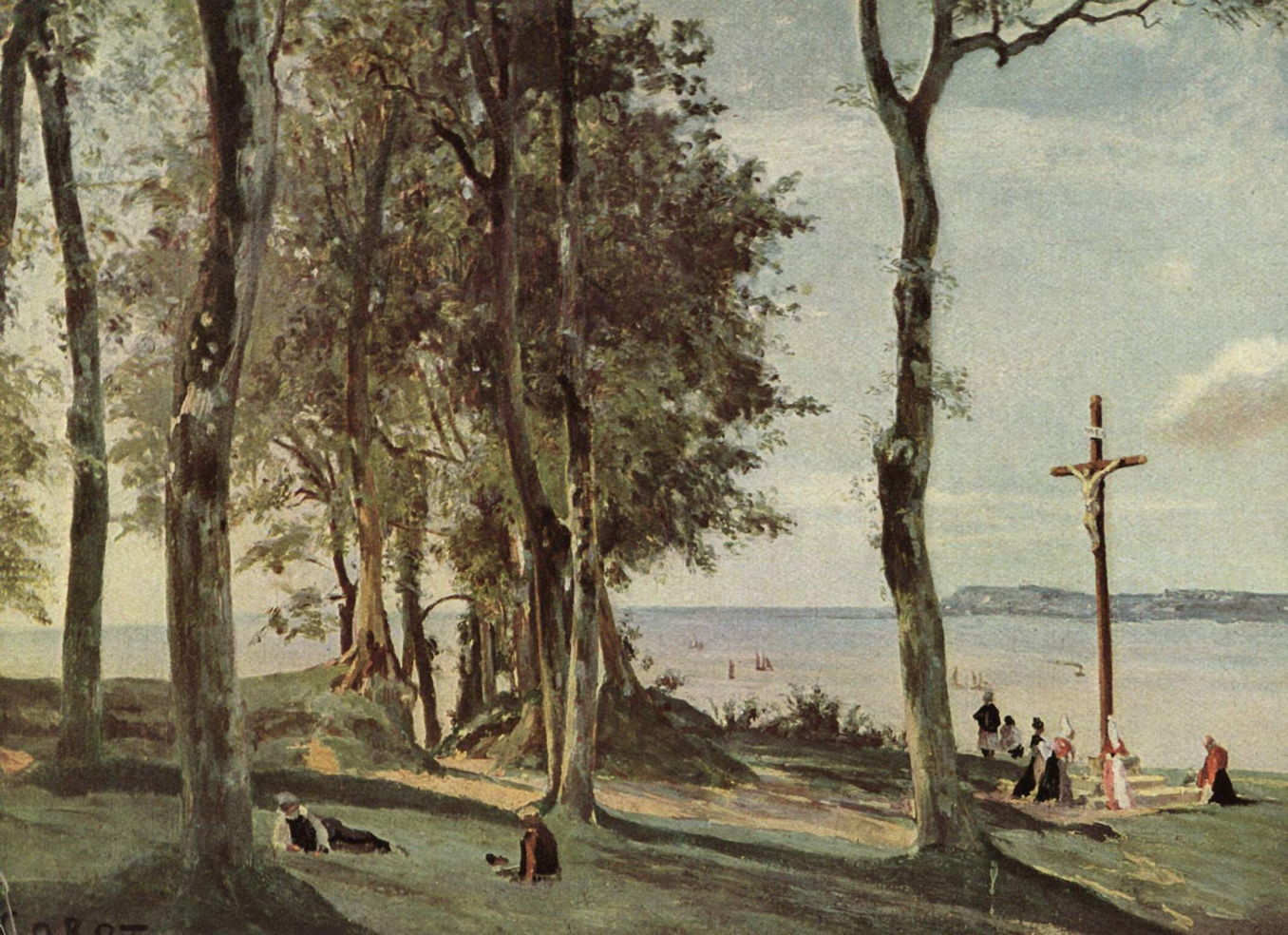
Honfleur: Calvary (c 1830) was painted just outside the town of Honfleur, on the southern bank of the Seine where it reaches the sea, south of Le Havre. Corot here starts making more gestural marks, particularly in the bark and foliage of this small grove of trees. Their canopies are made up of a wide variety of marks, imparting a distinctive texture. Where the foliage is sparse, as on the tree closest on the right, he marks out individual leaves. The figures are also painted gesturally, in a manner more typical of some of the pre-Impressionist paintings twenty or more years later.
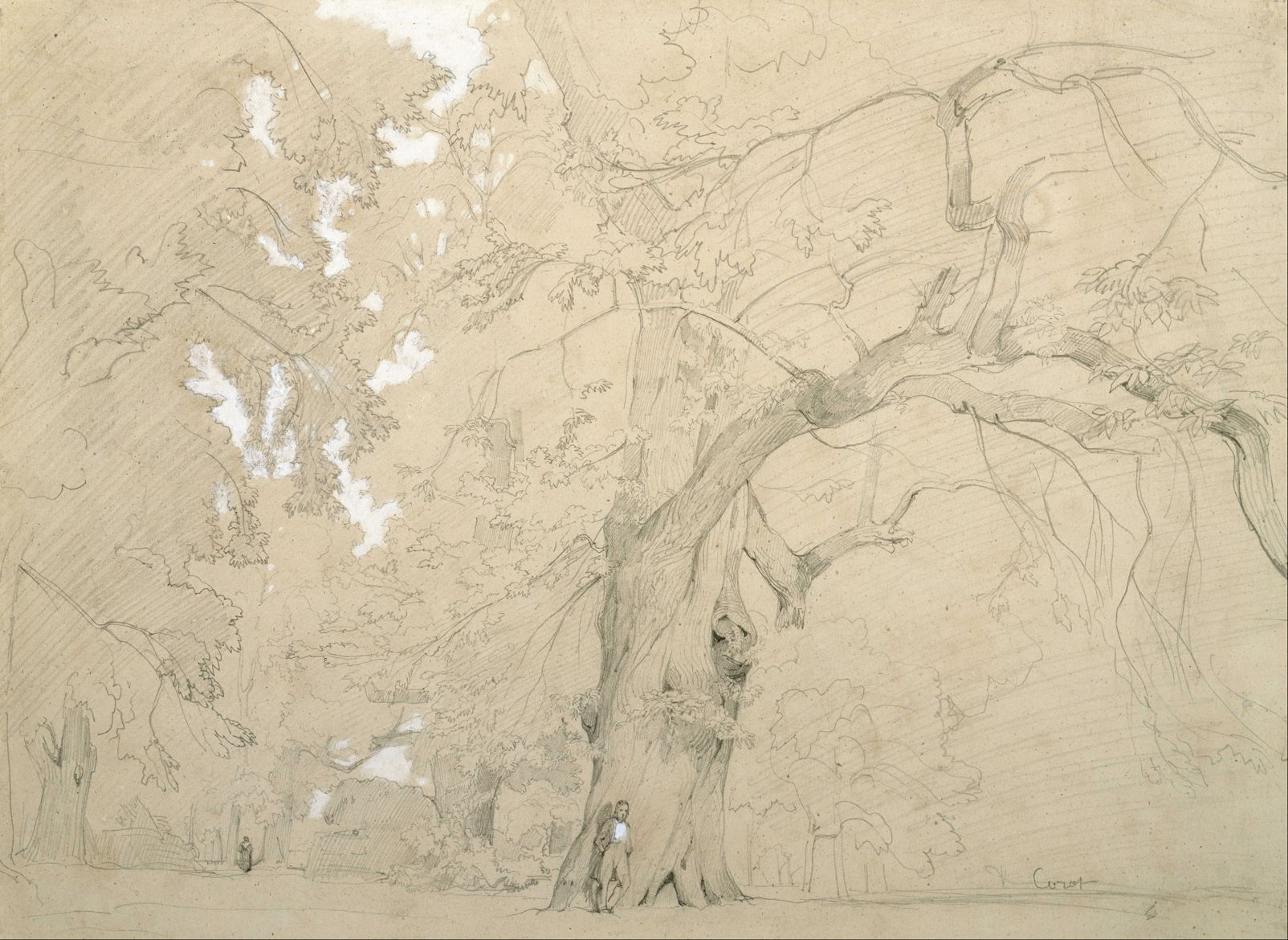
Although his oil sketches were often loose, Young Man in front of a Great Oak (1840-2) is more typical of the detailed graphite sketches Corot made of trees in Fontainebleau Forest and elsewhere. He captures the form and texture of the trunk of this oak with a remarkable economy of line. Although the forest canopy is more blocked in, he still shows its structure.
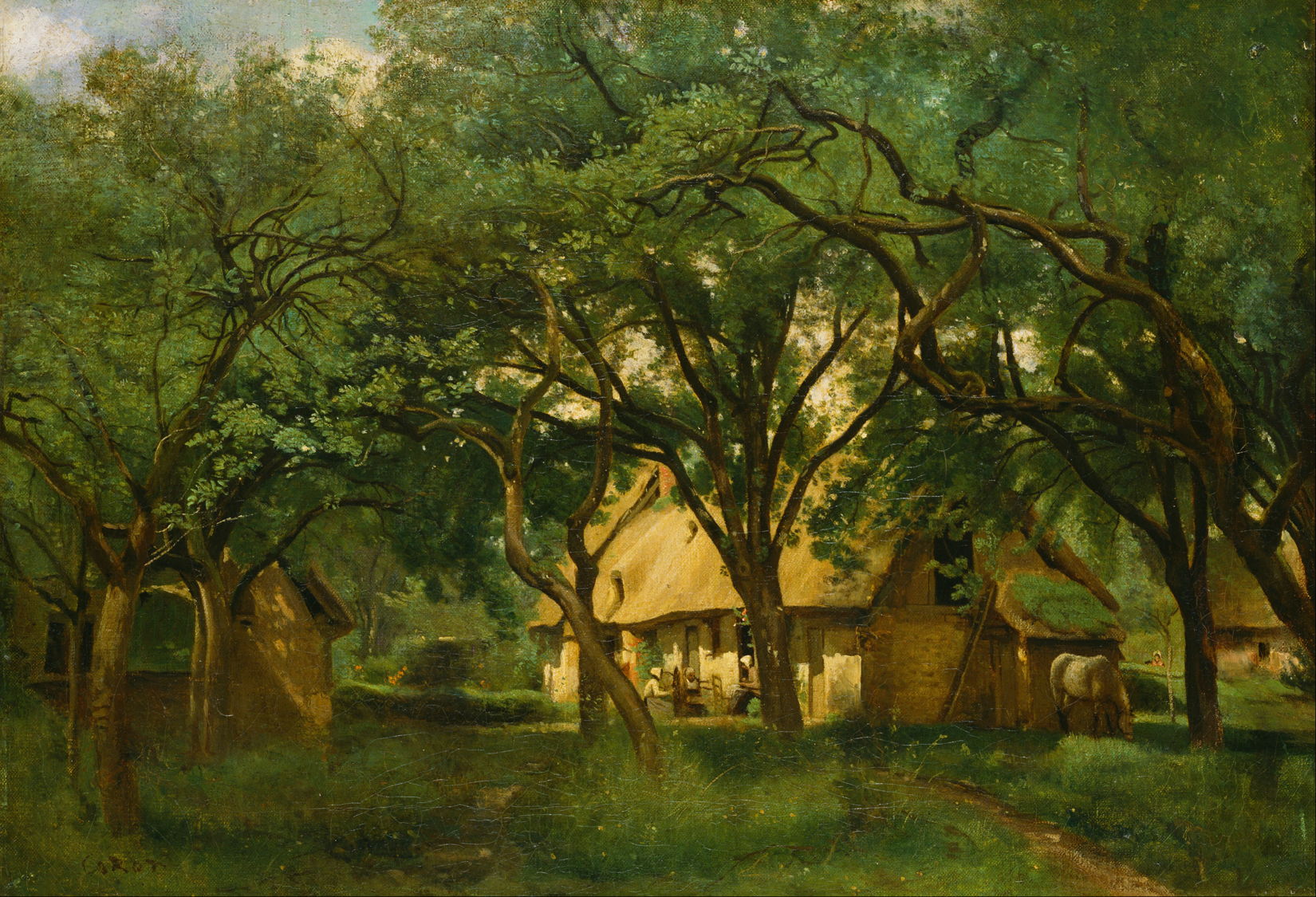
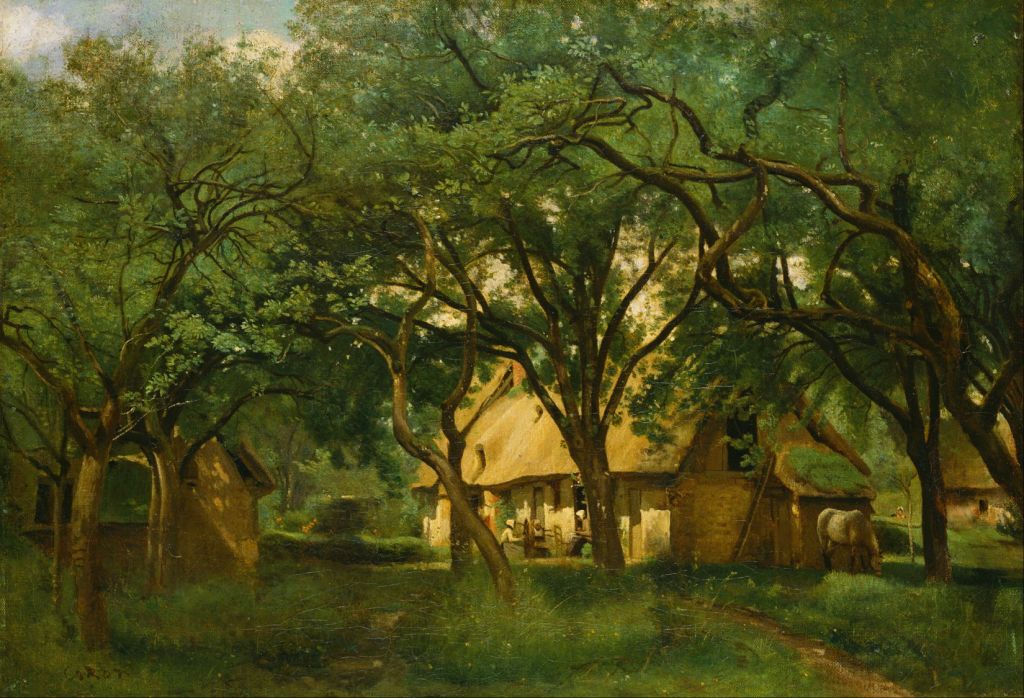
The Toutain Farm, Honfleur (c 1845) is a marked contrast to his more painterly Honfleur: Calvary of fifteen years earlier, and appears to be a finished studio painting, perhaps intended for the Salon. Its trees are marvellous and all but obscure and upstage the farmhouse beyond. The sinuous limbs of those trees shows his more structured approach to painting their canopies here, and a catalogue of different ways a trunk can give rise to branches. The canopy itself is shown in more detail, although at the upper left it seems more vague and sketchy, almost unfinished.
Corot’s critical reception was uneven, and he had many paintings rejected by the Salon jury. However, Baudelaire took up his cause, and he achieved recognition in the late 1840s, joining the jury in 1848. He assumed a more senior role, and taught Camille Pissarro, Berthe Morisot, and others who were to achieve later fame.
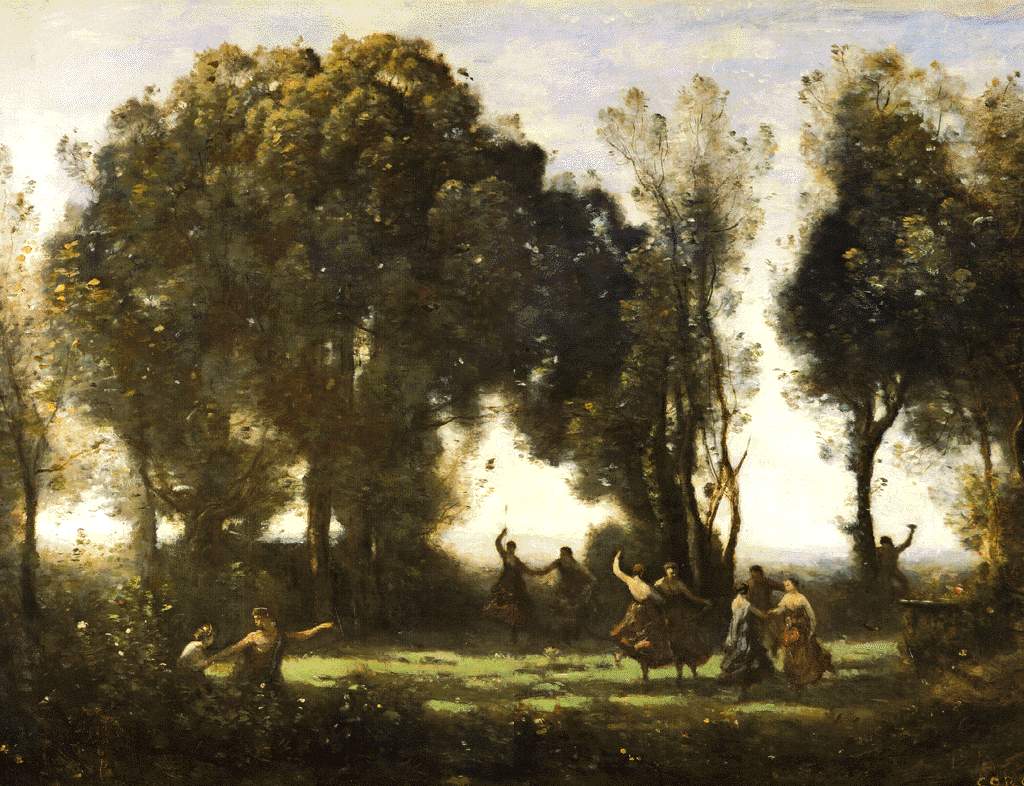
Later in his career, Corot was drawn more to using trees and landscape in mythological settings, as in Morning, Dance of the Nymphs (after 1850). In these, the figures are painted classically, but the trees are formed from a rich variety of marks. These include the more solid masses of the canopy of the large tree in the middle, and various strokes, dabs, and finer marks in those closer.
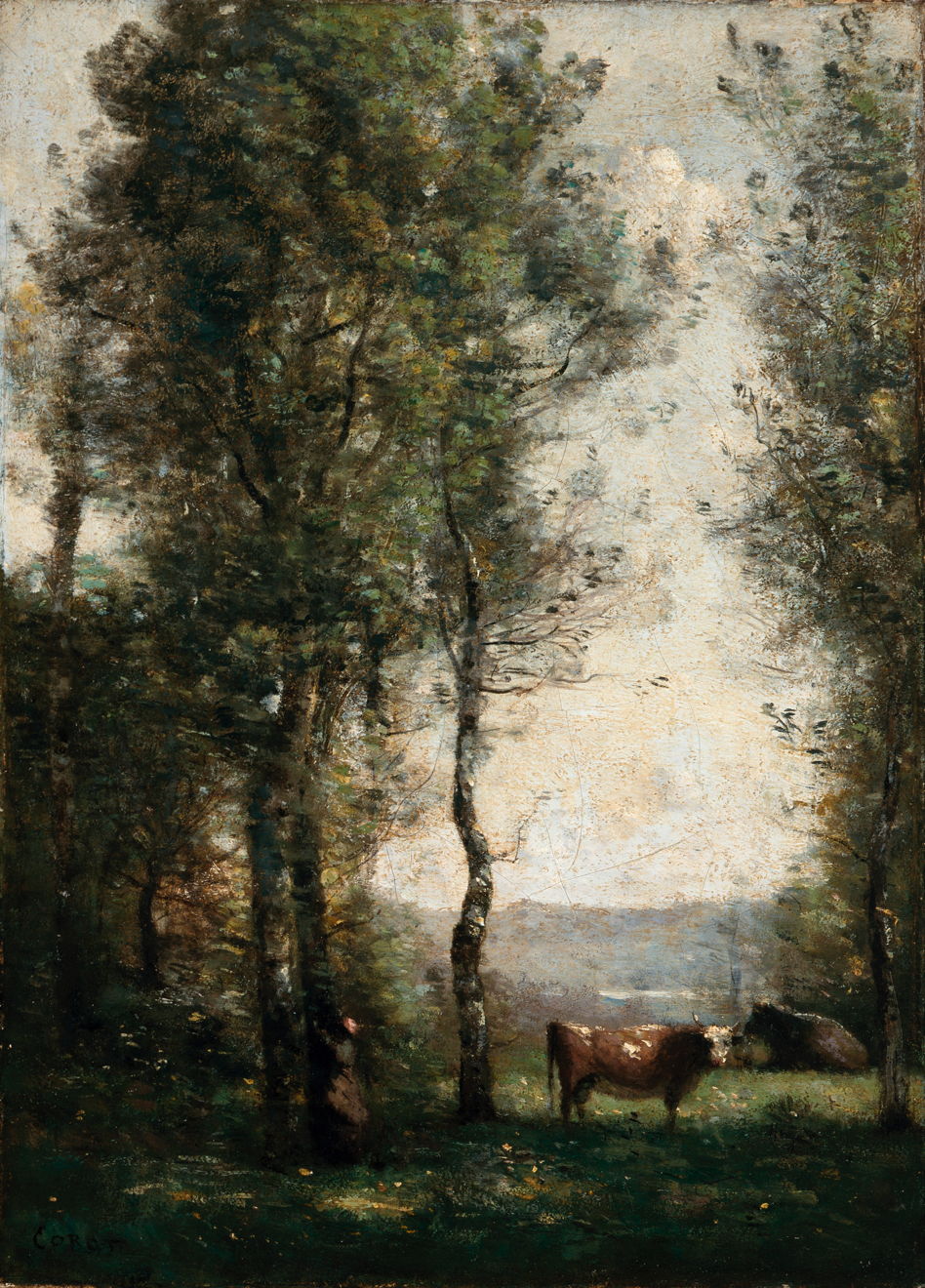
In Wooded Landscape with Cows in a Clearing (c 1855), Corot returns to more gestural marks, most obvious in the bright patches on the cows and trunks of the trees.

Le Concert Champêtre (1857) is one of the most beautiful of Corot’s mythological settings, with carefully finished figures clad in colourful robes, assuming statuesque poses. Yet his trees appear dark and almost threatening. Their construction adheres to his late style, although foreground twigs and leaves are more formally expressed.

Towards the end of his career, Corot painted many souvenirs which remain controversial. Lacking the originality of his earlier work, and their fresh colours, some see them as atypical and inferior to his earlier work. Souvenir de Mortefontaine (1864) is one of the more famous, and an example his late style for trees. They have clear underlying anatomical structure, with a wide range of marks to indicate foliage.

Morning, or Cathedral of Mantes, with a Fisherman (c 1865) is more colourful, and experiments further with composition. The trees here don’t frame the distant subject, but dissect it.

The Fisherman: Evening Effect (c 1865-70) is an unusual combination of early Impressionism and Corot’s late style of trees. It appears to have been painted quickly, with rough daubs of clouds, and captures the transient effects of light at dusk. The trees consist of loose collections of coarse and fine brushstrokes, some anatomical structure, and various dabs and spots.
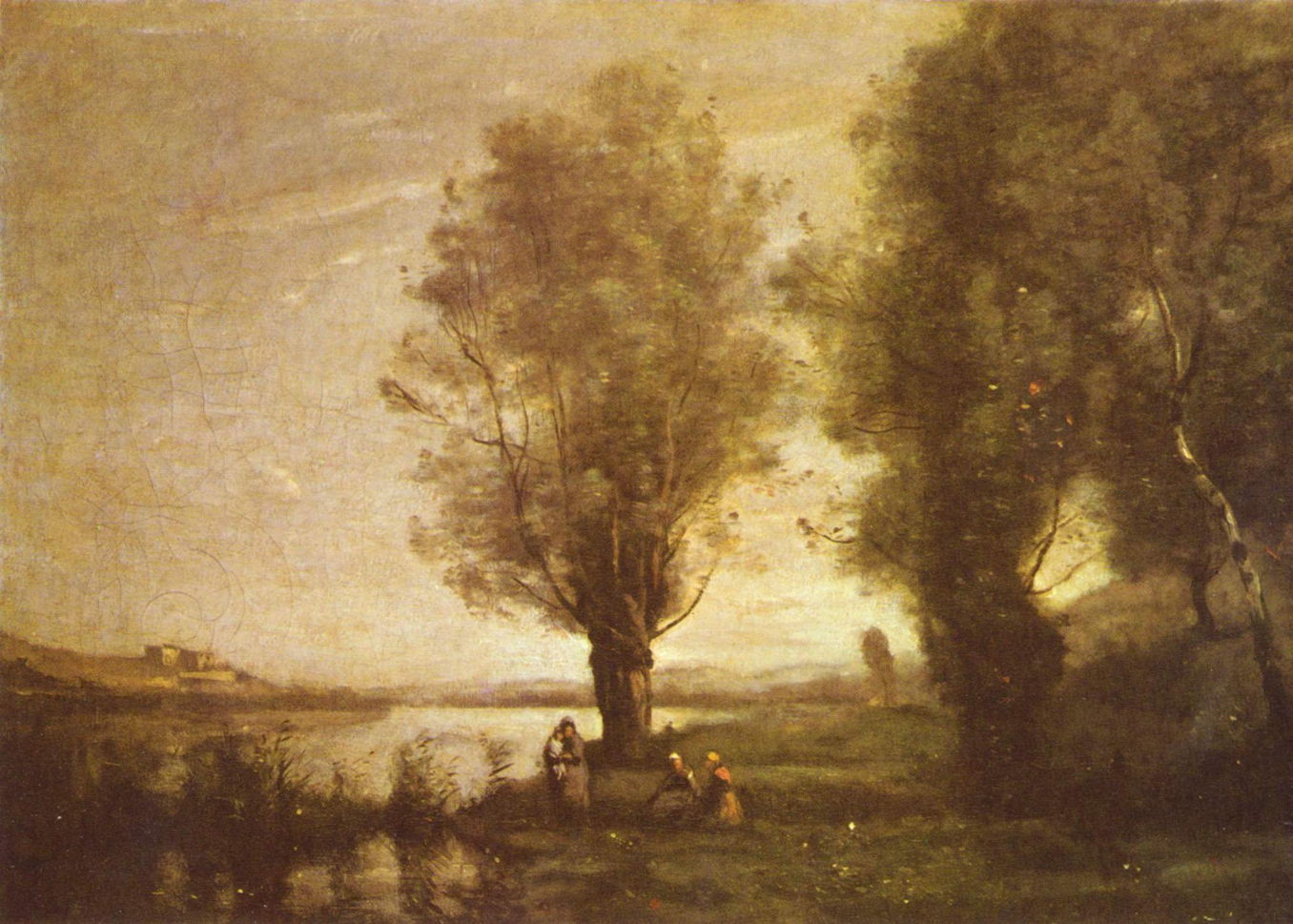
Rest under the Willows (1865-70) is more typical of Corot’s souvenirs, with its forlorn figures and dominating trees.
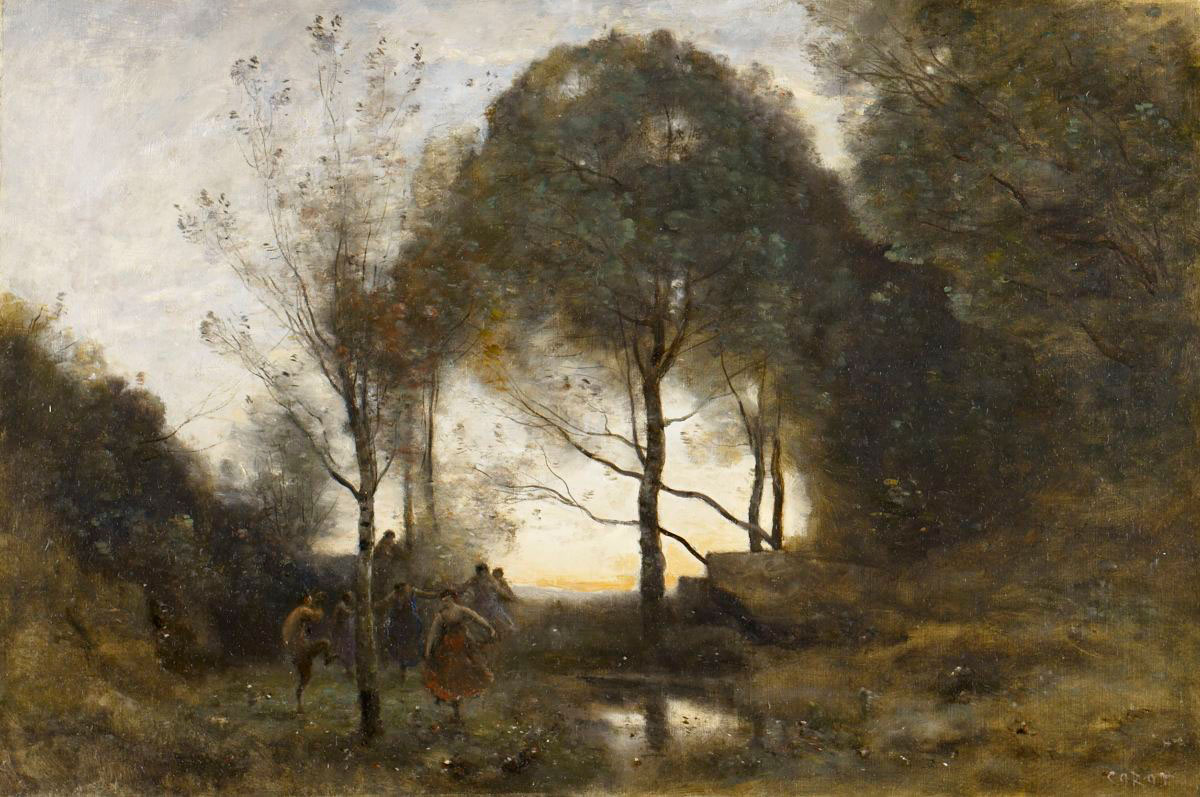
Nymphs and Fauns (before 1870) returns to a mythological theme, the nymphs and fauns dancing around low birch trees, behind which a more mature birch fills the centre of the painting.
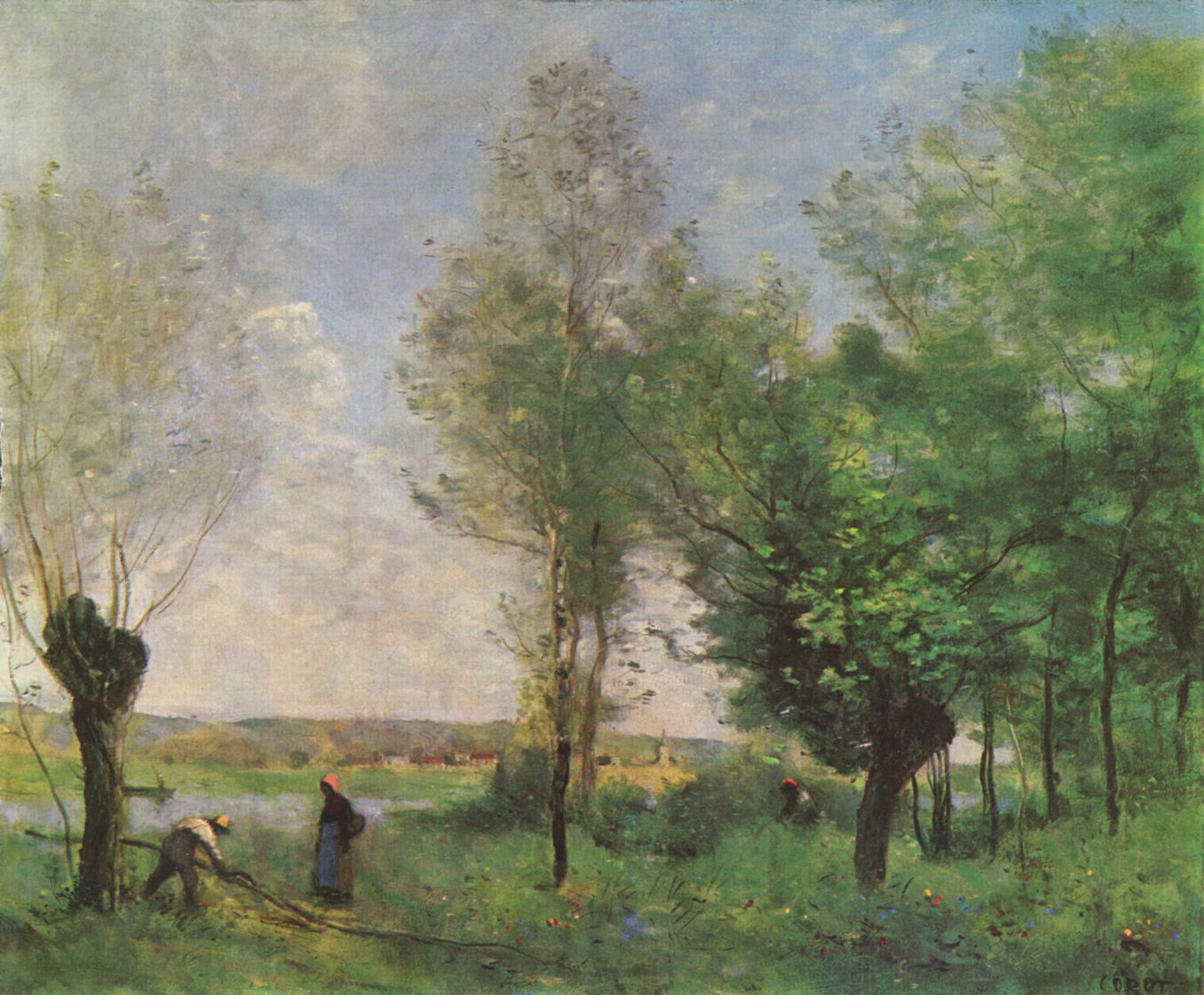
Souvenir de Coubron (1872) is one of Corot’s last and finest souvenirs, with a distinctly early Impressionist look. Unlike most of his others, its colours are more saturated and varied, with hats and flowers in bright reds and yellows, and rich greens throughout its lush vegetation. Although its trees are more uniform than in some of his earlier works, a couple are pollards, and each has its foliage constructed from a wide range of marks.
Although he taught Pissarro, who in turn mentored Cézanne, Corot’s late style wasn’t adopted by either of them, but his use of marks was influential on both, and many others in the late nineteenth century. If Constable had acted as a bridge, Corot was the crossroad leading to modern art.
References
Rehs Galleries’ Lyrical Landscapes
Wikipedia
Conisbee P, Faunce S and Strick J (1996) In the Light of Italy. Corot and Early Open-Air Painting, Yale UP. ISBN 978 0 300 067941.
Galassi P (1991) Corot in Italy. Open-Air Painting and the Classical-Landscape Tradition, Yale UP. ISBN 978 0 300 049572.
Jones K et al. (2008) In the Forest of Fontainebleau. Painters and Photographers from Corot to Monet, Yale UP. ISBN 978 0 300 138979.

