
For sheer awe there is little to compare with a volcano erupting. While some may remain quiescent for centuries and become tourist attractions, others erupt so violently they kill anyone within several miles of their peak. Land volcanoes mostly occur in long chains along the zones where earth’s tectonic plates are converging. These often coincide with mountain ranges like those of the western side of the Americas, and on the opposite side of the Ring of Fire around the Pacific Ocean. This weekend I show a small selection of portraits of those awesome mountains, starting with one of the most famous in art.
Mount Fuji, alternatively Fujiyama, reaches 3,776 metres (12,389 feet) elevation, making it the highest peak in Japan, and last erupted in 1707-08. The demanding walk to its summit was accomplished by the first foreigner in 1860, when Sir Rutherford Alcock reached it in eight hours, and returned in just three hours. It’s one of three holy mountains of Japan, and has been depicted and inspired poetry for many centuries.
One of the most famous collections of woodblock prints of the mountain is Hokusai’s Thirty-six Views of Mount Fuji, from 1830-32 (Edo), which proved popular in its home market, and over twenty years later when it arrived in Europe.

Best-known among those prints is Great Wave off Kanagawa, perhaps the most famous image of a wave, and an inspiration to many artists around the world.
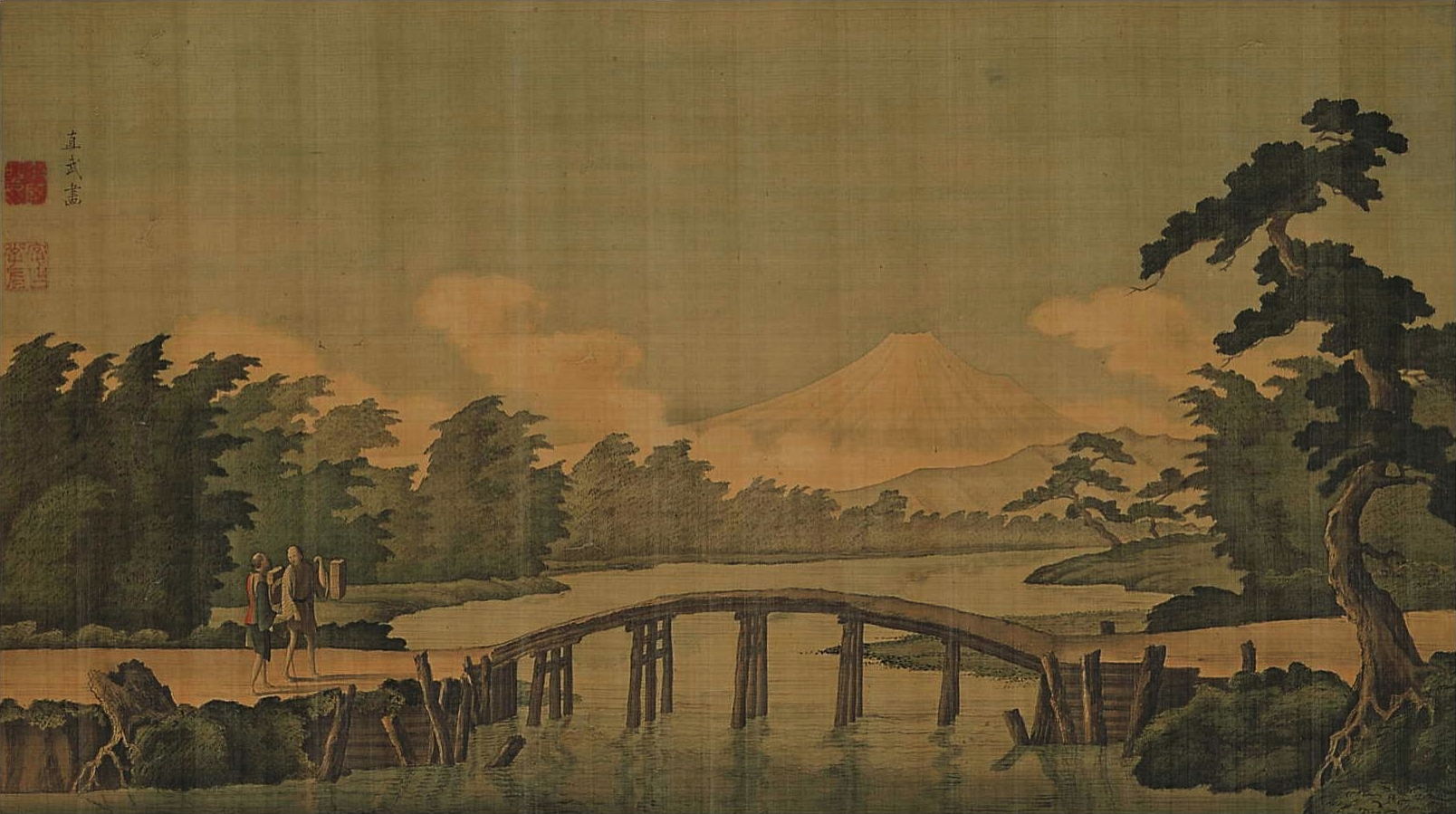
Naotake’s painting of a more classical view of Mount Fuji (Edo, 1770s) is an early example of the adoption of Western style, down to the effects of a rippled water surface on reflections.

Over thirty years after Hokusai’s collection, Hiroshige assembled his own Thirty-six Views of Mount Fuji, including The Entrance Gate In Enoshima (c 1858). This frames Fuji with a classical Japanese entrance gate on this island to the south-east of Tokyo.

When she visited Japan, the pioneer botanical artist Marianne North adapted her style, as seen in her Distant View of Mount Fujiyama, Japan, and Wistaria from about 1876. This floral association is based on a linguistic connection between the volcano and flower, as they share a common root in fuji.

Some of the most forceful and destructive volcanic explosions have taken place in the volcanoes further south along the Ring of Fire, on and around the island of Java. Marianne North visited and painted The Volcanoes of Merapi and Merbaboe, Java, from the Top of Boro Bodoer during the same tour in about 1876.
Situated in central Java, Mount Merapi attains an elevation of 2,910 metres (9,550 feet), and is the most active volcano in Indonesia. Its eruption in 1815 was responsible for the largest number of deaths from any volcano in recorded history, with as many as a quarter of a million dead, and that in 2010 killed over three hundred and fifty. Mount Merbabu is slightly higher at 3,145 metres (10,318 feet) but is currently dormant. Its last moderate eruption occurred in 1797, and reaching its summit is a popular if arduous walk taking 8-10 hours.
Between 1838-42, the US artist Titian Ramsay Peale was chief naturalist on board the Peacock when it undertook the United States Exploring Expedition of the Pacific and its islands. Among those he visited was Big Island of Hawai’i, which he painted in oils in 1842.
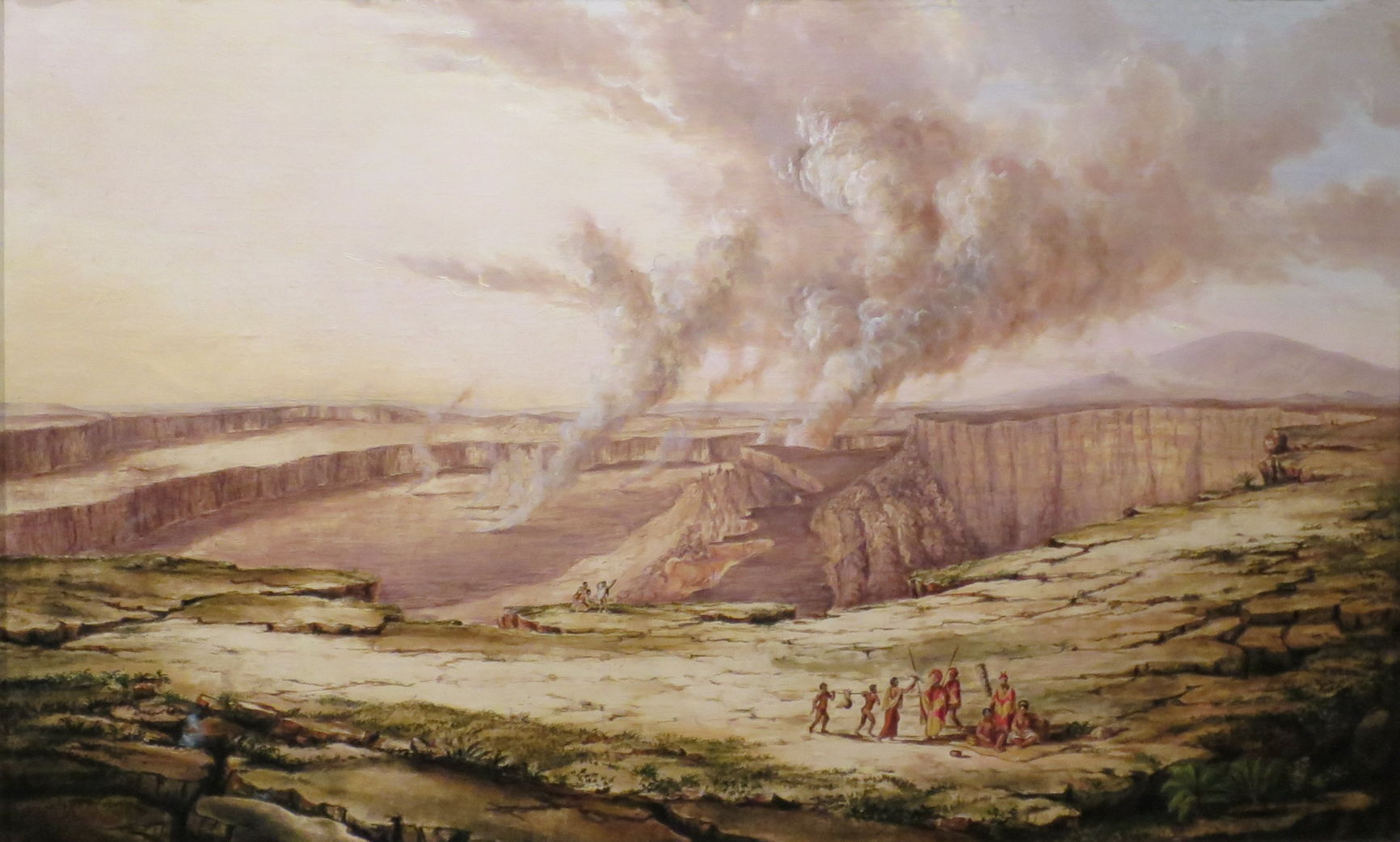
Peale’s Kilauea by Day shows a fairly unimpressive active shield volcano on the south-eastern shore. Although this may appear peaceful, in 1790 one eruption killed more than four hundred people in what remains the most deadly volcanic eruption in the US, and another major eruption was recorded in 1823.

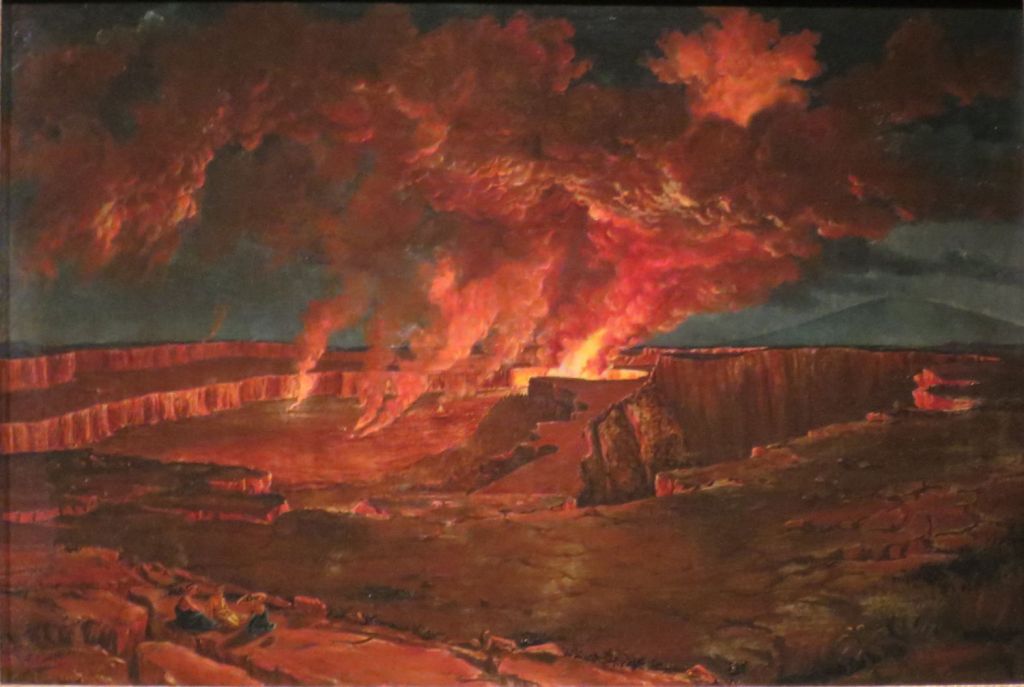
His matching view of Kilauea by Night is more impressively volcanic.
Anyone over the age of sixty should remember well the major eruption of Mount St. Helens, on the American side of the Pacific, in 1980.
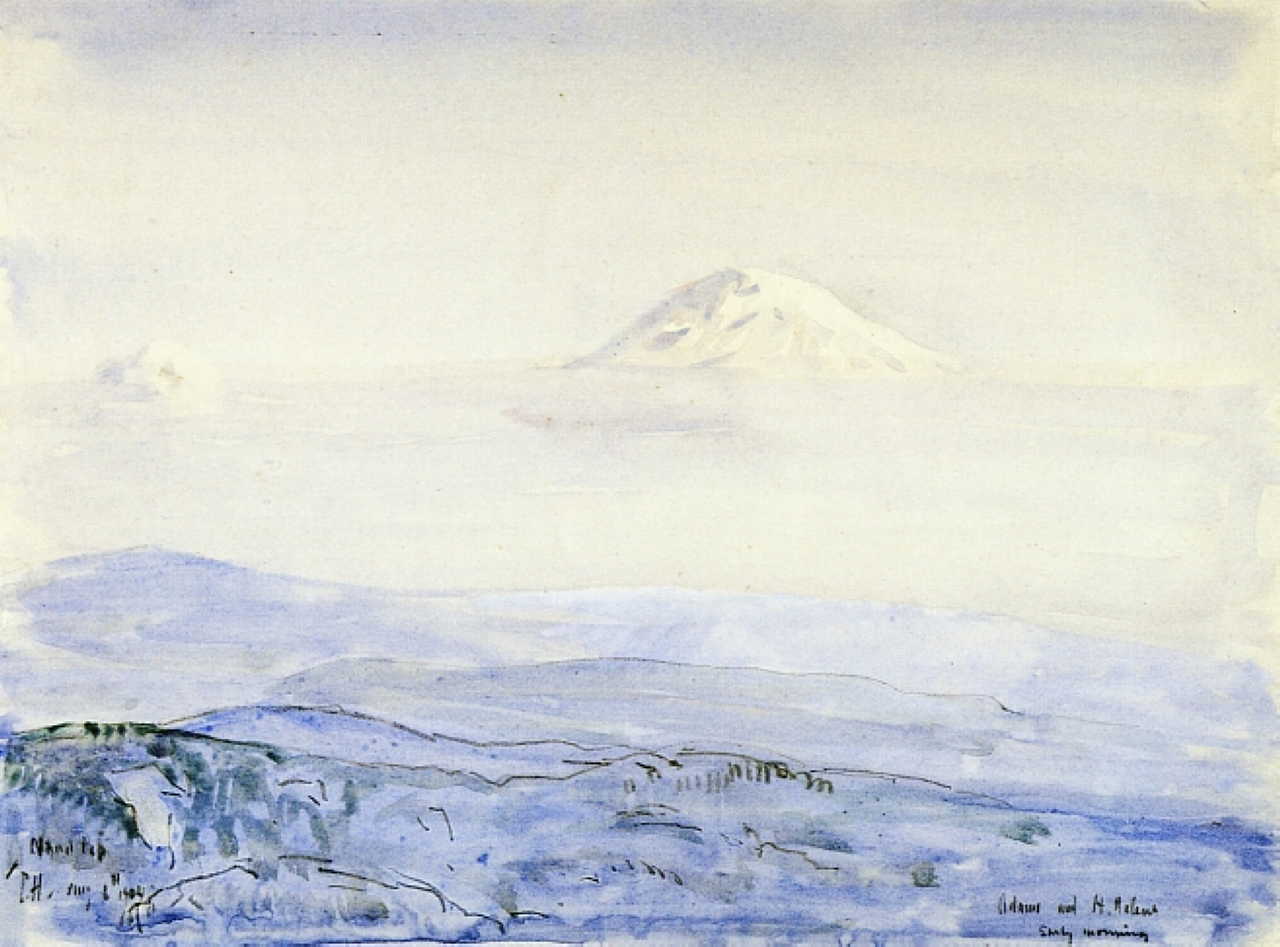
Childe Hassam’s plein air watercolour of the distant peak of Mount St. Helens in Washington State shows this active volcano that was originally just below 3,000 metres (10,000 feet) in elevation when he painted it in 1904. Following that eruption in 1980, which killed fifty-seven people, that was reduced to 2,549 metres (8,363 feet). In contrast, Mount Adams is only potentially active, and hasn’t erupted in over a thousand years. Its summit at 3,743 metres (12,281 feet) was first reached in 1854, but its more challenging east face wasn’t climbed successfully until 1921.
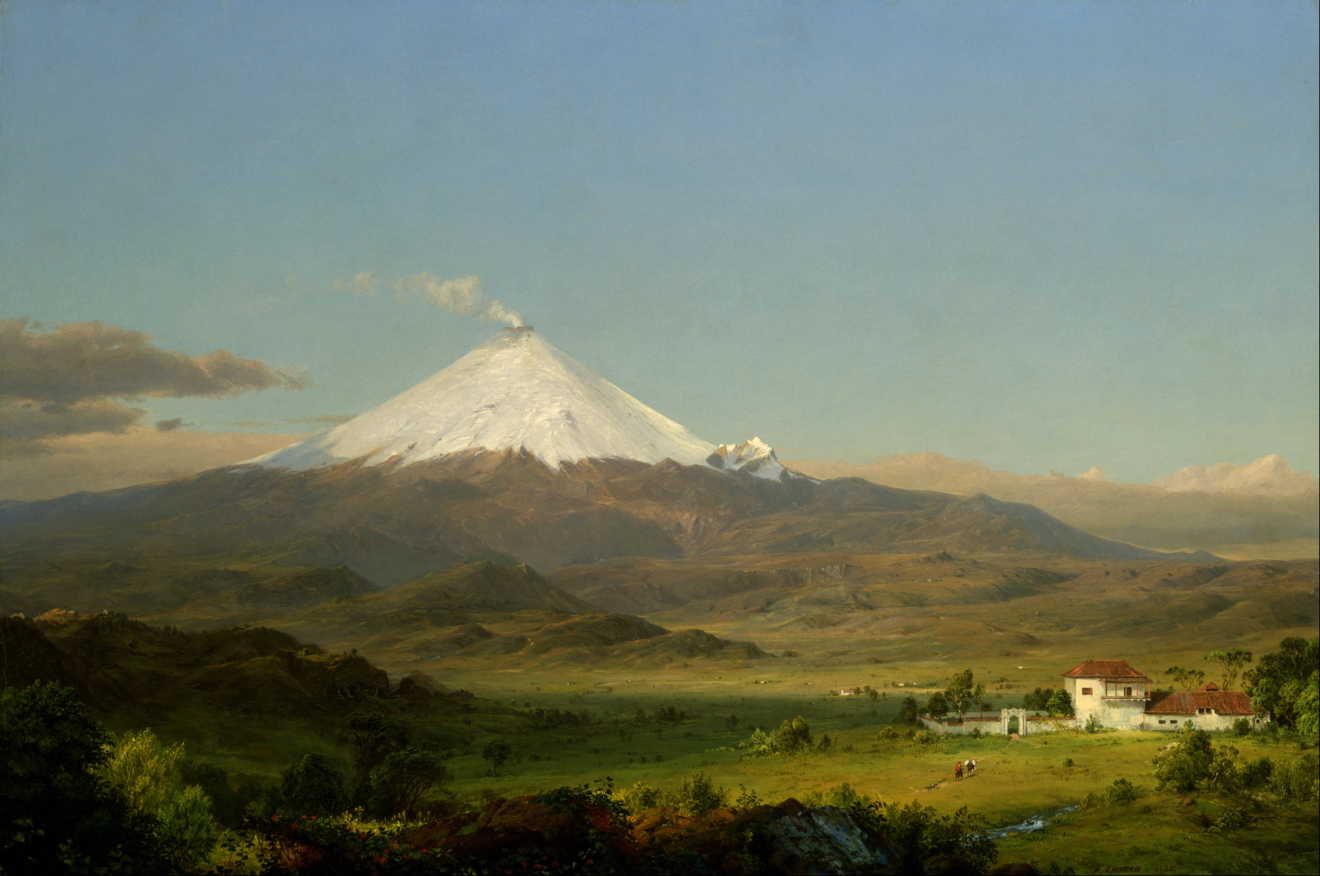
Following his expedition to Ecuador in 1853, Frederic Edwin Church turned the hundreds of sketches and drawings he had made of the volcano Cotopaxi into larger finished paintings. This is an active volcano to the south of the city of Quito, and rises to a height of almost six thousand metres (nearly twenty thousand feet). Its summit is a huge crater, on top of one of the few glaciers on an equatorial mountain. Just over twenty years later, its entire ice cap was melted by the flows from one of its most violent recorded eruptions. Its summit wasn’t reached until 1873, and it’s currently in the midst of an eruption that started back in October 2022.
There are many active volcanoes beyond the Pacific’s Rim of Fire, among them those on the Mid-Atlantic Ridge between North America and Europe, in Iceland.

One view that epitomises Iceland is that of the huge active volcano Hekla from Laugardalur (1922). This massive dome rises to an elevation of 1,488 metres (4,882 feet) above southern Iceland, and is one of Iceland’s most active volcanoes. Known to visitors as the Gateway to Hell, it last erupted in early 2000 for a brief period of ten days. Þórarinn captures it bathed in the low, warm light of sunset, seen from a park on the outskirts of Reykjavík. If this looks praeternatural, it’s because it is.

